
A toddler screaming in pain in a dark Arizona garage at night is a scenario no parent wants to imagine — but if you live in the Southwest, it is one worth preparing for. Here is the direct answer for scorpion sting in toddler first aid: treat every suspected scorpion sting in a toddler as an emergency. Move your child away from the scorpion, call 911 or head to the emergency department immediately, apply a cool compress on the way or while waiting, keep your toddler still and calm, and do NOT wait to see how symptoms develop — toddlers, especially under age five, are at the highest risk of severe reactions, and bark scorpion venom can escalate fast. Call Poison Control at 1-800-222-1222 for additional guidance while you act.
The first 10 minutes: what to do right now #
When a toddler may have been stung, speed matters more than certainty. You do not need to identify the species before acting — pediatric guidance treats any scorpion sting in a small child as potentially serious because it is genuinely difficult to tell a dangerous bark scorpion from a harmless one in the moment.
Move your toddler away from the scorpion. Scoop your child up and step back. Scorpions sting defensively, and a second sting is possible if the animal is still in the clothing or bedding. Do not chase the scorpion while holding your child — get distance first.
Call for emergency help immediately. In bark scorpion territory (Arizona, parts of New Mexico, Texas, California, and northern Mexico), call 911 or go directly to the nearest emergency department. If you are outside that region or unsure, call your pediatrician and Poison Control at 1-800-222-1222 right away. Do not adopt a wait-and-see approach with a toddler: the venom’s neurotoxic effects can progress from mild to severe in under an hour in young children, and early evaluation gives clinicians the best window to act.
Wash the area and apply a cool compress. Gently wash the sting site with soap and lukewarm water. Then apply a cool compress — a damp cloth or ice wrapped in a thin towel — for about 10 minutes on, 10 minutes off. Do not put ice directly on toddler skin, and do not immerse the limb in ice water. This eases local pain while you wait for help.
Keep the sting site still and at a comfortable level. Hold your toddler so the affected limb rests quietly — do not let them run around. Remove rings, bracelets, or tight clothing near the site in case swelling develops. Keep your toddler calm if you can: crying itself is not dangerous, but thrashing makes examination harder for responders.
Do not do any of the folk-remedy interventions. Do not cut the skin, do not try to suck out venom, do not apply a tourniquet, and do not give sedatives or any medicine unless a medical professional directs it. These measures do not help and can cause real harm — tourniquets in particular can damage a toddler’s limb quickly.
Do not give medicine on your own. No pain-reliever syrups, no antihistamines, nothing by mouth or on the skin, without explicit medical direction. Toddler dosing is weight-specific, and emergency clinicians want an unmedicated baseline when they assess your child. Describe your child’s pain to the responders; they will manage it appropriately.
Why toddlers face the highest risk #
Understanding the “why” behind the emergency framing helps you take it seriously without panicking. The Arizona bark scorpion (Centruroides sculpturatus) is the only scorpion in the United States whose venom can cause severe, life-threatening symptoms in humans, and young children bear the brunt of that risk.
Dose relative to body size. A bark scorpion injects roughly the same amount of venom whether it stings an adult or a toddler. In a 25-pound toddler, that venom is far more concentrated than in a 180-pound adult. This single factor explains most of the age difference in severity: the venom’s neurotoxins overstimulate nerve firing, and a small nervous system feels the effects sooner and harder.
The under-five danger window. Clinical reviews of Arizona sting records have consistently found that children — especially those younger than five — are the most likely to develop severe illness requiring intensive supportive care, including symptoms like roving eye movements, trouble swallowing, excessive drooling, and breathing difficulty. Many pediatric emergency departments in Arizona treat bark scorpion stings in toddlers with a standing high-alert protocol.
Symptoms can escalate in under an hour. Parents sometimes report that their toddler seemed “only” in pain for the first 20 minutes, then developed jerking eye movements or unusual restlessness. This pattern is exactly why medical guidance says not to wait: the trajectory of bark scorpion envenomation in small children can change fast, and the emergency department is the right place to be when it does.
Antivenom exists — and it works best early. Hospitals in scorpion territory stock a specific antivenom for severe Arizona bark scorpion envenomation. Clinical experience shows it can resolve serious signs and symptoms rapidly once administered. It is given in the hospital under medical supervision, not at home — another reason to get to the ER rather than managing the sting on the couch.
Bark scorpion or harmless species: safe identification pointers #
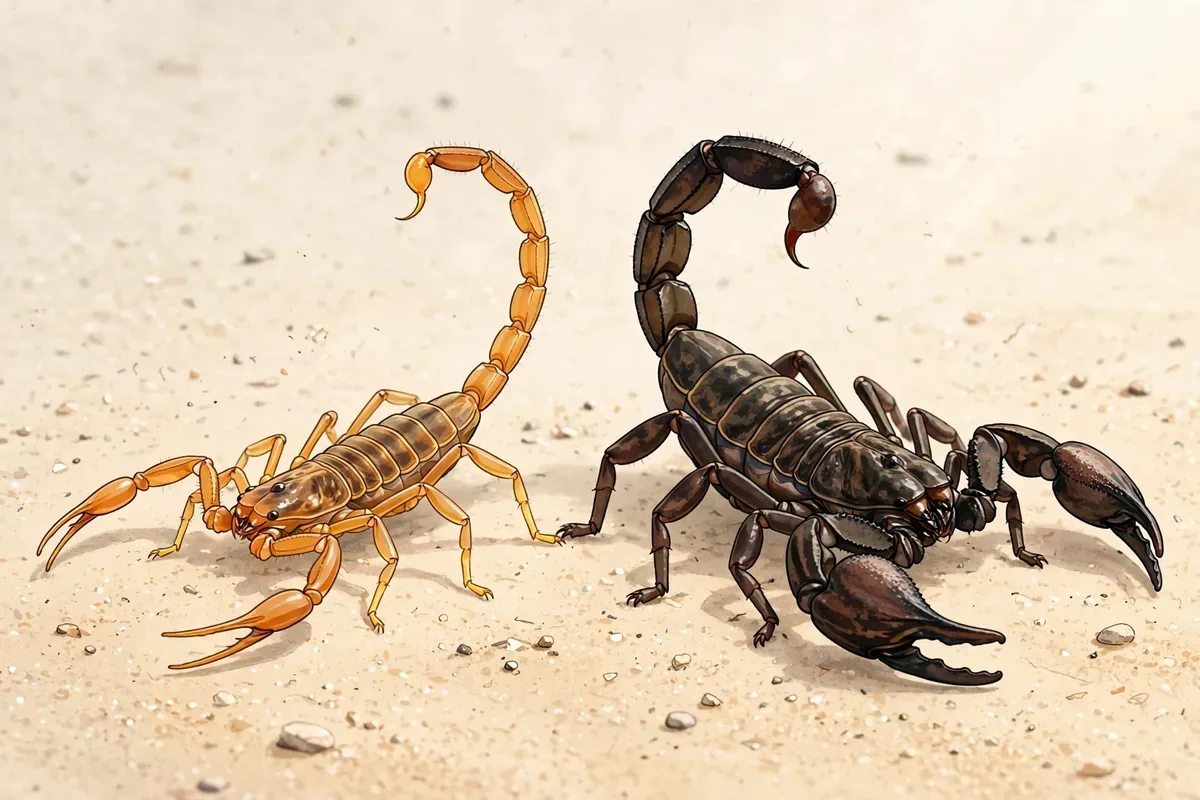
Most US scorpion species — the large, heavy-clawed desert hairy scorpions, for example — deliver stings that are painful but medically minor in healthy people. The bark scorpion is the exception, and it is also the one you are least likely to recognize, because it is small and unremarkable-looking. These pointers are descriptive only; never delay care to identify the species.
| Feature | Arizona bark scorpion | Typical harmless US species (e.g., desert hairy) | |—|—|—| | Size | Small — about 2 to 3 inches long, slender build | Larger — 4 to 6 inches, bulky and heavy-looking | | Color | Uniform tan, straw, or light brown; blends into bark and walls | Darker brown or nearly black; more conspicuous | | Tail and claws | Thin, delicate-looking tail; slender pincers | Thick, muscular tail; large, robust pincers (the bigger the claws, the milder the venom, as a rough rule) | | Behavior | Excellent climber — found on walls, ceilings, in shoes, in bedding, inside homes; nocturnal | Mostly ground-dwelling; found under rocks and debris outdoors | | Range | Arizona core; also parts of New Mexico, Texas, California, northern Mexico | Widespread across the Southwest deserts | | Sting character | Intensely painful with little swelling; numbness and tingling spreading from the site | Painful local sting with more swelling; symptoms usually stay local |
Do not touch the scorpion to identify it. If you can see it clearly, take a photo from a safe distance — the slender tail and small size are the giveaway features. A dead or safely contained specimen helps the ER, but your child’s care comes first, and clinicians treat based on symptoms and geography, not on a perfect species ID. For a deeper look at how clinicians think about these stings, see our guide to bark scorpion sting first aid.
Watching the hours after: what to monitor #
If the emergency evaluation results in observation at home — or while you are waiting for transport — here is what the coming hours typically look like and what each stage means. Keep a simple log: time, symptom, severity. Hand it to every clinician who sees your child.
| Timeframe | What may happen | What it means | |—|—|—| | Minutes 0–30 | Immediate sharp, burning pain at the sting site; crying; the site may look almost normal, with little redness or swelling | Intense pain with minimal swelling is classic for bark scorpion; do not let the mild appearance reassure you | | Minutes 30–90 | Numbness or tingling spreading from the site; restlessness; unusual eye movements (eyes darting or jerking); sensitivity to touch | Neurological signs are beginning — this is the escalation window; your child should already be under medical evaluation | | Hours 2–6 | Muscle twitching or jerking; drooling or trouble swallowing; slurred-sounding cries; sweating; nausea or vomiting | Significant envenomation; hospital-level care is required, and antivenom may be administered | | Hours 6–24 | Gradual settling with treatment; residual numbness, tingling, or hypersensitivity at the site; fatigue | Recovery phase under observation; symptoms can wax and wane, so continued monitoring matters | | Days 1–3 | Lingering tingling or odd sensations at the site; mild pain with touch | Bark scorpion sting effects can echo for up to 72 hours; follow up as your doctor directs |
Behavioral red flags specific to toddlers. Watch for: eyes moving in strange, uncontrolled patterns; a “thick tongue” quality to crying or babbling; drooling that is new for your child’s age; jerky, uncoordinated movements; unusual agitation alternating with limpness; or any breathing change — faster, labored, or noisy breathing. Any one of these after a suspected sting is an immediate 911 call, even if you already called once.
Do not be reassured by a normal-looking sting site. Parents consistently report that the most frightening bark scorpion stings in toddlers showed almost nothing at the skin surface. The venom’s action is neurological, not dermatological — the danger is in what you cannot see. Judge by behavior and systemic signs, not by the bump.
Catching the scorpion safely — without touching it #
A specimen helps with identification, but only attempt this if your child is already safe and supervised by another adult. Never prioritize the scorpion over your toddler’s care.
The jar method. Place a wide-mouth glass jar or sturdy plastic container over the scorpion. Slide a stiff piece of cardboard or a magazine under the mouth, keeping the container pressed down. Flip it upright and screw on a lid or tape the cardboard in place. Wear shoes and, if available, thick gloves — but never reach for the scorpion with your hands, even gloved.
If you cannot catch it safely, photograph it. A clear phone photo from 12 inches away, with something for scale, is genuinely useful. Note exactly where you found it: in a shoe, under the crib, on the bedroom wall, in the garage. Location tells pest professionals and clinicians a lot about the species and the infestation risk.
Do not squash it into unrecognizability. A flattened smear cannot be identified, and squashing risks getting venom on your skin or a stinger into a finger. Pediatric guidance notes that if you must kill it, do so without obliterating it — but containment in a jar is better than killing whenever possible.
Label and store safely. Mark the container “DO NOT OPEN — SCORPION,” keep it out of children’s reach, and bring it to the emergency department. Staff there handle specimens routinely.
What the emergency department may do #
Knowing what to expect reduces the terror of the ER visit and helps you advocate for your child.
Assessment first. Clinicians will examine the sting site, check vital signs, and watch for the neurological signature of bark scorpion envenomation: roving eye movements, hypersalivation, muscle fasciculations, and respiratory changes. They will ask about the timing, what you saw, and whether you brought the scorpion. Bring your symptom log.
Supportive care. Pain control, monitoring, and observation are the foundation. Children with mild, purely local symptoms may be observed for several hours and discharged with return precautions. Children with progressive neurological signs receive escalated care.
Antivenom for severe envenomation. For severe Arizona bark scorpion stings, hospitals can administer a specific antivenom that, in clinical experience, resolves serious signs and symptoms quickly — often within minutes to a couple of hours. It is an IV medication given under close monitoring, and the decision to use it rests with the treating physician based on your child’s clinical picture.
Observation period. Even after symptoms improve, expect several hours of observation. Bark scorpion effects can fluctuate, and clinicians want to see a stable trajectory before discharge. Ask for clear written return precautions: what to watch for at home, when to come back, and who to call overnight.
Poison Control follow-up. The 1-800-222-1222 line can provide case-specific guidance to you and can consult directly with the treating team. Save the number in your phone permanently if you live in scorpion country — many Arizona parents consider it as essential as 911. For perspective on how sting severity varies with the animal’s age and size, our article on are baby scorpions more dangerous addresses a common follow-up worry.
Making your home less inviting to scorpions #
After the crisis, prevention becomes the priority — especially because bark scorpions can establish themselves inside homes, climbing walls and entering through tiny gaps.
Seal the envelope. Install door sweeps on all exterior doors, seal gaps around plumbing and utility entries with caulk, repair window screens, and weather-strip the garage door. Bark scorpions can squeeze through gaps as thin as a credit card, so think in millimeters.
Declutter the perimeter. Remove woodpiles, rock piles, stacked bricks, and dense ground cover within about 20 feet of the house. These are scorpion condominiums. Keep firewood elevated and away from exterior walls.
Manage moisture and prey. Fix leaky outdoor faucets and irrigation overspray — moisture draws the insects scorpions hunt. Reducing the insect population around the foundation (without indiscriminate pesticide use near play areas) reduces the scorpion food supply.
Nightly shoe and bedding checks. In scorpion territory, shaking out shoes every morning and checking bedding before sleep are non-negotiable household habits. Keep cribs and toddler beds a few inches from the wall, and do not let blankets touch the floor. A blacklight flashlight used during a nighttime walkthrough makes scorpions glow — many Arizona families do a monthly blacklight sweep.
Professional help. If you find scorpions indoors repeatedly, call a pest management professional experienced with scorpions specifically. General insect sprays often fail against scorpions; targeted exclusion and habitat work succeed more reliably.
Warning signs: when to seek care #

Call 911 immediately if your toddler shows any of these after a suspected sting: trouble breathing, noisy or labored breathing; trouble swallowing or excessive drooling; uncontrolled or jerking eye movements; severe muscle twitching or jerking; slurred or “thick” crying; sudden limpness, unresponsiveness, or seizure-like activity; swelling of the face, lips, or tongue; or widespread hives. Do not wait to see if these improve — neurological symptoms in toddlers can escalate within the hour.
Even without those red flags, every suspected scorpion sting in a toddler warrants same-day medical evaluation — call 911, go to the emergency department, or at minimum call your pediatrician and Poison Control (1-800-222-1222) immediately. Pain alone, in a toddler in bark scorpion territory, is enough to justify the ER trip. For stings outside the Southwest, or when the scorpion is unknown, Poison Control can help you judge urgency — but when in doubt, go.
Frequently asked questions #
How can I tell if it was really a scorpion sting? My toddler just screamed in the garage. #
You may never get certainty, and that is okay — clinicians do not require it. The classic story is sudden, intense crying after the child touched or stepped near a dark hiding place (shoe, toy box, woodpile, under a blanket), with a sting site that hurts far more than it looks. Look for the scorpion with a flashlight without moving your child back into the area, and call Poison Control while you assess. A toddler’s severe pain with a nearly normal-looking site points more toward scorpion than toward most insect bites.
Are baby scorpions more dangerous than adults? #
This is one of the most common questions Arizona parents ask, and the honest answer is nuanced: a smaller scorpion injects less venom per sting, but bark scorpions of any size can cause significant symptoms in toddlers because of the child’s small body weight. Do not assume a tiny scorpion means a tiny problem — treat every sting in a toddler with the same urgency. We cover the details in our guide on are baby scorpions more dangerous.
Should we keep our toddler overnight in the hospital after a sting? #
That decision belongs to the treating physician, based on how your child’s symptoms evolve during observation. Children with only local pain are often observed for a few hours and discharged with strict return precautions. Children who develop any neurological signs — eye movement changes, twitching, drooling, swallowing difficulty — are typically admitted for monitoring and possible antivenom. Ask the team directly: “What would make you keep us, and what should bring us back tonight?” Get the answers in writing.
Can a scorpion sting kill a toddler? #
Deaths from scorpion stings in the United States are exceedingly rare in the modern era of emergency care, but severe bark scorpion envenomation in a small child is a genuine medical emergency that can cause respiratory compromise without prompt treatment. The reassuring part of that sentence is the second half: with timely emergency care and antivenom when indicated, children recover well. The entire strategy — immediate ER evaluation, no waiting at home — exists to keep a scary event from becoming a dangerous one.
What should I pack in a “scorpion kit” for our Arizona home? #
Keep it simple and medical, not heroic: a flashlight and a blacklight flashlight for nighttime checks; a wide-mouth jar with a lid for safe containment; your pediatrician’s after-hours number and Poison Control (1-800-222-1222) saved in every caregiver’s phone; and a printed card with your home address for babysitters to read to 911. Do not stock home antivenom or prescription rescue drugs unless a physician specifically prescribes them — the “kit” is about fast recognition and fast transport, not home treatment.
Medical and editorial note #
This guide is general information for parents and caregivers in scorpion country, not medical advice for your child. Scorpion stings in toddlers are time-sensitive emergencies, and only the clinicians evaluating your child can determine the right care. If your toddler may have been stung, call 911 or go to the emergency department immediately, and call Poison Control at 1-800-222-1222 for additional guidance. This article was prepared as an educational reference and does not replace professional emergency medical evaluation.


