
Do spiders bite in your sleep? Spider bites during sleep are possible but uncommon. A spider may bite if it becomes trapped against skin in bedding or clothing, but a mark noticed on waking cannot identify the culprit. Bed bugs, fleas, mosquitoes, mites, and non-bite skin conditions are other possibilities, so inspect the environment rather than diagnosing from the mark alone.
This guide walks you through what the evidence actually shows, how to tell the real night biters apart, and how to investigate your bedroom and stop the bites for good.
If you cannot identify the cause, avoid assuming a spider was responsible based only on the mark. Our guide to identifying an insect bite from a photo explains why appearance alone is not a reliable diagnosis.
The evidence first: spiders almost never bite sleepers #
Here is the comparison that matters. Before you read another word, look at how a true spider bite stacks up against the actual night biters across the clues you can observe:
| Clue | Spider bite (genuine) | Bed bug bites | Flea bites | Mosquito bites | |—|—|—|—|—| | Bite pattern | Usually a single mark, rarely repeated | Clusters or rows of 3-5 welts (“breakfast, lunch, dinner”) | Many small red bumps, often scattered | Isolated welts, one or two at a time | | Typical locations | Where skin was pressed against something | Exposed skin: arms, shoulders, neck, face | Ankles, lower legs, waistline, feet | Any exposed skin | | Pain at the time | Usually painless or mild, goes unnoticed | Painless; you never feel it happening | Often noticed — fleas are jumpy and active | You may hear or swat the mosquito | | How fast it shows | Usually within hours, single lesion | Hours to days; some people react slowly | Within hours, intensely itchy | Within minutes to hours | | Itch level | Mild to moderate | Moderate to strong | Very intense | Moderate | | Likelihood at night | Very rare | The classic nighttime biter | Common, especially with pets | Very common if windows open | | Key giveaway | You almost certainly saw or felt the spider | Dark spots or shed skins in mattress seams | Pets scratching, bumps on ankles | Buzzing, single welts |
The pattern tells the story. A row of itchy welts along your arm or a cluster on your neck points away from spiders and toward the blood-feeding insects that actually seek you out in the dark. Spiders are not bloodsuckers, and they do not hunt humans. Bed bugs, fleas, and mosquitoes do — feeding on blood is their entire reason for approaching you.
That said, no table can identify a bite from appearance alone. Even dermatologists cannot reliably tell what bit you just by looking at the mark, because bite reactions vary enormously from person to person and many skin conditions mimic bites. Use this table to narrow your suspicion, then confirm with the bedroom investigation steps later in this guide.
What entomologists actually say about spiders in your bed #
Spider experts have been correcting this myth for over a century. The Burke Museum at the University of Washington, home to one of the leading spider authorities in the country, states plainly that a spider might wander onto your bed as often as twice a year — not every night. If you keep blankets and bedspreads from touching the floor or walls, the chance of a spider on your bed drops to effectively zero.
Why so rare? Three reasons, all grounded in spider biology:
Spiders have no reason to bite you. They are not bloodsuckers. Unlike mosquitoes, bed bugs, ticks, and fleas, spiders get nothing from biting a human. They do not seek you out. When a spider encounters a sleeping person, it is far more likely to retreat than to attack. Britannica, quoting spider experts, notes that a sleeping human is actually frightening to a spider: your heartbeat and breathing create vibrations that spiders are extremely sensitive to, so they do their best to avoid you.
A sleeping person is a poor biting target. Spider fangs are located underneath the spider. When a spider is pressed down onto a surface, it reflexively bites what it is standing on — the sheet, not your body. Rolling over onto a spider usually crushes it before it can bite, which is why “I rolled onto it in my sleep” does not hold up as an explanation the way people assume.
True spider bites almost always involve a trapped or provoked spider. The verified bite cases entomologists accept happen when a spider is trapped inside clothing, or when someone puts a hand into a spider’s habitat without looking, or grabs a spider crawling on their skin. None of those scenarios describe a spider calmly strolling across your pillow at night.
Even National Geographic, quoting spider evolution researcher Dimitar Dimitrov, reports that although it is common to wake up with small skin bumps and blame a spider, there is almost always no reason to believe a spider is responsible. Most spiders’ fangs would barely leave a mark big enough to spot. The Ohio State University extension fact sheet on mystery bites puts it bluntly: true spider bites are quite rare and are commonly misdiagnosed by physicians.
The bottom line from the science: you can stop worrying about spiders in your sleep. Your investigative energy is far better spent on the creatures that actually feed on humans at night.
The real night biters: an identification checklist #

If something bit you overnight, run through this checklist. These four groups cause the vast majority of nighttime bites in the United States.
Bed bugs #
Bed bugs are the number one suspect for unexplained night bites. They feed exclusively on blood, they are most active in the hours before dawn, and their bites often appear in rows or clusters on exposed skin — arms, shoulders, neck, and face. The bite itself is painless; you will not wake up during it. Reactions typically show up hours to several days later, which is why people often blame the wrong night. Some people do not react at all, so one partner may be covered in welts while the other has none.
The strongest confirmation is physical evidence: small dark reddish-brown spots (digested blood) on sheets and mattress seams, tiny shed skins in the bed frame, or a faint sweet musty smell in a heavy infestation. If you want to understand the timeline better, our guide on how long bed bug bites take to appear explains why morning welts do not always mean last night’s feeding.
Fleas #
Fleas are the second classic night biter, especially in homes with cats or dogs. Flea bites cluster around ankles, lower legs, feet, and the waistline — wherever clothing is loose or skin was exposed near the floor. Unlike bed bug bites, flea bites are often noticed because fleas are active, jumpy, and tend to bite multiple times as they move. The itch is famously intense.
Check your pets first. If your cat or dog is scratching, biting at their fur, or has thinning patches of hair, fleas are a strong suspect. Flea dirt — tiny black specks that turn reddish when wet — on pet bedding or in carpet along baseboards confirms the diagnosis. Humans without pets can still get fleas, especially after moving into a previously occupied home or visiting an infested property.
Mosquitoes #
The mosquito is the least mysterious of the night biters. If you hear buzzing, find a dead mosquito on the wall, or have single isolated welts on exposed skin, you have your answer. Mosquitoes bite through light clothing in some cases and are drawn inside through open windows, torn screens, and gaps under doors. They are most active at dusk and during the night.
One useful clue: mosquito welts usually appear within minutes to hours of the bite and are isolated rather than clustered. If your bites showed up overnight in ones and twos on exposed skin while the window was open, mosquitoes are the simplest explanation — and the simplest explanation is usually right.
Mites: bird mites, rodent mites, and oak mites #
When bed bugs and fleas check out, mites are the next possibility. Bird mites and rodent mites are microscopic-to-tiny parasites that normally feed on birds and rodents but will bite humans when their hosts are gone — classically after a bird nest is removed from an attic or eave, or after rats or mice are eliminated from a home. Their bites cause intense itching and a crawling sensation, and victims often feel bites on the torso and around the waistline.
Oak mites cause seasonal outbreaks, typically in late summer and fall, when people spend time outdoors near pin oak trees and then come inside. The bites show up on the neck, shoulders, and upper body, often with delayed reactions. Unlike bed bugs, mites do not live in your mattress, which is why bedroom inspections come back clean and people grow frustrated. If your bites arrived after a nest removal, pest treatment, or heavy time under oak trees, mites deserve serious consideration. Talk to a pest control professional or a dermatologist if you suspect mites — they are hard to identify without magnification.
How to investigate your bedroom step by step #
Do not guess — investigate. This is the same systematic approach pest professionals use, and you can do it in about 30 minutes with a flashlight and a pair of gloves.
Step 1: Strip the bed completely. Remove the sheets, pillowcases, and blanket. Check every item for dark reddish spots, tiny blood smears, or small pale eggs clustered along seams. Bed bug fecal spots look like someone dabbed a fine-tip marker on the fabric — they will smear slightly when touched with a damp cloth.
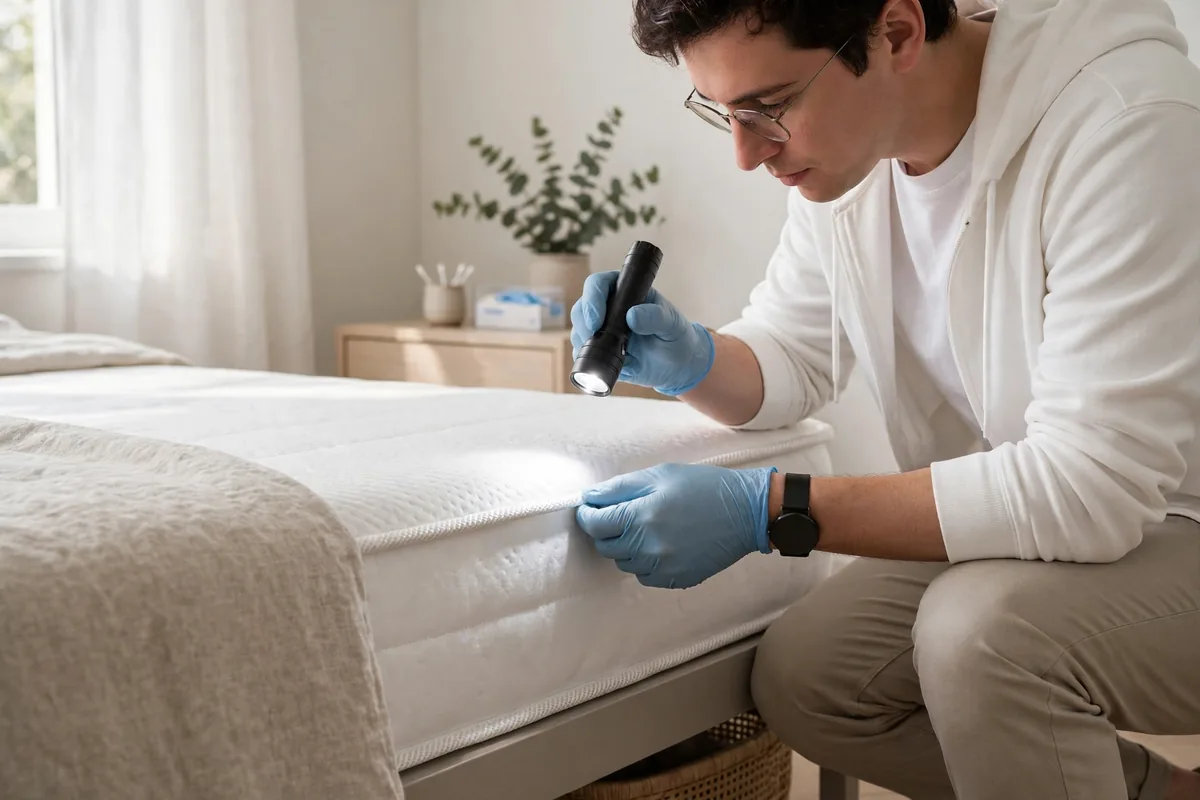
Step 2: Inspect the mattress. Stand the mattress up and examine the seams, piping, tags, and any tufts with your flashlight. Bed bugs hide in these tight spaces. Look for live bugs (about the size of an apple seed, reddish-brown, flat and oval), shed translucent skins, and clusters of dark spots. Check both sides and the box spring, especially the underside where the fabric staples to the frame.
Step 3: Check the bed frame and headboard. Pull the bed away from the wall. Inspect joints, screw holes, slats, and the back of the headboard — all favorite hiding spots. Run your flashlight along every crack. Bed bugs also hide behind baseboards, in nightstand drawers, and along carpet edges within a few feet of the bed.
Step 4: Look for non-bed-bug evidence. White socks pulled over your hands make excellent flea traps — walk around the bedroom and check for tiny jumping insects or black specks. Check window screens for tears that let mosquitoes in. Look up at the ceiling and walls for bird nests in eaves outside the room, which can signal a bird mite problem.
Step 5: Set a monitoring trap. Place bed bug interceptor cups under each bed leg (or simply wrap double-sided tape around the legs) and check them over the next week. If something is feeding on you at night, interceptors will catch it walking to or from the bed. This single step has solved more “mystery bite” cases than any other.
Step 6: Document everything. Photograph any evidence you find and keep a simple log: date, number of new marks, where on your body, and what you found during inspection. Patterns over a week or two often reveal the culprit more reliably than any single clue.
If your investigation turns up nothing after two weeks of monitoring but bites continue, it is time to call a licensed pest management professional for an inspection. Professionals have detection tools — including bed bug sniffing dogs and specialized monitors — that go far beyond a flashlight check.
Treating the marks you woke up with #
Whatever caused the marks, the immediate treatment is the same: keep it simple, keep it clean, and resist the urge to scratch.
Wash the area with mild soap and cool water as soon as you notice it. This removes any surface irritants and reduces the chance of infection if the skin is broken. Apply a cool compress or a clean cloth dampened with cold water for 10 to 15 minutes at a time to calm itching and swelling. Repeat as needed through the day.
For itching, an oral antihistamine taken per the label directions can help, and a thin layer of over-the-counter hydrocortisone cream on the mark may reduce the urge to scratch. These are general measures, not prescriptions — if you take other medications or have health conditions, check with your doctor or pharmacist first. Trim your fingernails short to limit skin damage from nighttime scratching you may not even notice.
Watch the marks over the next 48 to 72 hours. Normal bite reactions peak in itching around the first day and then fade. Do not pick, squeeze, or puncture any blister or bump — broken skin is an open invitation to bacterial infection, and many of the worst “spider bite” horror stories are actually skin infections that started as minor marks. For a deeper comparison of how different bites respond to similar treatments, see our guide on flea bites versus mosquito bites, which covers home care for both.
One warning about the internet: you will find advice suggesting you can identify the culprit from a photo of your bite. Ignore it. Bite appearance varies too much between individuals, and photo-based identification has no scientific validity. Your bedroom evidence — not the shape of the welt — is what solves the case.
Your bedroom prevention checklist #
Once you have treated the marks and identified (or ruled out) the culprit, work through this checklist to make your bedroom an unfriendly place for anything that feeds at night.
Seal the bed. Use a high-quality zippered mattress encasement and pillow encasements. These trap any bugs already inside and block new ones from settling into seams. Keep bedding from touching the floor — this is the single most effective spider deterrent as well, since spiders reach beds by climbing draped fabric. Pull the bed a few inches away from the wall.
Reduce clutter around the bed. Nightstands, under-bed storage, and piles of clothes create hiding places. Store items in sealed containers and keep the floor clear. Vacuum the bedroom weekly, including along baseboards, under the bed, and around the headboard — then empty the vacuum outside.
Block the flying biters. Repair or replace torn window screens. Keep windows closed at night during mosquito season, or run air conditioning. A fan blowing gently across the bed makes it harder for mosquitoes to land on you and disrupts the carbon dioxide plume they follow.
Protect your pets. If you have cats or dogs, keep them on a veterinarian-recommended flea preventive year-round, not just in summer. Wash pet bedding weekly in hot water. This single habit prevents most household flea problems before they start.
Be careful what you bring home. Inspect secondhand furniture, especially upholstered items and mattresses, before bringing them indoors. After hotel stays, keep luggage on a rack or in the bathtub — never on the bed — and inspect your room first. Wash and dry all travel clothing on high heat when you return.
Handle nests and gaps. If you find bird nests in eaves or attic vents, do not remove them yourself during nesting season — call wildlife or pest professionals. Seal gaps around pipes, vents, and utility lines with caulk or steel wool to keep rodents (and their mites) out of wall voids near bedrooms.
Work through this list once, and most nighttime bite problems never return.
Warning signs: when to seek care #

Call 911 immediately if you develop any of these after a bite or sting: trouble breathing or swallowing; swelling of the face, lips, tongue, or throat; widespread hives or a rash spreading fast; dizziness, fainting, or a racing heartbeat; or severe pain, muscle cramps, or tremors that came on quickly (possible black widow envenomation, which is a medical emergency).
For less urgent but still concerning signs, contact your doctor or an urgent care clinic promptly: a bite that keeps getting larger, hotter, or more painful after 48 hours; red streaks spreading outward from the mark; pus, warmth, or increasing swelling (possible infection); fever or chills; a dark or black center that is expanding; or any bite that is not improving after a week. If you actually saw a black widow or brown recluse bite you, or you caught the spider, bring a photo or the spider in a sealed container — and describe exactly where and how it happened. Genuine spider bites are rare, so clinicians take a witnessed bite seriously.
Frequently asked questions #
Can a spider bite me while I am asleep without me waking up? #
It is theoretically possible but, according to entomologists, extremely unlikely. Most spiders that end up on a bed leave without biting, and spiders are not attracted to sleeping humans — your breathing and heartbeat vibrations tend to drive them away. If you woke up with marks and never saw a spider, the odds strongly favor bed bugs, fleas, mosquitoes, or mites instead. The one honest exception is if you trapped a spider against your skin under clothing or bedding and pressed down on it, which is a defensive bite, not a nighttime hunt.
How do I know if my night bites are bed bugs or spiders? #
Look at the pattern and the evidence, not just the marks. Bed bug bites typically appear in rows or clusters on exposed skin and come with physical evidence: dark fecal spots on sheets, shed skins in mattress seams, or live bugs in the bed frame. Spider bites are usually solitary marks with no pattern and no bedroom evidence, and — critically — you almost certainly would have noticed the spider. When in doubt, run the bedroom investigation in this guide before deciding.
Why do I get bitten at night but my partner does not? #
This is one of the most common questions, and it does not mean the bites are imaginary. People react very differently to the same bites — research on bite reactions consistently shows that some individuals develop strong welts while others show no visible reaction at all. Bed bugs may also feed preferentially on one person because of where they sleep relative to the bugs’ hiding spots, or differences in body heat and carbon dioxide output. One partner reacting and the other not is completely normal and does not rule out bed bugs.
Do spiders bite more in certain seasons or regions? #
Spiders are more active and more visible in late summer and fall, which is when most spider encounters happen — but encounters are not bites. The medically significant spiders in the United States, the black widow and the brown recluse, have limited ranges: brown recluses are concentrated in the Midwest and South, and black widows favor the South and West, though widows occur more broadly. Outside those regions, a “recluse bite” diagnosis should be questioned. Seasonal increases in night bites are more often caused by mosquitoes (summer), oak mites (late summer and fall), or bed bugs brought home from summer travel.
Should I spray my bedroom for spiders? #
Routine pesticide spraying for spiders is generally unnecessary and often counterproductive — it can drive spiders into new hiding spots without solving anything, and it does nothing about the bed bugs, fleas, or mosquitoes that are the actual likely culprits. Focus on the physical measures in the prevention checklist: encasements, decluttering, screens, and pet flea prevention. If you have identified a specific pest, use treatments targeted at that pest, and consider a licensed pest management professional rather than broad do-it-yourself spraying in a sleeping area.
Medical and editorial note #
This guide is for general information only and is not medical advice. Bite reactions vary widely between individuals, and no article can diagnose what caused your marks or whether they need treatment. If you are worried about a bite, if symptoms are worsening, or if you have a known allergy to insect bites or stings, see a healthcare professional promptly. When in doubt, a clinician who can examine you in person is always the right call.
Sources & Further Reading #
These references support the general information about spider behavior and the limits of identifying a bite from skin appearance. A suspected spider bite cannot be confirmed from a mark alone, and urgent symptoms should be assessed based on the person’s condition rather than an assumed species.
- University of Minnesota Extension: Spiders — explains that spiders rarely bite people and that many suspected spider bites are overdiagnosed.
- Rutgers Cooperative Extension: Spiders of Medical Importance — describes the uncommon circumstances in which spiders bite people and the medically important groups in North America.
- Poison Control: Insect and Spider Bites—When to Worry — first-aid basics and symptoms that warrant medical evaluation.
- CDC Yellow Book: Poisonings, Envenomations, and Toxic Exposures — notes that suspected spider bites are often misidentified and outlines serious symptoms associated with medically important spiders.


