
You found an attached tick and someone mentioned antibiotics — the question of tick bite and doxycycline: when doctors recommend preventive antibiotics comes up after almost every high-risk bite. The direct answer: most tick bites never need antibiotics, and doctors consider a single preventive dose only when four specific conditions all line up at once. This guide explains those conditions in plain language so you can walk into the conversation with your doctor or pharmacist knowing exactly what matters.
The Four Criteria Doctors Check Before Considering a Single Dose #
Current infectious-disease guidelines take a restrained position: routine antibiotic prophylaxis after a tick bite is not recommended. The Infectious Diseases Society of America (IDSA), along with CDC guidance, describes a narrow situation where a clinician may reasonably offer a single dose of doxycycline. All four of the following must be true — if even one is missing or uncertain, the standard recommendation is watchful waiting rather than antibiotics.
The four conditions, stated generally so you can check your own situation before you call:
- The tick is reliably identified as an adult or nymphal black-legged (deer) tick — the species Ixodes scapularis. This is the only tick species linked to Lyme disease transmission in the United States.
- The tick was attached for an estimated 36 hours or longer, judged by how engorged it is with blood or by your exposure history. Transmission risk rises with attachment time, and short attachments carry very little risk.
- The preventive dose can be started within 72 hours of removing the tick. The clock starts at removal, not at the moment of the bite.
- The local rate of Borrelia burgdorferi (the Lyme bacterium) in this tick species is above 20% in the area where the bite occurred — generally true in parts of New England, the Mid-Atlantic states, and the upper Midwest. Your clinician or local health department knows the local picture.
On top of these four, the patient must have no contraindication to doxycycline (more on that below). The table below puts the two paths side by side:
| Factor | All four line up — ask about a single preventive dose | One or more is missing — watch and wait | |—|—|—| | Tick species | Reliably identified as an adult or nymphal black-legged (deer) tick | Dog tick, lone star tick, wood tick, or species unknown | | Attachment time | Estimated at 36 hours or longer from engorgement or exposure history | Removed quickly, flat and unfed, or attachment time unknown | | Timing | Within 72 hours of tick removal | More than 72 hours have passed since removal | | Local infection rate | Your area’s rate of Lyme bacteria in this tick species exceeds 20% | Low-rate area, or the local rate is unknown | | Contraindications | None — your doctor confirms you can take the drug | Pregnancy, young child, doxycycline allergy, or interacting medications |
Notice how demanding this list is. That is deliberate: most tick bites fail at least one criterion, which is why most doctors do not prescribe antibiotics after a bite. The decision is always the clinician’s — your job is to bring accurate information so the assessment is based on facts rather than guesswork.
Why the Tick Species Matters More Than the Bite Itself #
Lyme disease bacteria are carried by one group of ticks only: the black-legged tick, also called the deer tick (Ixodes scapularis in the eastern and central United States, and Ixodes pacificus on the West Coast). Dog ticks, lone star ticks, and American wood ticks do not transmit Lyme disease no matter how long they stay attached. So the very first question a doctor asks is not “how bad does the bite look?” but “what kind of tick was it?”
The tricky part: the ticks most likely to transmit Lyme are the nymphs — immature ticks roughly the size of a poppy seed. They are easy to miss, easy to mistake for a speck of dirt or a new freckle, and their bites are painless. Adult black-legged ticks are larger (about the size of a sesame seed unfed) and easier to spot, but nymphs account for the large share of transmissions simply because people rarely notice them in time.
Here is what to do about identification:
- Save the tick. Drop it into a small jar, a zip-top bag, or a piece of tape folded over it. A live tick in a sealed container is ideal; a dead one works too.
- Take a clear photo of the tick next to something for scale, like a coin, before you store it. Photos help if the specimen gets crushed.
- Do not rely on the bite mark alone. Redness around any bite tells you almost nothing about the species — only the tick itself can be identified.
- Ask for help. Your doctor, pharmacist, or local health department can often identify the species from a photo or the specimen, and many state health websites publish side-by-side identification pictures.
If you are unsure whether your tick was a black-legged tick or a dog tick, compare its features against a reliable identification guide such as the one at https://stinghelp.com/docs/deer-tick-vs-dog-tick-identification/ before your appointment. Bringing the actual tick to the visit beats any description you could give.
How Doctors Estimate Attachment Time #
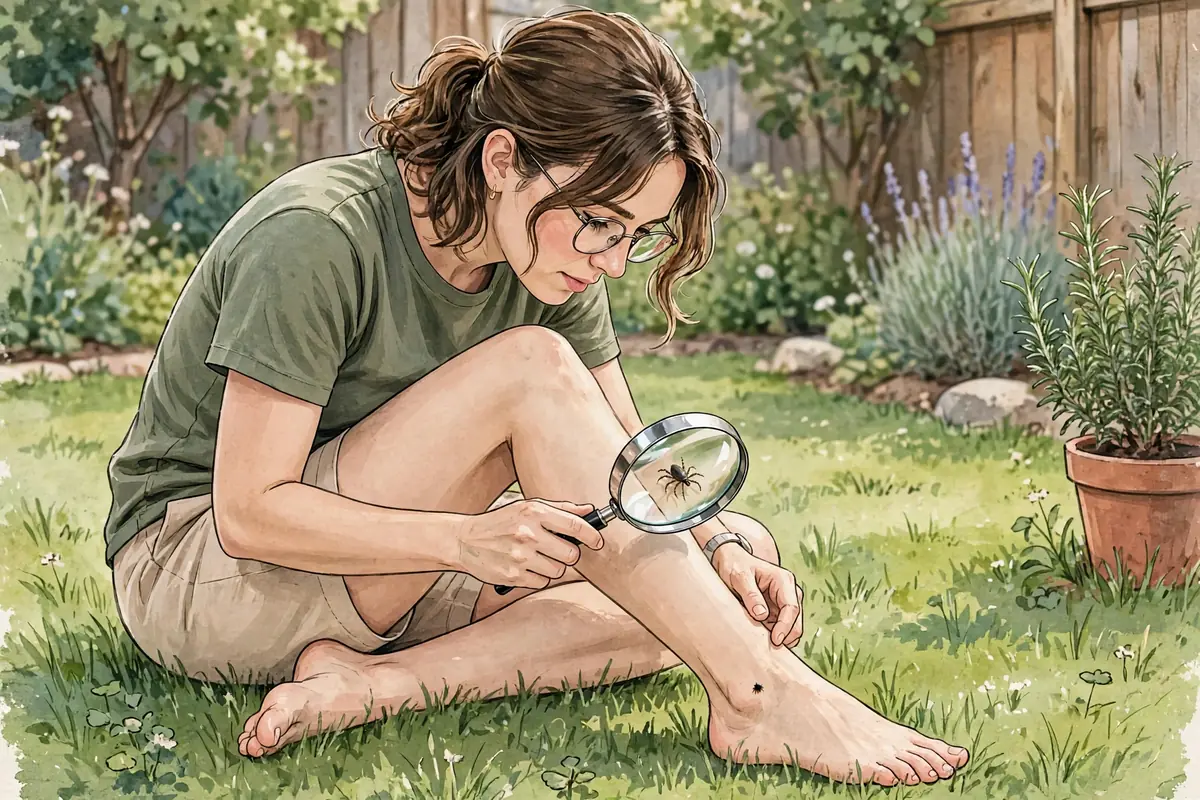
The 36-hour threshold exists because the Lyme bacterium lives in the tick’s gut and needs time to migrate to its salivary glands before it can enter your skin. Short attachments — a tick you brushed off the same day — carry a very low transmission risk. Long attachments carry more. Since nobody watches a tick feed in real time, clinicians estimate attachment from two sources: the tick’s appearance and your exposure history.
Engorgement clues. An unfed tick is flat. A tick that has been feeding for a day and a half or longer is visibly swollen, rounded, and often grayish rather than dark brown or black. The more engorged the tick, the longer it was almost certainly attached. Your doctor may examine the saved tick and use its size and shape to estimate feeding time — another reason to save it rather than flushing it.
Exposure history. Think backward through the last several days: when were you in woods, tall grass, leaf litter, or brush? When did you last check yourself for ticks? If you were hiking Saturday morning and found the tick Monday evening with no shower or tick check in between, the window for attachment is the whole stretch — and the tick may well have been on you the entire time. Write down the dates; they matter more than you think.
Crawling versus attached. If you found the tick crawling on your skin or clothing and it had not bitten, there was no transmission — attachment is required. Only embedded ticks count for the 36-hour question.
Be honest about uncertainty. “I don’t know when it attached” is a perfectly acceptable answer, and it is information in itself: when attachment time cannot be estimated, clinicians often treat the situation conservatively and recommend watchful waiting, since one of the four criteria cannot be confirmed.
The 72-Hour Clock Starts at Removal, Not at the Bite #
The single-dose prevention strategy was studied in people who received the dose within 72 hours of tick removal — that is the evidence window, and guidelines stay inside it. This detail confuses many people, so read it carefully: the 72 hours are counted from the moment the tick comes off your skin, not from the bite and not from when you first noticed it.
A few practical consequences follow from this:
- Remove the tick immediately and note the time. Prompt removal is the single most effective thing you can do, because it cuts off the attachment clock. Use clean, fine-tipped tweezers, grasp the tick as close to the skin surface as possible, and pull upward with steady, even pressure. Clean the area afterward with soap and water.
- Do not wait to see what happens. If the bite looks like it might qualify — a possibly black-legged tick, in a high-risk area, maybe attached a while — call your doctor or pharmacist the same day you remove it. Waiting three days to “see if a rash shows up” burns through the prevention window.
- If you are already past 72 hours, still call. The prevention window has closed, but your clinician will switch you to the watch-and-wait plan and tell you exactly which symptoms should bring you back. Late calls are common and completely fine.
One more timing note: the single preventive dose is not a treatment. If you already have an expanding rash or flu-like symptoms, you are past prevention — that is a different clinical situation (see the treatment section below), and it calls for a full evaluation, not a single dose.
Who the Single-Dose Option Is Not For #
Even when the bite itself meets all four criteria, the person matters as much as the tick. Guidelines exclude several groups from the single-dose doxycycline approach, and you should know where you stand before the conversation:
- Children under eight years old. Tetracycline-class antibiotics can affect developing teeth and bones, so the prophylaxis criteria as written apply to adults and older children. If your young child has a high-risk bite, ask the pediatrician what applies to your child’s age — do not assume, and do not give adult medication to a child.
- Pregnant or breastfeeding patients. Doxycycline is generally avoided in pregnancy because of possible effects on fetal bone and tooth development. Tell your clinician if you are pregnant, might be pregnant, or are nursing, and ask about the safest path for you.
- People with a doxycycline or tetracycline allergy. Any history of allergy to this drug family rules out the option. Mention all drug allergies when you call.
- People taking interacting medications. Doxycycline can interact with certain medicines and supplements (for example, some antacids and mineral supplements reduce its absorption). Bring a full medication list to the conversation.
- People worried about other tick-borne infections. The single-dose evidence is for Lyme disease prevention only. It has not been shown to prevent ehrlichiosis, anaplasmosis, babesiosis, or Rocky Mountain spotted fever. The reassuring part: the risk of those infections from a single recognized bite is considered very low, and they are not a reason to take antibiotics “just in case.”
Side effects exist even with one dose — nausea and sun sensitivity are the commonly discussed ones, and allergic reactions, while rare, are possible. These trade-offs are part of why doctors do not hand out the dose casually. When you talk to your clinician, ask directly: “Given my situation, do the likely benefits outweigh the downsides for me?”
If You Do Not Meet the Criteria: The Watch-and-Wait Checklist #
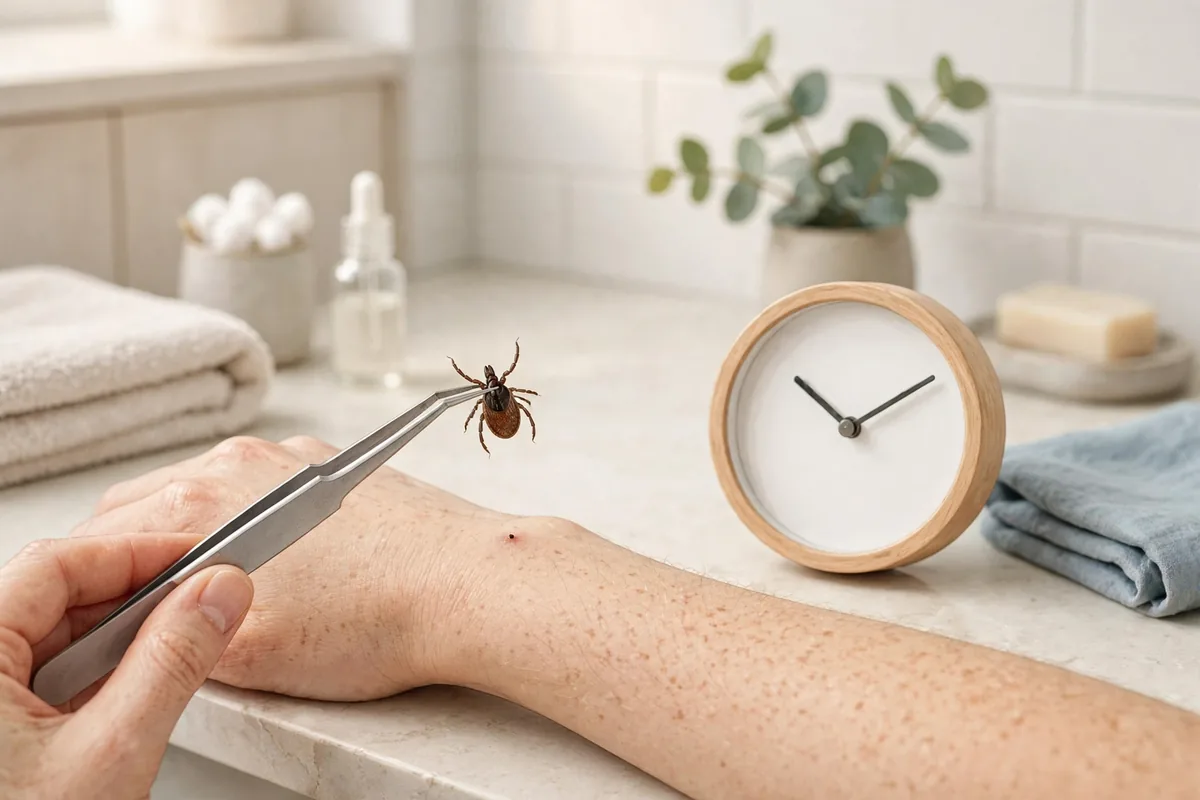
Most people land here — and that is fine. Watchful waiting is not “doing nothing.” It is the guideline-recommended plan for bites that do not meet all four criteria, and it works because early Lyme disease is very treatable when caught. Here is how to do it well:
- Mark the bite site. Circle the area lightly with a pen or take a dated photo so you can tell new redness from old irritation.
- Watch for 30 days. The monitoring window most clinicians use is about a month after the bite.
- Know the rash. Erythema migrans — the classic Lyme rash — usually appears within 3 to 30 days as an expanding red area, often (but not always) with a clearer center. It is typically not painful and not very itchy, which is why people overlook it.
- Track flu-like symptoms. Fever, chills, fatigue, muscle and joint aches, headache, or swollen lymph nodes in the weeks after a bite deserve a prompt call to your doctor.
- Keep a one-line log. Date of removal, where you were bitten, tick species if known, and any symptoms with dates. This turns a vague worry into a clear timeline if you need care later.
- Keep the tick. If symptoms appear, having the specimen can still help your clinician.
The reason watch-and-wait is safe: early Lyme disease responds excellently to standard antibiotic courses prescribed by your doctor. Prevention is a convenience, not a necessity — missing the prevention window does not mean missing your chance to be treated. For a detailed week-by-week monitoring routine, see the aftercare guide at https://stinghelp.com/docs/tick-bite-aftercare-next-few-weeks/.
How to Prepare for the Call or Visit With Your Doctor #
Doctors make this decision in minutes when the facts are organized, and they struggle when the facts are missing. A five-minute preparation turns your call from anxious guessing into a clean clinical assessment. Gather these before you phone:
- The tick itself, saved in a bag or jar — or a clear, scaled photo if the specimen is gone.
- The timeline: when you likely encountered ticks, when you found this one, and the exact date and time you removed it.
- Your attachment estimate: how engorged the tick looked, and whether it could have been attached 36 hours or more.
- Where the bite happened: town or county, and whether it was woods, yard, or park — local risk rates are geographic.
- Your status: current medications, drug allergies, and whether pregnancy or young age applies.
- Any symptoms so far, even mild ones, with dates.
Then ask these questions directly:
- “Based on this tick and timeline, do I meet the criteria for a single preventive dose?”
- “What symptoms should bring me back, and how quickly?”
- “Should this tick be sent for testing?” (Many health agencies do not recommend routine tick testing to guide treatment decisions — the clinical criteria above are what matter — but ask your doctor what your area advises.)
- “Is there anything I should avoid while we watch and wait?”
Write down the answers. Tick-bite anxiety makes details evaporate, and a short note keeps you from second-guessing the plan at midnight.
When Antibiotics Become Treatment Instead of Prevention #
Prevention and treatment are two different doors, and it helps to know which one you are walking through. A single preventive dose is for the window after a high-risk bite, before any illness. Once symptoms or a characteristic rash appear, you have moved into treatment territory — and treatment looks different:
- Treatment is a full course, not a single dose. If your doctor diagnoses early Lyme disease — often from the erythema migrans rash alone, without waiting for blood tests in endemic areas — the prescription is a multi-day course of antibiotics chosen for you. It is not the one-dose prevention strategy, and one is not a substitute for the other.
- Do not self-treat with leftover antibiotics. Old prescriptions in the medicine cabinet are the wrong drug, the wrong amount, or expired — and taking them can mask symptoms while the infection continues. Every treatment decision here belongs to your clinician.
- Blood tests have timing limits. Early Lyme is diagnosed clinically because antibodies take weeks to appear; testing too early can give false reassurance. If your doctor orders tests, ask when to do them and what the results will and will not prove.
- Finish what is prescribed. If you are given a treatment course, take it exactly as directed and call back if symptoms persist or worsen after finishing.
The line between the two is simple: no symptoms plus all four criteria within 72 hours of removal puts prevention on the table; symptoms or a rash at any point means evaluation for treatment. When in doubt about which side you are on, describe what you see and let your clinician decide.
Warning signs: when to seek care #
Call 911 immediately if you or someone with you develops signs of a severe allergic reaction or another medical emergency after a tick bite or after taking any medication: trouble breathing or swallowing, swelling of the face, lips, tongue, or throat, fainting or feeling about to faint, a rapid or weak pulse, chest pain, or sudden weakness or numbness on one side of the body.
For less dramatic but still urgent situations, contact your doctor promptly or visit urgent care if any of the following appear: an expanding red rash around the bite (especially one that grows over days), fever, chills, or flu-like body aches within about a month of the bite, severe headache with neck stiffness, facial drooping on one side, joint pain and swelling (particularly in large joints like the knee), heart palpitations or dizziness, or a bite area that becomes increasingly painful, swollen, warm, or streaked with red. Also call if the tick was attached for an unknown or long time in a high-risk area and you have not yet discussed prevention, or if you removed multiple ticks. When in doubt, call — tick-borne illnesses are easiest to treat early, and no clinician will fault you for checking.
Frequently asked questions #
Can I just take doxycycline on my own if the bite looks high-risk? #
No — do not self-prescribe. The prevention decision depends on the tick species, attachment time, local infection rates, timing since removal, and your personal contraindications, and getting any of those wrong means taking antibiotics for no benefit while accepting real side effects and contributing to antibiotic resistance. A single phone call to your doctor or pharmacist settles it properly, often the same day.
What if more than 72 hours have already passed since I removed the tick? #
The studied prevention window has closed, so a single preventive dose is no longer what guidelines describe. That does not leave you unprotected: switch to the 30-day watch-and-wait plan, keep the tick, note your dates, and call your doctor to confirm the plan and learn exactly which symptoms should bring you back in. Early Lyme disease is highly treatable, so careful monitoring is a genuinely safe fallback.
Does the single preventive dose protect against every tick-borne infection? #
No. The evidence behind the single dose concerns Lyme disease prevention after a black-legged tick bite. It has not been shown to prevent ehrlichiosis, anaplasmosis, babesiosis, or Rocky Mountain spotted fever. The good news is that the risk of those infections from a single recognized bite is considered very low. If you develop fever or flu-like symptoms after any tick bite, tell your doctor about the bite — the evaluation covers all tick-borne possibilities, not just Lyme.
Can my young child or I take the preventive dose during pregnancy? #
The prophylaxis criteria as written apply to adults and older children — children under eight and pregnant or breastfeeding patients are excluded because of the tetracycline class’s effects on developing teeth and bones. That does not mean a high-risk bite in these groups is ignored; it means the plan is individualized. Call your pediatrician or obstetric clinician promptly, describe the tick and timeline, and ask what monitoring or alternatives they recommend for your situation.
Should I have the tick tested for Lyme disease? #
Ask your doctor rather than assuming. Many public health agencies do not recommend routine tick testing to guide medical decisions, because the clinical criteria — species, attachment time, timing, and local rates — are what determine the plan, and a positive tick test does not prove transmission while a negative one does not fully rule it out. Saving the tick for species identification is widely useful; paying for laboratory testing of the tick is a separate question your clinician can answer for your area.
Medical and editorial note #
This guide is general information about when clinicians consider preventive doxycycline after a tick bite — it is not medical advice, it does not prescribe or recommend any medication for you, and it cannot replace an individual assessment. Tick-borne disease risk varies by species, geography, and season, and only a qualified healthcare professional who knows your history can decide what is appropriate in your case. If you are worried about a bite, contact your doctor, pharmacist, or local health department promptly rather than waiting.


