
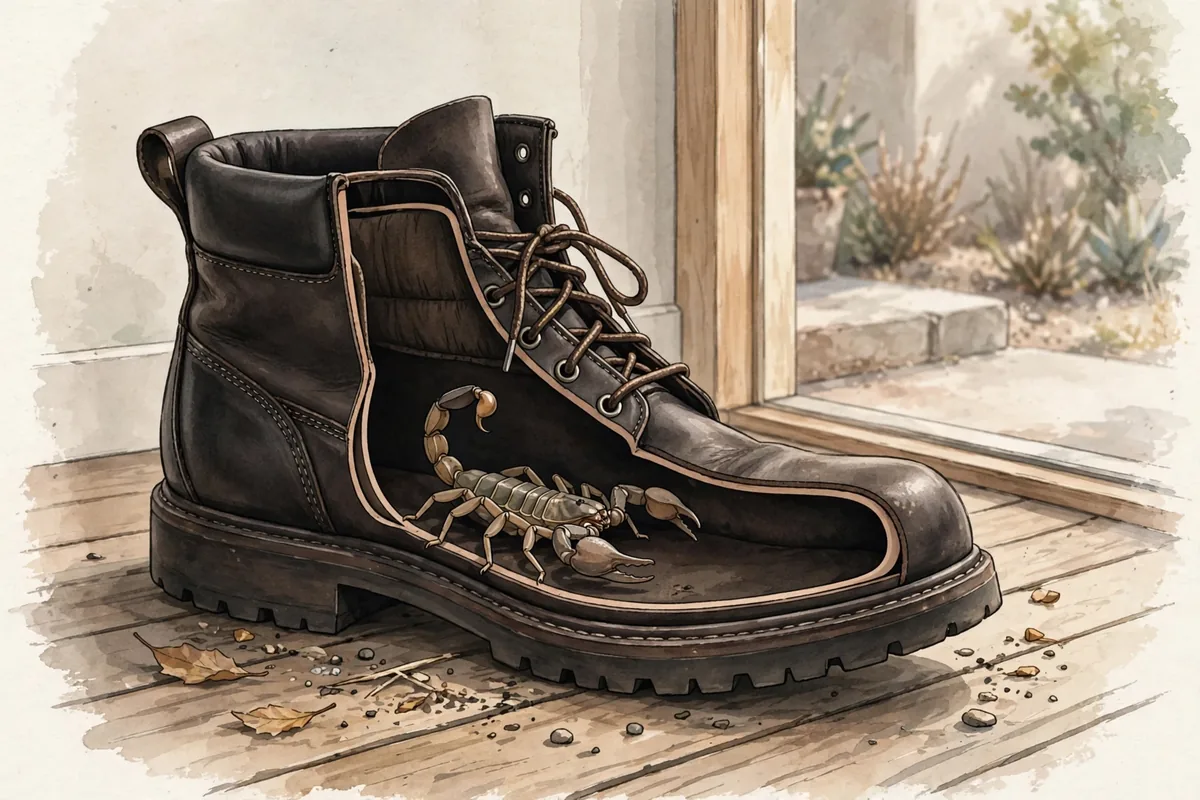
Scorpion in shoes prevention comes down to one simple habit: never slide your foot into a shoe without shaking it out first. Scorpions are nocturnal shelter-seekers, and the dark, cool interior of a shoe left by the door or in the garage is exactly the kind of hiding spot they wander into overnight. Most shoe stings happen in the morning to people who never saw it coming.
This guide covers why scorpions choose shoes, the daily habits that prevent encounters, how to scorpion-proof your home’s entry points, and what to do if prevention fails and someone gets stung.
Why scorpions end up in shoes #
They are looking for shelter, not for you #
Scorpions are not aggressive hunters of humans — they sting defensively when pressed against skin. At night they roam hunting insects, and by dawn they seek a tight, dark, sheltered crevice to wait out the day. A shoe sitting on the floor offers all three: darkness, enclosure, and residual coolness. Boots, sneakers, slippers, and work shoes left in garages, mudrooms, patios, or by the front door are all candidates.
Shoes left outside overnight are the highest risk — on a porch, beside a tent while camping, or in an open garage. But indoor shoes are not immune, especially in regions where scorpions are common, such as Arizona, Texas, New Mexico, and other parts of the Southwest. During the hottest months, scorpions may move indoors seeking cooler conditions, bringing them into contact with closets and entryways.
Which shoes are riskiest #
- Boots and high-tops. Deep interiors with toe boxes scorpions can tuck into far from the opening.
- Shoes stored on the floor. Anything at ground level is reachable; shoes on a raised rack are less so.
- Shoes in garages and sheds. These spaces have more entry points, more clutter, and more insects (scorpion food) than living areas.
- Damp shoes. Moisture attracts both scorpions and their prey, so sweaty gym shoes or shoes near a laundry area deserve extra caution.
The shake-out habit: your best daily defense #
How to shake out shoes properly #
- Pick up the shoe and hold it upside down. Turn the opening toward the floor.
- Shake it firmly several times. A couple of light taps is not enough — give it several hard shakes so anything inside is dislodged.
- Look inside with a light. Shine a phone flashlight into the toe box. Scorpions are small and the color of dust; a visual check catches what shaking misses.
- Tap the sole on the floor. A few firm taps dislodge anything clinging inside.
At night, a UV or black light makes scorpions glow a bright greenish color, which makes them dramatically easier to spot. A small UV flashlight is inexpensive and genuinely useful in scorpion country — for checking shoes, bedding, and baseboards after dark.
What NOT to do #
Never reach your hand into a shoe to “feel” whether it is clear. If a scorpion is inside, your probing fingers are exactly what it will sting. Always shake and look — never feel. Teach children this rule explicitly; kids are naturally inclined to stick a hand in.
Make it automatic #
The habit only works if it is every single time, not just when you remember. Pair it with an existing routine: shoes get shaken before feet go in, the way you check a mirror before changing lanes. Parents should model it visibly so children copy it — and check children’s shoes for them until the habit is solid.
Extend the same habit to clothing left on the floor, towels, and bedding in scorpion-prone areas. The principle is identical: anything a scorpion could have crawled into overnight gets shaken and checked before it touches skin.
Smart shoe storage #
Get shoes off the floor #
A simple shoe rack, shelf, or over-the-door organizer meaningfully reduces risk. Scorpions travel along the ground and up walls slowly; every foot of elevation and every smooth surface between the floor and your shoes lowers the odds of a nighttime visitor climbing in. Enclosed shoe cabinets are even better than open racks.
Where to keep shoes #
- Inside the house beats the garage, which beats the porch, which beats outside. Each step inward is safer.
- Away from exterior doors. The area right inside a door is the first place a wandering scorpion reaches. Store shoes in a closet or on a rack a few steps inside instead of piled by the threshold.
- In sealed containers when storing long-term. Off-season boots in a garage are prime real estate for scorpions; a lidded bin removes the opportunity.
- Off the ground while camping. Keep boots inside a zipped tent, in a stuff sack, or hung from a line — never sitting open on the ground overnight.
The entryway audit #
Once a month, look at your entryway the way a scorpion would: gaps under the door, clutter piled on the floor, shoes scattered at ground level. Small changes — a door sweep, a shoe rack, clearing the clutter — compound into real protection.
Scorpion-proofing your home and yard #
Shoes are one encounter point; the broader goal is fewer scorpions reaching your living spaces at all.
Seal the entry points #
- Install door sweeps on exterior doors, especially garage and back doors. The gap under a door is a scorpion highway.
- Seal cracks and gaps around pipes, cables, and vents with caulk or expanding foam. Scorpions are flat and fit through surprisingly small openings.
- Repair window and door screens. Torn screens are open invitations.
- Weather-strip the garage door. Garages are the most common indoor scorpion zone; a tight seal at the bottom makes a big difference.
Reduce what attracts them #
Scorpions come for shelter and for food (insects). So:
- Clear clutter from around the foundation: firewood stacks, rock piles, debris, and dense ground cover are scorpion harborage. Move firewood away from the house and store it off the ground.
- Trim vegetation touching the house. Branches and shrubs are bridges over your defenses.
- Fix moisture problems. Leaky outdoor faucets, damp mulch against the foundation, and pet water bowls left out overnight all attract insects — and the scorpions that hunt them.
- Use gravel or crushed rock for pathways near entry points; scorpions dislike crossing loose, shifting surfaces.
- Keep the interior tidy. Regular vacuuming and decluttering, especially in closets, under beds, and along baseboards, removes indoor hiding spots.
Outdoor lighting #
Bright outdoor lights attract the flying insects scorpions feed on. Switching to yellow “bug lights” or motion-sensor lighting near entryways reduces the insect buffet — and the scorpions that follow it.
Prevention methods compared #
| Method | Effort | Impact | |—|—|—| | Shake out shoes every time | Seconds, daily | Highest — stops the most common sting scenario | | Store shoes on a rack or in closed storage | One-time setup | High — removes ground-level hiding spots | | Door sweeps and sealing entry gaps | Weekend project | High — keeps scorpions out of the house | | Clear clutter and firewood from foundation | Periodic yard work | Medium-high — removes harborage and prey | | UV flashlight checks at night | Occasional | Medium — great for detection, not prevention | | Mothballs / ultrasonic repellers | Ongoing cost | None proven — skip these |
If you find a scorpion in a shoe #
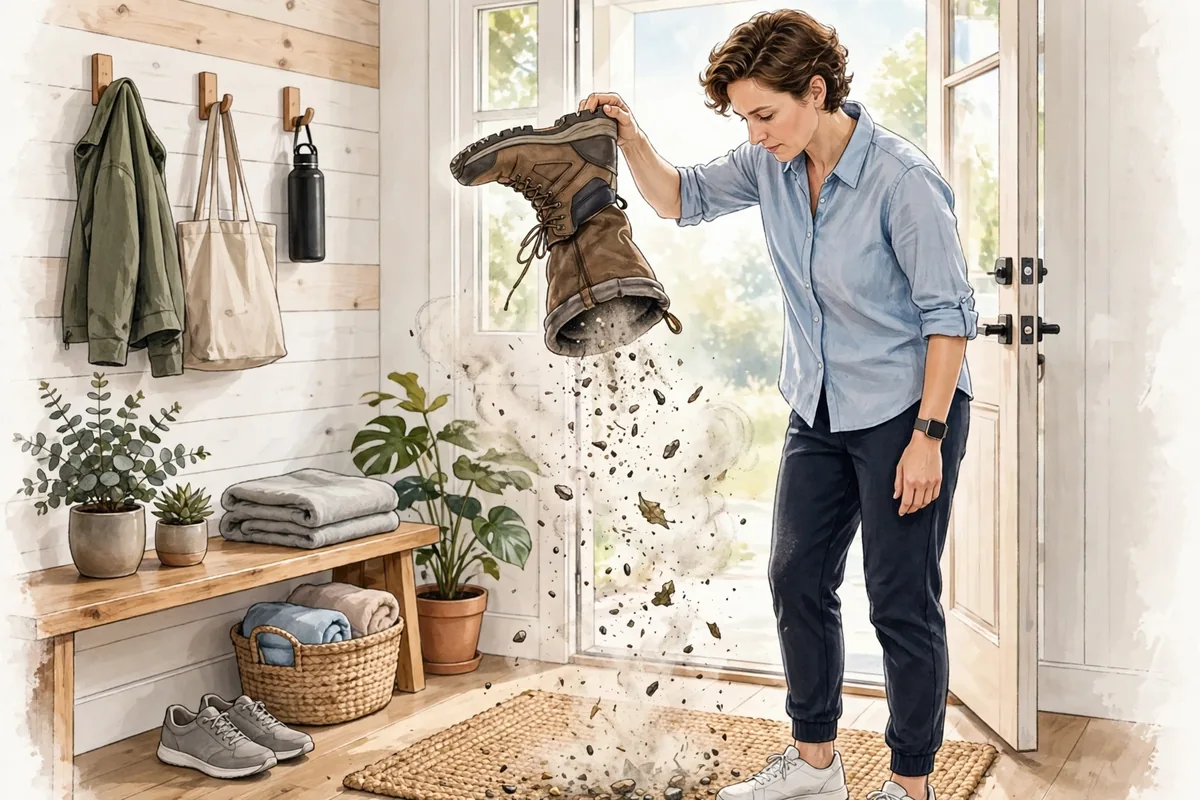
Stay calm. Do not put your foot in, do not reach in with your hand, and do not swat at it while it is inside the shoe — a swat can press the stinger into the shoe’s interior or your hand.
- Take the shoe outside if you can do so safely, holding it by the exterior.
- Shake it out vigorously onto the ground away from the house, or tip it so the scorpion can walk out on its own.
- Use a tool, not your hands. Long tweezers, tongs, or a stiff piece of cardboard can coax or lift a scorpion out. Never handle a scorpion directly — even one that looks dead can reflex-sting.
- Relocate or dispose at your comfort level. If scorpions are frequent visitors, take it as a signal to tighten up the prevention steps above.
Scorpion sting warning signs — get help fast. Most scorpion stings cause intense local pain but are not life-threatening. However, call 911 or Poison Control immediately if the sting victim — especially a child or older adult — develops trouble breathing, muscle twitching or thrashing, unusual eye movements, drooling, slurred speech, vomiting, widespread numbness, or signs of an allergic reaction such as hives or swelling of the face and throat. The Arizona bark scorpion, common in the Southwest, can cause serious systemic symptoms. When in doubt, seek urgent medical care rather than waiting to see how it develops. For general guidance on recognizing dangerous bite and sting reactions, see bite and sting warning signs.
What to do if someone is stung #
Immediate first aid #
- Stay calm and keep the victim still. Panic and rapid movement can speed venom circulation.
- Clean the sting site with soap and water.
- Apply a cold compress (wrapped in cloth, not ice directly on skin) to ease pain and swelling.
- Keep the affected limb still and at heart level if practical.
- Remove rings or tight jewelry near the sting in case of swelling.
What NOT to do #
- Do not try to suck out the venom — it does not work and risks infection.
- Do not cut the wound or apply a tourniquet.
- Do not apply heat to the sting site.
When to seek medical care #
Adults with only local pain, redness, and mild swelling can often manage with cold compresses and monitoring — but watch closely for the first few hours. Seek urgent care or call 911 for any of the warning signs listed above, for stings to young children, older adults, or anyone with a weakened immune system, or if pain is severe and unrelenting. Note the time of the sting and, if you can do so safely, note what the scorpion looked like — it can help medical staff assess the situation.
Protecting kids and pets #

Children are at higher risk from scorpion stings because of their smaller body size, and they are also more likely to stick hands into shoes, toy boxes, and dark corners. In scorpion country:
- Check and shake children’s shoes for them, every time.
- Teach kids never to pick up scorpions or reach into dark spaces, woodpiles, or under rocks.
- Keep cribs and beds slightly away from walls, and consider bed-leg interceptors or smooth barriers.
- Bring pet food and water bowls indoors overnight — they attract insects and the scorpions hunting them.
- If you find scorpions indoors more than rarely, consider a professional pest inspection to find entry points and harborage you may have missed.
Frequently asked questions #
Can a scorpion sting through a shoe? #
A scorpion inside a shoe stings the foot that steps onto it — the sting happens inside the shoe, against bare or socked skin, not through the shoe’s outer material. Thick leather boots worn on the foot do protect against stings from outside, which is why closed-toe shoes are recommended in scorpion areas. The danger scenario is always the scorpion already inside the footwear.
Do scorpions go in shoes during the day or night? #
Almost always at night. Scorpions are nocturnal — they roam after dark and seek shelter around dawn. A shoe sitting undisturbed overnight is available real estate by morning. Shoes you are actively wearing during the day are not at risk.
Will mothballs or repellents keep scorpions out of shoes? #
There is no reliable evidence that mothballs, essential oils, or ultrasonic devices keep scorpions away, and mothballs are toxic to people and pets. Physical habits (shake-out, elevated storage) and exclusion (sealing entry points) are the measures with real support behind them.
I found one scorpion in my house. Does that mean there are more? #
One scorpion does not prove an infestation, but it does prove scorpions can get in — which means the entry point is worth finding and sealing. If you start seeing them regularly, especially indoors, that pattern suggests either a nearby outdoor population pressing in or indoor harborage, and a professional inspection is worthwhile.
Are scorpion stings deadly? #
For healthy adults, most US scorpion stings — including from the Arizona bark scorpion — are painful but not fatal with prompt medical care. The real danger is to small children, the elderly, and people with certain health conditions, where venom can cause serious systemic effects. Because you cannot always identify the species in the moment, any sting with symptoms beyond local pain deserves medical evaluation, and severe symptoms deserve emergency care.
Medical and editorial note #
This guide is general information about scorpion prevention and sting first aid, not medical advice. Scorpion stings affect people differently, and children, older adults, and anyone with health conditions should be evaluated promptly after a sting. If severe symptoms appear, call 911 or Poison Control immediately rather than trying to manage the situation at home.


