
Powassan virus after tick bite exposure is rare, but it deserves attention because the virus can be transmitted quickly and, in some cases, causes serious brain illness. If you were bitten by a tick in an area where Powassan virus circulates and develop fever, headache, vomiting, or weakness within the following weeks, contact your healthcare provider promptly. Only a clinician can evaluate whether testing is appropriate; this guide explains the timeline and symptoms so you know what to watch for and when to seek care.
What Powassan Virus Is #
Powassan virus is a tick-borne virus found primarily in the northeastern and Great Lakes regions of the United States, as well as parts of Canada. It belongs to the flavivirus family, the same broad group that includes West Nile virus. The virus is carried mainly by Ixodes ticks, the same blacklegged (deer) ticks that spread Lyme disease, along with related tick species that feed on small mammals.
It is important to keep perspective. Most tick bites do not result in Powassan virus infection, and many people who are infected never develop symptoms at all. Reported cases are uncommon compared with Lyme disease. But Powassan stands out from other tick-borne illnesses in two ways that explain why public health agencies track it closely: the virus can pass from tick to person very quickly after the tick attaches, and a minority of infections progress to severe neurologic disease with lasting consequences.
There is no vaccine to prevent Powassan virus disease and no specific medicine that treats it. That makes prevention of tick bites, prompt tick removal, and early medical evaluation of concerning symptoms the entire strategy. Understanding the timeline below is the foundation of that strategy.
Why Transmission Speed Matters #
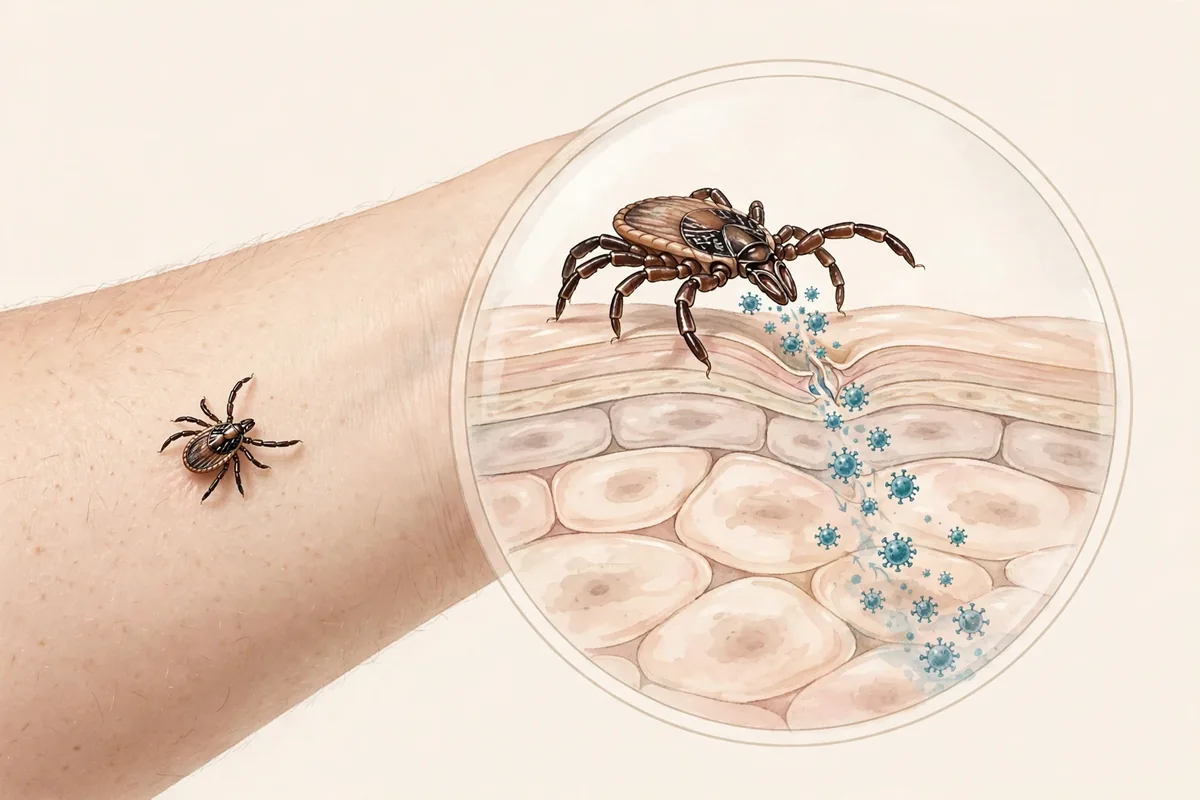
With Lyme disease, a tick generally needs to be attached for a day or more before the bacteria are likely to transmit. Powassan virus is different. Public health sources report that transmission can occur within as little as 15 minutes after an infected tick attaches. This is a meaningful difference: it means that finding and removing a tick quickly, while still important, does not offer the same margin of safety it does for some other tick-borne infections.
This does not mean every brief tick encounter leads to infection. The tick must be carrying the virus in the first place, and only a small fraction of ticks in most areas do. But the short transmission window is the reason health agencies emphasize avoiding tick bites altogether in areas where the virus circulates, rather than relying solely on fast removal.
Where and When Risk Is Highest #
Powassan virus activity follows the activity of its tick vectors. In the United States, most cases occur from late spring through mid-fall, when ticks are most active and people spend more time outdoors. Cases cluster in the Northeast and the Great Lakes region, though the geographic picture can shift as surveillance improves.
Ticks live in grassy, brushy, and wooded areas, and they are often found in hard-to-see places on the body such as the scalp, armpits, and groin. Anyone who hikes, camps, gardens, hunts, or works outdoors in these regions during tick season can encounter them. Children and older adults are worth special attention, not because they are bitten more often, but because they are among the groups at higher risk of severe illness if infected.
How Powassan Virus Spreads: Transmission Timeline #
The sequence below describes what can happen from the moment of a tick bite. It is a general timeline based on public health guidance, not a prediction for any individual case. Many infections stop at the earliest stages and never cause illness.
Minutes after attachment. If the tick is infected, the virus can begin passing into the skin within minutes. This is why prevention matters more than removal speed for this particular virus.
Hours after attachment. The longer an infected tick stays attached, the greater the chance of transmission. Removing the tick as soon as you find it is still worthwhile, because it also protects against other tick-borne diseases that need longer attachment times.
1 week to 1 month after the bite (incubation period). This is the range given on the CDC’s public information page for the time from tick bite to feeling sick. The CDC’s clinical guidance for healthcare providers describes the incubation period as 1 to 5 weeks. During this window, an infected person feels normal; the virus is establishing itself silently.
Weeks 1 to 5: symptom onset, if it occurs. When symptoms do develop, they typically begin within this window. Many infections remain asymptomatic or cause only a mild, nonspecific febrile illness that may be mistaken for a common virus.
Days after symptom onset: possible progression. In a minority of symptomatic cases, the illness progresses from initial flu-like symptoms to inflammation of the brain or its surrounding membranes. This progression is what makes Powassan virus disease potentially severe.
One honest caveat: because many infections cause no symptoms and mild cases often go undiagnosed, the precise timeline for any given person is uncertain. The ranges above reflect reported cases and clinical guidance, and individual experiences vary.
Symptoms of Powassan Virus Disease #
Symptoms fall into two broad categories: initial symptoms that resemble many common illnesses, and severe symptoms that indicate the nervous system is involved. The distinction matters because the first group is common and nonspecific, while the second group is a medical emergency.
Initial Symptoms #
According to the CDC, initial symptoms can include fever, headache, vomiting, and weakness. These may appear gradually or come on more suddenly. Because they overlap with influenza, stomach viruses, and countless other conditions, they cannot by themselves identify Powassan virus disease. Their significance depends on context: recent tick exposure in an area where the virus circulates is what should prompt a conversation with a healthcare provider.
Some people experience only these initial symptoms and then recover. Others have no symptoms whatsoever despite being infected. The fact that most infections do not lead to severe illness is reassuring, but it also means mild cases frequently go unrecognized, which is one reason reported case counts likely understate actual infections.
Severe Illness: Encephalitis and Meningitis #
Powassan virus can cause inflammation of the brain (encephalitis) or of the membranes surrounding the brain and spinal cord (meningitis). The CDC lists the following as symptoms of severe illness: confusion, loss of coordination, difficulty speaking, and seizures. Clinical guidance adds altered mental status, speech problems, weakness or paralysis, movement disorders, and cranial nerve problems.
These symptoms reflect injury to the central nervous system and always require emergency medical care. They can develop after the initial flu-like phase, sometimes rapidly. Anyone with a recent tick bite who develops confusion, trouble speaking, loss of coordination, or seizures should be taken for emergency evaluation immediately.
Outcomes and Long-Term Effects #
The CDC reports that approximately 1 out of 10 people with severe Powassan virus illness die. Among those who survive severe illness, approximately half experience long-term health problems, which can include recurring headaches, loss of muscle mass and strength, and memory problems. These figures describe severe, neuroinvasive cases, not all infections; the outlook for mild or asymptomatic infection is far better.
These statistics underline why severe symptoms must be treated as emergencies, but they should not be read as the likely outcome of every tick bite. The overwhelming majority of tick bites, even in areas where the virus circulates, do not lead to Powassan virus disease at all.
Who Faces Higher Risk of Severe Illness #
The CDC notes that anyone can develop severe illness if infected, but some groups face higher risk: older adults, children including infants, and people with weakened immune systems. If you or a family member falls into one of these groups and has had a tick bite followed by concerning symptoms, lean toward earlier medical evaluation rather than watchful waiting.
How Doctors Evaluate and Test for Powassan Virus #
Only a healthcare provider can determine whether Powassan virus testing or evaluation is appropriate. This section describes the general process so you know what to expect; it is not a guide to diagnosing yourself.
What the Clinician Considers #
According to the CDC, healthcare providers base their assessment on several factors together: the patient’s signs and symptoms, a history of living in or traveling to an area where Powassan virus is known to circulate, a history of possible exposure to the ticks that can spread it, and laboratory testing. No single element is decisive on its own.
This is why the details of your tick encounter matter. If you seek care, tell the clinician when and where the bite happened, what the tick looked like if you saw it, how long it may have been attached, whether you saved the tick, and exactly when symptoms began. Bring the tick in a sealed container if you kept it; identification of the species can inform the clinician’s thinking, though it cannot confirm or rule out infection by itself.
Laboratory Testing #
Your healthcare provider can order tests to look for Powassan virus or for other infections that cause similar symptoms. Testing approaches differ depending on the stage of illness, and interpretation requires clinical judgment. Because early symptoms overlap with many other conditions, clinicians typically consider a range of possible causes, including other tick-borne diseases and other causes of encephalitis and meningitis.
There is no at-home test for Powassan virus, and tick-testing services, while they exist, have limitations that a clinician can explain. A positive tick test does not mean you are infected, and a negative one does not guarantee you are not. Medical evaluation of the person, not the tick, is what guides care.
Treatment and Supportive Care #
The CDC states plainly that no medicines are available to treat Powassan virus disease. For mild illness, care focuses on rest, fluids, and over-the-counter pain medications to relieve symptoms. Severe illness may require hospitalization for supportive care such as help with breathing, hydration, and management of brain swelling. Antibiotics do not work against viruses, so they are not a treatment for Powassan virus itself, though clinicians may use them if a bacterial infection is also suspected.
If you are caring for someone with suspected severe illness at home while awaiting care, the priorities are keeping them hydrated, keeping fever manageable with measures their clinician approves, and watching for any neurologic change that would demand emergency help.
Seek emergency care immediately if someone with a recent tick bite develops any of these red-flag symptoms: confusion or disorientation, difficulty speaking or understanding speech, loss of coordination or balance, seizures, severe headache with neck stiffness, or rapidly worsening weakness. These can signal encephalitis or meningitis, which require hospital-level care without delay. Do not wait to see whether symptoms improve on their own.
What to Do After a Tick Bite in Powassan Areas #

Whether or not Powassan virus is on your mind, the steps after any tick bite are the same, and they are worth doing carefully.
Remove the tick correctly. Use fine-tipped tweezers to grasp the tick as close to the skin as possible and pull straight up with steady pressure. Our step-by-step guide to removing an attached tick safely walks through the full technique. Avoid squeezing the tick’s body, and do not use heat, nail polish, or other folk methods.
Clean the bite area. Wash the skin with soap and water or an antiseptic, and wash your hands. Note the date of the bite on your calendar or phone so you can track the incubation window accurately.
Watch for symptoms for at least a month. Because the incubation period can extend to about a month, keep the bite date in mind for several weeks. If fever, headache, vomiting, or unusual weakness develop during that window, contact your healthcare provider and mention the tick bite explicitly. Many people forget to connect a weeks-old bite to new symptoms, so the calendar note matters.
Know what is normal healing. A small red bump or mild itching at the bite site in the first days is common and usually not a sign of systemic illness. Our guide to tick bite rash vs. local irritation can help you tell the difference, and the tick bite aftercare guide covers what to expect in the weeks after a bite.
Preventing Tick Bites #
Prevention remains the most effective protection against Powassan virus. Use EPA-registered insect repellents containing DEET, picaridin, or oil of lemon eucalyptus according to label directions. Treat clothing and gear with permethrin products designed for that purpose. Wear long sleeves and pants tucked into socks in tick habitat, stay in the center of trails, and do a full-body tick check, including the scalp, after coming indoors. Showering within two hours of outdoor activity can wash off unattached ticks. Tumble-dry clothes on high heat to kill ticks you may have carried inside.
Powassan Virus Timeline at a Glance #
| Timeframe | What may be happening | |—|—| | Minutes after tick attaches | Virus transmission can begin if the tick is infected | | Hours after attachment | Transmission likelihood rises the longer the tick feeds | | 1 week to about 1 month | Incubation period; infected person typically feels well | | Within 1 to 5 weeks of bite | Initial symptoms (fever, headache, vomiting, weakness) may appear in symptomatic cases | | Days after initial symptoms | A minority of cases progress to encephalitis or meningitis | | Weeks to months after severe illness | Recovery period; some survivors have lasting neurologic effects |
Frequently asked questions #

How soon after a tick bite do Powassan virus symptoms appear? #
According to the CDC, the incubation period ranges from 1 week to 1 month on the public information page, and clinical guidance describes it as 1 to 5 weeks. Symptoms do not appear immediately after the bite; there is a delay of days to weeks while the infection establishes itself. If you develop fever, headache, vomiting, or weakness within about a month of a tick bite in an affected region, contact your healthcare provider and mention the bite.
Can Powassan virus be transmitted if the tick was attached only briefly? #
Yes, it can. Unlike Lyme disease, which generally requires a day or more of attachment, Powassan virus can be transmitted within as little as 15 minutes of an infected tick attaching. This is why prompt tick removal, while still important, is less protective against Powassan virus than avoiding bites in the first place. The tick must be infected for transmission to occur, and most ticks are not.
Is there a blood test for Powassan virus? #
Healthcare providers can order laboratory tests to look for Powassan virus infection, but testing decisions and interpretation belong to the clinician. Tests are considered alongside symptoms, exposure history, and the local epidemiology. There is no reliable at-home test. If you are concerned after a tick bite, the right step is to describe your exposure and symptoms to your healthcare provider and let them decide whether testing is warranted.
What is the treatment for Powassan virus? #
There is no specific medicine that treats Powassan virus disease. The CDC advises rest, fluids, and over-the-counter pain medications for milder illness, and hospital-based supportive care for severe illness, which can include help with breathing, hydration, and reducing brain swelling. Anyone with signs of neurologic involvement needs emergency medical care. Do not try to treat suspected Powassan virus disease on your own.
Should I save the tick that bit me? #
Saving the tick in a sealed container or bag can be helpful, because identifying the species gives your clinician additional context about which diseases are plausible. However, tick identification alone cannot confirm or rule out any infection, including Powassan virus. Commercial tick-testing services exist but have limitations your clinician can explain. The most useful information for your doctor is the date and location of the bite and the timeline of any symptoms.
Medical and editorial note #
This guide is for general information only and is not medical advice. Powassan virus disease can only be evaluated and diagnosed by a qualified healthcare provider using clinical judgment and laboratory testing. If you develop fever, headache, vomiting, weakness, or any neurologic symptoms after a tick bite, contact your healthcare provider promptly, and seek emergency care for confusion, seizures, difficulty speaking, or loss of coordination. This content was prepared by the StingHelp editorial team for educational purposes.


