
# Hotel Room Bed Bug Inspection Checklist
A hotel room bed bug inspection checklist is a short, systematic routine you run the moment you enter your hotel room — before you unpack — to check for signs of bed bugs. It takes about ten minutes, requires nothing more than your phone’s flashlight, and can save you from bringing bed bugs home in your luggage.
Bed bugs are not a reflection of how clean a hotel is. They travel in luggage and hitchhike from room to room, so even well-kept, expensive hotels can have an infestation. The good news is that a careful arrival inspection catches most problems early, when switching rooms is still easy. This guide gives you the full checklist, explains exactly what signs to look for, and covers what to do if you find evidence — plus how to protect your belongings on the trip home.
Before You Enter: The Luggage Protocol #
Your inspection starts in the hallway. Do not set your bags on the bed, the floor, or the upholstered bench until you have checked the room.
- Leave suitcases in the hallway or just inside the doorway.
- Set one bag on the metal luggage rack or in the bathroom tub (bed bugs avoid smooth, slick surfaces).
- Keep coats, backpacks, and handbags off the bed and upholstered furniture.
Hard-sided suitcases are somewhat less vulnerable than soft ones, and zipping everything closed matters more than the type of bag. Some travelers line their bags with large plastic bags or use zippered luggage encasements — these are reasonable extra precautions but not a substitute for the room check.
The 10-Minute Arrival Inspection #
Work through the room in this order. You need your phone flashlight (a small flashlight works too) and ideally an old credit card or hotel key card to probe seams.
Step 1: Mattress Seams and Piping #
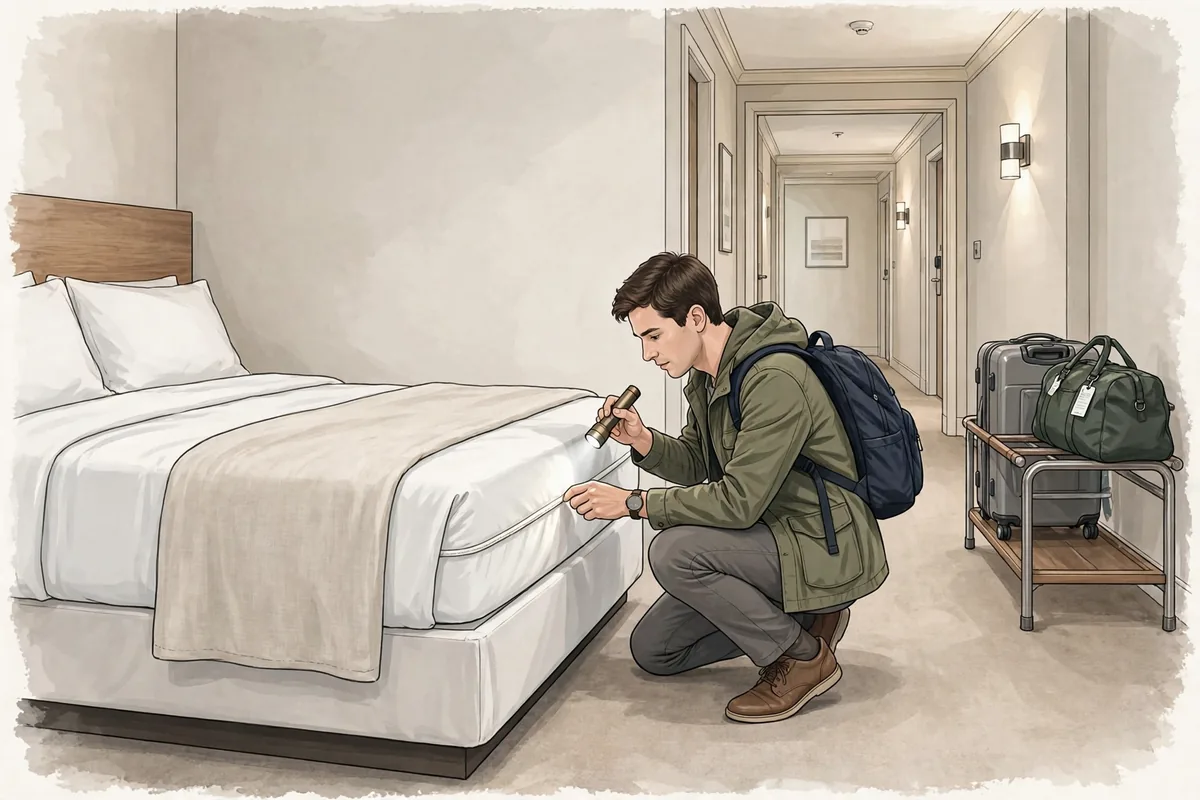
Pull back the sheets and blanket. Run your card along the seams, piping, and tufts of the mattress, shining the light into the creases. Check both sides of the mattress, the top and bottom edges, and the tags. Bed bugs hide in the tight folds of mattress seams during the day.
Step 2: Box Spring and Bed Frame #
If the bed has a box spring, check its seams and underside. Look at the bed frame, especially wooden slats and screw holes, and the corners where the frame meets the headboard. Bed bugs favor wood crevices.
Step 3: Headboard #
This is the single most commonly infested spot in a hotel room. Pull the bed slightly away from the wall if you can, or shine your light behind and around the headboard. Check the back of a wall-mounted headboard, its mounting brackets, and any decorative carvings or seams.
Step 4: Nightstands and Nearby Furniture #
Empty the nightstand drawer and check its joints, underside, and the drawer tracks. Look behind and under the nightstand. Check the alarm clock, lamp bases, and the area where the wall meets the floor near the bed.
Step 5: Upholstered Furniture and Curtains #
Check armchairs, sofas, and ottomans — seams, cushions, zippers, and the underside. Bed bugs sometimes infest the chair closest to the bed. Glance at curtain folds near the bed as well.
Step 6: Luggage Rack and Closet #
Inspect the luggage rack’s straps and joints. In the closet, check the back corners and the safe if there is one.
Signs of Bed Bugs: What to Look For #
You are unlikely to see a large, obvious swarm. Most inspections turn up indirect evidence. Here is what each sign means:
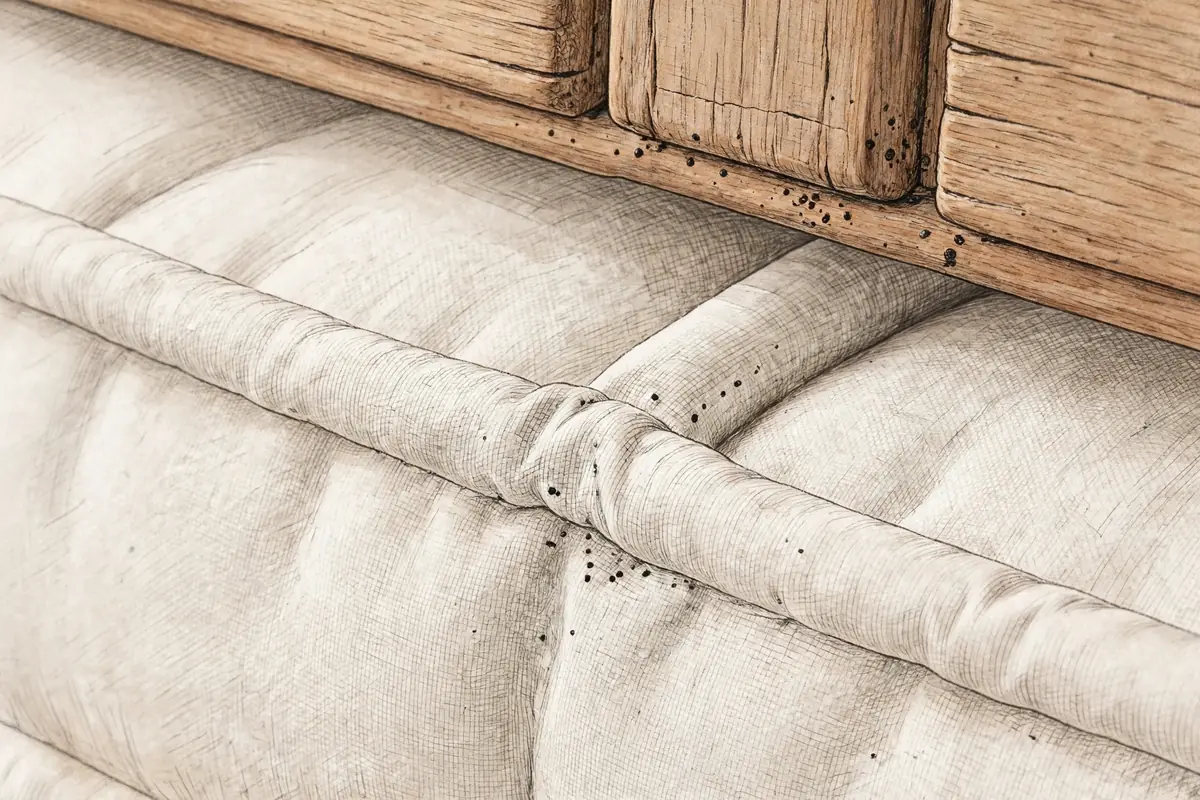
| Sign | What it looks like | What it means | |—|—|—| | Live bed bugs | Flat, oval, reddish-brown insects about the size of an apple seed | An active infestation; do not stay in the room | | Shed skins | Translucent, empty shells the same shape as the bug | Bed bugs are feeding and growing nearby | | Dark spots | Small black or rust-colored dots on seams and fabric | Fecal spots — digested blood; a classic sign | | Tiny white eggs | Rice-grain-sized, pearl-white, in crevices | Reproduction is happening; infestation is established | | Blood smears | Small rust-colored smudges on sheets | Bugs crushed during the night | | Sweet odor | A faint, musty, “coriander-like” smell | Only in heavy infestations; not reliable alone |
Live bugs are apple-seed sized and reddish-brown after feeding; unfed bugs are flatter and more tan. Nymphs are smaller and nearly translucent. A common lookalike is the carpet beetle larva, which is fuzzy and slower-moving — bed bugs are not fuzzy.
What the Signs Mean: A Quick Decision Guide #
Not every spot is a bed bug sign. Use this table to decide what you are seeing:
| What you see | Likely bed bugs? | Next step | |—|—|—| | Reddish-brown apple-seed-sized insect | Yes | Request a room change (different floor if possible) | | Clusters of black dots along a seam | Likely fecal spots | Check nearby for live bugs; ask for another room | | Translucent shells in a crevice | Likely shed skins | Same as above — move rooms | | A few lint balls or dust | No | Continue the inspection | | One isolated dark speck, nothing else | Uncertain | Check the whole bed; when in doubt, change rooms |
When evidence is ambiguous but you feel uneasy, requesting a different room is always reasonable. Most hotels would rather move you than deal with a complaint later.
If You Find Evidence of Bed Bugs #
Stay calm and act quickly:
- Do not unpack further. Keep everything zipped and off soft surfaces.
- Take photos of the evidence (live bugs, fecal spots) with your phone — these help if there is any dispute.
- Go to the front desk and calmly explain what you found. Ask for a room on a different floor, since bed bugs can travel between adjacent rooms.
- Inspect the new room with the same checklist before moving your bags in.
- Isolate your luggage in the new room — rack or tub, zipped shut — for the rest of the stay.
- When you get home, keep the unpack-outside routine (below) even if the second room was clean.
You are generally not obligated to pay for a room with an active infestation, and most reputable hotels will move you without argument. Keep your photos and note the room number, date, and who you spoke with.
During Your Stay: Keep the Risk Low #
- Live out of your suitcase on the rack; do not use the dresser drawers.
- Hang clothes you will re-wear rather than folding them onto furniture.
- Do a quick nightly glance at the mattress seam — it takes thirty seconds once you know where to look.
- If you wake with unexplained bites in a line or cluster, inspect the bed immediately; for guidance on identifying and treating them, see our guide on bed bug bites in a hotel and what to do.
Note that bite reactions vary widely — some people show no reaction at all — so the absence of bites does not prove a room is clean, and the presence of bites does not prove bed bugs. The visual inspection is the reliable part.
Warning signs — seek medical care: Bed bug bites rarely cause serious problems, but see a doctor or urgent care if bites show spreading redness, warmth, swelling, or pus (possible skin infection), if you develop hives or swelling beyond the bite area, or if you have any signs of an allergic reaction such as trouble breathing or swelling of the face or lips — call 911 for those.
Coming Home: The Unpack-Outside Routine #
This is the step most people skip, and it is how bed bugs reach new homes. Treat every trip as a possible exposure:
- Unpack outside the house — in the garage or on the driveway, not in the bedroom.
- Hot-dry everything. Clothes that can take heat go straight into the dryer on the hottest setting for at least 30 minutes. Bed bugs and their eggs die at sustained high temperatures; dryers are more reliable than washers for this.
- Vacuum the suitcase thoroughly, inside and out, including seams and pockets; empty the vacuum outside.
- Inspect the suitcase with a flashlight, and store it away from the bedroom — in the garage or a sealed bag — rather than under the bed or in the closet.
If you suspect bugs made it home (bites appearing over several nights, or you saw bugs in the hotel), do not try to treat a home infestation with over-the-counter foggers alone — these often scatter bed bugs deeper into hiding. Contact a licensed pest management professional, and consider a mattress encasement while you arrange treatment.
What Hotels Should Be Doing (And What to Ask) #

Reputable hotels inspect rooms regularly and work with pest professionals. When booking, you can ask whether the property has a bed bug monitoring program or recent inspections. Mattress and box-spring encasements and clutter-free room design both make infestations easier to spot. If a hotel dismisses your concern or refuses to move you, that is useful information about the property — and worth noting in your review.
Frequently asked questions #
How long does a proper hotel bed bug inspection take? #
About ten minutes for a thorough first check, working through the mattress, headboard, nightstands, and upholstered furniture. A nightly re-check of the mattress seam takes under a minute once you know the routine.
Are expensive hotels free of bed bugs? #
No. Bed bugs feed on people, not dirt, and they arrive in luggage. Five-star hotels get infestations too — they just tend to catch them faster because they inspect more often. Always run the checklist regardless of the price point.
Can bed bugs live in my suitcase? #
Yes — seams, zippers, and pockets of luggage are favorite hiding spots. That is why the hallway protocol, the hot dryer routine at home, and vacuuming the suitcase all matter. Hard-sided cases are somewhat less hospitable but not immune.
What should I do if I find bed bugs at 2 a.m.? #
Take photos, keep your bags zipped and off the bed, and go to the front desk — hotels have night staff for exactly this. Ask for a different floor. If no other room is available, sleep with bags sealed in the bathroom and request the move first thing in the morning, then run the full at-home routine when you return.
Do bed bug bites always appear in a line of three? #
Not always. The “breakfast, lunch, and dinner” pattern is a real tendency but far from a rule — bites can be scattered, clustered, or absent entirely. Use the visual inspection of the room, not your skin, as the deciding evidence.
Medical and editorial note #
This guide is for general information only and is not medical advice. Bed bug bites are a nuisance for most people, but skin infections and allergic reactions can occur. If bites worsen, spread, or you develop symptoms beyond mild itching, see a healthcare professional. Pest treatment decisions should involve a licensed pest management professional.


