Bee Sting ER and Urgent Care Costs: What Each Severity Level Bills (2026)
By StingHelp Editorial Team8 min read
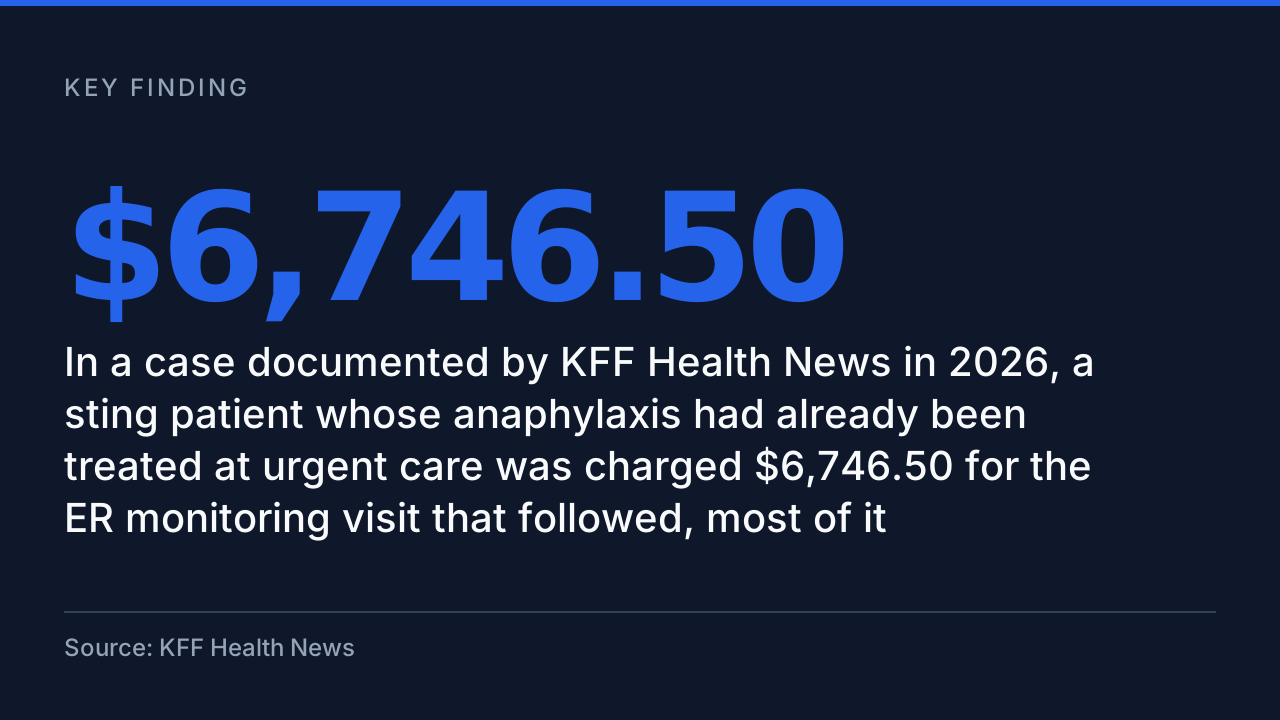
$6,746.50
In a case documented by KFF Health News in 2026, a sting patient whose anaphylaxis had already been treated at urgent care was charged $6,746.50 for the ER monitoring visit that followed, most of it critical-care codes.
→ $605 Total urgent care bill for an uninsured wasp-sting anaphylaxis case in Virginia in 2026: the visit, the epinephrine, and the fee to administer it. (KFF Health News, 2026)
→ $7,921 Buoy Health's estimate of an average ER visit for anaphylaxis without insurance, for all triggers, not stings alone. (Buoy Health, 2026)
→ $2,453 Average total cost of an emergency department visit for large-employer plan enrollees in 2019 claims data, all diagnoses. (Peterson-KFF Health System Tracker, 2019)
→ $175 Approximate price of a generic epinephrine auto-injector, per GoodRx figures cited by KFF Health News in 2026 – the device a patient can carry so the drug is already paid for before a sting happens. (KFF Health News, 2026)
→ $1,277 Average cost of an Advanced Life Support ambulance transport without insurance, per Buoy Health – billed on top of the ER visit, not inside it. (Buoy Health, 2026)
→ 80% Share of the average emergency department visit's cost made up of facility fees, per Peterson-KFF's analysis of 2019 large-employer claims. (Peterson-KFF Health System Tracker, 2019)
A bee sting is one of the cheapest emergencies to treat and one of the most confusing to be billed for. The drug that reverses a severe reaction costs very little; the room, the codes and the ride cost a great deal. This page answers the question patients ask after the bill arrives – was this charge normal? – with the only sting-specific numbers that exist in public: two itemised case bills reported in full by KFF Health News, set against national cost data for anaphylaxis, allergic reactions and emergency visits generally. Every figure carries its source and year, and case bills are labelled as cases, never dressed up as averages.
One rule comes before every number on this page. If a sting brings trouble breathing, throat tightness, widespread hives, dizziness or collapse, that is anaphylaxis: use an epinephrine auto-injector if one is available and call 911 or go to the nearest emergency department immediately. Nothing in any table below is a reason to wait, to shop around, or to choose a cheaper setting for a severe reaction. A large swelling that stays around the sting is a different problem – StingHelp’s guide to large local reactions versus anaphylaxis explains how clinicians tell the two apart – and it is the severe end of the table, not the mild end, where minutes matter more than money.
1 What Does an Urgent Care Visit for a Sting Cost?
For a straightforward sting, the visit itself is modest: $200 in one published urgent care example (Buoy Health, 2024). Severity rewrites the bill. In a documented anaphylaxis case, the visit line was $165, but the epinephrine added $400 and administering it added $40, for a total of $605(KFF Health News, 2026).
METRIC
VALUE
SOURCE
Urgent care visit fee, documented anaphylaxis case
In the documented case, the single most expensive line at urgent care was not the visit or the clinician – it was the epinephrine itself.
KFF Health News, 2026
The pattern to notice is that urgent care pricing is mostly a visit fee until a drug or a procedure joins it. A normal sting reaction – pain, redness and swelling that peaks and fades – is normally assessed, cleaned and sent home with advice, which is why knowing the warning signs that a sting is becoming dangerous matters more than the price list. The bill grows when the reaction is systemic: once epinephrine is given, the medication charge, the administration fee and a period of observation all attach to the same visit, and the case above shows the medication alone costing more than twice the visit fee.
Insurance changes the shape rather than the scale. With cover, an urgent care visit for an allergic reaction typically costs a copay in the range the table shows, while an uninsured patient pays the full itemised bill. Neither figure answers the emergency question, though. Urgent care is the right-priced setting for a reaction that is uncomfortable but stable; it is the wrong setting to choose for breathing difficulty simply because it is cheaper, and StingHelp’s guide to when a bee sting is an emergency sets out where that line sits.
2 What Does the Same Reaction Cost in the Emergency Room?
Far more, and the gap is structural. An average emergency department visit cost $2,453 in national claims data (Peterson-KFF Health System Tracker, 2019), an anaphylaxis visit without insurance is estimated at $7,921(Buoy Health, 2026), and one documented sting case was charged $6,746.50 merely for monitoring after treatment (KFF Health News, 2025).
Almost the entire documented monitoring bill was critical-care coding – the charge priced what could have happened, not the care that was actually delivered.
KFF Health News, 2025
Emergency room cost landmarks, USD
Average total cost of an emergency department visit, large-e
$2,453
Average ER visit for anaphylaxis without insurance
$7,921
Total ER charge for monitoring after a sting anaphylaxis cas
$6,746.50
The documented monitoring case is the extreme that explains the system. The patient’s anaphylaxis had already been reversed at urgent care; the emergency department reviewed her vitals, gave one dose of a stomach medicine also used for allergic reactions, and watched her. The charge was still in the thousands because anaphylaxis is coded as critical care, and critical care is priced by the presenting problem rather than by what the visit turns out to involve. She owed $3,100.24 of it herself because her deductible was unmet – a reminder that an insured patient’s real exposure is set by the deductible, not by the sticker price. Why monitoring follows epinephrine at all is a medical question, and it is answered in StingHelp’s guide to what to do after using an EpiPen.
Set against national data, the case is an outlier in size but not in direction. Emergency visits are priced around the clock: the department is staffed for the worst presentation at any hour, and every visit inherits that cost base. A severe allergic reaction that never reaches anaphylaxis is estimated in the range shown in the table, while full anaphylaxis sits at the top of it. Reactions can also return hours later, which is why the observation in the documented case was medically recommended even though its price is hard to defend – the pattern is described in the guide to delayed allergic reactions after a bee sting.
3 Which Line Items Drive a Severe Sting Bill?
Three things: the ride, the codes and the fluids. An ambulance averages $940 at basic life support and $1,277 at advanced life support without insurance (Buoy Health, 2026), while in the documented case two critical-care codes alone came to more than the rest of the bill combined (KFF Health News, 2025).
The ambulance is billed separately from the hospital, and ground ambulance charges sit outside the main federal surprise-billing protections – the ride can be its own dispute.
Buoy Health, 2026
Read the documented bill from the bottom up and the logic inverts. The only medication the emergency department actually gave cost $20.60. Everything above it was capacity: the room, the monitoring, and above all the critical-care codes, priced at $5,617.85 for the first block and $827.75 for the next. That is not an error in the ordinary sense; the coding system deliberately prices the risk the patient arrived with. It does mean a patient can receive almost no treatment in the ER and still receive the largest bill of the episode, which is precisely the outcome the hidden question behind this research – is this bill normal? – is really asking about. An itemised bill is therefore not paperwork to request after the fact; it is the only version of the bill that can be checked at all, because the summary total hides exactly the codes that decide whether the charge matches the visit that actually happened.
Transport is the second engine. The documented patient was sent the short distance between clinics by ambulance and reported a bill of $275, small only by comparison: the averages in the table are several times higher, and mileage can be charged on top. Multiple stings, a rural distance or an advanced life support crew all push the same line upward, and the first-aid decisions in the first minutes – covered in the guide to first aid for multiple wasp stings – are worth more than any later negotiation over the transport charge.
4 What Does Epinephrine Itself Cost?
The drug is cheap; the device is not. A generic auto-injector costs about $175 at pharmacy prices cited this year (KFF Health News, 2026), against an average cash price of $690 for a brand-name two-pack and $345 for a generic two-pack (Buoy Health, 2026) – all far below one ER visit.
METRIC
VALUE
SOURCE
Generic auto-injector, pharmacy price cited by KFF
Generic epinephrine auto-injector two-pack, average cash pri
$345
Brand-name EpiPen two-pack with discount cards
$359
Brand-name EpiPen two-pack, average cash price
$690
This is the blind spot in almost every cost discussion of sting emergencies: the debate is about visit prices, while the cheapest intervention in the whole pathway is the one bought beforehand. A patient who carries epinephrine treats the reaction in the first minute, and the remaining bill – observation, transport, monitoring – is the system pricing the risk that remains. A patient who does not carry it buys the same drug inside the most expensive buildings in medicine, at the prices the earlier sections show. The comparison is not close, and it holds at every severity level in this article.
Prices still vary enough to reward attention. Brand and generic two-packs differ by hundreds of dollars, discount cards close much of that gap, and a small number of states now cap what patients pay, as the table shows. Auto-injectors also expire, and an expired device is a false economy; StingHelp’s guides to whether an expired EpiPen can still be used and to the EpiPen versus Auvi-Q comparison cover the practical choices. None of this is a reason to delay using a device in a reaction – it is a reason to replace it on schedule.
5 Why Do Two Patients Pay Such Different Amounts?
Because the bill is set by complexity coding and insurance design, not by the sting. The least complex emergency visits averaged $592 while the most complex averaged far more, with patients paying $840 out of pocket at the top level (Peterson-KFF Health System Tracker, 2019), and facility fees made up 80% of the average visit’s cost (Peterson-KFF Health System Tracker, 2019).
Most of an emergency bill is the facility fee – the charge for the department existing, staffed and ready – which is why treatment-light visits still bill heavily.
Peterson-KFF Health System Tracker, 2019
Two wasp stings, two patients, bills an order of magnitude apart: the difference is rarely the insect. It is the code the visit attracts, the deductible the patient has left, whether an ambulance was called, and whether the reaction crossed the line into anaphylaxis coding. The national data makes the spread concrete – a quarter of emergency visits cost more than the threshold in the table, while another quarter cost a fraction of the average – so asking whether a bill is normal has no single answer, only a position within that spread and a set of lines that can each be checked against the visit record. Geography adds one more layer: the same tracker found the most expensive metropolitan areas charging more than twice the least expensive for comparable visits, before any difference in the care delivered is considered at all.
The practical reading of a sting bill is therefore line by line: the visit or facility fee, the drug and its administration, any critical-care codes, and the separate ambulance bill. Each has a source price somewhere on this page to compare against, and each can be queried with the provider using an itemised statement. What cost knowledge must never do is set the destination during the emergency itself. Mild reactions are managed at home every day – the treatment basics are in the honey bee sting treatment and paper wasp sting treatment guides, and spreading redness afterwards is addressed in the guide to bug bite infection, cellulitis and antibiotics – but a reaction involving the airway, the whole body or consciousness is an emergency at any price, and the bill is a problem for afterwards.
Key statistics at a glance | Source: see numbered sources below
Explore every figure in this article
Metric
Value
Year
Source
Urgent care visit fee in a documented wasp-sting anaphylaxis case (Virginia, 2026)
This page was built by the Data Gap Method in a fully degraded run, and the degraded stages are part of the record. Stage one demand mining ran manually through host web search because the Reddit route was blocked from this host and no ScrapeCreators key was available. Stage two, the supply check, used host web search rather than DataForSEO. Stage three, the backlink format filter, did not run at all, so no claim is made here about which formats earn links in this niche. Stage four, the existence gate, was run manually against the site’s full sitemap corpus after the vendor script failed on this host. The stage six recency sweep was partial for the same reason: its scripted Reddit leg was blocked, so the last thirty days were swept by host web search, which surfaced the October case that anchors the urgent care section. Every source in the fact sheet was then fetched and machine-checked, and each figure was confirmed against the page it is cited to. The charts and cards are drawn locally as vector graphics from the fact sheet; no AI image model was used. No sting-specific cost database exists, so the sting-specific figures are two itemised case bills reported by a national health newsroom, and every average beside them is labelled with the wider population it actually describes.
Sources consulted: 34
Sources cited: 5
Data freshness: current year: 14, last year: 6, older: 9
Data range: 2019-01-01 to 2026-11-13
Research date: 2026-11-13
Update schedule: On republication review
Limitations: No sting-specific cost database exists in public sources; the sting-specific figures are two itemised case bills reported by KFF Health News (2025 and 2026 incidents), and every average beside them is for anaphylaxis, allergic reactions, or emergency visits generally, labelled as such wherever it is used. US prices vary widely by facility, region and insurance status; no figure here is a quote for any individual visit.
Frequently Asked Questions
I think I am having anaphylaxis after a sting. Should I think about cost first?
No. Anaphylaxis can close the airway and drop blood pressure within minutes, so use an epinephrine auto-injector if you have one and call 911 or get to an emergency department immediately; cost decisions come afterwards. For scale, Buoy Health estimates an average ER visit for anaphylaxis without insurance at $7,921 – a serious bill, but a delayed reaction is the outcome no bill compares with. (Buoy Health, 2026)
How much does an urgent care visit for a bee or wasp sting cost?
For a routine sting, the visit itself is usually the small part: Buoy Health lists a $200 urgent care visit for an allergic reaction without insurance in its CityMD example. Severity changes everything, though – in a documented 2026 Virginia anaphylaxis case, the urgent care visit line was $165 but epinephrine and its administration fee brought the total bill to $605. (KFF Health News, 2026)
Why was an ER monitoring visit after a sting billed at several thousand dollars?
Because ER bills are built from codes, not minutes of hands-on care. In the case KFF Health News documented in 2026, the ER charged $6,746.50 for monitoring a sting patient whose reaction had already been treated, and $6,445.60 of it was two critical-care codes; the only medication line was $20.60 of famotidine. The codes price what could have happened, not only what did. (KFF Health News, 2025)
How much does the ambulance add to a sting emergency bill?
Ambulance transport is billed separately from the ER visit. Buoy Health puts an average Basic Life Support ride at $940 without insurance and an Advanced Life Support ride at $1,277, with mileage possibly extra. Individual bills vary widely: the patient in KFF Health News' monitoring case reported an ambulance bill of about $275 for a short transfer, and KFF notes rides frequently cost far more. (Buoy Health, 2026)
How much will I pay out of pocket for an ER visit if I have insurance?
In Peterson-KFF's analysis of 2019 large-employer claims, patients paid $646 out of pocket on average for an emergency department visit, against an average total cost of $2,453. Averages hide the spread: the most complex visits averaged $840 out of pocket, and an unmet deductible can push a single bill far higher, as the documented monitoring case shows. (Peterson-KFF Health System Tracker, 2019)
Can an urgent care center ask me to pay before giving epinephrine?
It happened in the case KFF Health News published in October 2026: an uninsured wasp-sting patient in anaphylaxis was asked for $400 for the epinephrine before the injection, and her total bill was $605. KFF reports that federal EMTALA rules require hospital emergency departments to stabilise patients regardless of ability to pay, but urgent care centers generally are not covered by that law unless a hospital owns them – one reason experts quoted by KFF advise calling 911 or going to the ER for a severe reaction. (KFF Health News, 2026)
What does it cost to carry my own epinephrine auto-injector?
Carrying the drug yourself is the cheapest line in this article. KFF Health News, citing GoodRx, puts a generic epinephrine auto-injector at about $175 in 2026; Buoy Health lists an average cash price of $345 for a generic two-pack and $690 for a brand-name EpiPen two-pack, with discount cards bringing the brand price to around $359. Prices vary by pharmacy and state, and some states cap what patients pay. (Buoy Health, 2026)
This article is for informational purposes only and isn’t medical advice. If you’re worried about a bite or sting, talk to a healthcare professional.
SJ
Dr. Sarah Jones, MD
MD — Medical Reviewer · Board-Certified Emergency Medicine Physician
Dr. Jones oversees StingHelp’s clinical verification process. Every guide is systematically evaluated against active Centers for Disease Control and Prevention (CDC), Environmental Protection Agency (EPA), and American Academy of Allergy, Asthma & Immunology (AAAAI) medical consensus standards to ensure symptom distinctions and care recommendations are clinically sound.
How this guide was prepared: Researched and structured by the StingHelp Editorial Team; verified against peer-reviewed dermatology literature; clinically reviewed November 2026.
RELATED CLINICAL GUIDES
More StingHelp guides
Explore physician-reviewed first-aid procedures, identification clues, and symptom comparisons for other common outdoor bites and stings.
Compare Asian tiger mosquito bites and honey bee stings using pictures, pain timing, stinger clues, safe first aid, allergy warning signs, and when to seek medical care.