Alpha-Gal Symptoms Hours After Eating Red Meat: Why You Wake Up With Hives at Night
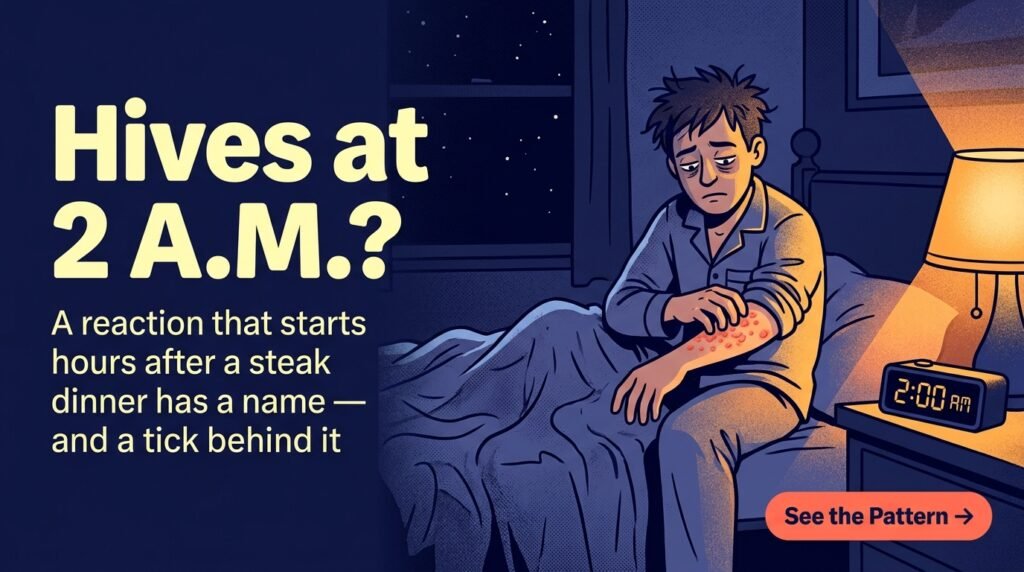
The fast answer: If hives, intense itching, or stomach trouble repeatedly wake you in the middle of the night — typically two to six hours after a dinner that included beef, pork, lamb, or venison — alpha-gal syndrome belongs on the list of possibilities. It is an allergy to a sugar found in mammal meat, set off by tick bites, and its signature is the delay: unlike almost every other food allergy, which strikes within minutes, alpha-gal reactions wait for hours, which is why they so often arrive after midnight and why so many people blame the wrong meal, a stomach bug, or “something I ate at lunch.” Only allergy testing can confirm it. This article is about recognizing the pattern, understanding the hidden triggers, and knowing exactly what to track before you see an allergist.
The Timeline That Gives It Away
Most people with alpha-gal tell some version of the same story, and hearing it laid out as a timeline is often what makes everything click. (For background on what the condition is and how tick bites set it up, see our overview of alpha-gal syndrome — this article focuses on the reaction itself.)
| When | What’s happening |
|---|---|
| Weeks to months earlier | One or more tick bites — in the U.S., usually a lone star tick — sensitize your immune system to alpha-gal, a sugar your body doesn’t make but most mammals do. Many people remember an unusually itchy bite that took weeks to settle. |
| 6:30 p.m. | You eat a normal dinner: a burger, steak, pork chops, lamb, or venison. You feel completely fine. |
| 9–11 p.m. | Still fine. You go to bed with no symptoms at all. |
| 12:30–3 a.m. | You wake up itching. Hives are blooming on your torso or limbs; you may have lip or eyelid swelling, stomach cramps, nausea, or diarrhea. In severe cases: wheezing, dizziness, or a feeling of faintness. |
| The next day | Symptoms fade. The mystery remains: nothing you ate at dinner “should” still be causing this at 2 a.m. — except that with alpha-gal, that is exactly the pattern. |
The American Academy of Allergy, Asthma & Immunology describes this plainly: because the symptoms are delayed, you may only wake up with them in the middle of the night after an evening meal. That nighttime pattern — fine at bedtime, miserable at 2 a.m., puzzled by morning — is the single most recognizable clue.
Why the Reaction Waits for Hours
Alpha-gal is short for galactose-alpha-1,3-galactose, and it is a carbohydrate — a sugar. Almost all other food allergies are reactions to proteins, which the body absorbs quickly, triggering symptoms within minutes. Alpha-gal in a piece of meat is largely attached to fats, and fats digest slowly: the fat-carrying particles that transport it into the bloodstream take hours to form and travel. So the allergic trigger effectively arrives on a delay fuse, and symptoms typically begin two to six hours after eating (some sources describe a range up to about eight hours). The delay is not a quirk of your imagination — it is built into the molecule’s delivery route, and it is the main reason this allergy is so often missed or mislabeled as unexplained hives or food poisoning.
What a Nighttime Reaction Can Look Like
Alpha-gal reactions range from annoying to dangerous, and they do not always look the same twice. Symptoms can include:
- Hives and itching — the most common presentation, sometimes intense enough to wake you from deep sleep. Some people itch severely with little visible rash.
- Swelling of the lips, face, tongue, or eyelids.
- Stomach and gut symptoms — abdominal pain or cramping, nausea, vomiting, diarrhea. For some people, GI symptoms are the main or even the only symptom, which is one reason alpha-gal gets mistaken for a stomach virus or gallbladder trouble.
- Breathing symptoms — cough, wheeze, chest tightness, shortness of breath.
- Anaphylaxis — the severe end of the spectrum: several symptoms at once, a drop in blood pressure, dizziness or fainting. This is a medical emergency (see below).
The CDC estimates that as many as 450,000 people in the United States may be affected by alpha-gal syndrome — so if this pattern sounds familiar, you are far from alone, and you are not imagining it.
Why It Doesn’t Happen Every Time (the Cofactor Puzzle)
“But I ate steak last month and I was fine.” Allergists hear this constantly, and it does not rule alpha-gal out. Reactions depend on more than the food:
- Portion and fat content. A large, fatty serving delivers more alpha-gal than a small, lean one. Fatty cuts and organ meats are concentrated sources; the same person may tolerate a small lean portion and react to a rich one.
- Alcohol. Drinking with the meal can amplify a reaction — and evening meals with wine or beer are exactly the meals followed by 2 a.m. symptoms.
- Exercise around the meal can similarly turn a tolerated serving into a reaction.
- NSAID pain relievers (such as ibuprofen) taken around the same time are another recognized cofactor.
- Your current sensitivity level. Alpha-gal antibody levels rise after new tick bites and fall over time without them, so your threshold literally changes across a summer.
This cofactor effect is why the history looks inconsistent — and why “it can’t be the meat, I eat it all the time” is the most common dead end in getting diagnosed.
Hidden Alpha-Gal: Where It Lurks Besides Steak
Meat on a plate is only the obvious source. Alpha-gal is present in all mammal-derived products, and a smaller share of people with the syndrome react to some of these as well:
| Hidden source | Where you’ll find it | Good to know |
|---|---|---|
| Gelatin | Gummy candies, marshmallows, some desserts and yogurts, gelatin-based medication capsules | One of the most common surprise triggers; check ingredient lists and ask pharmacists about capsule ingredients |
| Lard and tallow | Refried beans, pie crusts, baked goods, restaurant frying and roasting | Easy to miss when eating out — worth asking how food is cooked |
| Broths, stocks, and gravies | Soups, sauces, rice cooked in meat stock | A “meatless” soup may still be beef-stock-based |
| Dairy (for a subset) | Milk, cheese, butter, ice cream | Only some people with alpha-gal react to dairy — roughly a minority — so don’t cut it out on guesswork; sort it out with your allergist |
| Mammal-derived ingredients in medicines | Some capsules, and certain medical products made with gelatin or other mammal ingredients | Tell every doctor, dentist, and pharmacist about a confirmed alpha-gal diagnosis so they can check products in advance |
| Organ meats | Liver, kidney, sweetbreads, some sausages and pâtés | Especially concentrated sources — and sausage and processed meats can hide mammal content you’d never guess from the menu description |
Poultry, fish, and eggs do not contain alpha-gal — birds and fish don’t produce it — which is why chicken and seafood are the usual safe harbors while you sort out a diagnosis. Read more about the tick side of the condition in our guide to alpha-gal syndrome after a tick bite.
What to Track Before You See a Doctor
Because the reaction is delayed, the history you bring to the appointment is unusually important — often more important than any single test. For two to four weeks, keep a simple diary:
- What you ate and drank at each evening meal, including alcohol, and roughly how fatty or large the meat portion was.
- When symptoms started — the clock time, not just “that night.” A consistent 2–6 hour gap after mammal meat is the pattern an allergist is looking for.
- What the symptoms were and how long they lasted. Take a photo of hives if you can; they may be gone by morning.
- Cofactors: exercise that day, pain relievers taken, alcohol consumed.
- Your tick history: recent bites (especially unusually itchy ones), time spent in woods/grass, and whether you live in or visited lone star tick country — mainly the Southeast, mid-Atlantic, and an expanding range beyond it.
Bring the diary to an allergist. People in rural tick country may start with their primary care doctor, who can order the key blood test and refer as needed. The symptom pattern of the lone star bite itself is covered in our lone star tick bite symptoms guide.
Testing: What an Allergist Actually Does
The central test is a blood test measuring IgE antibodies specific to alpha-gal. A positive result, combined with your history of delayed reactions after mammal meat, is how the diagnosis is made. An allergist will also take a detailed history — what you ate, when symptoms began, your tick exposure — because the delayed pattern means the story matters as much as the lab value. Skin-prick testing with commercial meat extracts is generally considered less reliable for this particular allergy, which is another reason the blood test plus history is the standard route. What testing cannot do is be replaced by guesswork: hives at night have other causes, and cutting out major food groups on suspicion alone can leave you both undernourished and undiagnosed. Get the test, then make a plan with the results in hand.
While You Wait for Answers — and After
- Don’t self-prescribe a permanent diet. If reactions have been strong, it is reasonable to avoid mammal meat until you are evaluated — and to say so at the appointment — but long-term restrictions should be set with an allergist, since many people tolerate dairy and small amounts of some products.
- Know your emergency plan. If you have ever had breathing difficulty, throat or tongue swelling, or dizziness/fainting during a reaction, ask about carrying epinephrine auto-injectors (two, ideally) and use them at the first sign of a severe reaction, then call 911.
- Prevent new tick bites. Additional lone star bites can raise your antibody levels again and prolong the allergy. Repellent, permethrin-treated clothing, and post-outdoor tick checks are not optional extras for people with alpha-gal — they are part of the treatment.
- Reactions can fade. For many people, alpha-gal antibody levels decline over time when no new bites occur, and some eventually tolerate mammal meat again. Reintroducing it should only happen under an allergist’s guidance, ideally after repeat testing — not as a home experiment after a “good month.”
When to See a Doctor — and When to Call 911
Call 911 / seek emergency care immediately for: trouble breathing or wheezing, swelling of the tongue or throat, a hoarse voice or difficulty swallowing, dizziness, fainting, or a combination of symptoms in several body systems at once. If you have been prescribed epinephrine, use it first and then call — antihistamines are not a substitute for epinephrine in a severe reaction.
Book an appointment soon if: you have had two or more episodes of unexplained nighttime hives or stomach attacks; you have ever fainted or nearly fainted a few hours after a meal; your symptoms are GI-only but keep recurring after meat dinners; or you live in lone star tick country and the timeline in this article matches your experience. Bring your food-and-symptom diary and your tick history — and ask specifically about the alpha-gal IgE blood test.
Frequently Asked Questions
How many hours after eating do alpha-gal symptoms start?
Typically two to six hours after eating mammal meat — noticeably later than other food allergies, which usually strike within minutes. Some sources describe onset up to about eight hours. The delay happens because alpha-gal is a sugar carried largely on fats, and fats are absorbed slowly.
Can alpha-gal cause only stomach pain, with no hives?
Yes. Some people experience mainly gastrointestinal symptoms — cramping, nausea, vomiting, diarrhea — without prominent skin symptoms. That GI-only pattern is frequently mistaken for food poisoning or a stomach bug, especially since it also arrives hours after the meal.
Do chicken, turkey, or fish trigger alpha-gal?
No. Alpha-gal is produced by mammals; birds and fish do not make it. Poultry, seafood, and eggs are not alpha-gal sources, which is why they are the standard alternatives while a diagnosis is being sorted out.
If I have alpha-gal, do I have to give up dairy too?
Not necessarily. Only a subset of people with alpha-gal syndrome react to dairy products. This is exactly the kind of question to settle with your allergist and your diary rather than by cutting out food groups on your own — unnecessary restriction is a real cost.
Which tick bite causes alpha-gal syndrome?
In the United States, the lone star tick is the primary culprit, and most cases occur within its range — the Southeast and mid-Atlantic, expanding northward and westward. Other tick species are implicated in other parts of the world. Not every lone star bite causes the allergy, and researchers still don’t know exactly why some bites sensitize and others don’t.
Will a blood test really confirm it?
A blood test for alpha-gal-specific IgE is the main confirmatory test, interpreted together with your history of delayed reactions. A positive test plus the classic timeline is how the diagnosis is made; a negative test with a classic history is worth discussing further with an allergist rather than treating as the final word.
This article is general information, not medical advice, and it cannot diagnose alpha-gal syndrome. If the nighttime pattern described here sounds like yours, an allergist — with a blood test and your symptom diary — is the person who can give you a real answer.
By Dr. Sarah Jones