
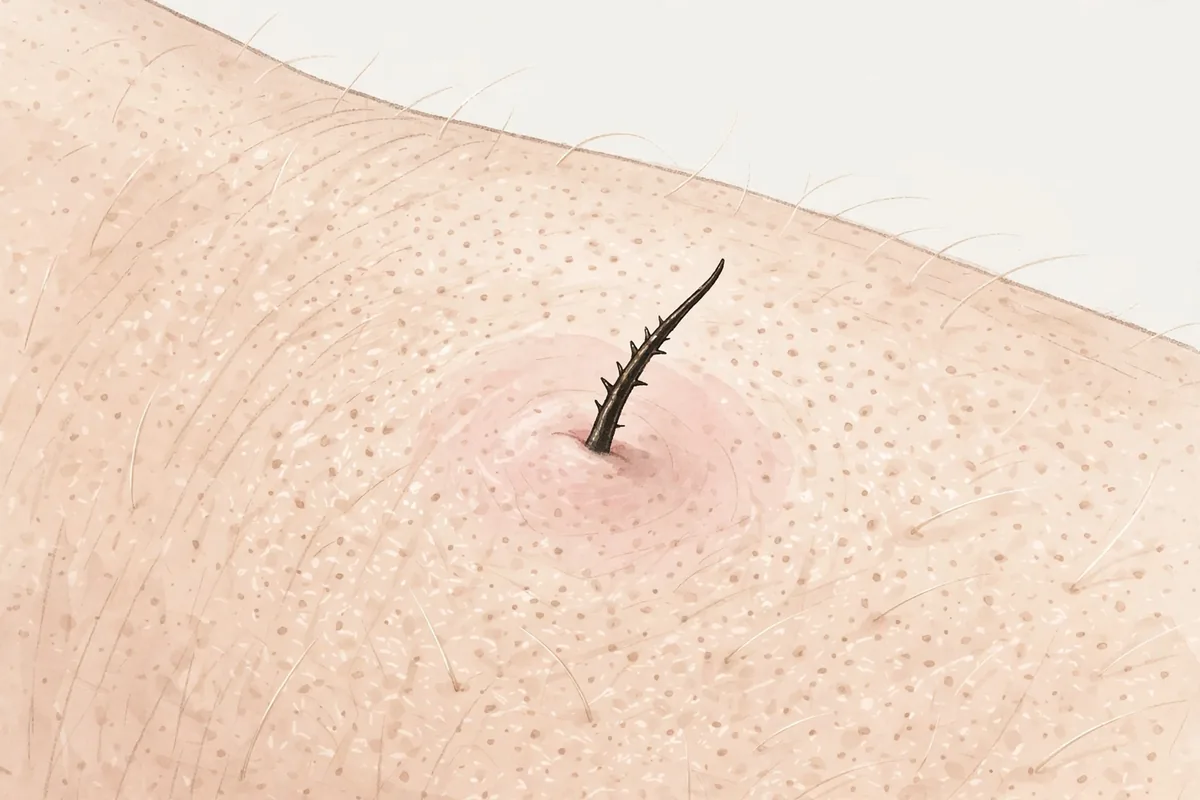
Got stung and now staring at a red bump, wondering if the stinger is still in there? How to tell if a bee stinger is still in your skin comes down to one simple visual check: look for a tiny dark speck — often described as a small black dot or short hair-like sliver — sitting right in the center of the sting. If you see it, the stinger is still embedded. If the center looks clean, it is probably gone or was never left behind.
How a bee sting leaves its mark #
When a honeybee stings you, it does not simply poke and fly away. The business end of a honeybee is a barbed weapon — the sting is lined with tiny backward-pointing barbs, like a microscopic harpoon. Human skin is thick and stretchy enough to trap those barbs. When the bee pulls away, the sting tears free from the bee’s body, leaving behind the sting shaft, a venom sac, and even a small bundle of muscles and nerves that keep pumping venom on their own for a short time. The bee dies from this injury — which is why only honeybees (among common stinging insects) routinely leave a stinger in you.
This matters for your self-check because the stinger is a physical object sitting in your skin, not just a sensation. The pain, redness, and swelling that follow a sting are your immune system’s response to the venom — they happen whether or not the stinger is still there. So “it still hurts” is not, by itself, evidence of a retained stinger. You need visual confirmation.
What you are looking for is small — a honeybee sting apparatus is only about 2-3 millimeters of it actually enters the skin, and the visible portion may be less than a millimeter. To the naked eye, it typically looks like:
- A tiny dark dot or speck in the center of the sting site
- A short, hair-like sliver that stands slightly above the skin surface
- A small dark fleck with a slightly translucent, balloon-like sac at its base (the venom sac)
The venom sac, when present, can look like a minuscule teardrop or blister attached to the dark shaft. If you see that little balloon, the stinger is definitely still in — and it is still worth removing promptly.
Bee vs. wasp vs. bumblebee: who leaves a stinger? #
One of the most common reasons people cannot tell whether a stinger is still in their skin is that they are not sure what stung them. Different insects behave very differently, and knowing which one got you tells you how likely a retained stinger actually is.
| Insect | Does it leave a stinger? | Why | What to check for | |—|—|—|—| | Honeybee (worker) | Yes, almost always | Barbed sting tears from the bee’s abdomen | Tiny dark speck with possible venom sac | | Bumblebee | Rarely | Sting is smoother than a honeybee’s | Usually nothing visible; treat like a wasp sting | | Wasp / yellowjacket | No | Smooth sting retracts cleanly | No stinger to find — do not dig | | Hornet | No | Smooth sting, like wasps | No stinger to find — do not dig | | Fire ant | No | Ants bite and sting with a different mechanism | No stinger; look for pustules instead |
This table is your first filter. If you watched a wasp or yellowjacket sting you, or the insect that stung you is still flying around pestering you (honeybees die after one sting in skin), then you almost certainly do not have a stinger in your skin — and digging around will only irritate the wound. If it was a honeybee — often described as the classic fuzzy amber-and-black bee — a retained stinger is the default assumption until you rule it out.
Knowing which insect stung you also tells you what aftercare to expect — wasps need no stinger check at all.
The 30-second check: how to tell right now #
You do not need special tools for this. Here is a quick, reliable routine:
1. Get bright light. Step into daylight or hold a phone flashlight close to the sting at a low angle. Side-lighting makes a tiny dark speck cast a shadow and stand out. Overhead bathroom light is the worst for this — move to a window if you can.
2. Look before you touch. Scan the center of the red bump before you press or rub anything. Pressing can push a shallow stinger deeper or break off the venom sac. You are looking for a dark speck, a tiny hair-like sliver, or a speck with a translucent sac attached.
3. Use magnification if you have it. A phone camera’s macro mode, a magnifying glass, or a cheap loupe turns a borderline call into a clear one. Zoom your camera to maximum on the center of the sting and look at the still image rather than trying to hold the camera steady.
4. Check the “hair test” carefully. New hair growing from a follicle looks similar to a stinger, which is a common source of confusion. A hair is uniform in thickness and usually angled; a stinger is usually shorter, darker, and sits in the dead center of the sting where the pain is worst. If the “speck” is off to the side where a hair follicle is, it is probably just hair.
5. Feel for resistance. If you see something that might be a stinger, do not squeeze it. A very light pass with a clean fingertip may let you feel a tiny raised point. But honestly, seeing it is the test — feeling alone is unreliable because the whole area is swollen and tender.
6. Note the timing. The sooner you check, the easier it is. Within the first few minutes, a retained stinger with its venom sac is usually visible. If hours have passed and you see nothing, either it was already removed (perhaps brushed off when you reacted to the sting) or it was never a honeybee.
What a retained stinger looks like vs. common lookalikes #
| What you see | Likely to be | Next step | |—|—|—| | Tiny dark dot, dead center, worst pain spot | Retained stinger | Remove promptly (see below) | | Dark dot with translucent balloon attached | Stinger + venom sac | Remove promptly — still pumping venom | | Tiny dark line angled to the side | Probably a hair | Leave it alone | | Red bump, no dark center at all | No stinger visible | Do not dig; treat as a sting without retained stinger | | Dark scab-like crust, hours or days later | Healing puncture or small scab | Leave it; do not pick | | Tiny white or pus-filled bump, day 2-3 | Local reaction or pustule | Do not squeeze; monitor for infection signs |
Safe removal: what to do once you find it #
Speed matters more than technique. Research on honeybee stings has shown that the single biggest factor in how much venom you absorb is how quickly the sting comes out — the detached apparatus keeps working itself deeper and pumping venom until it is removed. So once you have confirmed a stinger, get it out now, with whatever clean method is at hand.
Recommended: scrape it out #
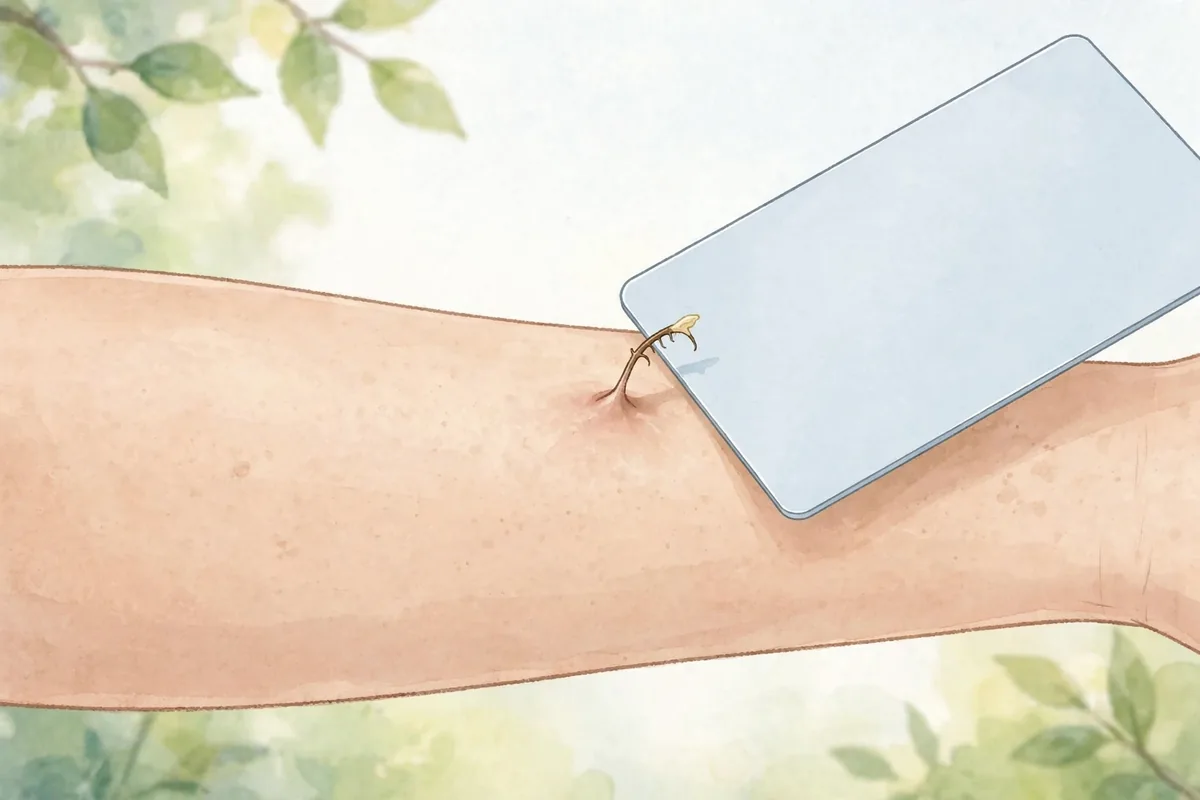
The classic, widely taught method is to scrape the stinger away with something flat and clean:
- A credit card, driver’s license, or ID card edge
- A butter knife (clean)
- Your fingernail, if it is clean and long enough
Hold the edge flat against the skin and push firmly across the sting in one smooth motion so the stinger slides or pops out. One pass is usually enough. Then wash the area with soap and water.
The traditional reason for scraping rather than grabbing is that pinching the venom sac can squeeze extra venom into the wound. (One much-cited study suggested squeezing makes little difference and speed is what counts — but since scraping is simple and avoids the question entirely, it remains the recommended first choice.)
If you only have tweezers #
If a flat edge is not available and you have clean tweezers, use them — a slightly imperfect removal now beats a perfect removal in ten minutes. Grip low, as close to the skin surface as possible, and pull the shaft out in the direction it entered. Avoid squeezing the translucent sac if you can see it. Clean the tweezers afterward, and clean the sting site.
For a step-by-step walkthrough with photos-style guidance, see remove a bee stinger.
After it is out #
- Wash the sting site with soap and water.
- Cold compress for 10-15 minutes at a time to ease pain and swelling.
- Relieve symptoms with an over-the-counter pain reliever or oral antihistamine per label directions if you normally use them — and talk to your doctor or pharmacist if you are unsure.
- Watch the site over the next few days for signs of infection or a spreading allergic reaction (see the warning signs section below).
What NOT to do while checking or removing #
When people are anxious about a possible stinger, they often do things that make the situation worse. Avoid these:
- Do not dig. If you cannot see a stinger, do not go hunting with needles, pins, or your nails. Blind digging tears skin, increases infection risk, and can push venom deeper. A sting with no visible stinger gets the same aftercare either way.
- Do not squeeze the area. Squeezing around the sting can push a shallow stinger deeper and irritate the venom site.
- Do not use suction devices. There is no good evidence they remove venom, and aggressive suction can bruise and damage skin.
- Do not apply heat first. Heat can increase blood flow and swelling; cold is the first-aid choice for a fresh sting.
- Do not ignore a stinger you can clearly see. Leaving a visible stinger with an attached sac in place “to come out on its own” allows continued venom pumping. Get it out.
- Do not assume it is fine because the pain stopped. Pain fading does not mean a retained stinger dissolved — check visually.
Why the stinger sometimes seems to “disappear” #

A few readers report that they clearly saw a stinger, looked away, and then could not find it. A few things can explain this:
- It fell out on its own. A shallowly embedded sting can dislodge when you brush the area or when the skin moves.
- You scraped it off accidentally. The instinctive swat or rub right after the sting often removes it.
- The venom sac detached. Sometimes the translucent sac breaks off while the dark shaft remains — you may still see the shaft.
- Swelling swallowed it. As the area swells, a tiny stinger can become harder to spot. This is another reason to check early, with good light.
If you clearly saw it and now cannot find it, do not dig. Wash the area, apply a cold compress, and monitor. Your body will typically expel or break down a tiny remaining fragment the way it handles a splinter — and a routine sting heals either way.
Special situations #
Stinger near the eye or on the eyelid #
Do not attempt to scrape or pull a stinger near the eye yourself — the risk of injuring the eye is too high. Cover the eye loosely if needed and get medical care promptly.
Stinger in a child #
Children often will not sit still for a careful inspection. Hold the area gently, use your phone flashlight, and scrape quickly. Do not use tweezers on a squirming child if you can avoid it — a card edge is faster and safer. Comfort and distraction (a cold compress, a favorite show) help more than precision tools.
Multiple stings #
After disturbing a hive, you may have several stingers in. Remove each one the same way — speed matters, so work quickly down the line rather than perfecting each one. Multiple stings are a reason to seek medical evaluation even without allergy symptoms, because a large venom load can cause a toxic reaction.
You are allergic to bee stings #
If you have a known bee venom allergy, the stinger check is secondary to your emergency plan: use your epinephrine auto-injector if you have systemic symptoms and call 911. Remove the stinger only if it can be done in seconds without delaying treatment. And if this sting was your first-ever systemic reaction, ask your doctor about allergy testing and venom immunotherapy afterward — our article on venom immunotherapy for insect stings explains the option.
Healing timeline after the stinger is out #
Once the stinger is removed, here is what a normal local reaction looks like:
| Time after sting | What is normal | |—|—| | Minutes | Sharp pain fading to ache, red bump forming | | First few hours | Swelling grows; itching may start | | 24-48 hours | Swelling and redness often peak, then start improving | | 3-5 days | Steady improvement; itching fades | | 5-7 days | Mostly resolved; a small firm bump or itch may linger |
If the area is still getting worse after 48 hours — more pain, more swelling, spreading redness, warmth — that is the point to check the warning signs section below rather than assuming the stinger is the problem. By then, the issue is usually inflammation or early infection, not a retained stinger.
Warning signs: when to seek care #
Call 911 immediately if you notice any of these after a sting: trouble breathing or swallowing; swelling of the face, lips, tongue, or throat; widespread hives or rash; dizziness, faintness, or feeling like you might pass out; a racing or irregular heartbeat; or a sense of doom or confusion. These are signs of anaphylaxis — a severe, life-threatening allergic reaction. If you carry an epinephrine auto-injector, use it first, then call 911. Even if you feel better after epinephrine, you still need emergency care, because symptoms can return.
Even without anaphylaxis, seek urgent care or call your doctor if: redness or swelling keeps spreading after 48 hours; you see red streaks radiating from the sting; the area becomes increasingly warm, very tender, or starts draining pus; you develop a fever; the sting is in or very near the eye, mouth, or throat; or you were stung many times. A sting that is not improving by day 3-5 deserves a clinician’s look.
Frequently asked questions #
Can a bee stinger stay in your skin permanently? #
Practically never. The sting apparatus is dead tissue with no blood supply — it cannot “grow in” or become part of you. Your body treats it like a splinter: it either works its way out through normal skin turnover or walls it off in a tiny, harmless bump that eventually surfaces. That said, a visible stinger should still be removed promptly, because while it sits there it keeps delivering venom and irritating the tissue.
What happens if you leave a bee stinger in? #
The venom sac attached to the sting keeps pumping venom for a short time after the sting, which means more pain, more swelling, and a longer-lasting local reaction than if you remove it quickly. Over days, a retained stinger can also act like a splinter — the site may stay red, tender, or slightly raised until the fragment works out. It does not dissolve into your bloodstream or cause delayed poisoning.
I was stung by a wasp — do I need to look for a stinger? #
No. Wasps, yellowjackets, and hornets have smooth stings that retract cleanly — they do not leave anything behind, which is also why they can sting repeatedly. If you are sure it was a wasp, skip the stinger hunt entirely and go straight to cleaning the site and applying a cold compress. Only honeybees (and occasionally bumblebees) leave stingers.
How do I know if the stinger is out or just broke off? #
Look at the site under bright light with magnification. If you see no dark speck and no translucent sac, the sting apparatus is out — even if the area is red and sore, since inflammation continues without the stinger. If you see a dark speck but no sac, a fragment of the shaft may remain; you can try one gentle scrape, but do not dig. If nothing is visible, treat it as removed.
Does it matter if I use tweezers instead of scraping? #
Speed matters more than method — getting the stinger out fast is the priority. Scraping with a flat edge is the traditional recommendation because it avoids squeezing the venom sac. If tweezers are all you have, use them promptly, gripping low near the skin. One widely discussed study even suggested squeezing makes little difference and removal speed is the decisive factor. Either way: do not delay removal while hunting for the “perfect” tool.
Medical and editorial note #
This guide is general information about bee stings, not medical advice. Everyone’s reaction to a sting is different, and only a qualified healthcare professional can evaluate your specific situation. If you are worried about a sting — especially if you have any history of allergy, the sting is near your eye or airway, or symptoms are worsening — seek medical care promptly rather than relying on a guide.


