
Alpha-Gal Symptoms Hours After Eating Red Meat: Night Hives and Hidden Sources
# Alpha-Gal Symptoms Hours After Eating Red Meat: Night Hives and Hidden Sources If you eat beef, pork, or lamb at dinner and then…
Venom immunotherapy protects 91%-96% of wasp-venom patients but 77%-84% for bee venom — and only a fifth to two-thirds of patients finish the course. Protection, completion, relapse and cost data, split by venom, by years completed and by country.
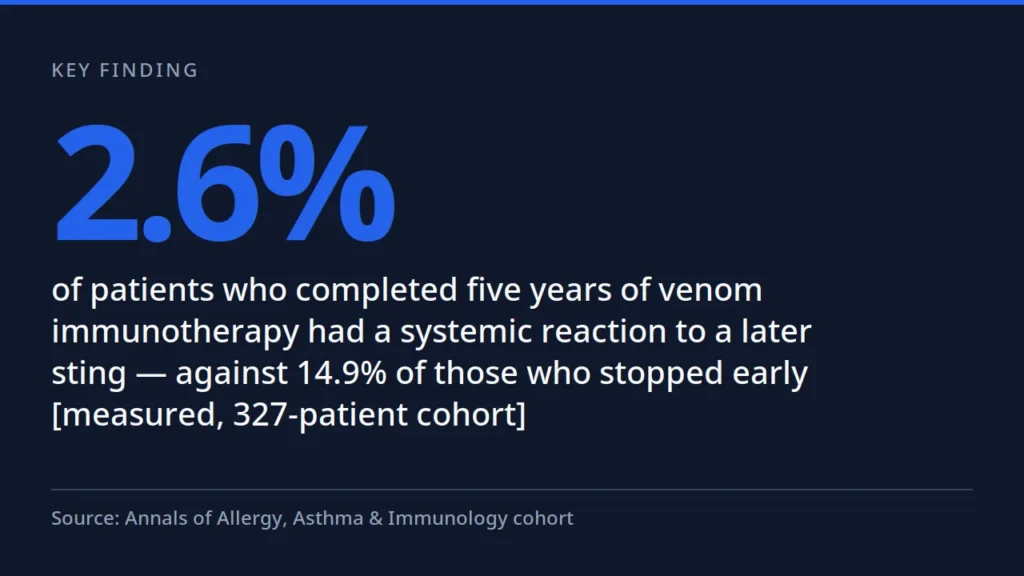
Source: Annals of Allergy, Asthma & Immunology long-term VIT cohort (327 patients) (2024)
Ask how well venom immunotherapy works and you will be quoted a single number — ‘about 98% effective’. Traced back to its sources, that number belongs to ant venom, effective in 97%-98% of patients (EAACI Guidelines on Allergen Immunotherapy: Hymenoptera venom allergy (Sturm et al. 2018), 2018); a classic Johns Hopkins paper describes the therapy more loosely as providing greater than 95% from sting anaphylaxis (Golden et al. 1998, J Allergy Clin Immunol (extended discontinuation observations), 1998). For the two venoms most people are actually treated for, the measured figures are lower and different from each other — and they describe patients who finished the course. In the largest recent cohort, patients who completed five years of therapy and were later stung had a systemic reaction in only 2.6% of cases, against a far higher rate in patients who stopped early (Annals of Allergy, Asthma & Immunology long-term VIT cohort (327 patients), 2024). This page publishes the numbers the slogan leaves out: protection by venom, what each course year adds, who finishes, what stopping costs, and what finishing costs.
One boundary before the data. Venom immunotherapy is a prescribed medical treatment, given under supervision because the injections themselves can cause reactions; whether to start, continue or stop it is a decision for the treating allergist, not for a statistics page. The numbers below also never reach complete protection — no venom, dose or duration in this data brings the risk to zero — so they are not a reason to set aside a prescribed adrenaline auto-injector. If a sting causes breathing difficulty, throat tightness, dizziness or collapse, that is an emergency: use the auto-injector and call 911. Our guides to the warning signs of anaphylaxis after a sting and to when a second EpiPen dose is needed cover the response itself; this page covers the arithmetic of the treatment that is meant to prevent it.
The data falls into five parts: protection first, because the honest headline is a table, not a slogan; then course length and completion — the two questions patients actually live with; then relapse after stopping; and finally what a finished course costs in the systems that have published a price. A sting allergy action plan is where these numbers end up being used; readers weighing allergy against sheer venom dose may also want our explainer on multiple stings, allergy and venom load.
Across the trials and sting challenges behind the EAACI guideline, venom immunotherapy is effective in 91%-96% of patients treated with vespid (wasp and yellow jacket) venom, 77%-84% of those treated with honeybee venom, and 97%-98% of those treated with ant venom (EAACI Guidelines on Allergen Immunotherapy: Hymenoptera venom allergy (Sturm et al. 2018), 2018). Against an untreated risk of anaphylaxis of 30% to 60% on the next sting (Golden et al. 1996, J Allergy Clin Immunol (Johns Hopkins discontinuation cohort), 1996), that is a large effect at every level — but it is three different numbers, not one.
| METRIC | VALUE | SOURCE |
|---|---|---|
| Protection rate — honeybee venom | 77%-84% | EAACI Guidelines on Allergen Immunotherapy: Hymenoptera venom allergy (Sturm et al. 2018) |
| Protection rate — vespid (wasp/yellow jacket) venom | 91%-96% | EAACI Guidelines on Allergen Immunotherapy: Hymenoptera venom allergy (Sturm et al. 2018) |
| Protection rate — ant venom | 97%-98% | EAACI Guidelines on Allergen Immunotherapy: Hymenoptera venom allergy (Sturm et al. 2018) |
| Odds of a severe systemic reaction, treated vs untreated (meta-analysis) | 0.08 | Dhami et al. 2017, EAACI systematic review and meta-analysis (Allergy) |
| Risk of anaphylaxis on the next sting, untreated | 30% to 60% | Golden et al. 1996, J Allergy Clin Immunol (Johns Hopkins discontinuation cohort) |
| Risk of a systemic reaction while on venom therapy | less than 2% | Golden et al. 1996, J Allergy Clin Immunol (Johns Hopkins discontinuation cohort) |
| Pooled claim circulated for the therapy overall | greater than 95% | Golden et al. 1998, J Allergy Clin Immunol (extended discontinuation observations) |
The pooled claim deserves a fair reading before it is discounted. When Golden’s Johns Hopkins group wrote that standardised venom therapy provides greater than 95% from insect sting anaphylaxis (Golden et al. 1998, J Allergy Clin Immunol (extended discontinuation observations), 1998), they were summarising a clinic population treated mostly with vespid venoms — the group whose measured range, 91%-96%, genuinely sits in the mid-nineties. The distortion happens downstream, when the sentence is quoted without its population and applied to a beekeeper starting honeybee therapy, whose guideline range is 77%-84%. That gap is not a rounding error: roughly one in five honeybee patients who complete therapy are not fully protected by it.
The strength of the effect itself is not in doubt. The systematic review behind the guideline pooled the controlled evidence and found the odds of a severe systemic reaction on re-sting reduced to 0.08 of the untreated odds (Dhami et al. 2017, EAACI systematic review and meta-analysis (Allergy), 2017) — an order-of-magnitude change, and the same review is candid that the base is thin: only a small set of studies met its inclusion bar out of the many thousands screened. Two practical consequences follow. First, treat the ranges as ranges; the second decimal place does not exist in this literature. Second, remember what these rates are not: they are not the risk faced by someone with a large local reaction rather than anaphylaxis, a different and much lower-risk situation that immunotherapy is not usually prescribed for.
In the Turkish single-centre cohort, the type of reaction patients had on a field re-sting differed significantly only once therapy passed the >4 years mark (Istanbul Medical Journal 2025, single-centre VIT effectiveness cohort (71 patients, Türkiye), 2025) — and every anaphylaxis case sat on the short side of the line: 4 of 4 of the anaphylaxis cases after re-sting were in patients whose treatment was incomplete (Istanbul Medical Journal 2025, single-centre VIT effectiveness cohort (71 patients, Türkiye), 2025). The long-term cohort tells the same story from the other end: completers reacted systemically in 2.6% of re-stings, premature stoppers in 14.9% (Annals of Allergy, Asthma & Immunology long-term VIT cohort (327 patients), 2024).
Read the duration data as a gradient, not a switch. Nothing in these cohorts says a patient is unprotected in year three and protected in year five; what the Turkish data show is that reaction severity on re-sting keeps improving with time on therapy, becoming statistically visible somewhere past four years. The Slovenian cohort shows why the question is not academic: 57% of patients were stung again within five years of starting (Kadivec & Kosnik 2017, Golnik, Slovenia (514-patient cost cohort), 2017), so for most patients the course is not a waiting room before real life resumes — the test arrives during treatment, when 86.3% of stung patients in that cohort tolerated their stings well (Kadivec & Kosnik 2017, Golnik, Slovenia (514-patient cost cohort), 2017).
The honest account also includes what the therapy itself does on the way. In the European adverse-events registry, systemic reactions to the injections were recorded in 17.2% of cases (Frontiers in Allergy 2026, Adverse Events Registry (ADER) latent class analysis, 2026), with honeybee venom and fast up-dosing schedules carrying the higher odds — which is why build-up happens in a clinic, and why a reaction during treatment is a clinical event to discuss, not a reason to quietly stop attending. The newest real-world snapshot, a small cohort published in October of this year, fits the pattern: no systemic reactions during build-up, then one during maintenance — 6.3% of its patients — after which the team discontinued that patient’s therapy (Toxins 2026, Istanbul real-world VIT cohort (16 adults), 2026). Duration, in other words, cuts both ways in the data: longer courses protect more, and every additional year is another year of supervised injections. Where the balance sits for one patient is exactly the judgement the treating allergist is for.
Completion is the least quoted and most variable number in this field. Across the cohorts that publish it, the share of patients who completed the planned five years runs from 19.7% in a Turkish centre whose venom supply failed, through 34% at another Turkish university clinic, to 64.5% in the long-term cohort (Annals of Allergy, Asthma & Immunology long-term VIT cohort (327 patients), 2024). The spread is not mainly about patient willpower: in the lowest cohort, 80.2% of patients were interrupted because the product became unavailable (Istanbul Medical Journal 2025, single-centre VIT effectiveness cohort (71 patients, Türkiye), 2025).
The middle cohort is the most instructive, because nothing dramatic happened to it. At Hacettepe, 34% of treated patients completed five years (Allergy and Asthma Proceedings 2024, Hacettepe University VIT cohort (105 patients, Türkiye), 2024) — no supply collapse, just the ordinary friction of a half-decade of clinic visits. The consequence of stopping there was measurable: of the premature stoppers who were re-stung, 44% developed a systemic reaction, while the completers who were re-stung had none (Allergy and Asthma Proceedings 2024, Hacettepe University VIT cohort (105 patients, Türkiye), 2024). Put the three cohorts together and the pattern is hard to miss: the therapy’s published protection rates are completion-weighted, and the weight varies by a factor of three between systems.
Behaviour after the course leaks in a second, quieter way. In the Turkish cohort, only 46.5% of patients on therapy carried an adrenaline auto-injector (Istanbul Medical Journal 2025, single-centre VIT effectiveness cohort (71 patients, Türkiye), 2025), and of the carriers who were re-stung, fewer than half used it. Finishing a course of injections and maintaining the rest of the safety routine are separate achievements — auto-injectors expire on the shelf whether or not they are carried, as our guide to whether an expired EpiPen still works explains, and the steps after one is used matter as much as carrying it, which is why we keep a walkthrough of what to do after using an EpiPen. The data asset here is uncomfortable but useful: the weak point in the chain is rarely the pharmacology.
For vespid venom, reported relapse — a systemic reaction to a sting after therapy ends — runs at 0%-10% in the first one to five years after discontinuation (EAACI Guidelines on Allergen Immunotherapy: Hymenoptera venom allergy (Sturm et al. 2018), 2018), and the Johns Hopkins cohorts put the residual risk after five to six years of therapy at 5% to 10% (Golden et al. 1998, J Allergy Clin Immunol (extended discontinuation observations), 1998). Honeybee therapy ends less cleanly: 17% of patients relapsed within one year of stopping (EAACI Guidelines on Allergen Immunotherapy: Hymenoptera venom allergy (Sturm et al. 2018), 2018). Stopping early is worse by either measure, at 22%-27% (EAACI Guidelines on Allergen Immunotherapy: Hymenoptera venom allergy (Sturm et al. 2018), 2018).
Most of what is known about stopping comes from a small number of long-running cohorts, and the oldest of them still anchors the field. The Johns Hopkins programme challenged its graduates with supervised stings for years after discontinuation: systemic symptoms followed 3% (Golden et al. 1996, J Allergy Clin Immunol (Johns Hopkins discontinuation cohort), 1996), most of them mild, none life-threatening — the empirical basis for the now-standard view that five to six years of vespid therapy can be stopped with a single-digit residual risk. That view has a venom limit and a patient limit. The venom limit is the honeybee gap above. The patient limit is in the callout: a history of reacting to the treatment itself marks the group whose relapse risk stays high, and it is why guidelines carve out patients for longer or lifelong therapy rather than naming a universal stopping date.
Children are the clear exception in the other direction: 5% of children with moderate-to-severe reactions relapsed after stopping, in follow-up stretching to twenty years (EAACI Guidelines on Allergen Immunotherapy: Hymenoptera venom allergy (Sturm et al. 2018), 2018) — the best long-term numbers in this article, and a reminder that the adult ranges should not be read onto a treated child. What no study in this set can do is certify an individual. The guideline is blunt that no blood test, skin test or antibody level currently estimates one person’s relapse risk, which is why the post-treatment plan — including whether an auto-injector stays in the pocket, and which one, as our EpiPen and Auvi-Q comparison sets out — remains a clinical conversation rather than a calculation.
There is no such thing as ‘the cost of venom immunotherapy’ — there are prices inside systems, and they differ by a factor of four. A complete five-year course was costed at 2,886 euros per patient on a Slovenian insurer’s price list (Kadivec & Kosnik 2017, Golnik, Slovenia (514-patient cost cohort), 2017); a Swiss university hospital’s internal costing of five years of bee-venom injections came to EUR 11,612.59 (Int Arch Allergy Immunol 2023, University Hospital Zurich costing study, 2023). The only venom-specific price published for US patients is a clinic list price of $2,500 per year, labelled as such below (Allergenix clinic pricing page, West Des Moines, Iowa, US (vendor list price), 2026).
| METRIC | VALUE | SOURCE |
|---|---|---|
| Complete five-year course — Slovenia, insurer price list | 2,886 euros | Kadivec & Kosnik 2017, Golnik, Slovenia (514-patient cost cohort) |
| Extra cost of the course over a lifetime of auto-injectors — Slovenia | 1,905.6 euros | Kadivec & Kosnik 2017, Golnik, Slovenia (514-patient cost cohort) |
| Treating the index sting reaction — Slovenia, mean | 180.4 euros | Kadivec & Kosnik 2017, Golnik, Slovenia (514-patient cost cohort) |
| Five years of bee-venom injections — Zurich hospital costing | EUR 11,612.59 | Int Arch Allergy Immunol 2023, University Hospital Zurich costing study |
| Five years, intralymphatic route — same Zurich costing | EUR 5,942.15 | Int Arch Allergy Immunol 2023, University Hospital Zurich costing study |
| Modelled extra cost vs auto-injectors over 10 years — Danish model [modelled] | EUR 7,428 | Sturm et al. 2026, Allergy — Danish payer cost-effectiveness model |
| Modelled cost per QALY gained — Danish model [modelled] | EUR 15,550 | Sturm et al. 2026, Allergy — Danish payer cost-effectiveness model |
| Programme price per year — one US clinic’s published list [vendor] | $2,500 per year | Allergenix clinic pricing page, West Des Moines, Iowa, US (vendor list price) |
The labels are the content of this section. The Slovenian figure is a payer’s price list applied to a real cohort; the Zurich figures are one hospital’s internal costs for two different routes in one city; the Danish figures are outputs of a decision model, marked [modelled] in the table because no patient was ever billed them; and the American figure is a single clinic’s advertised price, the only venom-specific US number a patient can read — American cost data otherwise lives inside generic allergy-shot pages that do not price venom therapy separately. Averaging these four systems into one ‘typical cost’ would manufacture a fifth number that describes nowhere.
Cost-effectiveness is a different claim from cheap, and the Danish model makes it precisely: over ten years, depot venom therapy cost a payer EUR 7,428 more per patient than auto-injectors alone and bought health at EUR 15,550 per quality-adjusted life year (Sturm et al. 2026, Allergy — Danish payer cost-effectiveness model, 2026) — inside the range health systems usually call good value, for a treatment whose alternative is a lifetime of emergency risk. The Slovenian authors make the same point from the ward side: one course, at 2,886 euros, equals roughly sixteen emergency treatments for systemic reactions at their prices (Kadivec & Kosnik 2017, Golnik, Slovenia (514-patient cost cohort), 2017), in a cohort where the average index reaction — the sting that started everything — cost 180.4 euros to treat (Kadivec & Kosnik 2017, Golnik, Slovenia (514-patient cost cohort), 2017). Whether the arithmetic persuades a given payer is not this page’s call; that it exists, sourced and labelled, is the point of publishing it.


This page was built with the DataGap Method, and its degraded stages are named here because they are part of the record. Stage 1 (demand mining) was degraded: Reddit is unreachable from the research host and no ScrapeCreators key was available, so demand for this topic is unmeasured — the cluster entered scoring on SERP and literature evidence, with a counted thread demand of zero. Stage 3 (the backlink format filter) did not run: it needs DataForSEO, which was not available, so no format percentages are claimed anywhere in this run. The Stage 4 existence gate ran manually over the site’s full sitemap corpus, because the vendor script crashes on this host, and returned CLEAR — this site had no immunotherapy page at all. The Stage 6 recency sweep ran as a manual web-search fallback after the script’s Reddit leg was blocked; it contributed the registry safety analysis and the October 2026 real-world cohort. All images are locally drawn charts (no image-generation API was available). Verification: ten of the thirteen source hosts blocked or defeated the automated checker, so every such source was opened and read in a browser in the same session and each value confirmed word for word — of the 51 facts in the underlying sheet, 9 were machine-verified and 42 browser-confirmed, and none was dropped. Three limits deserve emphasis. US cost data for venom immunotherapy specifically does not exist in the published literature we could find; the US figure here is one clinic’s list price and is labelled a vendor price. European costs come from three different systems and are never blended. And completion rates cannot be compared across cohorts without their causes — the lowest rate in this article was produced by a drug-supply failure, not by patients.
It depends on the venom, which is the part the slogans leave out. The EAACI guideline puts effectiveness at 91%-96% for vespid (wasp and yellow jacket) venom, 77%-84% for honeybee venom, and 97%-98% for ant venom. So 'about 98% effective' is true for the venom fewest people are treated for, and materially overstates the honeybee figure. (EAACI Guidelines on Allergen Immunotherapy: Hymenoptera venom allergy (Sturm et al. 2018), 2018)
The protection you banked is partial, and the shortfall shows up on the next sting. In a 71-patient Turkish cohort, all four patients who developed anaphylaxis after a field re-sting had incomplete treatment, and reaction type differed significantly only once patients passed four years of therapy. Whether and when to stop is an allergist's decision — but the data say the course length is not a formality. (Istanbul Medical Journal 2025, single-centre VIT effectiveness cohort (71 patients, Türkiye), 2025)
Fewer than the brochures imply, and the rate says as much about the system as the patient. In the largest recent cohort here — 327 patients — 64.5% completed five years. Other centres report far lower completion; in one Turkish cohort only 19.7% finished, because the venom product became unavailable, not because patients quit. (Annals of Allergy, Asthma & Immunology long-term VIT cohort (327 patients), 2024)
Mostly, but not completely, and not to zero-risk. In the Johns Hopkins cohorts, adults who stopped yellow jacket / mixed vespid VIT after five to six years kept a residual systemic-reaction risk of 5% to 10% — far below the untreated baseline, but not zero, and it did not disappear with longer follow-up. (Golden et al. 1998, J Allergy Clin Immunol (extended discontinuation observations), 1998)
There is no single price — there is a price per system. The only full-course costing from a national insurer's price list (Slovenia) puts five years at 2,886 euros per patient. A Swiss university hospital's internal costing of bee-venom injections over five years is more than four times that. Any page quoting one 'cost of VIT' without naming the country and the payer is quoting a slogan, not a price. (Kadivec & Kosnik 2017, Golnik, Slovenia (514-patient cost cohort), 2017)
Follow your allergist on this — guidelines keep auto-injectors for patients at risk of multiple stings or with risk factors for relapse, because no venom's protection reaches 100%. Real-world carrying is patchy: in the 71-patient Turkish cohort only 46.5% of patients on VIT carried an auto-injector at all, and only 8 of the 20 carriers who were re-stung actually used it. (Istanbul Medical Journal 2025, single-centre VIT effectiveness cohort (71 patients, Türkiye), 2025)
The injections can cause reactions, which is why build-up happens under supervision. In the European Adverse Events Registry analysis (398 treatments, 8 countries), systemic adverse events were recorded in 17.2% of cases, with honeybee venom and rush up-dosing carrying higher odds. Most reactions are managed in clinic, but the number is part of an honest account of what the course involves. (Frontiers in Allergy 2026, Adverse Events Registry (ADER) latent class analysis, 2026)
Dr. Jones oversees StingHelp’s clinical verification process. Every guide is systematically evaluated against active Centers for Disease Control and Prevention (CDC), Environmental Protection Agency (EPA), and American Academy of Allergy, Asthma & Immunology (AAAAI) medical consensus standards to ensure symptom distinctions and care recommendations are clinically sound.
Explore physician-reviewed first-aid procedures, identification clues, and symptom comparisons for other common outdoor bites and stings.
# Alpha-Gal Symptoms Hours After Eating Red Meat: Night Hives and Hidden Sources If you eat beef, pork, or lamb at dinner and then…
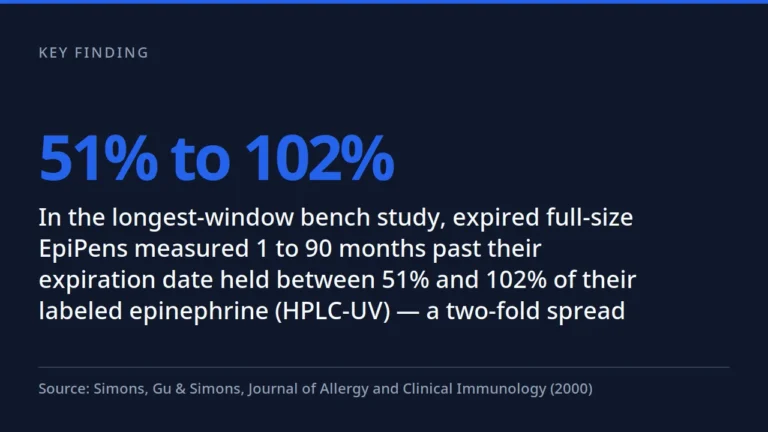
What laboratories actually measured inside expired EpiPens and other auto-injectors: epinephrine content by months past expiry, study by study, with storage conditions, the one delivery study, the firing tests — and why no individual pen's strength can be assumed.
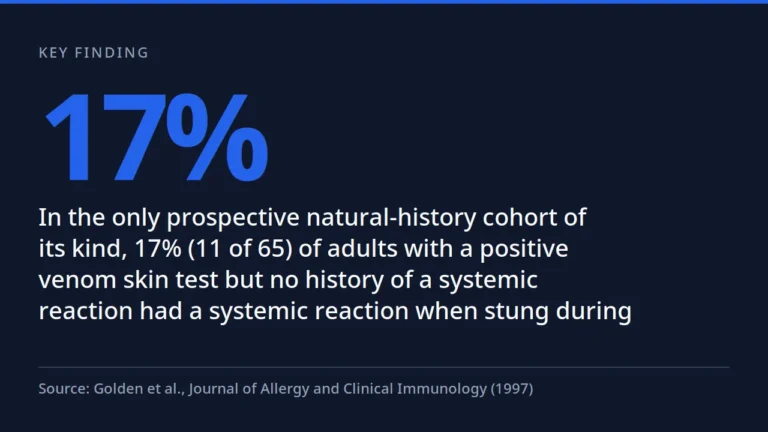
A positive venom allergy test in someone who has never reacted is common, usually temporary, and a weaker prediction than it sounds: the measured prevalence, sting-outcome and fading data, with every population and year attached.