
Lyme Disease Rash vs Cellulitis: Key Differences
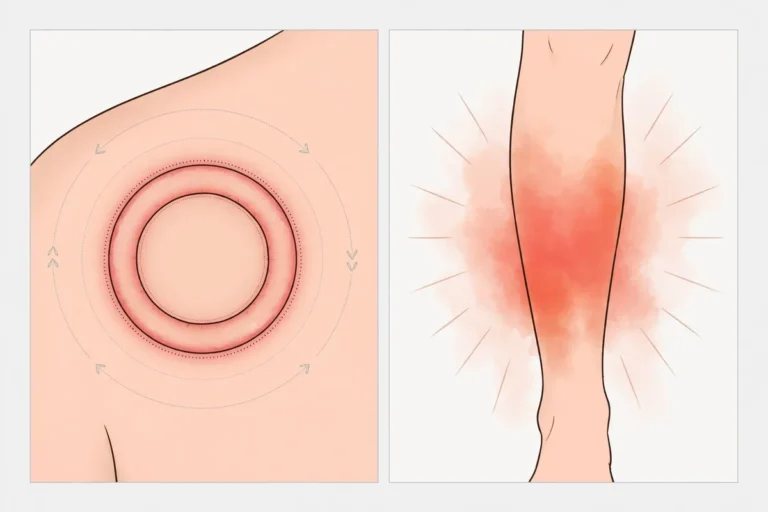
A red area on your skin is getting bigger, and you are trying to decide what it might be. The question lyme disease rash…
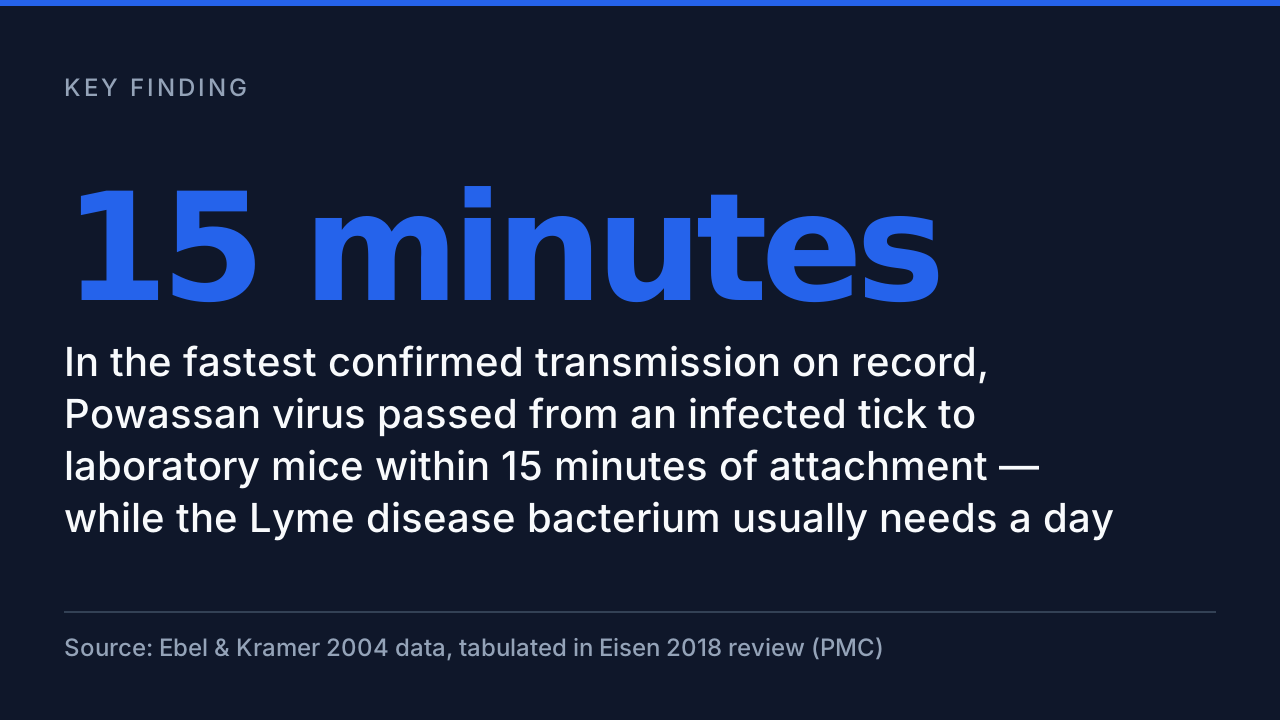
One tick, six different clocks. Powassan virus can pass within 15 minutes while Lyme disease usually needs 36 to 48 hours — and official sources disagree on the hours in between. Every figure sourced, every conflict named.
Source: Ebel & Kramer 2004 data, tabulated in Eisen 2018 review (PMC) (2004)
You found the tick, you removed it, and now you are doing the maths everyone does: how long was it on me, and how much danger am I in? The honest answer is that there is no single tick clock. One blacklegged (deer) tick can carry six different infections, and each one moves from tick to person on its own schedule. At the fast end, Powassan virus was passed within 15 minutes of attachment in animal studies (Ebel & Kramer 2004 data, tabulated in Eisen 2018 review (PMC), 2004). At the slow end, the CDC says that in most cases a tick must be attached 36-48 hours or more before the Lyme disease bacterium can be transmitted (CDC Lyme disease fact sheet (CDC Stacks), 2019). Everything else — anaplasmosis, babesiosis, ehrlichiosis and Borrelia miyamotoi disease — falls somewhere between those two extremes.
Most pages answer only the Lyme version of this question, because Lyme is the disease with the best data. We go deeper on that single clock in our dedicated guide to how long a tick must be attached to transmit Lyme. This page does the job nobody has done in one place: it puts all six diseases side by side, shows the risk hour by hour where studies measured it, and — just as important — shows you where official sources publish different numbers for the same disease, instead of quietly picking one. For a wider look at what these ticks carry, start with our tick bites hub. One warning before the tables: the comforting idea that every tick-borne disease allows a day or two of grace is true for some of these infections and dangerously wrong for others. The only disease on this page with no meaningful grace period at all is Powassan virus.
Health departments usually express transmission time as a removal window: get the tick off within this many hours and the risk of infection drops. The fullest official table of this kind is published by New York State’s Department of Health. Here it is, with the CDC and Harvard Medical School figures placed alongside it, so you can see exactly where they agree — and where they do not.
| METRIC | VALUE | SOURCE |
|---|---|---|
| Powassan virus — removal window (NYS DOH) | 15 minutes | Ulster County Health Dept (NYS DOH transmission table) |
| Powassan virus — fastest confirmed transmission, animal study | 15 minutes | Ebel & Kramer 2004 data, tabulated in Eisen 2018 review (PMC) |
| Anaplasmosis — removal window (NYS DOH) | 12 hours | Ulster County Health Dept (NYS DOH transmission table) |
| Anaplasmosis — measured minimum, most cases (Harvard) | 12 to 24 hours | Harvard Medical School Lyme resource |
| Babesiosis — removal window (NYS DOH) | 24 hours | Ulster County Health Dept (NYS DOH transmission table) |
| Babesiosis — measured minimum, most cases (Harvard) | 36 hours | Harvard Medical School Lyme resource |
| Ehrlichiosis — removal window, lone star tick (NYS DOH) | 36 hours | Ulster County Health Dept (NYS DOH transmission table) |
| Ehrlichiosis — blacklegged-tick species, about (Harvard) | 24 hours | Harvard Medical School Lyme resource |
| Borrelia miyamotoi disease — can transmit within (Harvard) | 24 hours | Harvard Medical School Lyme resource |
| Lyme disease — removal window (NYS DOH) | 36 hours | Ulster County Health Dept (NYS DOH transmission table) |
| Lyme disease — CDC guidance, most cases | 36-48 hours | CDC Lyme disease fact sheet (CDC Stacks) |
Read the table with one distinction in mind. A removal window is an action deadline for the public — a conservative line drawn so that daily tick checks stay ahead of the germ. A measured minimum is what researchers observed in transmission studies. The two are related, but they are not the same measurement, and confusing them is the source of most of the disagreement you will find online.
How to use this table: find the row for the disease you are worried about, then compare it with how long the tick was actually attached. Every hour under the window is genuinely reassuring for the bacterial diseases — and no row on this table is a guarantee in either direction. Disease-specific detail lives on our symptom pages for Powassan virus after a tick bite, anaplasmosis symptoms and babesiosis symptoms.
Removal windows tell you when to act. They do not tell you your actual risk at the hour you found the tick. For that, the only evidence that exists comes from animal studies in which a single infected tick was allowed to feed for a measured time — the scenario that best matches a real human bite — pooled in a 2018 review by Lars Eisen in Ticks and Tick-borne Diseases.
| METRIC | VALUE | SOURCE |
|---|---|---|
| Lyme disease — infection probability after two days of attachment, single infected nymph | 10% | Eisen 2018 review, Ticks Tick Borne Dis (PMC full text) |
| Lyme disease — infection probability after three days of attachment | 70% | Eisen 2018 review, Ticks Tick Borne Dis (PMC full text) |
| Lyme disease — infection probability after a complete feed | 94% | Eisen 2018 review, pooled study table (PMC full text) |
| Borrelia miyamotoi — transmission probability within the first day, mice | 10% | Breuner et al. 2017, Ticks Tick Borne Dis (CDC Stacks) |
| Borrelia miyamotoi — transmission probability by two days, mice | 31% | Breuner et al. 2017, Ticks Tick Borne Dis (CDC Stacks) |
| Borrelia miyamotoi — transmission probability by three days, mice | 63% | Breuner et al. 2017, Ticks Tick Borne Dis (CDC Stacks) |
| Borrelia miyamotoi — transmission probability after a complete feed, mice | 73% | Breuner et al. 2017, Ticks Tick Borne Dis (CDC Stacks) |
| Powassan virus — mice infected within minutes of attachment | 83% | Ebel & Kramer 2004 data, tabulated in Eisen 2018 (PMC) |
The Lyme curve is the foundation under almost every public health window on this page: the probability of infection from a single infected nymph was about 10% after two days of attachment, rising to about 70% by three days and 94% after a complete feed (Eisen 2018 review, Ticks Tick Borne Dis (PMC full text), 2018). At the one-day mark the pooled record is stark — none of 87 hosts, 0 infected became infected at all (Eisen 2018 review, pooled study table (PMC full text), 2018). Borrelia miyamotoi, a Lyme relative that causes a relapsing-fever-like illness, runs about a day ahead on the same tick: already 10% transmissible within the first day in the CDC-authored mouse study, climbing to 63% by day three (Breuner et al. 2017, Ticks Tick Borne Dis (CDC Stacks), 2017). Powassan is in a different league entirely, infecting 83% of mice within minutes (Ebel & Kramer 2004 data, tabulated in Eisen 2018 (PMC), 2004). If you want the illness side of that speed, see our Powassan virus symptoms timeline.
Read these numbers honestly: they come from mice and other laboratory animals, not people, and human risk at each hour is probably lower and certainly less precise. What the animal record establishes beyond dispute is the shape of the risk — near zero for Lyme in the first day, then a steep climb — and the fact that Powassan plays by different rules. It also explains why the daily tick check is such powerful advice for the bacterial diseases, and why it cannot be the whole defence against the virus.
Search this topic and you will find confident, contradictory hours quoted by official sources. Rather than hide that, here are the disagreements, named. Anaplasmosis has the widest spread of any disease on this page; even Lyme, the best-studied disease here, has a dispute about where its clock starts.
| METRIC | VALUE | SOURCE |
|---|---|---|
| Anaplasmosis, high end — attachment required (NJ Dept of Health) | 24 to 48 hours | New Jersey Dept of Health, Anaplasmosis FAQ |
| Anaplasmosis, animal data — transmission possible in (Maine CDC) | less than 24 hours | Maine CDC tick FAQ |
| Anaplasmosis and babesiosis — unlikely to transmit under (Dutchess County DOH) | 24 hours | Dutchess County Dept of Health (NY) |
| Babesiosis, animal data — transmission possible in (Maine CDC) | less than 36 hours | Maine CDC tick FAQ |
| Lyme disease, earliest start — transmission usually starts between (Maine CDC) | 24-72 hours | Maine CDC tick FAQ |
| Ehrlichiosis, second figure — transmission most often after (South Carolina DPH) | 36 hours | South Carolina Dept of Public Health |
For anaplasmosis, New York’s removal window is 12 hours, Harvard’s measured minimum is 12 to 24 hours, Maine CDC notes transmission in less than 24 hours in mice (Maine CDC tick FAQ, 2026), and New Jersey’s FAQ says an infected tick requires 24 to 48 hours (New Jersey Dept of Health, Anaplasmosis FAQ, 2024). For babesiosis, New York’s window of 24 hours sits against Maine’s finding that transmission may take less than 36 hours in hamsters (Maine CDC tick FAQ, 2026) and Harvard’s minimum of 36 hours in most cases. And Maine CDC says Lyme transmission usually starts between 24-72 hours (Maine CDC tick FAQ, 2026), while the CDC’s own guidance puts most cases at 36-48 hours or beyond.
Ehrlichiosis hides a different kind of disagreement: two different ticks. New York’s 36 hours window and South Carolina’s 36 hours figure (South Carolina Dept of Public Health, 2026) concern the lone star tick’s Ehrlichia species, while Harvard’s 24 hours describes Ehrlichia muris eauclairensis, carried by blacklegged ticks in the Upper Midwest. Same disease name, different tick, different clock. Most of the remaining gaps come from definitions — a removal deadline is deliberately cautious, a study minimum is an observation, and a state FAQ may round either one. When sources conflict, the safe behaviour is identical anyway: remove the tick now, because every disease on this page rewards speed. Not every tick carries these germs in the first place — see do all ticks carry Lyme disease for the infection rates behind that.
After a high-risk bite, people often ask whether they can simply take an antibiotic and be done with it. Guidelines describe that option for exactly one disease on this page — Lyme — and surround it with conditions that all have to hold at the same time.
| METRIC | VALUE | SOURCE |
|---|---|---|
| Attachment threshold — estimated attachment, by engorgement | 36 hours | StatPearls point-of-care summary of IDSA criteria |
| Start deadline — dose started within, after removal | 72 hours | StatPearls point-of-care summary of IDSA criteria |
| Local infection rate — ticks infected with B. burgdorferi, at least | 20% | StatPearls point-of-care summary of IDSA criteria |
| Adult dose — single dose of doxycycline in the guideline | 200 mg | IDSA Science Speaks, clinician update 2026 |
| Trial evidence — efficacy of the single dose (Nadelman 2001) | 87% | Nadelman et al. 2001, N Engl J Med (PubMed) |
| Trial evidence — erythema migrans, placebo group | 3.2% | Nadelman et al. 2001, N Engl J Med (PubMed) |
| Trial evidence — erythema migrans, doxycycline group | 0.4% | Nadelman et al. 2001, N Engl J Med (PubMed) |
Under the IDSA criteria, a single preventive dose of doxycycline may be offered only when all of the following hold: the tick is reliably identified as an adult or nymphal deer tick; the estimated attachment is 36 hours or more, judged by how engorged the tick is; the dose can be started within 72 hours of the tick being removed; and the local rate of tick infection with the Lyme bacterium is at least 20%, as it is in parts of New England, the mid-Atlantic, Minnesota and Wisconsin (StatPearls point-of-care summary of IDSA criteria, 2020). Where those conditions are met, the guideline dose is a single 200 mg for adults, and 4.4 mg/kg for children (IDSA Science Speaks, clinician update 2026, 2026). The evidence behind the rule is a randomised trial in New York in which erythema migrans developed in 3.2% of placebo recipients against 0.4% of those given the single dose — an efficacy of 87% (Nadelman et al. 2001, N Engl J Med (PubMed), 2001).
Notice what the rule does not cover: there is no equivalent preventive dose endorsed for anaplasmosis, babesiosis, ehrlichiosis, Borrelia miyamotoi disease or Powassan virus, and for anaplasmosis the IDSA states plainly that no antibiotic prophylaxis is recommended after a tick bite. Whether the Lyme criteria fit your bite — the species, the engorgement, the local infection rate, your own medical history — is a judgement for a clinician who can examine you, and it should be made promptly rather than after days of watching and waiting. Please do not self-prescribe: this section reports what the guidelines say so you can have an informed conversation with a clinician quickly, ideally the same day. Our companion page explains when doxycycline is recommended after a tick bite in more detail.
Everything in this article collapses into one instruction: remove the tick now, properly. The CDC’s method is simple — clean, fine-tipped tweezers, grasped as close to the skin as possible, pulled away with steady, even pressure. Then clean up, write down the date, and start the watch described below.
| METRIC | VALUE | SOURCE |
|---|---|---|
| Lyme disease — cases that develop the erythema migrans rash, national figures | 70-80% | Maine CDC tick FAQ |
| Anaplasmosis — symptoms typically begin, days after the bite | 5 to 14 days | Harvard Medical School Lyme resource |
| Powassan virus — confirmed case in a Madison County, NY resident (county announcement) | 1 confirmed case | Madison County Public Health press release, Oct 2026 |
| Lyme prevention — dose window closes, hours after removal | 72 hours | StatPearls point-of-care summary of IDSA criteria |
The removal details matter. Do not twist or jerk the tick, which can snap off the mouthparts; dispose of it in alcohol, a sealed container or tape, or flush it, and never crush it with your fingers. Afterwards, clean the bite area and your hands thoroughly with soap and water, rubbing alcohol or hand sanitiser, and skip the folk remedies — petroleum jelly, heat and nail polish do not work and waste the minutes that matter. Save the tick in a sealed container if you can, because identification helps a clinician later. Our checklist for the first 24 hours after a tick bite walks through the same ground step by step.
Then watch yourself for several weeks. The expanding erythema migrans rash appears in about 70-80% of Lyme cases nationally (Maine CDC tick FAQ, 2026), and flu-like symptoms are the shared early warning of almost everything on this page: anaplasmosis symptoms typically begin 5 to 14 days after the bite (Harvard Medical School Lyme resource, 2026), usually with fever, chills and a severe headache. Fever, an expanding rash, severe headache, confusion or weakness after any tick bite means prompt medical care — and tell the clinician about the bite, because these diseases are diagnosed faster when they know. Know the tick bite warning signs and the normal timeline for tick bite symptoms, and follow our tick bite aftercare guide for the next few weeks. One last timing fact: this is not only a summer problem. Ticks can be active on any day the temperature is above freezing, and as recently as October 2026 a Powassan virus case was confirmed in a Madison County, New York resident — 1 confirmed case announced by the county health department that month (Madison County Public Health press release, Oct 2026, 2026). A daily tick check after time outdoors, in every month of the year, remains the single habit that beats every clock on this page.


This page was compiled on 13 November 2026 with the DataGap Method, run in degraded free mode. Degraded stages, named honestly: demand evidence came from general web search rather than Reddit thread mining (this host is blocked from Reddit’s API); the Stage 3 link-format filter did not run; and the automated recency script crashed on this host (its Reddit leg returned HTTP 403), so recency was checked with manual searches instead — which is how the October 2026 Madison County Powassan case was found. Every figure was verified against its live source page on the research date with the method’s verify_facts checker; six facts sit on domains that block automated checkers (PubMed and StatPearls) and were confirmed by opening those pages directly. Where authoritative sources publish different hours for the same disease, all versions are shown and the disagreement is named rather than averaged away.
It depends entirely on which germ the tick carries, and there is no universal grace period. Powassan virus passed to mice within 15 minutes of attachment, and 83 percent of mice were infected at that point — but most tick-borne bacteria move far more slowly. Remove the tick right away with fine-tipped tweezers, clean the area, note the date, and watch for fever or rash over the following weeks. If symptoms appear, seek medical advice promptly and mention the bite. (Ebel & Kramer 2004 data, tabulated in Eisen 2018 review (PMC), 2004)
The CDC states that in most cases a tick must be attached 36 to 48 hours or more before the Lyme bacterium can be transmitted. The animal-study record behind that guidance is reassuring at the short end: across pooled experiments, none of 87 rodent hosts exposed to a single infected nymph for a full day became infected. Risk then climbs steeply with time attached, which is why daily tick checks matter. Our dedicated Lyme guide covers that clock in depth. (CDC Lyme disease fact sheet (CDC Stacks), 2019)
Because they are publishing different things. New York's table is a removal deadline — get the tick off within 12 hours and risk drops. Harvard's summary describes measured transmission, at least 12 to 24 hours. Maine notes transmission under a day in mice, while New Jersey's FAQ puts the requirement at 24 to 48 hours. These are removal windows, study minimums and cautious roundings side by side, not one measurement — which is why this page lists them separately instead of averaging them. (New Jersey Dept of Health, Anaplasmosis FAQ, 2024)
No. A preventive (prophylactic) antibiotic is described in guidelines only for Lyme disease, and only when several conditions hold at once: the tick is identified as a deer tick, it was attached an estimated 36 hours or more, the dose can start within 72 hours of removal, and local ticks carry the Lyme bacterium at a rate of at least 20 percent. Whether those conditions fit your situation is a decision for a clinician, not something to self-prescribe. (StatPearls point-of-care summary of IDSA criteria, 2020)
Not reliably. Maine CDC warns that people are generally not good at estimating attachment times, which is why clinicians judge by how engorged — swollen with blood — the tick is. Engorgement is the measure built into the Lyme prophylaxis criteria, where an estimated attachment of 36 hours or more is one of the conditions a clinician weighs. If you are unsure, treat the bite as worth a prompt call to a healthcare provider rather than guessing from the clock. (Maine CDC tick FAQ, 2026)
Clean the bite area and your hands with soap and water or rubbing alcohol, save the tick in a sealed container or alcohol if you can, and write down the date and where on your body it was attached. Then watch yourself for several weeks: an expanding rash, fever, chills or muscle aches are reasons to seek medical care promptly and mention the bite. Timing matters because the Lyme prevention window closes 72 hours after removal — waiting to see is how that window gets missed. (StatPearls point-of-care summary of IDSA criteria, 2020)
No. There is no licensed vaccine and no specific antiviral treatment for Powassan virus; care for severe cases is supportive, usually in hospital. That is one reason its speed matters so much: in the animal studies the virus infected 83 percent of mice within 15 minutes of attachment, long before the daily tick check that protects against slower diseases. Prevention — repellent, treated clothing, and checking skin right after being outdoors — is currently the only defence. (Ebel & Kramer 2004 data, tabulated in Eisen 2018 (PMC), 2004)
Last updated:
This article is for informational purposes only and isn’t medical advice. If you’re worried about a bite or sting, talk to a healthcare professional.
Dr. Jones oversees StingHelp’s clinical verification process. Every guide is systematically evaluated against active Centers for Disease Control and Prevention (CDC), Environmental Protection Agency (EPA), and American Academy of Allergy, Asthma & Immunology (AAAAI) medical consensus standards to ensure symptom distinctions and care recommendations are clinically sound.
Explore physician-reviewed first-aid procedures, identification clues, and symptom comparisons for other common outdoor bites and stings.
A red area on your skin is getting bigger, and you are trying to decide what it might be. The question lyme disease rash…
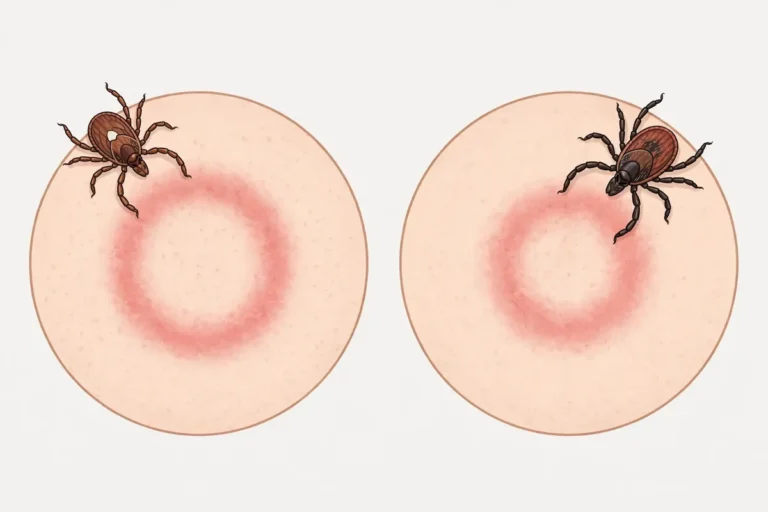
A red, expanding circle spreads across the skin a few days after a hike through tall grass. Many people see that shape and immediately…
You come home from a hike through tall grass, peel off your clothes, and wonder: did any ticks hitch a ride inside on fabric?…