
Do Lint Rollers Remove Ticks?
The post-hike ritual is all over social media: before you walk back inside, you grab the lint roller from the car and roll it…
You come home from a hike through tall grass, peel off your clothes, and wonder: did any ticks hitch a ride inside on fabric? It is a reasonable worry, ticks…
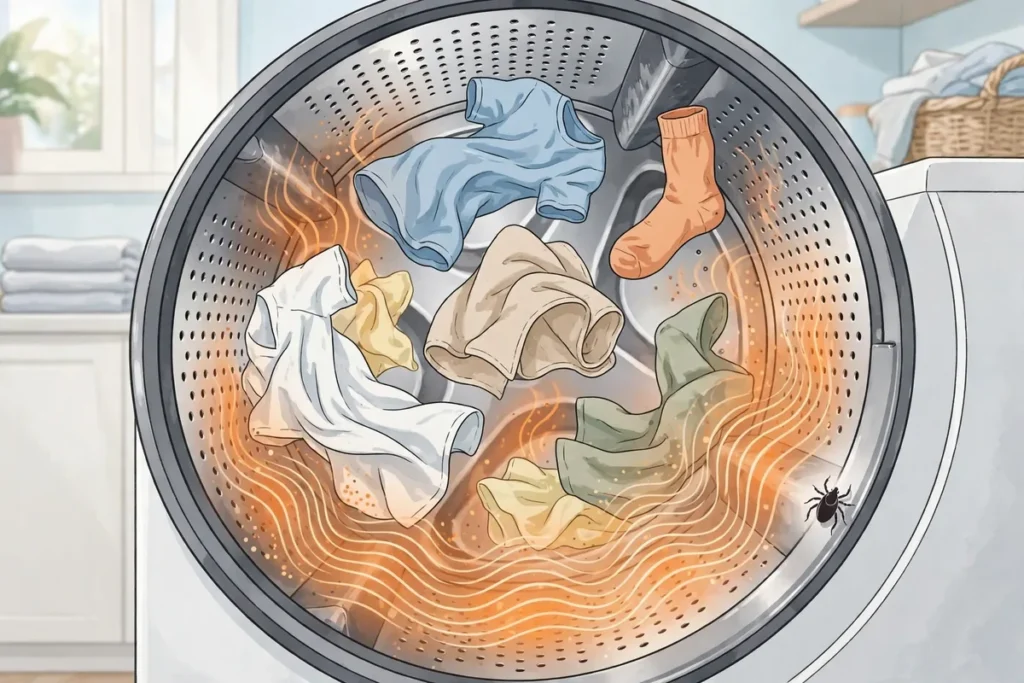
You come home from a hike through tall grass, peel off your clothes, and wonder: did any ticks hitch a ride inside on fabric? It is a reasonable worry, ticks can cling to clothing for hours before crawling onto skin, especially on children. The reassuring news is that one of the most effective tick-killing tools is already in your laundry room. Does a hot dryer kill ticks? Yes. The CDC’s guidance is direct: put dry clothes in a dryer on high heat for 10 minutes to kill ticks after you come indoors.
But the details matter. Dry clothes and damp clothes behave differently, washing alone is not enough, and the dryer is one step in a routine rather than the whole defense. This article lays out exactly what the science and public health guidance say: the 10-minute rule, why washing alone fails, the dry-first-then-wash protocol, how to handle damp loads and delicates, and how the dryer step fits into a complete post-outdoor tick routine. Note the scope: this is about decontaminating clothing and gear. A hot dryer is not a treatment for a tick bite or an attached tick, never apply dryer heat to skin.
Heat, not detergent, is what reliably kills ticks on clothing. The CDC advises tumbling dry clothes on high heat for 10 minutes after coming indoors. State health departments echo this: Minnesota’s Department of Health recommends tumble-drying clothing and gear on high heat for at least 10 minutes to kill blacklegged ticks, and Maryland’s guidance gives the same 10-minute figure for dry clothing.
Why does dry heat work so well? Ticks are highly vulnerable to desiccation. They maintain their water balance in humid microclimates like leaf litter, and sustained hot, dry air overwhelms that balance quickly. A dryer’s high-heat cycle combines temperature and airflow in exactly the way ticks cannot tolerate. This is also why the guidance specifies dry clothes: moisture in the load absorbs heat energy as it evaporates, shielding ticks until the load is fully dry, which is why damp loads need significantly longer.
A 2016 study published in the journal Ticks and Tick-borne Diseases tested ticks through standard wash cycles and found that cold and warm water washes did not kill them. Only hot water, at least 130°F (54°C), was reliably lethal in the wash. The practical problem: most household “warm” settings fall well below that threshold, and many fabrics cannot tolerate true hot-water washing anyway.
If your instinct after a hike is to toss everything straight into the washer on a normal cycle, know that ticks may survive the wash and then crawl out during sorting, transfer, or folding, potentially into your laundry room rather than the woods where you found them. Washing is for cleaning the clothes; heat-drying is for killing the ticks. The two jobs need different tools, which is why public health guidance treats the dryer step as the critical one.
If the fabric allows it, washing in hot water (at least 130°F) adds a layer of protection. But check care labels first, athletic wear, delicates, and many synthetics do not tolerate it, and do not rely on the wash alone even when hot water is an option. The dryer remains the most reliable single step, and it works regardless of what happened in the washer.
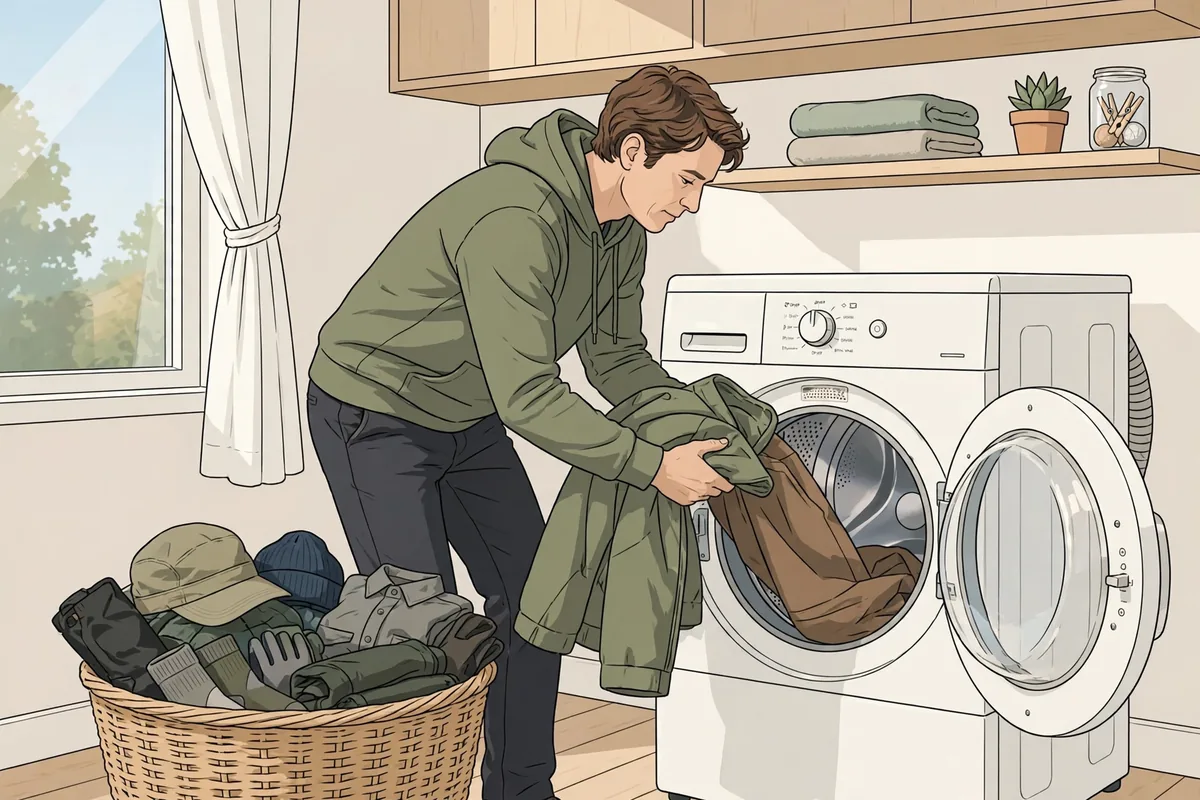
This is the sequence recommended by tick-borne disease specialists and consistent with CDC guidance:
Putting potentially tick-infested clothes through the washer first gives ticks a ride through water that does not kill them, plus handling steps, loading, unloading, transferring, where they can escape onto you, the laundry room, or other clothes. Dryer-first means the kill step happens with minimal handling and before ticks get a watery reprieve. Think of it as quarantine first, cleaning second.
The guidance covers gear too: jackets, hats, scarves, and even backpacks that tolerate the dryer. Items that cannot go in the dryer, leather boots, delicate shells, should be inspected carefully by hand and stored away from bedrooms. A thorough visual check plus isolation (a sealed bag or a hot garage for a few days) is the fallback for non-dryer-safe items.
The CDC’s guidance adds a crucial qualifier: if clothes are damp, dry thoroughly first and then tumble on high for 10 more minutes. Moisture is the enemy of the 10-minute rule because evaporating water keeps the load cooler. Maryland’s public health guidance is even more explicit for loads that must be washed first: tumble dry on low heat for 90 minutes or high heat for 60 minutes to ensure elimination. The principle is simple, the load must be fully hot and dry, and the 10-minute clock starts once it is.
Jeans, sweatshirts, hoodies, heavy socks, and towels hold more moisture and insulate their inner layers. For these, 20 to 30 minutes on high heat is a safer target than the bare 10-minute minimum. When in doubt, add time, the cost of extra dryer minutes is trivial compared to the cost of a surviving tick.
Some fabrics cannot take high heat. For these, options include: the longest dryer-safe setting the label allows (low heat for 90 minutes is the published alternative), careful hand inspection with a lint roller (surprisingly effective at picking up nymphs), or sealing the items in a bag and placing them in a hot car or sunny spot, though these fallbacks are less certain than dryer heat. Never put dryer-prohibited items on high heat and hope for the best; melted synthetics are a real outcome.
To be absolutely clear: the dryer guidance is for clothing and gear only. Never attempt to use dryer heat, a hair dryer on hot, or any heated device on skin to kill an attached tick, burns are a serious risk and heat can agitate the tick. Attached ticks should be removed with fine-tipped tweezers using steady upward pressure. Our guide to removing an attached tick safely shows the correct technique.

| Method | Effectiveness on clothing | Key limitation |
|---|---|---|
| Dryer, high heat, 10+ min (dry load) | Highly reliable, the CDC-recommended standard | Needs longer for damp or thick loads |
| Washing, hot water ≥130°F | Kills ticks at true hot temperatures | Most “warm” cycles are cooler; damages some fabrics |
| Washing, cold or warm water | Does not reliably kill ticks (2016 study) | Gives false confidence |
| Dryer, low heat, 90 min | Effective alternative per state guidance | Slow; still needs full drying |
| Lint roller / visual inspection | Useful supplement, catches nymphs on smooth fabrics | Misses ticks in seams and folds |
| Freezing | Unreliable for ticks; many survive | Not recommended as a decontamination method |
Prevention starts before the hike. Use an EPA-registered repellent containing DEET, picaridin, IR3535, oil of lemon eucalyptus, or 2-undecanone on exposed skin, following label directions. Treat clothing and gear, pants, socks, boots, with permethrin, which both repels and kills ticks on contact and remains effective through several washings. Wear long pants tucked into socks in tick habitat, choose light-colored clothing so ticks are easier to spot, and walk in the center of trails away from brushing vegetation.
The dryer handles clothes; the shower handles you. Bathe or shower as soon as possible after coming indoors, washing helps rinse off unattached ticks and makes attached ones easier to find. Then do a full-body check with a hand-held or full-length mirror: under the arms, in and around the ears, inside the belly button, behind the knees, between the legs, around the waist, and through the hair. Parents should help children check thoroughly. Remove any attached tick promptly with fine-tipped tweezers.
Dogs are very susceptible to tick bites and can ferry ticks indoors on their fur. Talk to your veterinarian about appropriate tick prevention products for your pets, and check pets for ticks after outdoor time just as you check yourself. Around the house, keep lawns mowed, clear leaf litter and brush at the yard’s edge, and keep play equipment in sunny, dry areas, ticks thrive in humid shade. For trip planning, our outdoor bite prevention checklist covers the broader strategy for keeping biting pests off you on the trail.
Even with perfect laundry habits, bites happen. Save any removed tick for identification, note the date of the bite, and watch the site and your health over the following weeks. Our aftercare guide on what to watch in the weeks after a tick bite details the symptoms worth tracking, and the tick bite warning signs guide covers when to seek care promptly.

Will a normal wash cycle kill ticks on my clothes?
Usually not. A 2016 study in Ticks and Tick-borne Diseases found that cold and warm water washes did not kill ticks; only water at or above 130°F (54°C) was reliably lethal. Since most household wash settings run cooler than that, the dryer, not the washer, is the reliable kill step. Run dry clothes on high heat for at least 10 minutes.
How long do ticks live on clothing without a host?
Ticks can survive on clothing for hours to days depending on the species, life stage, temperature, and humidity. Nymphs are especially hardy in humid conditions. The practical point is not the exact survival time but that a tick on your jacket this morning can still be alive and questing tonight, which is why prompt dryer treatment after outdoor activities matters.
Does the dryer kill tick eggs too?
Tick eggs are rarely a concern on clothing, ticks lay eggs in the environment (leaf litter, soil crevices), not on fabric or people. The dryer guidance targets the life stages that hitchhike: larvae, nymphs, and adults. Sustained high heat is lethal to all mobile stages, which is what you need.
Can I just put my hiking clothes in a sealed bag for a few days instead?
Isolation can work eventually, but it is slow and uncertain, ticks tolerate starvation far better than heat, surviving weeks to months without feeding depending on conditions. The dryer gives you certainty in minutes. Sealed-bag isolation is a reasonable fallback only for items that cannot tolerate any dryer heat, and even then, combine it with careful inspection.
Is a hot dryer enough protection on its own after hiking in tick country?
No, it is one layer. The dryer decontaminates clothing, but ticks may already be on your skin, your pets, or your gear. Pair it with repellents before you go out, a full-body tick check and shower after you return, prompt removal of any attached ticks, and monitoring for symptoms in the following weeks. Layered prevention is the whole strategy; the dryer is simply the best laundry layer.
Medically reviewed by Dr. Sarah Jones, MD.
This article is for informational purposes only and isn’t medical advice. If you’re worried about a bite or sting, talk to a healthcare professional.
Dr. Jones oversees StingHelp’s clinical verification process. Every guide is systematically evaluated against active Centers for Disease Control and Prevention (CDC), Environmental Protection Agency (EPA), and American Academy of Allergy, Asthma & Immunology (AAAAI) medical consensus standards to ensure symptom distinctions and care recommendations are clinically sound.
Explore physician-reviewed first-aid procedures, identification clues, and symptom comparisons for other common outdoor bites and stings.

The post-hike ritual is all over social media: before you walk back inside, you grab the lint roller from the car and roll it…

The pitch is appealing: a natural white powder, made from fossilized algae, that kills ticks without synthetic chemicals. Garden blogs recommend it, pet forums…

You found a tick on your dog, and there is a box of Capstar in the cabinet from the last flea scare. It is…