Positive Venom Test, No Reaction: How Common That Result Is and What It Predicts (2026)
A positive venom allergy test in someone who has never reacted is common, usually temporary, and a weaker prediction than it sounds: the measured prevalence, sting-outcome and fading data, with every population and year attached.
Positive Venom Test, No Reaction: How Common That Result Is and What It Predicts (2026)
By StingHelp Editorial Team9 min read
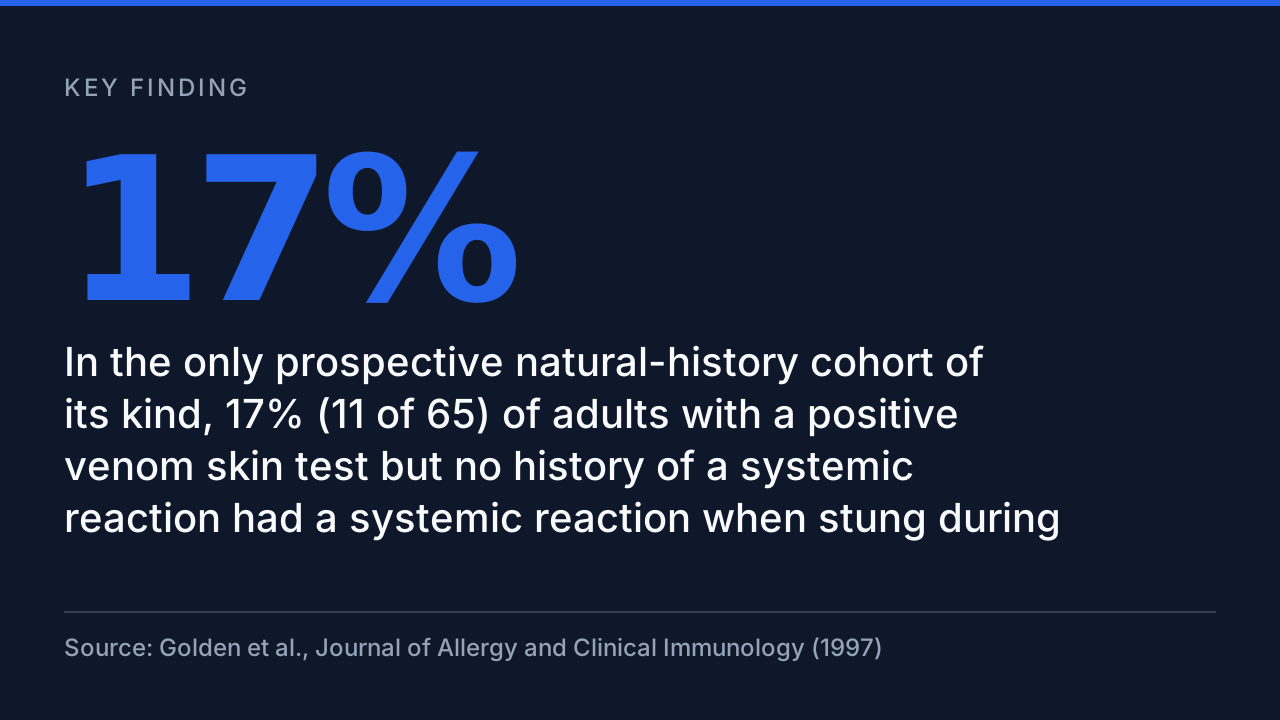
17%
In the only prospective natural-history cohort of its kind, 17% (11 of 65) of adults with a positive venom skin test but no history of a systemic reaction had a systemic reaction when stung during follow-up.
→ 15% Share of adults with no history of an allergic sting reaction who nevertheless had a positive venom skin test (asymptomatic sensitization), in a stratified random sample of a general adult population (n=269). (Golden et al., JAMA (1989), 1989)
→ 26.5% Share of the same general adult population sample with IgE antibodies to venom demonstrable by skin test or radioallergosorbent test (RAST), most of whom had never had an allergic reaction. (Golden et al., JAMA (1989), 1989)
→ 5% to 15% The US stinging-insect practice parameter's summary range for how many people with asymptomatic sensitization will have a systemic reaction to a subsequent sting – lower than the 17% the one prospective cohort actually measured. The two figures are reported side by side in this article, not merged. (Stinging Insect Hypersensitivity Practice Parameter Update 2016, quoted by AAAAI Ask the Expert, 2017)
→ 59% Share of venom-allergic patients (200 clinic patients with allergic sting reactions) whose IgE tests were positive to BOTH honeybee and Vespula venom by the CAP assay – double positivity, which component testing then showed was usually not double allergy. (Muller et al., Allergy (2009), 2009)
A venom allergy test that comes back positive in a person who has never had an allergic reaction is common enough to have its own name in the literature: asymptomatic sensitization. In a stratified random sample of adults, 15% of those with no history of an allergic sting reaction had a positive venom skin test (Golden et al., JAMA (1989), 1989). This page gathers what has actually been measured about that result — how often it occurs, what happened when people with it were later stung, and how quickly it goes away — with the population and the year attached to every figure.
Two things should be said plainly at the start. A positive test is not a diagnosis of allergy, and it is not an emergency. The emergency in this subject is a systemic reaction itself, whose signs are covered in our guides to anaphylaxis warning signs after a sting and bee sting warning signs. What follows is data reporting: the studies, their numbers, and the positions the guidelines take. Decisions about testing or treatment in any individual case belong to an allergist, not to a statistics page.
There is also an honesty point about the evidence itself. Almost everything measured about this question comes from two Johns Hopkins cohorts, one published in 1989 and one in 1997, and the natural-history half of the question has never been re-measured with modern component tests in a general population. The figures below are therefore printed with their dates on them. Where a guideline summary gives a different number from the cohort that measured it, both are shown and the difference is named rather than averaged away.
1 How Common Is a Positive Venom Test in People Who Have Never Reacted?
In the 1989 random-sample study, 26.5% of adults had IgE antibodies to venom on skin test or blood test (Golden et al., JAMA (1989), 1989), and 15% of those with no allergic-reaction history were skin-test positive — while only 3.3% of the same population reported ever having had a systemic sting reaction. The test-positive group was roughly five times the size of the group with any clinical history.
METRIC
VALUE
SOURCE
Positive venom skin test, no history of allergic sting reaction (general adult population, random sample)
The same test, in the same population, read 35% positive among people stung within the previous three years and 20% among those stung earlier — a positive result is partly a timestamp of the last sting.
Golden et al., JAMA (1989), 1989
The spread between these studies is not noise; it is mostly method. The 1989 study used the assays of its era and a working adult population, the Greek study tested military ground personnel outdoors for a living, and the highest figure in the table, 41.6%(Blank et al., Journal of Allergy and Clinical Immunology: In Practice (2025), reporting an earlier representative cohort, 2025), comes from a modern blood-test threshold low enough to count faint sensitization that older methods missed. What survives every method is the shape of the finding: in each cohort, people with a positive test and no reaction history outnumber people with an actual reaction history many times over. Notably, most of the test-positive adults in the 1989 sample had never sought medical advice about stings at all — the gap between the test result and the lived experience is the normal case, not the exception, which is also why so many people first meet this question through a delayed reaction after a bee sting rather than through a laboratory.
A second pattern in the 1989 data is easy to miss: positivity tracked the calendar. Adults stung recently tested positive far more often than adults whose last sting was years earlier. That single observation predicts the fading data in the fourth section of this article — if a positive result partly reflects how long ago the immune system last met venom, then time alone should erase many positives, and the follow-up cohort found that it does.
2 Why the Answer Changes With the Population Tested
Test beekeepers and 42% carry bee venom IgE (Bousquet et al., Journal of Allergy and Clinical Immunology (1984), 1984); test pollen-allergic clinic patients and 45.7% are venom-IgE positive with no systemic history; test schoolchildren in Indonesia and the figures fall again. The percentage is a property of who was tested and with what, which is why this article never merges these cohorts into one rate.
METRIC
VALUE
SOURCE
Bee venom-specific IgE present (beekeepers, any sting frequency)
In the beekeeper survey, the subgroup stung more than two hundred times a year had no allergy at all and uniformly negative skin tests — at that exposure level, the association between stings and sensitivity runs backwards.
Bousquet et al., Journal of Allergy and Clinical Immunology (1984), 1984
The beekeeper gradient is the most counterintuitive result in this literature. Reaction histories were concentrated in the least-stung beekeepers (45%), thinned as annual sting counts rose (20%, then 9%), and vanished in the most-stung group — even though venom IgE was present in 42% of beekeepers overall. Heavy, repeated exposure looked less like cumulative risk and more like training, an observation that sits behind much of what is known about tolerance in multiple stings and venom allergy. A positive test in a beekeeper and the same result in an office worker are the same laboratory line drawn from very different immune histories.
The clinic and school cohorts make the complementary point. Pollen-allergic patients tested positive at 45.7%, but their non-atopic controls — people with no allergic background — still reached 26.7%, close to the general-population figures from 1989. In the Indonesian schoolchildren, sensitization was again common while reactions were almost absent: one child reported a significant local reaction and none a systemic one, in a cohort where most had never been stung at all. Any page that quotes a single sensitization rate without naming its population is quoting an artefact of recruitment, a point worth remembering when reading about wasp stings in children or any other group whose exposure differs from yours.
3 What Happened When Test-Positive People Were Actually Stung
Only one study has followed test-positive, history-negative adults forward and counted what happened at the next sting: 17% had systemic reactions (Golden et al., Journal of Allergy and Clinical Immunology (1997), 1997). That sits far above the under-<2% recorded for test-negative or treated people, and far below the 50% seen in patients who had already reacted once. Guideline summaries quote a lower range, and the disagreement is documented below rather than smoothed over.
METRIC
VALUE
SOURCE
Systemic reaction when stung — positive skin test, no reaction history (prospective cohort)
One subgroup breaks the reassuring average: among the small group whose positive skin tests were still positive at re-testing, the reported systemic-reaction frequency was 67% at the early follow-up — the authors’ own caution that an average can understate the risk when sensitivity persists for years.
Golden et al., Journal of Allergy and Clinical Immunology (1997), 1997
The three risk figures in this table do not agree, and the reasons are visible. The cohort’s 17% counts any systemic reaction, in a sample of stung subjects small enough that a handful of outcomes moves the percentage. The 5% anaphylaxis figure (Blank et al., Journal of Allergy and Clinical Immunology: In Practice (2025), reporting Sturm et al., 2025) counts only the most severe endpoint, so it is not measuring the same event. The practice parameter’s 5% to 15%(Stinging Insect Hypersensitivity Practice Parameter Update 2016, quoted by AAAAI Ask the Expert, 2017) is neither: it is a consensus range written for clinicians, set cautiously below the single measurement that exists. Readers comparing sources will meet all three numbers presented as ‘the’ risk; they are answers to three slightly different questions. Golden’s 2007 review adds a further limit that applies to every figure here: the degree of sensitivity on a skin or blood test does not reliably predict how severe a reaction would be, which is one reason clinicians separate a large local reaction from anaphylaxis by the history of what happened, not by the size of a test result.
The persistent-positive subgroup deserves its caution label. At the early re-test, those whose skin tests had stayed positive showed the 67% frequency; by the late re-test the corresponding figure was 20%, in an even smaller group. The honest reading is not that persistence multiplies risk by a known factor, but that the reassuring average is built mostly from people whose sensitivity was already fading — and that the cohort was too small to say precisely how much that matters. That uncertainty is itself a finding: nearly three decades later, no larger cohort has replaced these sixty-five stung subjects as the evidence base.
4 How Fast Does a Positive Venom Test Disappear?
In the prospective cohort, sensitivity disappeared at 12% per year (Golden et al., Journal of Allergy and Clinical Immunology (1997), 1997): 45% of positive skin tests had turned negative by a mean of four years, and the skin-test half-life in people without symptoms was 4 years, against 7 years in patients receiving venom immunotherapy.
METRIC
VALUE
SOURCE
Positive skin tests turned negative by the early re-test (asymptomatic adults)
The two tests do not fade together: among subjects whose skin test had turned negative, venom-specific IgE was still positive in 38% at the early visit and 30% at the late one — which test went negative depends on which test you repeat.
Golden et al., Journal of Allergy and Clinical Immunology (1997), 1997
Positive skin tests that had turned negative, by follow-up time
Negative by 2.5 years
33%
Negative by 4 years (mean)
45%
Negative by 6.8 years
80%
Read as a single series, the cohort’s re-tests describe a result with a shelf life: a third of positives gone by the early visit, about half by four years, and four-fifths by the late visit. The review literature’s summary range of 30% to 60%(Golden, Immunology and Allergy Clinics of North America (2007), 2007) is the same observation compressed. This is the natural history behind the practice parameter’s remark that most people with asymptomatic sensitization lose the sensitivity over time — the parameter is summarising this cohort, not a newer one, because there is no newer one.
Movement ran in both directions. 8.7% of initially negative subjects had become positive by follow-up, most of them after stings between visits, which fits the 1989 finding that a recent sting raises the chance of a positive test. A venom test is therefore best read as a dated snapshot of a moving quantity: accurate about the season it was taken in, weaker evidence about any other. Anyone comparing an old result with a new one is looking at two snapshots of a process whose measured half-life, in people who never reacted, is 4 years.
5 Positive to Bee and Wasp Venom at Once: How Often Are Both Real?
Among venom-allergic patients, double positivity is common and heavily assay-dependent: 59% by one platform and 32% by another, in the same patients (Muller et al., Allergy (2009), 2009). When component-resolved testing was applied, only 41.7% of double positives were confirmed as true double sensitization (Sturm et al., PLoS ONE (2011), 2011) — the rest largely reflected cross-reactivity.
METRIC
VALUE
SOURCE
Double positivity by the CAP assay (venom-allergic clinic patients)
In the inhibition study, 50.8% of double-positive results were based on cross-reactive carbohydrate determinants — sugar structures shared across venoms that make a test light up for an insect whose venom the immune system has never truly targeted.
Sturm et al., PLoS ONE (2011), 2011
These studies were run in patients who had already reacted, so their percentages describe clinic populations, not the asymptomatic reader — but the mechanism they document applies to any double-positive result. Whole-venom extracts share carbohydrate structures and partly similar proteins, so a single sensitization can print as two. In the Sturm study, the measured double-sensitization rate ran from under one in five on the basophil activation test to nearly two in three on one IgE platform, in the same patients: the answer to ‘how common is double positivity’ is partly a question about machinery. Component testing, which checks the species-specific marker allergens instead of whole venom, is what separates the two situations, and it left a minority of double positives standing as genuinely double.
For the asymptomatic person, the practical consequence is about interpretation, not treatment: a double-positive printout is the expected output of cross-reactivity in a large share of cases, which is why specialists revisit the result with component tests before drawing conclusions about wasps, hornets and yellowjackets versus bees. As with a single positive, the laboratory pattern is the beginning of the interpretation — the reaction history remains the deciding evidence.
6 What the Guidelines Do With a Positive Test and No Reaction
The parameter’s reasoning is statistical before it is clinical: positive venom IgE results are present in more than a fifth of healthy adults, so a test-first approach would label far more people than a history-first one ever would.
Stinging Insect Hypersensitivity Practice Parameter Update 2016, quoted by AAAAI Ask the Expert, 2017
The two guideline positions were written twenty years apart on different continents and land in the same place, because both are built on the data in the sections above: sensitization is common, usually transient, and only loosely coupled to reactions, while a documented systemic reaction is the event that changes management. The parameter adds the operational corollary that evaluation starts from the history of the reaction — what happened, how fast, and how severe — with testing used to identify the insect once a reaction has occurred. For readers, the legitimate use of that framework is orientation: knowing which questions an allergist will ask, and what a written sting allergy action plan contains, is different from deciding one’s own case, and knowing when a bee sting is an emergency matters more than any laboratory value.
Nothing in either guideline dismisses the person holding the positive result. Both leave room for specialist judgement in cases the averages do not describe — unavoidable occupational exposure, for instance, or coexisting conditions that raise the stakes of a reaction. What the guidelines remove is the automatic pathway from a positive printout to treatment. The data on this page show why that pathway was removed: it would mostly treat a laboratory pattern that the follow-up studies watched disappear on its own.
Key statistics at a glance | Source: see numbered sources below
Chance of a systemic reaction to a sting in large local reactors and in children with mild skin-only systemic reactions (a different, often-confused group)
This article was assembled with the Data Gap Method from published studies and guideline documents, in degraded mode, with every degraded stage named. Stage 1 (demand): Reddit data is blocked from this host and the discovery run recorded zero counted threads for this cluster, so demand is labelled unmeasured rather than estimated. Stage 2 (supply check): the host’s web search was used instead of a SERP API. Stage 3 (backlink format filter): DID NOT RUN — no format percentages are claimed anywhere in this article. Stage 4 (existence gate): run manually over a 689-URL corpus of StingHelp’s own pages and returned CLEAR; StingHelp had no venom-testing content. Stage 6 (recency): the recency sweep script crashed on its Reddit leg (an incomplete-read error, the same host failure as previous runs); a fallback web search over the preceding 30 days found no new sensitization or natural-history figure, so nothing in the article rests on an in-window statistic. Stage 7 (verification): every fact was checked against its source page. The scripted checker verified 12 facts directly; publisher hosts blocked the scripted fetcher (403 and 503 responses) and PubMed was unreachable from this host (status 203, a failure recorded in earlier runs), so the remaining facts — including every figure from the 1989 and 1997 Johns Hopkins papers — were confirmed by opening and reading each source in a browser, and each such fact carries a note saying so in the underlying fact sheet. Figures that a 2025 review restates from earlier cohorts are labelled secondary and are never merged with the primary measurements. Prevalence figures are properties of the populations and assays that produced them and are labelled as such throughout; no figure from one cohort is averaged with another. Visuals are locally drawn SVG charts made from the fact sheet; no AI image service was used. All sources are free and public, and no paid API, dataset or tool was used at any stage.
Sources consulted: 41
Sources cited: 13
Data freshness: current year: 0, last year: 1, older: 12
Data range: 1984-03-01 to 2026-11-13
Research date: 2026-11-13
Update schedule: Annual
Limitations: The core natural-history evidence comes from two Johns Hopkins cohorts measured in 1989 and 1997 and has never been re-measured with modern component assays in a general population; the sting-outcome denominator in the 1997 cohort is 65 subjects. Prevalence figures are properties of specific populations and assays and are labelled as such throughout; they are never averaged into a single rate.
Frequently Asked Questions
How common is a positive venom test in someone who has never had a reaction?
Common. In a random sample of adults, 26.5% had IgE antibodies to venom on skin test or blood test (Golden et al., JAMA 1989), and 15% of those with no history of an allergic sting reaction had a positive skin test. Later cohorts using lower blood-test thresholds found sensitization in up to 41.6% of adults. Most of these people never react to a sting. (Golden et al., JAMA (1989), 1989)
If a venom test is positive but I have never reacted, what is the measured chance of a reaction to a future sting?
The only prospective measurement followed adults with positive skin tests and no reaction history: 17% (11 of 65) had a systemic reaction when stung (Golden et al., 1997). The US practice parameter summarises the risk more cautiously, at 5% to 15%. Both figures are reported in this article with their sources; an allergist interprets what they mean in an individual case. (Golden et al., Journal of Allergy and Clinical Immunology (1997), 1997)
Does a positive venom test usually go away on its own?
In the prospective cohort, yes, more often than not: 45% of positive skin tests had turned negative after a mean of 4 years, and 80% by about 7 years, a loss rate of 12% per year. Blood-test IgE faded more slowly and was still detectable in 30-38% of people whose skin test had already turned negative. (Golden et al., Journal of Allergy and Clinical Immunology (1997), 1997)
Why do different sources give different risk numbers for the same situation?
Because they measured different things. The 17% figure counts any systemic reaction in one 1990s prospective cohort; a 5% figure reported by Sturm et al. counts anaphylaxis specifically; and the practice parameter's 5% to 15% is a consensus summary range, not a single measurement. The endpoint and the study design change the number. (Blank et al., Journal of Allergy and Clinical Immunology: In Practice (2025), 2025)
My test was positive to both bee and wasp venom. Does that mean two allergies?
Usually not, according to the component-testing studies. Double positivity appeared in 59% of venom-allergic patients on one assay and 32% on another (Muller et al., 2009); when component-resolved testing was applied, only about 41.7% of double positives were confirmed as true double sensitization (Sturm et al., 2011), with cross-reactive carbohydrate determinants explaining much of the rest. (Muller et al., Allergy (2009), 2009)
Do guidelines recommend venom testing for people who have never had a systemic reaction?
The EAACI position paper states that diagnostic venom tests are not recommended in subjects with no history of a systemic reaction (or only a large local reaction), and the US practice parameter advises against basing immunotherapy on test results alone without such a history. Testing decisions in an individual case belong to the treating allergist; this article reports the published data and the guideline positions only. (Bilo et al., EAACI Interest Group on Insect Venom Hypersensitivity, Allergy (2005), 2005)
How fast does venom sensitivity fade in people who have never reacted?
At about 12% per year in the prospective cohort – a skin-test half-life of 4 years in asymptomatic adults, compared with 7 years in patients receiving venom immunotherapy. By the late follow-up visit, 80% of the originally positive skin tests in asymptomatic adults had become negative. (Golden et al., Journal of Allergy and Clinical Immunology (1997), 1997)
Golden DBK, Marsh DG, Freidhoff LR, et al.. “Natural history of Hymenoptera venom sensitivity in adults.” ncbi.nlm.nih.gov/pubmed/9438483. Accessed 2026-11-13.
Grigoreas C, Galatas I, Kiamouris C, Papaioannou D. “Insect-venom allergy in Greek adults.” pubmed.ncbi.nlm.nih.gov/9062629/. Accessed 2026-11-13.
Bousquet J, Menardo JL, Aznar R, Robinet-Levy M, Jullien M. “Clinical and immunologic survey in beekeepers in relation to their sensitization.” jacionline.org/article/0091-6749(84)90405-6/abstract. Accessed 2026-11-13.
Bergmann-Hug K, Fricker M, Hausmann O, Helbling A, Jorg L. “Sensitization to Hymenoptera venom in pollen allergic patients: frequency and involvement of cross-reacting carbohydrate determinants.” journals.plos.org/plosone/article?id=10.1371%2Fjournal.pone.0238740. Accessed 2026-11-13.
Makassar schoolchildren venom sensitization study. “Bee- and wasp-venom sensitization in schoolchildren of high- and low-socioeconomic status living in an urban area of Indonesia.” pmc.ncbi.nlm.nih.gov/articles/PMC8686719/. Accessed 2026-11-13.
Blank S, Korosec P, Slusarenko BO, Ollert M, Hamilton RG. “Venom component allergen IgE measurement in the diagnosis and management of insect sting allergy.” push-zb.helmholtz-munich.de/deliver.php?id=39895. Accessed 2026-11-13.
Bilo BM, Rueff F, Mosbech H, Bonifazi F, Oude-Elberink JNG; EAACI Interest Group on Insect Venom Hypersensitivity. “Diagnosis of Hymenoptera venom allergy.” pubmed.ncbi.nlm.nih.gov/16197464/. Accessed 2026-11-13.
Muller UR, Johansen N, Petersen AB, Fromberg-Nielsen J, Haeberli G. “Hymenoptera venom allergy: analysis of double positivity to honey bee and Vespula venom by estimation of IgE antibodies to species-specific major allergens Api m 1 and Ves v 5.” pubmed.ncbi.nlm.nih.gov/19120073/. Accessed 2026-11-13.
This article is for informational purposes only and isn’t medical advice. If you’re worried about a bite or sting, talk to a healthcare professional.
SJ
Dr. Sarah Jones, MD
MD — Medical Reviewer · Board-Certified Emergency Medicine Physician
Dr. Jones oversees StingHelp’s clinical verification process. Every guide is systematically evaluated against active Centers for Disease Control and Prevention (CDC), Environmental Protection Agency (EPA), and American Academy of Allergy, Asthma & Immunology (AAAAI) medical consensus standards to ensure symptom distinctions and care recommendations are clinically sound.
How this guide was prepared: Researched and structured by the StingHelp Editorial Team; verified against peer-reviewed dermatology literature; clinically reviewed November 2026.
RELATED CLINICAL GUIDES
More StingHelp guides
Explore physician-reviewed first-aid procedures, identification clues, and symptom comparisons for other common outdoor bites and stings.
Allergy, Anaphylaxis & Severe Reactions35 min read
What laboratories actually measured inside expired EpiPens and other auto-injectors: epinephrine content by months past expiry, study by study, with storage conditions, the one delivery study, the firing tests — and why no individual pen's strength can be assumed.
Allergy, Anaphylaxis & Severe Reactions29 min read
Venom immunotherapy protects 91%-96% of wasp-venom patients but 77%-84% for bee venom — and only a fifth to two-thirds of patients finish the course. Protection, completion, relapse and cost data, split by venom, by years completed and by country.
Allergy, Anaphylaxis & Severe Reactions27 min read
How many people with an epinephrine auto-injector actually carry it, have it at the scene, use it during anaphylaxis, and use it correctly? The joined study data — each rate with its population and year, sting-specific figures separated.
STAY INFORMED
Keep practical guidance close.
Seasonal bite forecasts, updated first-aid protocols, and evidence-based outdoor prevention tips delivered to your inbox.
Your information is handled under our Privacy Policy. For urgent symptoms, seek medical help rather than waiting for an email response.