Minute Pirate Bug Bites in Fall: The Tiny Black Bug With a Painful Bite
The fast answer: If a speck-sized black bug keeps landing on you during warm fall afternoons and delivering a sharp, surprising pinch, you are almost certainly dealing with the minute pirate bug — also called the insidious flower bug. It does not drink blood, it injects no venom, and it cannot give you a disease. The bite is a quick test-probe from a hungry predator whose normal food has disappeared for the season. The bad news: insect repellent genuinely does not stop them. The good news: the season is short, the bites are harmless for most people, and a few simple habits cut the number of bites dramatically.
What Is a Minute Pirate Bug?
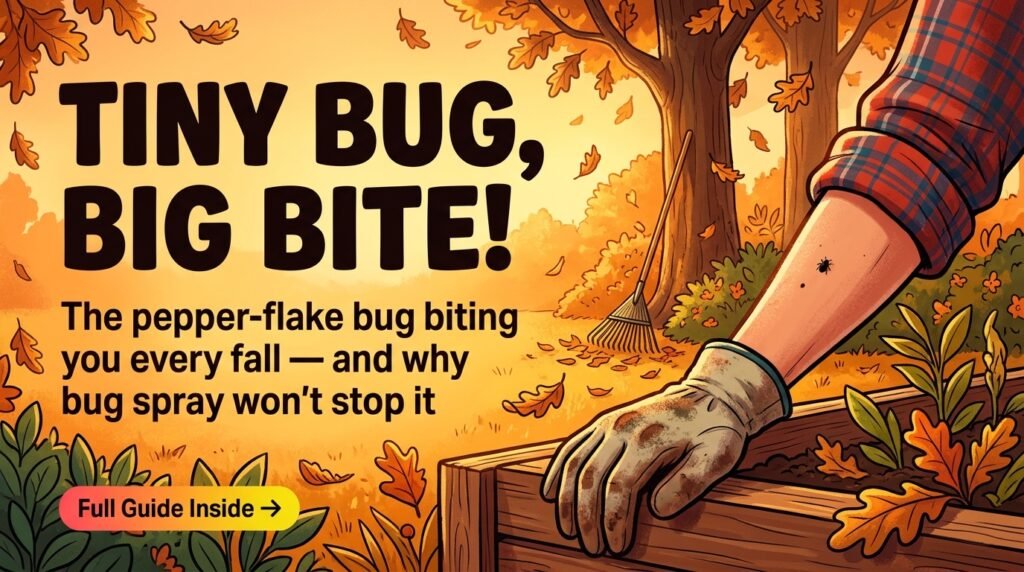
The minute pirate bug (Orius insidiosus) is one of the smallest “true bugs” you will ever notice — roughly 1/5 of an inch long, oval-shaped, and patterned in black and white. Most people describe it as looking like a flake of ground pepper or a tiny seed that moves. It has a short, blunt, straw-like beak tucked under its head, built for piercing insects and sucking them dry.
For most of the year, this bug is firmly on your side. All spring and summer it patrols gardens, farm fields, and woodland edges, eating insect eggs, thrips, aphids, spider mites, and tiny caterpillars. It is considered so useful that growers deliberately release pirate bugs in greenhouses and fields as biological pest control. University extension services describe it as a valuable predator that limits pest numbers without any chemicals at all.
So why is a beneficial garden hero suddenly biting you in October? The answer is timing — and hunger.
Why Minute Pirate Bugs Bite People in the Fall
In late summer and early fall, the pirate bug’s world falls apart. Its prey — the aphids, thrips, and insect eggs it hunts — becomes scarce as plants die back and fields are harvested. At the same time, the bugs disperse from fields and woodlands, drifting on the wind and landing on whatever is warm and available. Iowa State University’s extension service notes that this migration is random and unpredictable: numbers vary from place to place, day to day, and year to year, with the most activity on the warmest, sunniest days.
When a pirate bug lands on your bare arm, it does what it is built to do: it probes. Entomologists believe the bug is testing the surface for food or moisture — your skin simply happens to be the surface. Extension specialists are very clear on what the bite is not:
- It is not feeding on your blood. Pirate bugs do not drink blood at all.
- It injects no venom and no saliva — the bite is a purely mechanical poke from its short beak.
- It cannot transmit disease to people or pets.
- And no, the old urban legend is false: the bug does not urinate or excrete acid on your skin. Iowa State calls that story “preposterous” and says there is absolutely no truth to it.
The bite is, in other words, a case of mistaken identity. You are not its prey. You are just a warm landing pad that failed its taste test.
Why Does a Bug This Small Hurt So Much?
Almost everyone who has been bitten says the same thing: the pain is wildly out of proportion to the bug’s size. A mosquito bite you might not notice for an hour announces itself as an itch. A pirate bug bite announces itself immediately, as a sharp prick or pinch — more like being jabbed with a pin than being bitten.
That is because of the mechanics. A mosquito slides a needle-thin mouthpart into a capillary and delivers numbing saliva. A pirate bug has none of that finesse: it drives a short, blunt beak straight into the skin, and your nerves report the intrusion instantly. There is no anesthetic, no anticoagulant — just a poke. The poke is also why there is usually no blood and no itch at first, only that sudden, startling sting.
What the Bites Look Like (and How People React Differently)
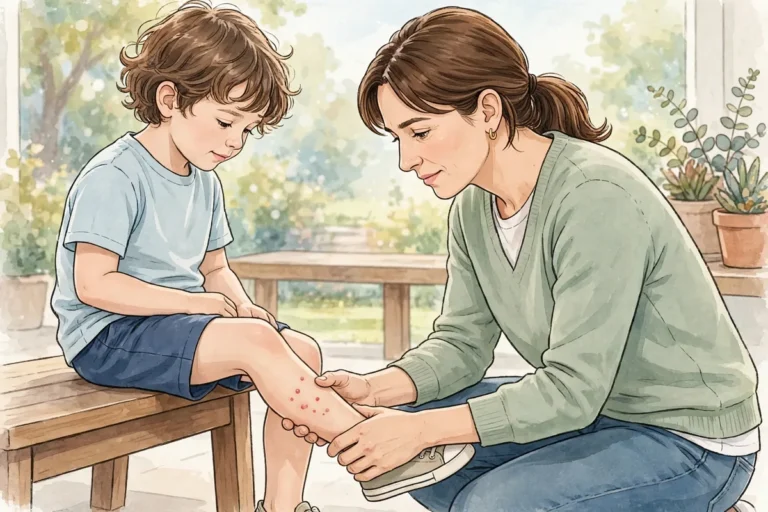
Reactions vary a lot from person to person, which is one reason these bites cause so much confusion. According to Iowa State’s extension service, after a pirate bug bite some people swell up with a welt like a mosquito bite, some simply turn red at the spot, and others have no reaction at all. Two people sitting on the same porch can have completely different evenings — one covered in itchy welts, the other convinced the first is imagining things.
Typical features of a minute pirate bug reaction:
- A sudden sharp pinch felt the moment it happens (unlike most bites, you usually know exactly when it occurred)
- A small red spot, flat or slightly raised, at the probe site
- In sensitive people, a firm, itchy welt resembling a mosquito bite that develops over the next several hours
- Marks on exposed skin — arms, neck, shoulders, legs — wherever the bugs landed
- No central puncture wound, no blister, and no spreading rash in a normal reaction
Most marks settle down within a few days. Because there is no venom involved, there is nothing to “work through” your system — once the tiny mechanical injury heals, the episode is over.
Pirate Bug, Chigger, Oak Mite, or Thrips? Telling Fall’s Invisible Biters Apart
Fall is peak season for mystery bites, and the pirate bug has several look-alike culprits. The single most useful clue is where on your body the bites are and whether you saw the biter:
| Culprit | Do you see/feel it? | Where bites appear | Timing and feel |
|---|---|---|---|
| Minute pirate bug | Yes — a visible black-and-white speck; you feel a sharp pinch instantly | Exposed skin it lands on: arms, neck, shoulders, legs | Warm, sunny fall afternoons; pain first, possible welt later |
| Chiggers | No — larvae are nearly invisible; you never feel the bite itself | From the ground up: ankles, sock line, waistband, under elastic | Intense itching starts hours later and lasts for days |
| Oak leaf itch mites | No — mites drift down from oak trees and can’t be seen | From the top down: neck, shoulders, upper arms, torso | Pimple-like itchy bumps appear about a day after yard work or sitting under oaks |
| Thrips | Barely — tiny sliver-like insects, mostly in gardens and flowers | Hands and arms while gardening or handling plants | Mild, prickly irritation while working with plants |
The pattern matters because the fixes differ. Chiggers call for ground-level precautions; oak mites call for a shower and a change of clothes after yard work (see our guide to oak mite bites and fall rash and the side-by-side chigger bites vs. oak mite bites comparison). Pirate bugs, uniquely, let you see and feel the culprit in the act — if a pepper-flake speck just pinched you, there is no mystery to solve.
Why Bug Spray Doesn’t Work on Pirate Bugs
This is the part that frustrates everyone: you can be wearing repellent and still get bitten, repeatedly. Iowa State’s extension service states it bluntly — available insect repellents have no effect on minute pirate bugs.
The reason is that repellents like DEET and picaridin were designed for a completely different enemy. Mosquitoes and ticks actively hunt you, following your body heat, breath, and skin odors; repellents jam that homing system so the insect never lands. A pirate bug is not hunting you at all. It drifts in on the breeze, lands wherever it lands, and probes out of habit. There is no host-seeking behavior for a repellent to disrupt — the bug is not choosing you, so there is nothing to “repel.” Spraying your yard or fogging is equally pointless, and extension services advise against it: the bugs blow in from fields and woodland over a huge area, and you would be poisoning a beneficial predator that protects your garden all summer.
How to Get Fewer Bites (What Actually Works)
- Use clothing as a shield. The beak is short and blunt — it cannot probe through fabric. Long sleeves and long pants during peak afternoons cut bites to near zero on covered skin.
- Time your yard work. Pirate bugs are most active on warm, sunny, calm afternoons and sluggish in the cold. Extension guidance from Minnesota suggests doing outdoor work on cooler, cloudier days, or in the morning, when the bugs are far less active.
- Brush them off, don’t slap. A slap pins the bug against your skin and guarantees a probe. A quick brush with the back of your hand removes it unharmed and unbothered.
- Change and shower after long sessions outdoors. Bugs hitchhiking on clothing can keep probing indoors. A shower and fresh clothes end the encounter.
- Accept a few bites as the price of a nice day. On the worst afternoons — a warm, still October day after harvest — some bites are simply unavoidable outdoors. They are harmless for the vast majority of people.
Relief: Treating Minute Pirate Bug Bites
Treatment is simple comfort care, the same as for most minor bites. For a fuller rundown, see our existing minute pirate bug bites treatment guide. The essentials:
- Wash the spot with soap and water.
- Cold compress or an ice pack wrapped in cloth for 10–15 minutes calms the initial sting and limits swelling.
- Calamine lotion or 1% hydrocortisone cream helps if a welt turns itchy.
- An oral antihistamine (such as cetirizine or loratadine, per the label) can take the edge off itching, especially at night.
- Don’t scratch. The skin isn’t broken by venom, but scratching can break it — and broken skin is how ordinary bites turn into infected ones.
How Long Does Pirate Bug Season Last?
The biting window opens in late summer — often as field crops are harvested — and peaks on warm days in early to mid fall. It ends with sustained cold: once hard frosts arrive and daytime highs stay low, the migrating adults die off or settle into winter shelter, and the bites stop until the following year. Expect the annoyance to come in waves: a chilly, gray week may give you total relief, then one gorgeous 75-degree afternoon brings the bugs back in force. In most of the Midwest and Mid-Atlantic, the season runs roughly from late August or September until the first hard freeze — a matter of weeks, not months.
When to See a Doctor
Pirate bug bites almost never need medical care, but the same warning signs apply as for any bite. Get checked promptly if you notice:
- Redness that keeps spreading after two to three days, or red streaks moving away from the bite
- Increasing pain, warmth, swelling, or any pus — signs of a skin infection
- Fever, chills, or swollen lymph nodes
- Swelling of the lips, tongue, or face, widespread hives, or any trouble breathing — treat this as an emergency and call 911
- A mark that simply is not improving after a week
If you are ever unsure whether a bite reaction is normal, a pharmacist, clinician, or — for any suspected poisoning or venom concern — Poison Control at 1-800-222-1222 (free, 24 hours) can advise you.
Frequently Asked Questions
Do minute pirate bugs bite at night or come indoors?
They are daytime, outdoor biters, most active in warm afternoon sun. Individuals may ride indoors on clothing or skin, but they do not infest homes, bedding, or furniture, and they cannot live indoors for long. If you are getting bitten in bed at night, a pirate bug is not the culprit.
Why do they bite me but not my spouse?
Two reasons: luck of the landing, and individual skin reactivity. Extension services note that reactions range from nothing at all to a swollen welt. Your spouse may be bitten just as often but simply not react — or not notice the brief pinch.
Can minute pirate bugs bite dogs or cats?
Pets outdoors can be probed just like people, but thick fur protects most of their skin, and the bugs have no interest in animals as hosts. They do not live on pets, and there is no disease risk to them.
How long do the marks last?
For most people, the red spot fades within a few days. Sensitive people can have an itchy welt that lingers several days, similar to a mosquito bite. A mark that keeps growing, hurts more, or drains after several days should be checked for infection.
Will spraying my yard get rid of them?
No — and extension services specifically advise against trying. The bugs migrate in from fields, gardens, and woodland over a wide area, so spraying cannot keep them out, and you would be killing a predator that eats your garden pests all summer long.
Are minute pirate bugs the same as insidious flower bugs?
Yes — same insect, two names. “Minute pirate bug” describes the group; the common species in the eastern and central US is Orius insidiosus, the insidious flower bug.
By Dr. Sarah Jones