Greenhead Fly Season at the Jersey Shore: When They’re Worst, and How to Plan Around Them
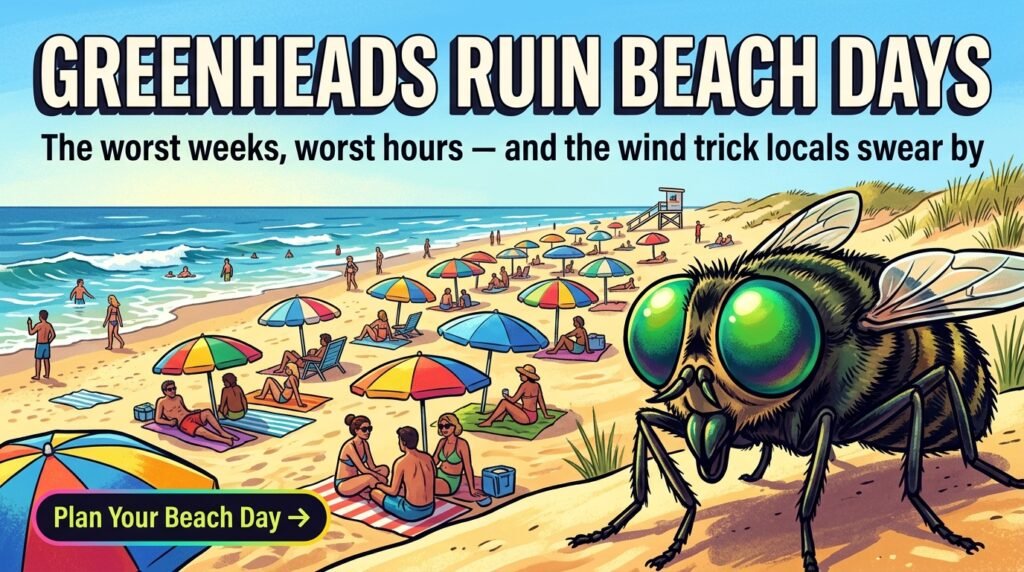
The fast answer: Greenhead flies — the big, green-eyed horse flies that breed in Jersey Shore salt marshes — are a beach problem from late June through Labor Day, with peak numbers in July and August. On any given day they are worst between about 10 a.m. and 3 p.m., when it’s hot, sunny, and calm. The single biggest day-to-day factor is wind direction: a breeze blowing off the ocean pushes them back into the marsh, while a wind blowing off the land (from the west) carries them straight onto the sand. Arrive before 9 a.m. or after 4–5 p.m., pick a breezy spot, and many “unbearable” greenhead days become perfectly manageable.
If you’ve ever had a perfect Jersey Shore beach day destroyed in about ten minutes — everyone slapping their legs, umbrellas folding, coolers being packed — you already know this fly. What most beachgoers don’t know is how predictable greenheads actually are. Their season, their hours, and even their worst days follow patterns you can plan around. This guide covers the calendar, the clock, the wind rule locals use, what the bite does, and the defenses that genuinely work (plus the ones that mostly don’t).
Meet the greenhead: a horse fly with a marsh address
The greenhead (Tabanus nigrovittatus) is a type of horse fly, named for its large, brilliant green eyes. It’s roughly a half-inch to an inch long, dark-bodied, and a strong, persistent flier. Only the females bite. They need protein from blood to produce later batches of eggs, and their mouthparts work like tiny scissors — slicing the skin so blood pools and can be lapped up. That’s why a greenhead bite hurts immediately and can bleed a little, unlike a mosquito’s painless needle prick.
The key to the whole Jersey Shore greenhead story is real estate. Greenhead larvae develop in salt marshes and coastal wetlands, in the moist, organic-rich mud along the high-tide line. The Jersey Shore’s barrier islands sit directly between ocean beaches and vast marsh — in many towns, just a few blocks apart. Adult greenheads emerging from the marsh don’t have far to travel to find a crowd of people in swimwear, and a packed beach is, from a fly’s perspective, an easy buffet. Towns where the island is narrow and the marsh is close tend to suffer most; wider island sections get a natural buffer.
For identification details and step-by-step bite care, see our companion guides on greenhead fly bites and greenhead fly bite first aid.
The season calendar: when greenheads arrive, peak, and leave
Greenheads are a strictly warm-weather problem. Rutgers University researchers have studied them at the Shore since the 1970s and documented peak summer days when a single trap collected more than 1,000 flies in an hour — so the swings between a mild week and a miserable one can be dramatic. Here’s the typical pattern:
| Period | What to expect |
|---|---|
| Mid to late June | First adults emerge from the marsh. Noticeable on calm, hot days near the marsh, but beach pressure is usually light and patchy. |
| July | Peak season begins. Populations surge; hot, still days can be intense, especially on narrow barrier islands close to the marsh. |
| August | Peak continues through most of the month. This is prime greenhead season — and prime beach season — so plan around them. |
| Late August to Labor Day | Numbers start to taper in most years, though a hot, calm spell can still produce bad days. |
| After Labor Day | Activity drops off significantly. September beach days are largely fly-free — one reason locals rate early September among the best beach days of the year. |
Season length varies with the weather — a hotter summer generally means more greenheads and a longer run — but “late June through Labor Day, worst in July and August” is the window to plan around.
The worst hours: mid-morning to mid-afternoon
Within a day, greenheads keep business hours that unfortunately match prime beach time. They bite from sunrise to sunset, but activity peaks in the middle of the day — roughly 10 a.m. to 3 p.m. — when heat and humidity are highest. Entomologists who study them note the one time they essentially never bite is at night.
That daily rhythm gives you two reliable escape hatches:
- Early sessions: Beaches before about 9 a.m. are generally much calmer, even in the heart of July.
- Late sessions: After 4–5 p.m., activity usually falls off sharply. A late-afternoon beach trip is one of the best greenhead-avoidance strategies there is.
The wind rule: the Jersey Shore local’s real forecast
Ask a Shore regular whether tomorrow will be a “fly day” and they won’t check the calendar — they’ll check the wind. Wind direction and speed have an enormous effect on how many greenheads reach the beach:
- Ocean breeze (wind off the water, from the east/southeast): This is your friend. Greenheads are not strong fliers in a steady breeze, and an onshore wind pushes them back toward the marsh. Many days that “should” be bad are fine because of a good sea breeze.
- Land breeze (wind from the west): This is the bad-day pattern. A westerly wind funnels marsh flies directly onto the beach, sometimes in swarms, and can turn a beach day into a scramble for cover within minutes.
- Hot, sunny, and calm: The worst combination of all — peak hours plus no wind to keep them down.
One nuance: the closer you are to the marsh, the less the wind matters — flies are already there. The wind rule matters most for ocean beaches a few blocks or more from the marsh edge. Many Shore communities also run daily fly reports in season, and the big black box traps you’ll see at marsh edges genuinely reduce local numbers — a managed beach with traps is a good sign.
Those black boxes at the marsh: greenhead traps, explained
Drive through any Shore town in July and you’ll see them — big black box traps on posts at the edge of the marsh. These are greenhead traps, and they’re not decoration. The dark box mimics the large, dark shape of an animal, which is exactly what a hunting greenhead is looking for; flies that land on or enter the trap are caught and can’t escape. Rutgers’ long-running research program helped develop and evaluate this approach, and communities that deploy traps at marsh edges see meaningfully fewer flies in the immediate area — on peak days, traps have collected greenheads by the thousands. For a beachgoer, the practical takeaway is simple: towns and beaches that invest in trapping are actively managing their fly problem, and the sand near well-trapped marsh edges tends to be more bearable on marginal days. The traps reduce numbers; they don’t eliminate them — wind and timing still rule your day.
What a greenhead bite does, hour by hour
Because the female slices rather than pierces, the bite is painful on contact and may bleed briefly — press a clean tissue on it for a minute or two. Afterward, expect a raised, itchy welt that can look angry for a day or two and itch for several days. Swelling is usually modest compared with the immediate pain. In New Jersey, greenheads are not known to transmit disease to people; the main medical risk is a skin infection from scratching, so keeping the bite clean matters more than any fancy remedy.
Quick bite care
- Wash the bite with soap and water as soon as you can.
- Apply a cold pack or a cool, wet cloth to calm pain and swelling.
- Use an over-the-counter anti-itch cream or calamine for itching; an oral antihistamine can help if itching is intense — follow the package directions.
- Don’t scratch. Keep nails short on kids, and watch for spreading redness over the next 48 hours.
What actually repels greenheads (honest version)
Greenheads have a well-earned reputation for shrugging off repellents that work fine on mosquitoes. Nothing makes you invisible to them — but the following genuinely reduce bites, especially combined:
- DEET (20–30%) or picaridin (20%): The most effective options. Neither stops every greenhead, but both significantly reduce biting. Apply after sunscreen, cover all exposed skin, and reapply after swimming.
- Light-colored, loose clothing: Greenheads are drawn to large, dark, moving shapes. Light colors make you a less obvious target, and loose fabric is a real barrier — they generally can’t bite through clothing worn loosely, though very thin, tight, stretchy fabric can sometimes let bites through.
- Position: Set up where the breeze is — near the waterline rather than against the dunes, and away from the marsh side of the island. A beach fan aimed at your spot helps more than most people expect, because greenheads are weak fliers in moving air.
- Timing: As above, the early-morning and late-afternoon shifts dodge the worst hours entirely.
What about folk remedies and scented lotions people swear by at the Shore? Experiences vary and the evidence is anecdotal at best. Treat them as a bonus layer, not your plan — wind, timing, and a proven repellent are the plan.
Your greenhead-proof beach day: a planning checklist
- The night before: Check the wind forecast. Westerly winds + a hot, calm forecast = high greenhead risk. Ocean breeze forecast = go with confidence.
- Pick your hours: On high-risk days, go early (arrive before 9 a.m.) or shift to a late session after 4–5 p.m.
- Pick your beach: Wider island sections and beaches farther from the marsh usually fare better; beaches with visible box traps at the marsh edge are actively managed.
- Set up smart: Claim a breezy spot near the water, not a sheltered hollow by the dunes.
- Dress and spray: Light colors, loose cover-up for breaks, DEET or picaridin on exposed skin, reapplied after swimming.
- Have an exit plan: If the wind dies or shifts west midday and the flies arrive in force, that’s the pattern — not bad luck. Pack up, enjoy lunch in town, and come back for the calm late afternoon.
When to see a doctor
Most greenhead bites need nothing beyond home care. Get medical attention if you notice:
- Redness that spreads outward or a red streak moving away from the bite, especially after the first 48 hours
- Increasing pain, warmth, swelling, or any pus after the second day
- Fever along with a worsening bite
- Signs of an allergic reaction — hives spreading over the body, swelling of the lips or face, or any trouble breathing (call 911 for breathing difficulty)
- A bite that isn’t clearly improving after a week
Greenheads aren’t the only slashing biters at East Coast beaches — if your bites came from a smaller fly around your ankles, or you’re also swatting flies inland, compare with our guide to horse fly vs. deer fly bites.
Frequently asked questions
When is greenhead season at the Jersey Shore?
Greenheads typically appear in mid-to-late June, peak through July and August, and decline significantly after Labor Day. September beach days are usually largely fly-free.
What time of day are greenhead flies worst?
Peak activity is roughly 10 a.m. to 3 p.m. on hot, sunny, low-wind days. They bite from sunrise to sunset but are much less active early in the morning and after about 4–5 p.m., and they don’t bite at night.
Why does the wind direction matter so much?
Greenheads breed in the salt marsh behind the barrier islands. A wind blowing off the land (from the west) carries them onto the beach; a breeze off the ocean pushes them back and makes flying difficult for them. That’s why the same beach can be fine one day and unbearable the next.
Do greenhead flies transmit disease?
In New Jersey, greenheads are not known to transmit disease to humans. Their bites are painful and can become infected if scratched, but they are not disease vectors the way some mosquitoes and ticks are.
What is the best repellent for greenhead flies?
DEET in the 20–30% range and picaridin at 20% are the most effective options, though neither stops every bite. Combining repellent with light-colored loose clothing and a breezy spot works better than any product alone.
Can greenheads bite through clothing?
Generally no — they can’t bite through fabric worn loosely. Very thin, stretchy fabric pressed tight against the skin can occasionally let a bite through, so loose, moderately woven, light-colored clothing is the reliable barrier.
By Dr. Sarah Jones