Stable Fly vs. House Fly: How to Tell Apart the Look-Alike That Bites Your Ankles
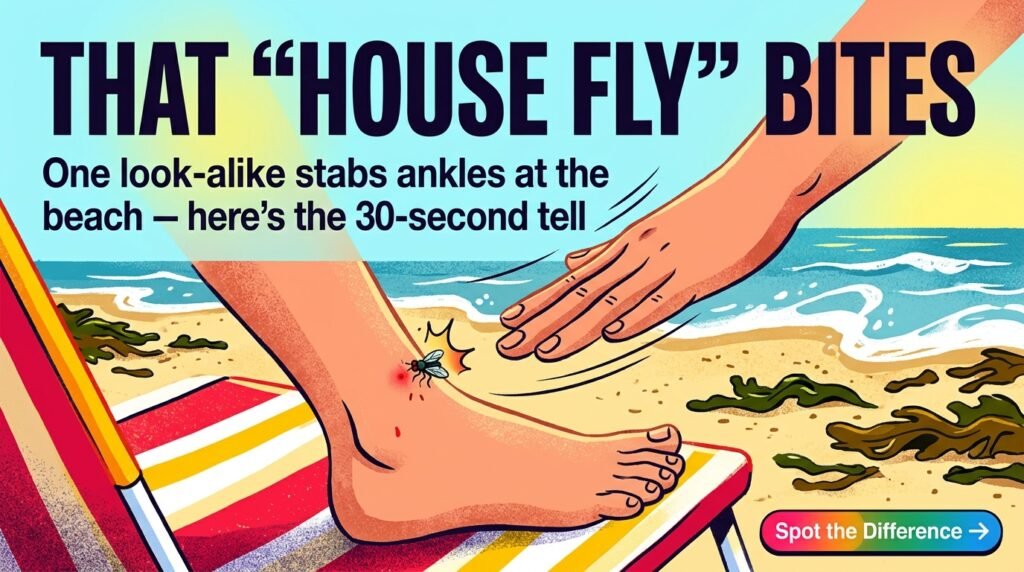
The fast answer: If a “house fly” just bit you — a sharp, stabbing pinch, usually on your ankle or lower leg, often at the beach, a lake shore, or around animals — it was almost certainly not a house fly at all. House flies cannot bite; their mouthparts are built like a sponge for lapping up liquids. The biter is the stable fly (Stomoxys calcitrans), a near-perfect house fly look-alike with one giveaway: a rigid, needle-like proboscis that sticks straight forward from its head like a bayonet. Learn that one feature, and you’ll never be fooled again.
This confusion is one of the most common in the biting-fly world, because the two flies are close in size, both gray with dark stripes, and both show up around homes, farms, and food. University of Florida extension specialists call the stable fly exactly what it is — the biting house fly look-alike. Here’s how to separate them with confidence, why the stable fly hunts ankles, what to do about the bite, and how to keep them away.
The 30-second identification test
You don’t need a microscope. Three checks, in order:
- Did it bite? A sharp, painful stab settles the question by itself. House flies are physically incapable of biting — no exceptions. Painful bite = stable fly (or another biting fly).
- Look at the head. On a stable fly, a stiff, pointed proboscis projects forward from under the head, visible in profile like a tiny lance. A house fly’s mouthparts are soft and blunt, tucked under the head — built for sponging, not piercing.
- Look at the abdomen. A stable fly’s abdomen carries a checkered, spotted pattern of dark patches. A house fly’s abdomen is plainer, without that checkerboard look — and if the fly is calmly dabbing at a surface with its mouth, it’s a house fly feeding.
Stable fly vs. house fly: full comparison
| Feature | Stable fly | House fly |
|---|---|---|
| Does it bite? | Yes — painful, stabbing bites | No — cannot bite at all |
| Mouthparts | Rigid, forward-pointing proboscis (“bayonet”) | Soft, sponging mouthparts for lapping liquids |
| Who feeds on blood | Both males and females | Neither — feeds on liquids, food waste, moisture |
| Abdomen | Checkered/spotted dark pattern | Plainer, no checkerboard spots |
| Body | Gray, about ¼ inch, dark stripes on the thorax | Gray, about ¼ inch, four dark stripes on the thorax |
| Where you meet it | Beaches and lake shores, barns and stables, dog runs, campgrounds — outdoors | Kitchens, garbage areas, anywhere food and waste are |
| Behavior | Fixates on ankles and lower legs; lands, bites fast, persists after being brushed off | Wanders onto food and surfaces; doesn’t pursue legs |
| Breeding sites | Rotting vegetation — beach wrack, wet hay and straw, grass clippings, manure mixed with bedding | Moist, decaying organic matter — garbage, manure, compost |
| Peak season | Late summer into fall (August–September beach outbreaks) | All warm months |
One more behavioral tell: a stable fly at rest tends to sit with its head up and doesn’t fold its wings flat over its back the way a house fly does — but honestly, the bite and the bayonet are the tells you’ll actually use.
Why stable flies go for your ankles
Stable flies are visual hunters that key in on large animals — cattle and horses are their classic targets, which is how they got their name. Both males and females need blood, and they feed multiple times a day. They typically fly low and strike low: the lower legs and ankles of livestock, dogs, and any person sitting still nearby.
That’s why the classic stable fly scene is a beach chair. Along the Great Lakes and other northern shores, late-summer outbreaks are a documented phenomenon: decomposing beach wrack — the mats of algae and vegetation that wash up along the waterline — is ideal stable fly breeding material, and in August and September the emerging adults head for the nearest ankles, which happen to belong to people relaxing in low chairs. They can deliver several bites in quick succession, they’re persistent after being swatted away, and they’ll even follow you indoors — one of the few biting flies that will bite inside a building. Their bite can also get through thin socks, so “I was wearing socks” doesn’t rule them out.
What a stable fly bite feels and looks like
The bite itself is a sudden sharp stab — more startling than a mosquito bite and impossible to ignore. It leaves a small red mark or welt that itches intensely for a few days and can develop into a small, hard lump. Multiple bites clustered around the ankles and lower calves are typical. Unlike horse and deer fly bites, stable fly bites usually don’t draw a visible bead of blood, and swelling is usually much less dramatic. Stable flies are not known to transmit diseases to people in the United States; the realistic risk is a secondary skin infection if bites are scratched raw.
Relief, step by step
- Wash the bites with soap and water.
- Apply a cold pack or cool cloth for the first day to calm itching and irritation.
- Use calamine lotion or an over-the-counter anti-itch cream as directed; an oral antihistamine can help if itching is keeping you awake.
- Resist scratching — broken skin around the ankles heals slowly and infects easily. Keep the area clean and covered if you’re heading back outside.
- Watch for spreading redness, warmth, or increasing pain after 48 hours — signs of infection that need medical care.
Keeping stable flies away
Protect the target. Stable flies hunt ankles, so defend ankles: long pants and real shoes beat sandals in outbreak areas, and a repellent containing DEET or picaridin applied to the lower legs helps — expect to reapply more often than you would for mosquitoes, as repellents wear off faster against determined biting flies.
Choose your spot. At the beach, sit away from the wrack line — the band of washed-up vegetation along the shore — and away from dune grass where flies rest. A breeze helps; stable flies, like most biting flies, are weaker in moving air.
Don’t forget the dog. Dogs are prime stable fly targets — flies work their legs and belly, and dogs in outdoor kennels, runs, and dog parks in late summer can collect clusters of ankle and belly bites that owners mistake for a rash or allergies. If your dog comes home from the yard or a boarding kennel with itchy lower-leg bites during an outbreak, stable flies belong on the suspect list. Shade, a fan in the kennel area, and moving exercise to breezier spots all help; ask your veterinarian before applying any repellent product to your dog, since products made for people aren’t automatically safe for pets.
Remove the nursery (for homeowners and animal owners). Stable flies breed in rotting plant material, not in your house. The most effective long-term control is sanitation: spread manure and soiled bedding thin so it dries fast, clear wet hay, straw, and grass-clipping piles promptly, clean up spilled feed, and rotate hay-feeding spots. Wood shavings make better stall bedding than straw or hay because they break down more slowly. In barns, traps and parasitoid wasps that attack fly pupae are established tools. And because stable flies will come indoors to bite, keep window and door screens in good repair during late-summer outbreaks.
Could it be something else?
Ankle-level biting has a few other suspects. Deer flies and horse flies also bite low, but they’re larger, noisier, and their bites hurt more and swell more — here’s our deer fly bite treatment guide for comparison. Black flies are tiny, swarm near running water in spring, and leave itchy, sometimes bleeding bites — see our black fly bite treatment guide. And if the bites match the stable fly pattern, our stable fly bite treatment guide goes deeper on care.
The other ankle-biters, at a glance
Stable flies aren’t the only things working the ankle shift. If your biter doesn’t quite match the bayonet test, use this quick field comparison:
| Biter | How it announces itself | Typical setting | Bite result |
|---|---|---|---|
| Stable fly | Silent landing, sudden sharp stab, mostly ankles | Beaches, lake shores, farms, dog areas | Small itchy welt, sometimes a hard lump; little swelling |
| Deer fly / horse fly | Loud buzzing, circles your head and shoulders before landing | Woods, trails, marshes, fields | Painful bite that may bleed; large swelling over 24–72 hours |
| Black fly | Nearly invisible; swarms around head, neck, and ankles | Near streams and running water, spring and early summer | Itchy bite, sometimes with a spot of blood; swollen glands in heavy attacks |
| Mosquito | High whine, usually dusk and dawn | Everywhere, especially near standing water | Familiar itchy bump, no sharp pain at the moment of biting |
Why stable flies are so hard to shake off
People new to stable flies are often struck by how committed they are. A house fly flees at a wave; a stable fly circles back. There are reasons. Stable flies hunt largely by sight, keying in on big, contrasting shapes — the dark silhouette of legs against sand, sky, or ground — and once a fly has found a host, an interrupted meal doesn’t end the hunt. A stable fly that’s brushed off mid-feed will typically return and try again, sometimes repeatedly, and because these flies feed more than once a day and both sexes feed, an infested shoreline can produce what feels like a coordinated assault on every exposed ankle. They also move well: stable flies are strong fliers that can travel miles from where they bred, which is why you can be bitten at a tidy, well-kept beach with no obvious breeding site in view — the wrack line down the shore may be producing them. Indoors, they’re the exception among biting flies: they will follow hosts into barns, garages, and homes and bite there, one more reason they’re confused with house flies until the first stab lands.
When to see a doctor
Stable fly bites almost never need a doctor. Seek care if you develop:
- Redness that spreads, a red streak, increasing pain or warmth after 48 hours, or any pus
- Fever with a worsening bite
- Swelling of the face or lips, widespread hives, or trouble breathing after any bite (an emergency — call 911)
- Bites that aren’t improving after a week to ten days
Frequently asked questions
Can house flies bite?
No. House flies have sponging mouthparts designed to lap up liquids; they have no way to pierce skin. If something that looked like a house fly bit you, it was a stable fly — its close look-alike — or another biting fly entirely.
How can I tell a stable fly from a house fly at a glance?
Look for the bayonet: a stiff, needle-like proboscis pointing forward from the stable fly’s head, plus a checkered, spotted pattern on its abdomen. Behavior is the other giveaway — a “house fly” that keeps landing on your ankles and stinging you is a stable fly.
Why do stable flies only bite my ankles?
They fly low and target the lower legs of their hosts — the legs of cattle and horses, and the ankles of seated or standing people. It’s simply where they hunt, which is why beach chairs and picnic blankets are prime attack zones.
Do stable flies transmit diseases?
They are not known to transmit diseases to people in the United States. The main risk is an ordinary skin infection from scratching, so keep bites clean and watch for spreading redness.
Where do stable flies come from at the beach?
They breed in decomposing vegetation. On northern lake and ocean shores, the wrack line — washed-up algae and plant debris — breeds them in late summer, which is why outbreaks peak in August and September and why sitting away from the wrack helps.
What keeps stable flies off me?
Cover the ankles (pants, socks, closed shoes), use DEET or picaridin on the lower legs and reapply often, sit away from shore debris lines, and — at home — remove rotting hay, grass, and bedding piles where they breed.
By Dr. Sarah Jones