
Can Bed Bugs Climb Walls?
You spot a small, flat, reddish-brown bug crawling up your bedroom wall, or worse, on the ceiling, and the question hits you immediately: can…
Bed bug treatment, measured: 20,000x deltamethrin resistance ratios, the 54.8 °C egg lethal temperature, fogger trial results and field elimination rates — every figure from a primary source.
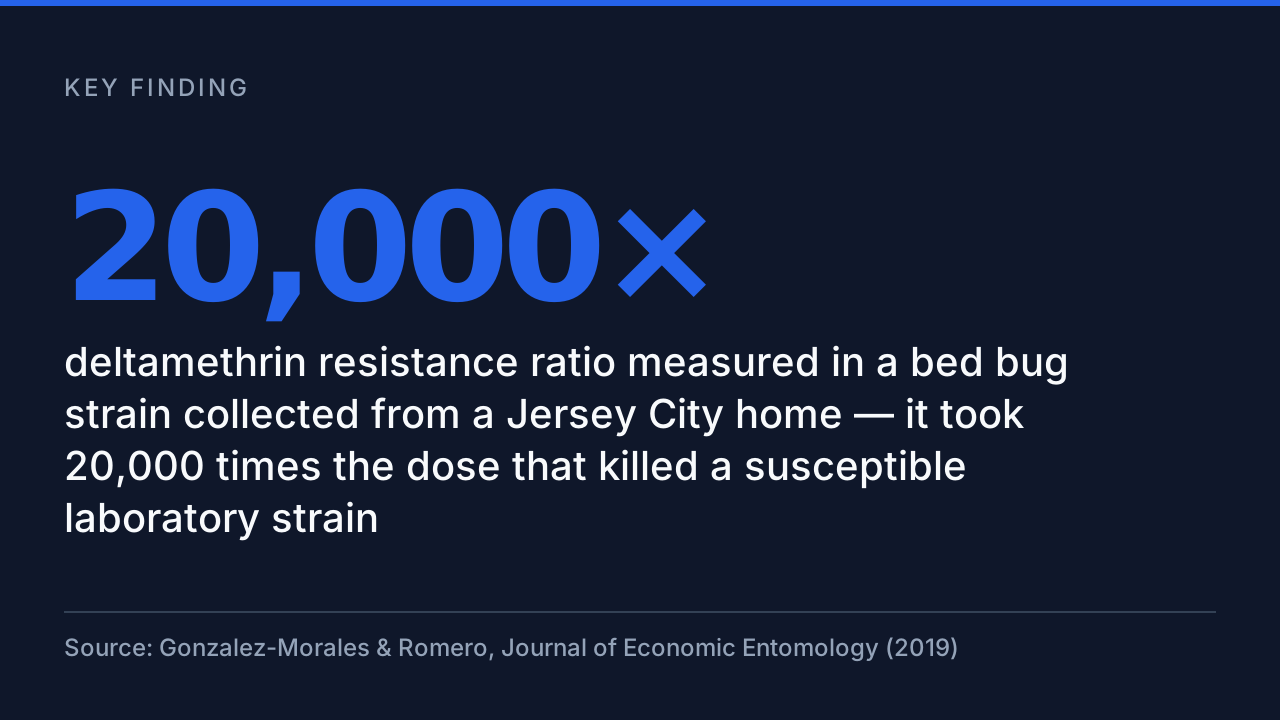
Source: Gonzalez-Morales & Romero, Journal of Economic Entomology (2019)
Bed bug advice usually arrives as folklore: a temperature quoted without an exposure time, a resistance claim without a strain, a visit count without a survey. This article replaces the folklore with the measurements themselves — the laboratory and field record on what bed bug treatments actually do, assembled from the primary studies and printed with the conditions each number was measured under.
The headline finding is a dose problem. A strain collected from a home in Jersey City carried a deltamethrin resistance ratio of 20,000: the dose that killed a susceptible laboratory strain had to be multiplied twenty-thousand-fold. That figure is not an outlier sitting on top of a tidy scale — it is one method-bound measurement among several, and the first job of this article is to keep the methods separate, because a resistance ratio means nothing without its strain, its chemical and its bioassay attached.
The second job is correction. The lethal temperatures quoted across the internet are routinely attributed to the wrong paper, and the industry’s favourite statistic about itself — how many visits control takes — circulates in a version no survey supports. Both are corrected here, against the real sources. Nothing in this article is a treatment manual, and no pest-company figure appears in it as data. If you are checking a room after travel rather than fighting an established infestation, start with the hotel room bed bug inspection checklist.
Pyrethroid resistance in US bed bugs was already already widespread in 2007, and the ratios measured since are method-bound but unambiguous: a Cincinnati strain at 3,333, a Richmond strain at 5,200, and a Jersey City strain — this article’s headline — twenty-thousand-fold. In a 2023 study, 7 of 13 of thirteen US field populations had very high deltamethrin resistance ratios.
| METRIC | VALUE | SOURCE |
|---|---|---|
| Deltamethrin resistance ratio, Cincinnati strain | 3,333 | Gonzalez-Morales & Romero, Journal of Economic Entomology |
| Deltamethrin resistance ratio (LD50), Richmond, Virginia strain | 5,200 | Adelman et al., PLoS ONE |
| Deltamethrin resistance, laboratory-selected strain (filter contact vial bioassay) | >9,375 | Zhu et al., Journal of Medical Entomology (PMC) |
| Deltamethrin resistance ratio at LD25 (topical), Knoxville strain | 72,893 | Gaire et al., Pesticide Biochemistry and Physiology |
| Deltamethrin resistance ratio at LD50 (topical), Knoxville strain | 291,626 | Gaire et al., Pesticide Biochemistry and Physiology |
The largest ratios in the record come from a Knoxville strain measured by topical application: 72,893 at the LD25 endpoint and 291,626 at LD50, from a study whose main subject was essential oils. A laboratory strain selected for resistance using a filter-paper contact assay showed >9,375 resistance to deltamethrin and 6,990 to lambda-cyhalothrin. These numbers cannot be ranked against each other — topical lethal-dose ratios, contact-assay ratios and knockdown-time ratios are different measurements — and this article never averages them.
Two different numbers headline the resistance literature — 20,000x from the 2019 synergist study and 291,626x from the 2020 topical study — and both are real. What a reader should take from the spread is not a league table but a floor: by every method, in every programme that went looking between 2007 and 2023, pyrethroid resistance in US homes was found at levels the authors themselves describe as very high. The reference point matters too: every ratio is measured against a laboratory strain kept away from insecticides for decades, so a ratio describes the distance from that baseline, not a dose anyone should apply.
Three mechanisms are experimentally identified in bed bugs: a thickened, remodelled cuticle that slows the insecticide’s entry; detoxification enzymes — chiefly cytochrome P450s and esterases — that destroy it; and knockdown resistance, where mutations in the nerve’s sodium channel (V419L and L925I) dull the target itself. Of 110 US populations screened in 2010, 88% already carried one or both kdr mutations, and in New Jersey’s temporal sample the L925I mutation reached 100%.
| METRIC | VALUE | SOURCE |
|---|---|---|
| US bed bug populations screened for kdr mutations (2010) | 110 | Zhu et al. 2010, reported in Adelman et al., PLoS ONE |
| New Jersey populations sequenced for kdr mutations, 2010–2024 | 227 | Journal of Pest Science (Springer), 2025 |
| Share of sampled populations carrying the V419L mutation, by year | 95.3-100% | Journal of Pest Science (Springer), 2025 |
| Synergism ratio of DEF with deltamethrin, Jersey City strain | 102.3 | Gonzalez-Morales & Romero, Journal of Economic Entomology |
| Synergism ratio of PBO with deltamethrin, Cincinnati strain | 158.8 | Gonzalez-Morales & Romero, Journal of Economic Entomology |
| Neonicotinoid resistance ratio (RR50), Linden 2019 population | 76.9 | Insects (MDPI), 2023 |
The deepest genetic record comes from New Jersey, where 227 populations collected between 2010 and 2024 show the end state of the process: V419L appears in 95.3-100% of populations across the period, and a 2025 study of eight New Jersey strains found 8 of 8 carrying both mutations together, with detoxification enzyme activity raised alongside them. The synergist experiments connect the genetics to the spray can: when detoxification enzymes were blocked in the laboratory, deltamethrin became dramatically more effective against the Jersey City strain (synergism ratio 102.3 with DEF) and the Cincinnati strain (158.8 with PBO) — direct evidence that metabolic enzymes carry a measurable share of those strains’ resistance.
The practical reading is narrow but real. Resistance in the field is layered, which is why single-mechanism products disappoint, and why the neonicotinoids are the exception that proves monitoring matters: in the 2023 study, only one of thirteen populations — Linden 2019, at 76.9 — showed high neonicotinoid resistance, while the rest sat near the susceptible baseline.
The only controlled test of over-the-counter foggers — the ‘bug bombs’ sold everywhere — exposed five field-collected populations to three leading products for a full two hours; the populations showed little, if any adverse effects. The experiment’s susceptible control strain reached 91% mortality in the open within a day, but was unaffected under a single layer of cloth. Professional residual sprays against a moderately resistant strain reached no more than 70% mortality on any substrate tested.
| METRIC | VALUE | SOURCE |
|---|---|---|
| Effect of three OTC total-release foggers on five field-collected populations | little, if any | Jones & Bryant, Journal of Economic Entomology |
| Highest mortality, Bedlam / Demand CS / Temprid SC on any substrate (resistant strain) | 70% | Insects (MDPI), 2016 |
| Transport GHP: LC90 performance ratio (concentration multiplier vs laboratory strain) | 900-2017 | Insects (MDPI), 2023 |
| Temprid SC: LC90 performance ratio (concentration multiplier vs laboratory strain) | 55-129 | Insects (MDPI), 2023 |
| Tandem: LC90 performance ratio (concentration multiplier vs laboratory strain) | 100-196 | Insects (MDPI), 2023 |
| Silica gel dust (CimeXa): mortality after a brief exposure, three resistant populations | >95% | Insects (MDPI), 2023 |
The mixture sprays built to answer resistance perform better, but their measured price is concentration: against three resistant populations, Transport GHP needed 900-2017 times the laboratory-baseline concentration to reach its LC90 endpoint, Temprid SC needed 55-129, and Tandem 100-196. Direct application tells the same story at label rates — deltamethrin sprayed straight onto a moderately resistant strain at the highest label rate killed 36% in one test and 50% in a repeat sixteen months later. Products built on a named active ingredient, like the one examined in does Crossfire kill bed bugs, inherit this record: the question is never the brand, it is the strain in the room. Our earlier explainer reached the same conclusion from the consumer side, asking do store-bought bed bug sprays work?
The pattern across two decades of product testing is consistent: contact and coverage decide outcomes more than chemistry does. Foggers fail on both counts — resistant bugs, and bugs the mist never reaches. Residual sprays fail on the first count against resistant strains. The desiccant dust stands apart precisely because it does not negotiate with any of the three resistance mechanisms: it removes the waterproofing from the insect’s cuticle, and the insect dries out.
The lethal temperatures quoted across the internet come from a 2011 study designed to mimic commercial whole-room heat treatment — and they are routinely attributed to the wrong paper. The lethal temperature at the near-total endpoint (LTemp99) is 48.3 °C for adults and 54.8 °C for eggs. Time trades against temperature only so far: at forty-five degrees Celsius, adults reach that endpoint in 94.8 min, while eggs survive for hours. Cold is measured in days: complete mortality of every life stage required 80 hours of sustained deep cold.
| METRIC | VALUE | SOURCE |
|---|---|---|
| Lethal temperature (LTemp99 endpoint), adults | 48.3 °C | Kells & Goblirsch, Insects (MDPI) |
| Lethal temperature (LTemp99 endpoint), eggs | 54.8 °C | Kells & Goblirsch, Insects (MDPI) |
| Lethal temperature (LTemp50 endpoint), adults | 43.5 °C | Kells & Goblirsch, Insects (MDPI) |
| Lethal temperature (LTemp50 endpoint), eggs | 47.5 °C | Kells & Goblirsch, Insects (MDPI) |
| Time to the LTime99 endpoint, adults at forty-five degrees | 94.8 min | Kells & Goblirsch, Insects (MDPI) |
| Time to the LTime99 endpoint, eggs at forty-eight degrees | 71.5 min | Kells & Goblirsch, Insects (MDPI) |
| Lower lethal temperature (LLT99 endpoint), all life stages | -31.2 °C | Olson et al., Journal of Economic Entomology |
| Mortality of exposed tropical bed bugs, brief steam application | 100% | Kong et al., Pest Management Science (PubMed) |
| Mortality of tropical bed bugs under a fabric cover, longer steam application | 89 ± 6% | Kong et al., Pest Management Science (PubMed) |
The halfway points underline the stage problem: the LTemp50 sits at 43.5 °C for adults and 47.5 °C for eggs — even the egg halfway mark is close to the adult near-total mark, which is why treatments designed around adults fail quietly. Sustained moderate heat does real damage below the kill line: at forty degrees Celsius, adults died within 2 days, and fertility stayed suppressed for 40 days after sublethal exposure ended. Those are multi-day laboratory exposures, not heater settings; the consumer versions of the idea are tested in do portable bed bug heaters work and does a hair dryer kill bed bugs. The heat literature only looks contradictory — an acute adult threshold of 48.3 °C versus complete mortality at forty degrees given two full days — until exposure time is restored to the numbers.
Cold is slower than folklore suggests. The modelled lower lethal temperature at the LLT99 endpoint across life stages is -31.2 °C, and some eggs survived brief exposures to -25 °C — which is why the freezing advice in our bed bugs in luggage checklist is written in days, not hours. Steam is the sharpest contact tool in the record: one second of direct steam killed 100% of exposed tropical bed bugs, but under one layer of fabric, ten seconds managed 89 ± 6% — the harbourage problem again, and the same story told in does steam kill bed bugs. Two principles organise all of it: the coldest spot in the room decides a heat treatment, not the thermostat; and time trades against temperature only within limits, below which brief heating scatters bugs deeper without killing them.
Laboratory ratios predict difficulty; field trials measure it. In an Indianapolis low-income high-rise, three strategies ran side by side for ten weeks: non-chemical methods only — encasements, steam, hand removal — eliminated bed bugs from 67% of apartments; IPM, combining chemical and non-chemical methods, reached 44%; insecticides only managed 33%. The researchers’ own warning label travels with the numbers: the groups started unequal, the non-chemical group lightest and the insecticide group heaviest, and the differences were not statistically significant.
| METRIC | VALUE | SOURCE |
|---|---|---|
| Apartments eliminated after ten weeks, non-chemical methods only | 67% | Wang et al., Insects (MDPI) |
| Apartments eliminated after ten weeks, insecticides only | 33% | Wang et al., Insects (MDPI) |
| Apartments eliminated after ten weeks, IPM (combined) | 44% | Wang et al., Insects (MDPI) |
| Bed bug count reduction after ten weeks, diatomaceous-earth IPM | 97.6% | Wang, Gibb & Bennett, Journal of Medical Entomology |
| Bed bug count reduction after ten weeks, chlorfenapyr-spray IPM | 89.7% | Wang, Gibb & Bennett, Journal of Medical Entomology |
| Infestation rate after twelve months of building-wide IPM (fell) | 3% | Wang et al., Journal of Integrated Pest Management |
| Infestation rate after twelve months, control building on monthly service (rose) | 12% | Wang et al., Journal of Integrated Pest Management |
| Infestations eliminated by steam / steam + dust field programmes | 97-100% | Kong et al., Pest Management Science (PubMed) |
An earlier trial of two least-toxic IPM programmes shows the distance between reduction and elimination: counts fell by 97.6% under the diatomaceous-earth programme and 89.7% under the chlorfenapyr programme, yet eradication at ten weeks stood at 50% of apartments in each. At building scale the record sharpens. Twelve months of building-wide IPM cut one high-rise’s infestation rate to 3% — achieved even though the contractor only partially followed the protocol — while the control building, on conventional monthly service, rose to 12%. In a long field trial, steam-based programmes eliminated 97-100% of infestations, over a programme measured in most of a year. Established infestations behave this way wherever they sit; the problems documented in bed bugs in hospitals and emergency rooms are this same record at institutional scale.
Read together, the field studies locate most failure in delivery rather than chemistry: starting infestation level, resident cooperation, clutter and whether the whole building is treated move the outcome more than the choice among programmes. The honest limits deserve stating plainly — these trials are small, the largest strategy comparison covers a single building’s apartments, and no national monitoring programme exists to widen the picture. The field record is a patchwork of careful small studies, and it is printed here at that strength.
The regulator’s page on bed bug treatment reads like the shadow of the efficacy data. The EPA classifies improvised heating — space heaters, fireplaces — as legal but not safe, noting such treatments have been known to burn down homes. Rubbing alcohol, a folk remedy still recommended in comment threads, has caused numerous house fires when used against bed bugs; its measured story is in does rubbing alcohol kill bed bugs. Using too many foggers at once risks a fire and/or explosion, and improvised freezing may not get cold enough — exactly what the cold-tolerance model predicts. The pattern covers most home remedies, including the ones in does borax kill bed bugs: unmeasured methods carry unmeasured risks.
| METRIC | VALUE | SOURCE |
|---|---|---|
| US EPA on DIY heating treatments (space heaters, fireplaces) | burn down homes | US EPA, Stay Legal and Safe in Treating for Bed Bugs |
| US EPA on rubbing alcohol used against bed bugs | numerous house fires | US EPA, Stay Legal and Safe in Treating for Bed Bugs |
| US EPA on using too many fogger products at once | fire and/or explosion | US EPA, Stay Legal and Safe in Treating for Bed Bugs |
| US EPA on DIY freezing treatments | not get cold enough | US EPA, Stay Legal and Safe in Treating for Bed Bugs |
The professional alternative is not a sales pitch in this record; it is a workload. In the 2013 operator survey, 69% of companies said two or three services were typically needed and 12% said more than three, while the median initial service took 3.4 hours. The methods mix explains the hours: insecticides remain the default for 95% of professionals, but 84% also deploy encasements and 40% use whole-room heat — layered programmes, not single products. The obstacle professionals name most is not the bug’s biology but its shelter: 80% cited homeowner clutter as the biggest customer-side challenge. The difficulty rating has barely moved in a decade — 68% called bed bugs the most difficult pest to control in 2015, and in the December 2025 survey 24% still ranked them the single most difficult.
One figure in this section carries its own correction. Pest-company blogs widely repeat that nearly 80% (commonly cited; no primary source traceable) of operators need at least three visits to control an infestation. No primary source for that figure is traceable — in one version it is even attributed to the 2007 resistance paper, which contains no survey at all. The traceable record is the survey used above: about seven in ten companies needing two or three services, a minority needing more. Expect the practical shape of the field to persist: with the L925I mutation fixed in the best-sampled populations, pyrethroid-only products will keep failing there, and practice will keep shifting toward dusts, heat and mixtures — the categories with measured performance. The verdict of the whole record is simple. Treatment failure is not mysterious and not bad luck; it is measured — and the methods that work share one property: none of them asks the bug’s nervous system for permission.


How this article was built (DataGap Method, degraded mode — named honestly): demand for this topic could not be measured directly (Stage 1: public Reddit data is blocked on this host, so demand is marked UNMEASURED), and the Stage 3 format check did not run. The existence gate (Stage 4) was run manually against a fresh 690-URL sitemap corpus of this site and returned CLEAR. Every number sits in a verified fact sheet with its primary source; facts were machine-verified against their source pages where the host allowed it and confirmed by reading the sources directly — including four journal PDFs — where it did not. One widely repeated industry statistic could not be traced to any primary source and is published labelled contested. No vendor or pest-company figure is used as data anywhere. Images are charts drawn locally from the fact sheet; no AI image service was used.
Most likely because the bugs are measurably resistant and never touch a lethal dose. A Jersey City field strain had a deltamethrin resistance ratio of 20,000 (Gonzalez-Morales & Romero, 2019), and 88% of US populations screened in 2010 carried kdr resistance mutations. On top of that, sprays cannot reach bugs inside harbourages — in the fogger experiments, even a susceptible strain survived under one layer of cloth. (Gonzalez-Morales & Romero, Journal of Economic Entomology, 2019)
In the only controlled test of the three leading over-the-counter foggers, five field-collected bed bug populations showed little, if any, adverse effects after a full two-hour exposure (Jones & Bryant, 2012). The susceptible laboratory strain died when exposed in the open (98% by day 5-7) but was unaffected under a thin cloth cover. The EPA separately warns that using too many foggers at once can cause a fire or explosion. (Jones & Bryant, Journal of Economic Entomology, 2012)
In laboratory measurements designed to mimic whole-room heat treatment, the lethal temperature for 99% mortality was 48.3 °C for adults and 54.8 °C for eggs (Kells & Goblirsch, 2011). Time substitutes for temperature only down to a point: at 45 °C, 99% of adults died in 94.8 minutes, but eggs survived the full seven-hour trial. These are professional-equipment numbers — the EPA warns that DIY heating with space heaters or fireplaces has burned down homes. (Kells & Goblirsch, Insects (MDPI), 2011)
Yes, but the measured requirement is days of sustained deep cold, not an overnight freeze. Olson et al. (2013) found 100% mortality of all life stages needed a minimum of 80 hours at -16 °C; their model predicted survivors after a week above -12 °C, and some eggs survived short exposures to -25 °C. The EPA notes DIY freezing methods may not get cold enough to work at all. (Olson et al., Journal of Economic Entomology, 2013)
The traceable survey figure: in the 2013 NPMA/University of Kentucky survey of 251 companies, 69% said two or three services were typically needed, 12% said more than three, and 16% said one visit was enough. Pest-company blogs often repeat a claim that 'nearly 80%' of operators need at least three visits; no primary source for that figure is traceable, and it does not match the survey it appears to descend from. (Potter & Haynes, ICUP 2014 proceedings (2013 survey), 2013)
On contact, yes — a one-second steam application killed 100% of exposed tropical bed bugs in laboratory tests (Kong et al., 2024). Under a single layer of fabric, ten seconds of steam killed 89 ± 6%. In a 37-week field trial, steam-based programs eliminated 97-100% of infestations. Steam is a contact tool: its measured weakness is the same as every other method's — the bugs it never reaches. (Kong et al., Pest Management Science (PubMed), 2024)
No, and the field studies show the gap. In a 2012 Indianapolis apartment trial, ten weeks of professional treatment eliminated bed bugs from 67% of apartments using non-chemical methods only, 44% under IPM and 33% using insecticides only — with small groups and different starting infestation levels. Laboratory thresholds tell you what a treatment can do under controlled exposure; field results tell you what delivery, clutter and starting numbers do to it. (Wang et al., Insects (MDPI), 2012)
Last updated:
This article is for informational purposes only and isn’t medical advice. If you’re worried about a bite or sting, talk to a healthcare professional.
Dr. Jones oversees StingHelp’s clinical verification process. Every guide is systematically evaluated against active Centers for Disease Control and Prevention (CDC), Environmental Protection Agency (EPA), and American Academy of Allergy, Asthma & Immunology (AAAAI) medical consensus standards to ensure symptom distinctions and care recommendations are clinically sound.
Explore physician-reviewed first-aid procedures, identification clues, and symptom comparisons for other common outdoor bites and stings.
You spot a small, flat, reddish-brown bug crawling up your bedroom wall, or worse, on the ceiling, and the question hits you immediately: can…
You pull back the sheets and notice tiny black specks. Your stomach drops, is it bed bugs, or fleas? Both pests leave behind dark…
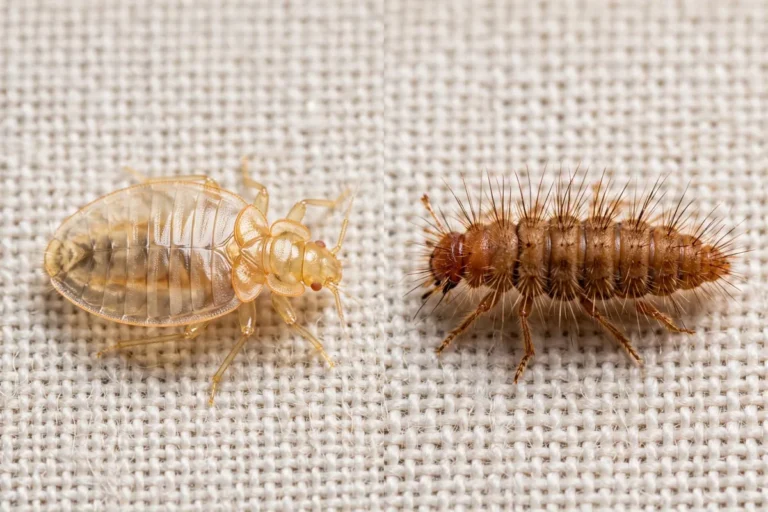
You found a tiny bug in the bedroom, and your stomach dropped. The question of bed bug nymph vs carpet beetle larva is one…