
You are at the pharmacy counter with a new allergy action plan, and the pharmacist asks which auto-injector your allergist prescribed — EpiPen or Auvi-Q. Both boxes promise to save your life, and the choice suddenly feels enormous. Here is the direct answer from this epipen vs auvi-q comparison: both devices deliver the same emergency medicine for anaphylaxis, so the “better” one is the device you will carry every single day and can fire without hesitation when seconds count.
EpiPen vs Auvi-Q: Side-by-Side Comparison #
EpiPen, made by Viatris, is the name most people know — the orange-tipped pen that has been around for decades. Auvi-Q, made by kaleo, is the compact challenger with a talking voice and a credit-card footprint. The table below lays out the practical differences that actually matter at the moment of use.
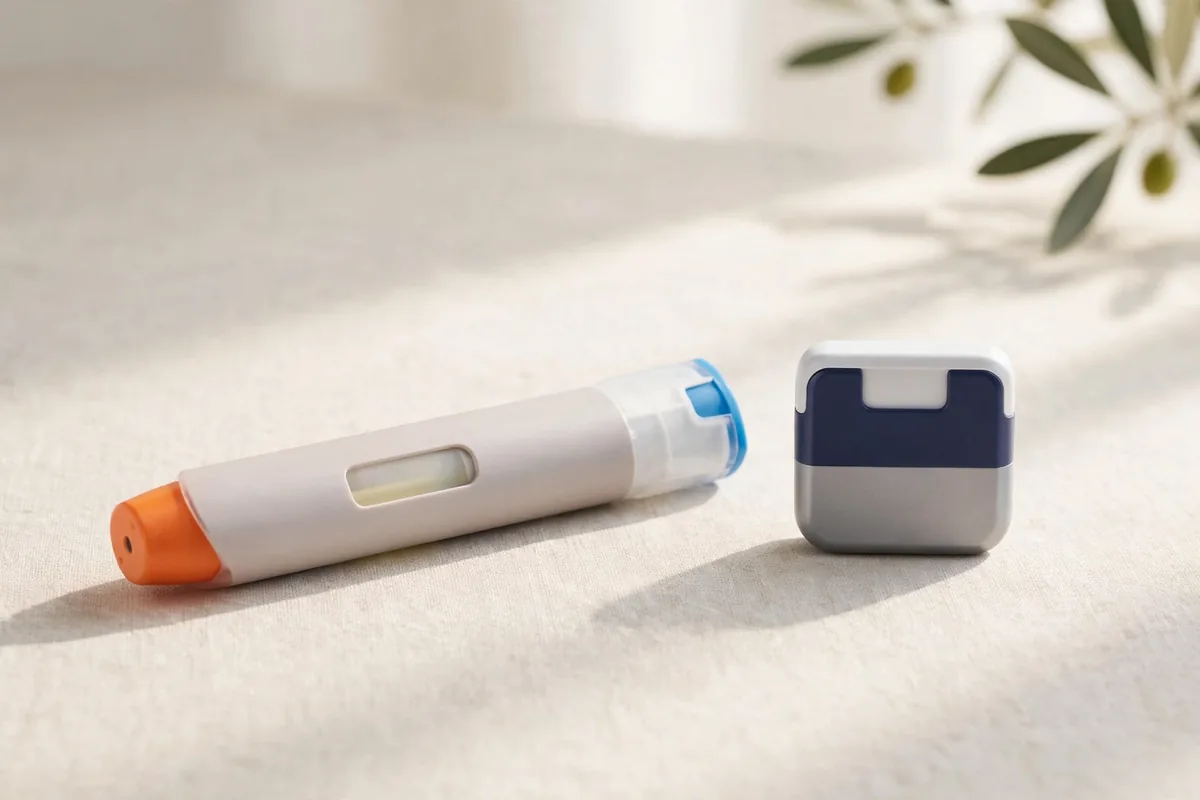
| Feature | EpiPen (Viatris) | Auvi-Q (kaleo) | |—|—|—| | Shape and size | Pen-shaped, about 6 inches long | Compact rectangle, roughly 3.3 x 2 inches | | Voice prompts | None — printed instructions on the device | Yes — electronic voice guides each step | | Visual guidance | Written steps on the label | LED light plus a red activation button | | Hold time | About 3 seconds, per the device label | About 2 seconds, per the device label | | Needle after use | Covered before use; does not retract | Retracts automatically after injection | | Safety release | Orange safety cap to pull off | Slide-off outer case with guided steps | | Trainer device | Trainer version available | Trainer included in a gray TRAINER case | | Size options | Adult and pediatric sizes | Adult and pediatric sizes, including an infant/toddler size | | Carrying | Long pen shape; belt clips and cases common | Pocket-sized; fits a jeans pocket or small purse | | Name recognition | The name everyone knows | Less known — show it to family and teachers |
The headline takeaway: neither device is “stronger” medicine. They exist to do the same job — deliver epinephrine into the outer thigh during anaphylaxis — and they differ in how they help you do it. EpiPen leans on familiarity and simplicity: a pen shape, an orange cap, and printed steps. Auvi-Q leans on coaching: a voice that talks you through the injection and a needle that disappears afterward. Your decision should be built around which design you trust yourself to use correctly while panicking, and which one you will actually keep on your person.
What Both Devices Actually Do #
Before comparing features, lock in what these devices share, because the similarities matter more than the differences. Both EpiPen and Auvi-Q are epinephrine auto-injectors prescribed for anaphylaxis — the severe, whole-body allergic reaction that can follow a bee or wasp sting, a food exposure, or a medication reaction.
Both deliver the same emergency medicine. Epinephrine is the first-line treatment for anaphylaxis in every major allergy guideline. It constricts blood vessels, relaxes airway muscles, and counters the dangerous drop in blood pressure. Neither brand has a “stronger” version of this effect; the medicine is the medicine.
Both are used on the outer thigh. You press the device firmly against the outer thigh and follow the steps on the device label until the dose is delivered. The label on each device spells out the exact hold time and technique — always follow the label on the device in your hand, not your memory of the other brand.
Both are a bridge, not a cure. An auto-injector buys time; it does not replace emergency care. After using either device, you still call 911 and go to the emergency department, because the medicine wears off and symptoms can return. Anyone prescribed one of these devices should also have a written allergy action plan from their allergist.
Both require a prescription and a conversation. Neither device should be chosen from a pharmacy shelf display or a friend’s recommendation. Your allergist matches the device to your age, weight, medical history, and ability to use it — and that prescription decision is where this comparison becomes useful background, not a substitute. If you are still learning to recognize a severe reaction, start with our guide to the warning signs of anaphylaxis after a sting.
Size and Portability: The Carry-Every-Day Test #
Here is the uncomfortable truth of auto-injectors: the device left in the kitchen drawer has a one hundred percent failure rate. Allergists repeat a version of this constantly, because the most common reason an auto-injector “fails” is that it was not there. Size and portability are not convenience features — they are safety features.
EpiPen is pen-shaped and about six inches long. It rides in a purse, backpack, or belt-clip case without much thought, but it is awkward in a jeans pocket and conspicuous in fitted clothing. Most carriers end up with a dedicated case or pouch, which is fine as long as the case actually travels with them. The familiar shape is also an advantage in group settings: a teacher or coworker who has seen one before will recognize it instantly.
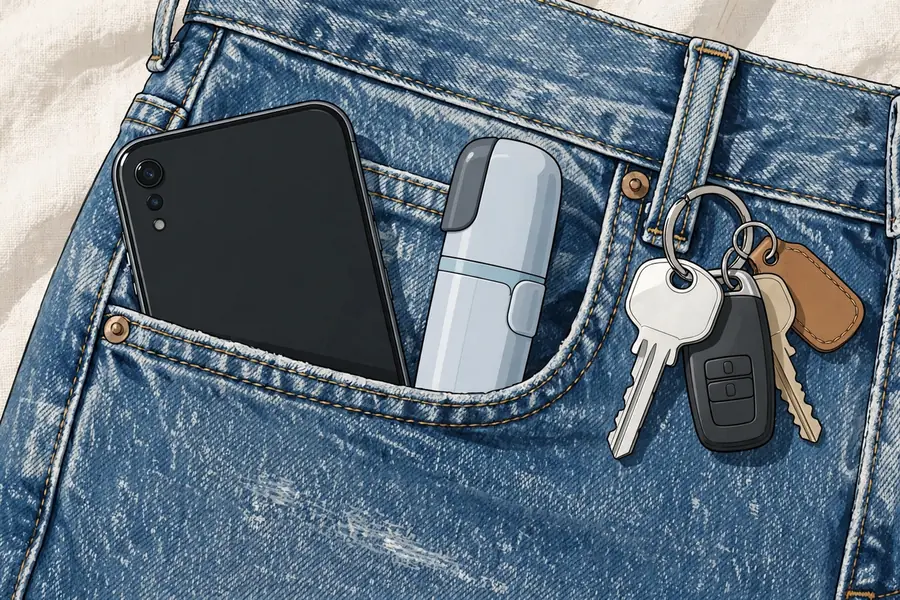
Auvi-Q is roughly the footprint of a credit card and under an inch thick. It slips into a front pocket, a small clutch, a running belt, or a jacket pocket — places a six-inch pen simply does not go. For teenagers who refuse to carry anything bulky, for runners, and for anyone whose lifestyle defeated the pen shape, that size difference can be the difference between carrying and not carrying.
Run the carry-every-day test honestly. Think about yesterday: where would each device have lived from morning to night? If the answer for the pen is “in my bag in the car” but the answer for the compact one is “in my pocket,” you have learned something important. The best auto-injector is the one present at the picnic, the trailhead, and the restaurant — not the one with the better spec sheet sitting at home.
Carry means both devices, plural. Allergists commonly prescribe a two-pack because a second dose may be needed, and because having a backup covers the “I left one at home” scenario. Whatever brand you choose, keep the pair together and keep them with you.
Voice Guidance Under Panic #
Anaphylaxis is not a calm moment. Your hands shake, your thinking narrows, and a panicked bystander may be the one holding the device. This is the scenario where the two brands diverge most sharply, and it deserves its own honest look.
Auvi-Q talks you through it. The device plays electronic voice instructions that walk you step by step: remove the outer case, place against the thigh, press the red button, hold. An LED light and the red activation button give your eyes something to follow when your brain is overloaded. For a babysitter, a new teacher, or a friend who has never touched an auto-injector, that coaching can be the difference between action and frozen hesitation.
EpiPen relies on printed instructions. The steps are printed right on the device — blue to the sky, orange to the thigh, in the classic teaching phrase — and the design is deliberately simple: pull the orange safety cap, press firmly against the outer thigh, hold. Millions of people have been trained on this sequence, which means a random bystander is more likely to have seen it demonstrated.
Panic degrades fine motor skills and reading. That is not speculation; it is why emergency equipment is designed the way it is. A voice telling you what to do next removes the need to read small print with shaking hands. But a voice also requires you to listen and follow, which is its own challenge mid-reaction. Neither approach eliminates the need for practice.
The tiebreaker is who else might use it. If you are choosing a device for a child, the relevant user is often an adult caregiver — a teacher, coach, or grandparent. Walk that person through the actual device you carry, whichever brand it is. A two-minute demonstration with the trainer device beats every feature comparison ever written, and it is the single highest-value thing you can do after picking up the prescription.
Needle and Safety Design #
Nobody looks forward to the needle part, so both manufacturers have engineered the moment of injection to be as foolproof as possible. The approaches differ, and each has a genuine logic behind it.
Auvi-Q’s needle retracts automatically. After the injection completes, the needle pulls back inside the device on its own. That design reduces the chance of an accidental needle stick afterward — meaningful if a child is nearby, if you are shaky, or if a helpful bystander grabs the used device. The injection itself is triggered by pressing the red activation button once the device is positioned.
EpiPen’s needle is covered before use and stays exposed after. The orange tip covers the needle until the moment of injection, and the device is pressed firmly against the thigh to trigger. After use, the needle does not retract, so the used device needs to be handled carefully and handed to emergency responders — which you will be doing anyway, since you are going to the emergency department.
Hold times are printed on each label. EpiPen’s label calls for holding about three seconds; Auvi-Q’s calls for about two. These are not interchangeable numbers to memorize — they are printed on the device in your hand for a reason. In the moment, follow the label, not your memory. This is also why switching brands without retraining is a bad idea: muscle memory from one device does not transfer cleanly to the other.
Accidental injection gets the same response either way. The most common mishap is firing into a thumb or finger while handling the device — usually from holding it upside down or pressing the wrong end. If that happens with either brand, seek medical care promptly and bring the device. It is a known, manageable event, and it is one more reason to practice with the trainer until the correct grip is automatic.
Trainers and Practice #
A trainer device — a needle-free replica that lets you rehearse the steps — might be the most underrated part of either product. Reading about an injection and performing one under adrenaline are different skills, and the gap between them is closed by repetition.
Auvi-Q includes a trainer in the box. It arrives in a gray case marked TRAINER, and it replays the same voice prompts as the real device without any needle or medicine. That means every practice run is a full dress rehearsal: the same voice, the same button, the same hold. Keep the trainer somewhere visible, not buried in a drawer.
EpiPen’s trainer is available separately. Ask your pharmacist or allergist for one — they are commonly provided on request. The trainer walks through the same cap-pull, press, and hold sequence as the real device. If you were not offered one at pickup, ask; it is a normal request, not an imposition.
Practice with the people around you. Your device only helps if the humans nearby know the steps. Sit down once with family members, and separately with your child’s teacher or caregiver, and run the trainer through a full cycle. Let each person hold it, press it against their own thigh through clothing, and hear or read the steps. Two minutes each. This small ritual does more for your safety than any feature on either box.
Rehearse on a schedule, not on memory. Confidence fades. Run the trainer again when the school year starts, before summer camp, and before any big trip. Each rehearsal takes less time than reading this section, and each one rebuilds the muscle memory that panic tries to erase.
Check expiration dates as part of the ritual. Auto-injectors expire, and an expired device is not something to rely on. Each time you practice, glance at the date on the real devices. Set a phone reminder a month before expiry so the replacement arrives before the old one lapses. Your pharmacist can tell you the current replacement process and timing.
Cost, Access, and Talking to Your Allergist #
Features only matter if you can get the device, afford to keep it current, and have a prescription that matches it. This is the least exciting section and the most practical one.
Prices and insurance coverage vary widely. What your plan covers, what your copay looks like, and whether one brand is preferred on your formulary can differ enormously between insurers — and can change year to year. Do not assume either brand is automatically the cheaper one. Check your specific plan, and ask your pharmacist to run both options if your allergist has not specified a brand.
Assistance and discount programs may exist. Manufacturer savings programs, pharmacy discount cards, and authorized generic versions come and go. Your pharmacist sees these options daily and can tell you what is currently available for your prescription. A five-minute conversation at pickup can save real money over the years you will be refilling.
Prescriptions are usually brand-specific. A prescription written for one auto-injector brand generally cannot be filled as the other without your prescriber’s involvement. If you want to switch — because of size, cost, or the voice feature — that starts with a conversation with your allergist, not a request at the pharmacy counter. The switch itself is simple; what matters is getting retrained on the new device’s steps.
Bring this comparison to the appointment. Allergists make this recommendation many times a week, and they appreciate a patient who has thought about it. Tell them where you will carry it, who else might need to use it, and what worries you about the moment of use. Those three answers will usually point straight to the right choice — and the right choice, one more time, is the device you will carry every day and can fire without hesitation.
Revisit the decision when life changes. A device that worked for a cautious ten-year-old may not suit a sixteen-year-old who lives in gym shorts. A new job, a new school, a new sport — any of these is a good moment to ask whether your current device still fits your actual days. The prescription can evolve with you.
Warning signs: when to seek care #

Call 911 immediately if you develop trouble breathing or swallowing, swelling of the face, lips, tongue, or throat, widespread hives, dizziness or fainting, or a racing heartbeat after a sting, bite, or allergen exposure. If you carry an epinephrine auto-injector, use it as prescribed on the device label and call 911 right away — do not wait to see if symptoms improve on their own.
That blockquote is the core of your allergy action plan, whichever device you carry. A few more points complete the picture. After using an auto-injector, always go to the emergency department even if you feel better — the medicine wears off, and a second wave of symptoms can arrive hours later. If symptoms do not improve after the first dose, your action plan and the device label describe the next steps; follow them exactly and tell responders what you already used.
Learn the difference between a large local reaction and true anaphylaxis, because it changes your response: a big, painful, swollen sting site without breathing trouble, throat tightness, dizziness, or widespread hives is frightening but different from the whole-body emergency above. Our guide on large local reaction vs anaphylaxis walks through that distinction. When in doubt, treat it as the emergency — hesitation is the danger, not overreaction.
Frequently asked questions #
Which is better, EpiPen or Auvi-Q? #
The honest answer: the better device is the one you will carry every day and can use without hesitation. Both deliver the same emergency medicine for anaphylaxis. Choose based on size and portability for your lifestyle, whether voice guidance would help you or your caregivers, cost under your insurance, and — most importantly — your allergist’s recommendation for your specific situation.
Can I switch from one brand to the other? #
Talk to your allergist first. Prescriptions for auto-injectors are usually brand-specific, so switching requires a new prescription, not just a pharmacy request. If you do switch, retrain yourself and your caregivers on the new device with its trainer — the steps, hold time, and safety release differ, and muscle memory from the old brand does not transfer cleanly.
Do I still need emergency care after using an auto-injector? #
Yes, always. The medicine is a bridge, not a cure: it wears off, and symptoms can return in a second wave hours later. Call 911 after using the device, go to the emergency department, and tell responders which device you used and when. Bring the used device with you if you safely can.
How do I keep track of expiration dates? #
Check the date on your devices regularly — tie it to something you already do, like the start of the school year or daylight saving time changes. Set a phone reminder a month before expiry so the replacement arrives in time. Ask your pharmacist about the current refill and replacement process, since programs and timing can change.
Should my family members learn to use my device too? #
Absolutely — this may matter more than which brand you chose. Anyone who spends time with you or your child should run through the trainer device at least once: hold it, position it, and follow the steps. A teacher, coach, or grandparent who has practiced is dramatically more likely to act quickly than one seeing the device for the first time during your emergency.
Medical and editorial note #
This guide is general information comparing two epinephrine auto-injector devices, not medical advice and not a recommendation for any individual. Device selection, dosing, and emergency action plans are decisions to make with your allergist or prescribing clinician, and you should always follow the instructions on your device label and your written allergy action plan. If you experience signs of a severe allergic reaction, use your prescribed device as directed and call 911 immediately.


