Direct answer: The most important asian tiger mosquito bite vs hobo spider bite treatment differences are certainty and risk interpretation. Asian tiger mosquitoes are established human biters, while a characteristic dangerous “hobo spider bite” syndrome is not supported by current evidence. Treat mild local symptoms conservatively, but seek care for severe, spreading, infected-looking, or systemic symptoms.
A red bump alone cannot reliably distinguish an Asian tiger mosquito bite from a supposed hobo spider bite. In fact, current spider guidance makes an even more important point: many skin wounds blamed on spiders were never linked to a spider at all. If no spider was seen biting—or safely captured for expert identification—diagnostic certainty is low.
Evidence-first takeaway
Do not assume that a painful, blistered, or necrotic-looking skin lesion is a hobo spider bite. Current university sources do not find convincing evidence that hobo spiders cause a characteristic flesh-destroying bite, and CDC guidance warns that many alleged spider bites are actually other skin conditions, including bacterial infections.
Asian tiger mosquito bite vs hobo spider bite: quick comparison
| Clue | Asian tiger mosquito | Hobo spider |
|---|---|---|
| Arthropod | Aedes albopictus, a small black-and-white mosquito | Eratigena agrestis, a brown funnel-weaver spider |
| Human biting | Regularly bites people for a blood meal | Can bite defensively, but bites are uncommon and a distinctive dangerous syndrome is not established |
| Typical exposure clue | Outdoor yards, gardens, vegetation, container-water habitats | Spider physically seen or found nearby; funnel web or ground-level shelter may be present |
| Skin identification | Usually an itchy bump or wheal, but appearance varies | No validated “hobo spider bite appearance” that can diagnose the species from skin alone |
| Major medical concern | Local reaction; mosquito-borne viruses when epidemiologically relevant | Rule out other causes if the wound is severe, expanding, infected-looking, or necrotic |
| First step | Wash, cool compress, itch control, prevent more bites | Wash, cool compress, safely preserve/photograph spider if available, monitor symptoms |
The strongest difference is therefore not a specific “two-dot” pattern, color, or lesion shape. It is whether a known mosquito fed on exposed skin versus whether a spider was actually observed and reliably identified.
What an Asian tiger mosquito looks like
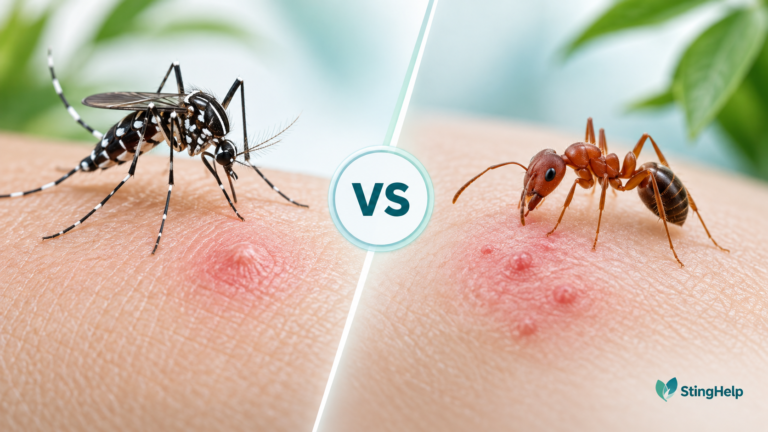
The Asian tiger mosquito, Aedes albopictus, is a dark mosquito with conspicuous white bands on the legs and white markings on the body. It commonly breeds in small water-holding containers and can be encountered around homes, gardens, vegetation, and shaded outdoor spaces.
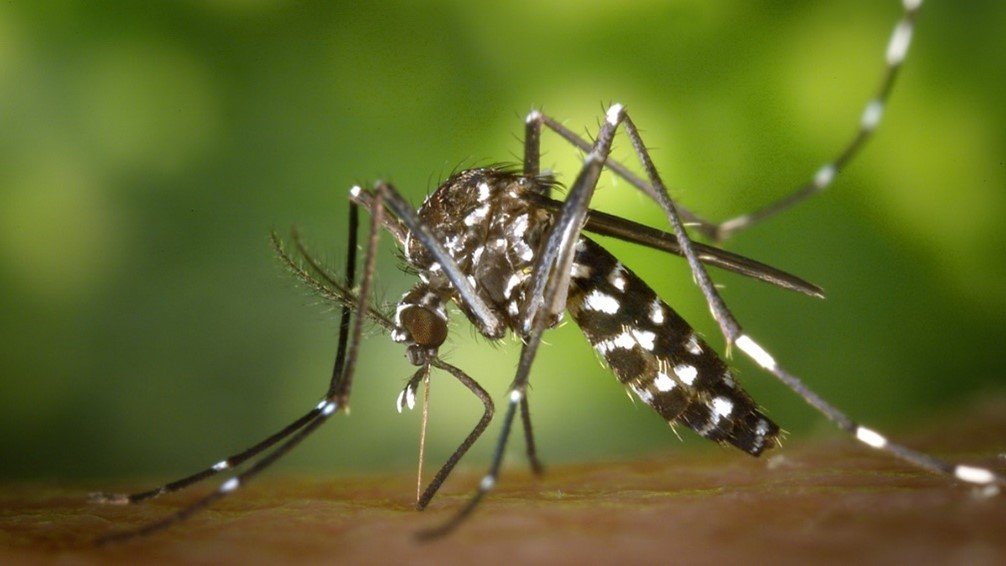
A bite may feel like a tiny prick or may go unnoticed until itching develops. Some people get a small red papule; others develop a larger wheal or more pronounced localized swelling. Several bites can occur on exposed skin.
What is a hobo spider?
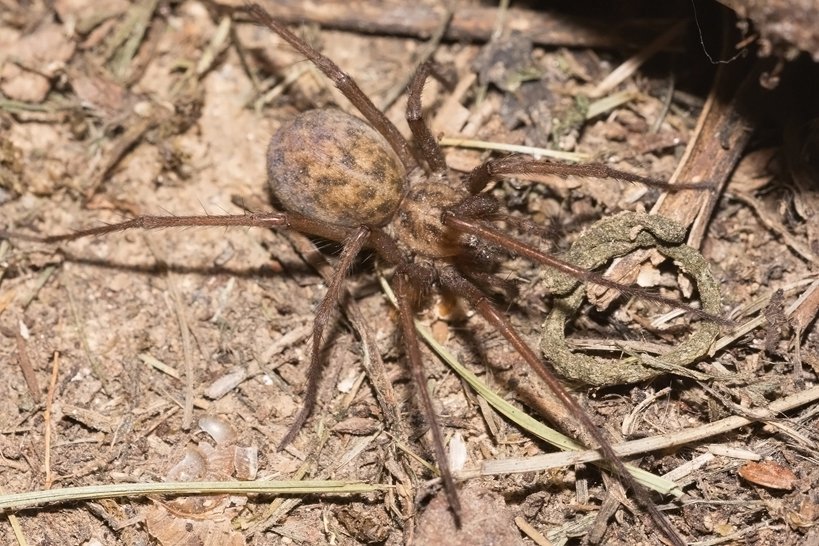
The hobo spider, Eratigena agrestis (formerly Tegenaria agrestis), is a member of the funnel-weaver family Agelenidae. Washington State University describes it as a relatively large, swift-running brown spider that builds funnel-shaped webs in dark or sheltered areas. It is native to Europe and was introduced into parts of North America.
Adult hobo spiders can resemble several other brown funnel-weavers and house spiders. Nonexperts often cannot identify them confidently from a casual photo. Utah State University specifically warns that many spiders resemble the hobo spider and that nonexpert identification is unreliable.
Important naming clarification
A hobo spider is a funnel-weaver in the family Agelenidae. It is not the same thing as the medically dangerous Australian funnel-web spiders in the family Atracidae. Similar common names can create unnecessary alarm, so scientific names matter.
Are hobo spider bites dangerous?
Current evidence does not support the old claim that hobo spiders commonly cause severe necrotic or “flesh-eating” wounds. Washington State University’s current fact sheet states that hobo spiders were improperly identified as dangerous and that recent research has not shown them to be harmful to humans. Utah State University similarly says there is no significant scientific evidence supporting a necrotic hobo-spider bite.
This is an important correction because older reports from the Pacific Northwest linked hobo spiders to necrotic arachnidism. Those historical reports still circulate online, but current entomology guidance has moved away from treating a necrotic skin lesion as a recognizable hobo-spider syndrome.
Why “spider bite” is often the wrong diagnosis
CDC’s current Yellow Book guidance emphasizes that most alleged spider bites do not involve a spider that was actually observed biting the person. A warm, painful, tender, or necrotic skin lesion may instead represent a bacterial skin infection or another medical condition.
That does not mean spiders never bite. They can bite defensively when trapped against the skin, handled, or disturbed. It means the diagnosis should not be reverse-engineered from a wound photograph. If a lesion is worsening, treatment should focus on the actual clinical problem rather than assuming a spider species from appearance alone.
Asian tiger mosquito bite vs hobo spider bite symptoms
Asian tiger mosquito bites have a well-established pattern of local reactions: itching, redness, a papule or wheal, and variable swelling. Hobo-spider bite symptoms are much less specific because there is no validated characteristic lesion pattern that reliably identifies E. agrestis.
Typical mosquito-bite symptoms
- Small itchy bump or wheal.
- Localized redness and swelling.
- Multiple lesions on exposed skin when mosquitoes are active.
- Itching that may become more noticeable after the mosquito has left.
If a spider was actually seen biting
A minor spider bite can cause local pain, redness, or swelling. The reaction varies by species and individual. CDC/NIOSH recommends washing the area, applying a cool cloth or ice-filled cloth, and seeking professional care when warranted. It also advises identifying the spider only if that can be done safely.
A painful wound that keeps enlarging, forms a dark or necrotic center, drains pus, becomes increasingly warm, or is accompanied by fever deserves medical evaluation regardless of whether a spider is suspected.
Pictures: can a hobo spider bite be diagnosed from the skin?
No. For asian tiger mosquito bite vs hobo spider bite pictures, the actual arthropod is far more useful than the skin. Even experts generally need the spider itself—or high-quality diagnostic views—to separate similar funnel-weaver species.
Likewise, a mosquito bite photograph usually cannot prove that Aedes albopictus was the species involved. Seeing the black-and-white mosquito feeding or capturing a clear image of it provides stronger evidence.
If you only have a skin lesion and no insect or spider, use the What Bit Me? identification guide to organize exposure clues while keeping uncertainty explicit.
Asian tiger mosquito bite vs hobo spider bite treatment differences
For mild local reactions, first aid overlaps: wash the skin, use a cool compress, avoid scratching, and use an appropriate over-the-counter itch or pain product only if it is safe for you and used according to the label. The larger difference is what you should not assume.
For a likely Asian tiger mosquito bite
- Wash the area gently with soap and water.
- Use a cool compress to reduce itching or swelling.
- Avoid scratching and protect broken skin.
- Use an appropriate OTC anti-itch treatment if safe for you and according to the label.
- Prevent additional mosquito bites with EPA-registered repellent, protective clothing, screens, and standing-water control.
- Consider travel and local mosquito-borne disease activity if fever or systemic illness develops.
For a suspected spider bite
- Wash the bite area with soap and water.
- Apply a cool damp cloth or wrapped cold pack to reduce swelling.
- Elevate the affected area if practical.
- Do not cut the wound, squeeze it, or attempt to “remove venom.”
- If the spider is available, photograph or preserve it safely without risking another bite.
- Seek medical attention for severe pain, spreading symptoms, systemic illness, infection signs, or an uncertain worsening wound.
For general care steps, see the StingHelp bite and sting first-aid guide.
Decision guide: what should you do next?
Small itchy bump after obvious mosquito exposure: routine bite care and mosquito prevention are usually reasonable.
Spider was seen and safely photographed: keep the image/specimen for identification and monitor the bite.
No spider was seen but the wound is hot, very painful, draining, rapidly expanding, or necrotic-looking: do not label it a hobo spider bite; seek medical evaluation for infection and other causes.
Breathing difficulty, fainting, severe systemic symptoms, rapidly spreading swelling, or collapse: seek emergency care.
When should you seek medical care?
Medical evaluation is appropriate when pain or swelling is severe or getting worse, redness is spreading, the area becomes increasingly hot, pus or drainage appears, fever develops, a blister or ulcer is progressing, or symptoms are not following the expected course of a mild bite.
Seek emergency care for trouble breathing, throat or facial swelling, fainting, severe dizziness, rapidly worsening widespread hives, confusion, collapse, or another severe systemic reaction.
When a clinician evaluates an alleged spider bite, tell them whether a spider was actually seen, when the lesion appeared, how quickly it changed, whether there was an injury, travel, outdoor exposure, or known skin infection risk, and whether you have photographs of the arthropod.
What about necrosis or a “flesh-eating” wound?
Necrosis should never be used as proof of a hobo spider bite. CDC guidance notes that painful necrotic lesions attributed to spiders are frequently something else, including bacterial infection. True necrotic spider bites are most strongly associated with recluse spiders (Loxosceles species), not with a validated hobo-spider syndrome.
If tissue is becoming dark, blistered, ulcerated, or rapidly damaged, professional assessment is important. The practical question is not “does this look like a hobo bite?” but “what condition is causing this wound, and does it need treatment?”
USA: where are hobo spiders encountered?
Hobo spiders were introduced to North America and are best known from parts of the western United States and Pacific Northwest. Washington State University continues to document them in Washington, while Utah State University notes that they may be found in Utah homes, particularly during late summer and fall.
Distribution alone does not prove a bite. A person in a region where hobo spiders occur can still have a mosquito bite, bacterial skin infection, another spider species, or a completely unrelated skin condition.
Europe: the hobo spider is native, but the medical story is different
Eratigena agrestis is native across Europe into Central Asia. The 2026 Spiders of Europe database reports no known medical problems from the species in Europe and notes that the dramatic American toxicity claims were not verifiable.
This is especially important for GEO accuracy: European readers should not import old U.S. internet narratives about “necrotic hobo spider bites” into local identification. In Europe, the species is a familiar member of the regional spider fauna rather than an established medically dangerous spider.
How Asian tiger mosquito disease risk differs
Asian tiger mosquitoes are medically relevant for a different reason: infected Aedes albopictus can transmit viruses including dengue, chikungunya, and Zika where transmission occurs. A routine mosquito bite still does not mean infection, but fever or significant systemic illness after relevant travel or during local transmission deserves medical advice.
That distinction matters because the hobo-spider comparison is primarily about avoiding misdiagnosis, while the mosquito comparison includes exposure to established mosquito-borne pathogens.
How to prevent Asian tiger mosquito bites
Use EPA-registered repellent, wear protective clothing when practical, maintain window and door screens, and remove standing water from containers around homes and yards. Asian tiger mosquitoes can use small water-holding objects, so repeated checks are more effective than a one-time cleanup.
How to reduce unwanted hobo-spider encounters
Reduce clutter near foundations, seal gaps where practical, use screens, move stored items carefully, and wear gloves when handling boxes, firewood, or materials where spiders may shelter. Do not handle an unknown spider with bare hands just to identify it.
If the concern is another spider type, browse the StingHelp Spider Bites hub. If the bite is immediately painful outdoors and no spider was seen, compare the deer fly guide. If a painful sting occurred around an ant mound, the fire ant comparison may fit better.
Frequently asked questions
How can you tell an Asian tiger mosquito bite from a hobo spider bite?
The best clue is a witnessed exposure. A black-and-white mosquito seen feeding strongly supports an Asian tiger mosquito. A “hobo spider bite” should not be diagnosed from a wound photo alone; reliable spider identification generally requires the actual spider or expert-quality diagnostic images.
Do hobo spider bites cause skin necrosis?
Current university guidance does not find significant scientific evidence that hobo spiders cause a characteristic necrotic or flesh-destroying bite. A worsening necrotic-looking wound should be medically evaluated for other causes, including bacterial infection.
What are the most useful differences to compare?
Compare whether the arthropod was seen, whether the lesion is mainly itchy versus painful and progressive, the exposure setting, geography, and whether the wound is behaving like a simple local reaction or a worsening medical problem.
What should you do if you caught the spider?
Do not handle it with bare hands. If it can be done safely, keep a clear photograph or securely contained specimen for expert identification. Correct identification is far more useful than trying to match the wound to internet pictures.
Which warning signs matter most?
Seek care for rapidly spreading redness, severe or increasing pain, warmth, drainage, fever, a progressing blister or ulcer, or significant systemic illness. Breathing difficulty, facial or throat swelling, fainting, collapse, or a severe rapidly worsening reaction requires emergency evaluation.
When should someone seek medical care after a mosquito or suspected spider bite?
Seek medical advice when symptoms are severe, worsening, infected-looking, systemic, or diagnostically uncertain. After mosquito exposure, also mention recent travel and local mosquito-borne disease activity if fever, rash, severe headache, marked joint pain, or other illness develops.
Authoritative references
- CDC Yellow Book — Post-Travel Dermatologic Conditions: Spider Bites
- CDC/NIOSH — Venomous Spiders at Work
- Washington State University — Hobo Spider, reviewed December 2025
- Spiders of Europe 2026 — Eratigena agrestis
- CDC — Asian Tiger Mosquito
Bottom line
The safest interpretation of asian tiger mosquito bite vs hobo spider bite treatment differences is evidence-based rather than appearance-based. A typical mosquito bite can usually receive routine symptom care. A suspected hobo-spider wound should not be labeled necrotic arachnidism from a photo; worsening, infected-looking, ulcerating, or systemic symptoms need evaluation for the true cause.
Educational information for a U.S.- and Europe-focused audience. This article cannot diagnose a spider species, infection, allergic reaction, or mosquito-borne illness from a photograph and does not replace professional medical care.