
Kids Playing in Leaf Piles: Fall Bite Safety
The Short Answer The classic October parenting puzzle of kids playing in leaf piles bug bites goes like this: your child spends a happy…
What the counted record says about stings in children: how many are stung, how reactions break down, why 61% are hospitalised while only 29% receive adrenaline, and what happens on the next sting.
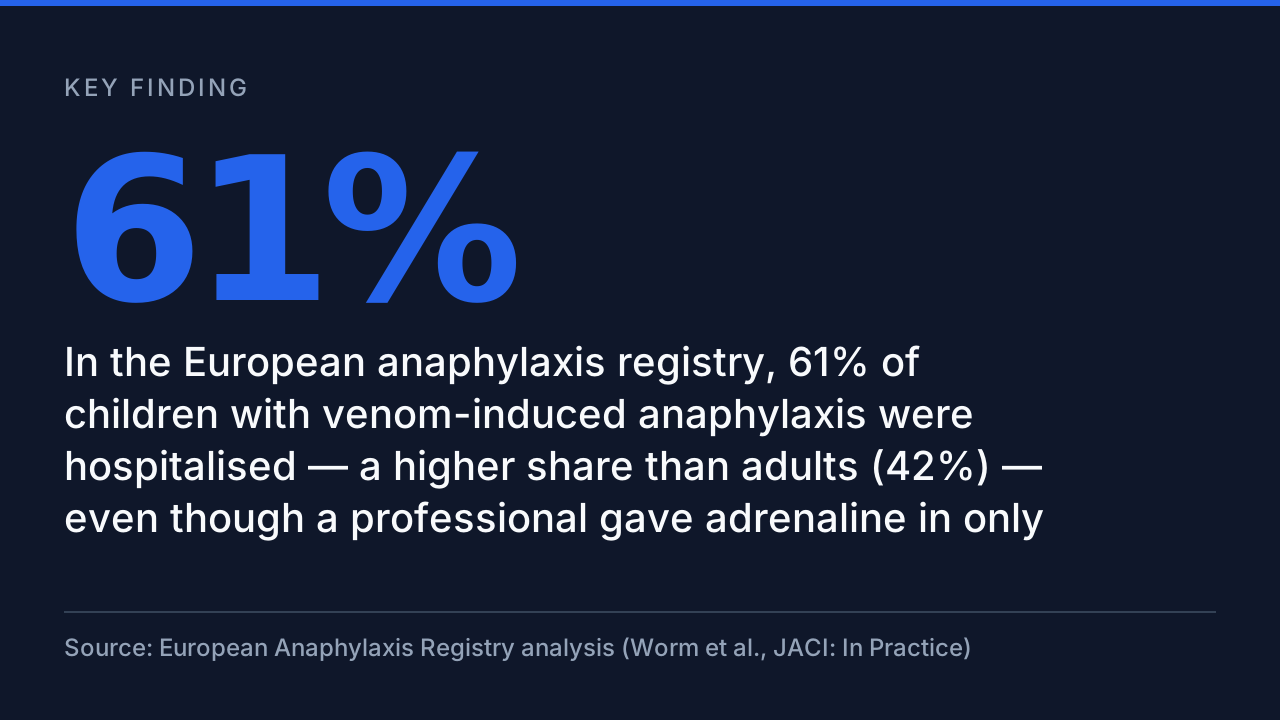
Source: European Anaphylaxis Registry analysis (Worm et al., JACI: In Practice) (2024)
If a child develops whole-body symptoms after a sting — widespread hives, swelling of the lips or tongue, difficulty breathing, repeated vomiting, dizziness or collapse — that is anaphylaxis: adrenaline is the first-line treatment, it should be given without delay, and the child needs emergency care immediately. That guidance frames everything on this page, and StingHelp’s guide to the warning signs of sting anaphylaxis covers it in practical detail. What follows is something different: the counted record of what actually happens to children who are stung, assembled from school surveys, emergency-department surveillance, the European anaphylaxis registry and follow-up cohorts that have never been joined on one page.
Read in sequence, the record describes a chain with four links: how many children are stung, what their reactions look like, what treatment they receive, and what happens on the next sting. The weakest link is the third. In the European anaphylaxis registry, 61% of children with venom anaphylaxis were hospitalised (European Anaphylaxis Registry analysis (Worm et al., JACI: In Practice), 2024) — a higher share than adults — yet a professional administered adrenaline in only 29% of the children’s cases (European Anaphylaxis Registry analysis (Worm et al., JACI: In Practice), 2024). The reactions themselves leave little room for hesitation: 91% began within half an hour of the sting (European Anaphylaxis Registry analysis (Worm et al., JACI: In Practice), 2024).
One discipline runs through every table below: each number keeps its own population. A school survey in Turkey, a birth cohort in Ireland, US emergency surveillance and a European registry of confirmed anaphylaxis cases do not measure the same children, and this page never merges them. Where two studies disagree, both are printed with their labels, because the honest answer to how often this goes badly is a range with names on it, not a single borrowed figure. The site’s practical guides for parents, such as its wasp sting treatment guide for children, cover what to do; this page covers what the numbers say.
Most of them, by their early teens. In Izmir, Turkey, 61.6% of schoolchildren aged twelve to fourteen had been stung at least once (Izmir school survey (Allergologia et Immunopathologia), 2016); a second Turkish survey recorded 54.5% across ages six to eighteen (Trabzon school survey (Turkish Journal of Medical Sciences), 2021), and an Israeli national survey 56.3% (Graif et al., JACI 2006 (via AAAAI release), 2006). An Irish birth cohort counting from birth found 21.9% stung by age five (BASELINE birth cohort, Ireland (Clifford et al., Pediatric Allergy and Immunology), 2018).
The exposure numbers explain why this page exists: a sting in childhood is not a rare event but a common one, and the datasets agree on the direction even where their levels differ. The Irish cohort is the conservative anchor — it followed children from birth and asked repeatedly, so its lower percentages reflect younger ages and prospective counting rather than lower risk. Boys are stung more than girls in every survey that reports the split, a pattern that returns later in the clinic data.
Emergency data tell the same story from the other end. US NEISS-AIP surveillance — which counts all non-dog bites and stings treated in emergency departments, a category in which insects account for 67.5% of visits (NEISS-AIP national estimates (Langley et al., Wilderness & Environmental Medicine), 2010) — recorded an annual average of 149,457 visits for children under five alone (NEISS-AIP national estimates (Langley et al., Wilderness & Environmental Medicine), 2010), and the youngest children carried the highest visit rate of any age group. StingHelp’s guides to fire ant stings in children and to fever in a child after a bug bite cover the situations parents meet most often; the surveillance record says how often those situations reach an emergency department.
Among stung children, large local reactions dominate and severe systemic reactions are rare. The Izmir survey recorded large local reactions in 24.3% of stung children and mild systemic reactions in 8.1%, while severe systemic reactions accounted for 0.8% (Izmir school survey (Allergologia et Immunopathologia), 2016). The Israeli survey, using a broader moderate-to-severe category, recorded 2.5% (Graif et al., JACI 2006 (via AAAAI release), 2006) — the gap between the two is definitional, and both figures are printed with their labels.
| METRIC | VALUE | SOURCE |
|---|---|---|
| Large local reactions among stung children, Izmir | 24.3% | Izmir school survey (Allergologia et Immunopathologia) |
| Mild systemic reactions among stung children, Izmir | 8.1% | Izmir school survey (Allergologia et Immunopathologia) |
| Severe systemic reactions among stung children, Izmir | 0.8% | Izmir school survey (Allergologia et Immunopathologia) |
| Moderate-to-severe systemic reactions among stung children, Israel | 2.5% | Graif et al., JACI 2006 (via AAAAI release) |
| Large local reactions per reported sting, Trabzon | 5.2% | Trabzon school survey (Turkish Journal of Medical Sciences) |
| Systemic reactions per reported sting, Trabzon | 1.3% | Trabzon school survey (Turkish Journal of Medical Sciences) |
| Reported stings delivered by honey bees, Trabzon | 66.2% | Trabzon school survey (Turkish Journal of Medical Sciences) |
| Local reactions among children stung by age five, Ireland (none systemic) | 52.1% | BASELINE birth cohort, Ireland (Clifford et al., Pediatric Allergy and Immunology) |
Two denominators run through this table and they must not be averaged. The Izmir and Israeli figures are shares of stung children; the Trabzon figures are shares of reported stings — 5.2% of individual stings produced a large local reaction and 1.3% a systemic one (Trabzon school survey (Turkish Journal of Medical Sciences), 2021). A child stung three times enters the second kind of table three times and the first only once, which is most of why the per-sting rates look smaller.
The culprit pattern also splits by denominator. In the Trabzon survey, honey bees delivered 66.2% of all reported stings (Trabzon school survey (Turkish Journal of Medical Sciences), 2021) — exposure is mostly bees, a point that matters when the clinic data below point the other way. The Irish preschool cohort is the mildest picture of all: of the children stung by age five, 52.1% reported local reactions and none had a systemic reaction (BASELINE birth cohort, Ireland (Clifford et al., Pediatric Allergy and Immunology), 2018). For the swelling-heavy reactions that dominate childhood stings, StingHelp’s explainers on the difference between a large local reaction and anaphylaxis and on skeeter syndrome in children draw the line parents actually need: which swellings are expected, and which are the start of something systemic.
The European registry’s paediatric cohort — 725 children with venom-induced anaphylaxis (European Anaphylaxis Registry analysis (Worm et al., JACI: In Practice), 2024) — reacted differently from its adult cohort. Skin involvement appeared in 93% of children and respiratory involvement in 77%, both more often than in adults, while cardiovascular involvement was less frequent, at 61% against 85% in adults (European Anaphylaxis Registry analysis (Worm et al., JACI: In Practice), 2024). Symptoms also varied by age within childhood itself.
| METRIC | VALUE | SOURCE |
|---|---|---|
| Children with venom anaphylaxis in the registry | 725 | European Anaphylaxis Registry analysis (Worm et al., JACI: In Practice) |
| Skin involvement in children’s venom anaphylaxis | 93% | European Anaphylaxis Registry analysis (Worm et al., JACI: In Practice) |
| Respiratory involvement in children’s venom anaphylaxis | 77% | European Anaphylaxis Registry analysis (Worm et al., JACI: In Practice) |
| Cardiovascular involvement in children’s venom anaphylaxis | 61% | European Anaphylaxis Registry analysis (Worm et al., JACI: In Practice) |
| Cardiovascular involvement in adults’ venom anaphylaxis | 85% | European Anaphylaxis Registry analysis (Worm et al., JACI: In Practice) |
| Culprit insect wasps, in a referred cohort of children with systemic reactions | 76% | Hacettepe University clinic cohort (International Archives of Allergy and Immunology) |
| Boys in that referred systemic-reaction cohort | 75% | Hacettepe University clinic cohort (International Archives of Allergy and Immunology) |
The practical meaning of the profile is timing. With 91% of reactions beginning within half an hour (European Anaphylaxis Registry analysis (Worm et al., JACI: In Practice), 2024), the registry describes an emergency that declares itself quickly, in skin and breathing first. That is the pattern behind StingHelp’s guide to when a bee sting is an emergency: in a child, a reaction that spreads beyond the sting site inside that first half hour is the signal to act, not to watch and wait.
Boys dominate every dataset on this page — 75% of the referred Turkish clinic cohort were boys (Hacettepe University clinic cohort (International Archives of Allergy and Immunology), 2013), and the registry found boys affected more frequently, without any increase in atopy. Exposure explains part of it, since boys are stung more; but the clinic cohort shows the pattern persists among children whose reactions were already systemic, which exposure alone does not explain.
Here the chain breaks. Children in the registry were hospitalised at 61% against 42% for adults (European Anaphylaxis Registry analysis (Worm et al., JACI: In Practice), 2024), yet adrenaline — the guideline first-line treatment for anaphylaxis — was administered by a professional in only 29% of the children’s cases, and 31% of adults’ (European Anaphylaxis Registry analysis (Worm et al., JACI: In Practice), 2024). The survey data point the same way: in the Israeli national survey, only 14.5% of children with moderate-to-severe reactions reached an emergency department at all (Graif et al., JACI 2006 (via AAAAI release), 2006).
| METRIC | VALUE | SOURCE |
|---|---|---|
| Hospitalisation after venom anaphylaxis, adults | 42% | European Anaphylaxis Registry analysis (Worm et al., JACI: In Practice) |
| Adrenaline given by a professional, adults | 31% | European Anaphylaxis Registry analysis (Worm et al., JACI: In Practice) |
| Venom immunotherapy initiated after the reaction, both age groups | 78% | European Anaphylaxis Registry analysis (Worm et al., JACI: In Practice) |
| Ever-stung children who visited an emergency department, Israel | 5.8% | Graif et al., JACI 2006 (via AAAAI release) |
| Children with moderate-to-severe reactions who visited an emergency department, Israel | 14.5% | Graif et al., JACI 2006 (via AAAAI release) |
| Children with local reactions who visited an emergency department, Israel | 10.4% | Graif et al., JACI 2006 (via AAAAI release) |
Read together, the two registry figures describe a system that reaches for the expensive response and hesitates over the cheap one. Admission is precaution-heavy in children — understandable, given the speed of onset — but the registry authors’ own conclusion is that adrenaline should be applied according to current guidelines, and the gap is not unique to children: adults fared barely better. Nothing in this data singles out parents or clinicians; it measures a pathway, and the pathway’s weak link is the decision to give adrenaline early. StingHelp’s practical pages on when to give a second dose of epinephrine and on what to do after using an EpiPen exist for exactly that decision point.
The follow-up link, by contrast, works. Venom immunotherapy — the treatment that prevents the next anaphylaxis — was initiated in 78% of registry cases, children and adults alike (European Anaphylaxis Registry analysis (Worm et al., JACI: In Practice), 2024). And the care-seeking data carry one more quiet warning: only 5.8% of ever-stung children in the Israeli survey had any emergency visit at all (Graif et al., JACI 2006 (via AAAAI release), 2006), so the cases that reach a registry are the visible fraction of a much larger, mostly uncounted experience.
Childhood sting allergy usually softens with time, but it does not reliably vanish. In the long Johns Hopkins follow-up, moderate or severe reactions on later stings occurred in 17 percent of adults who had not received venom immunotherapy as children — against just 3 percent of those who had (Golden et al., New England Journal of Medicine 2004 (Johns Hopkins release, EurekAlert), 2004). For children whose reactions were mild and skin-only, the chance of a systemic reaction to a future sting is put at 5% to 10% (Golden, Insect sting anaphylaxis (Immunology and Allergy Clinics of North America), 2007).
| METRIC | VALUE | SOURCE |
|---|---|---|
| Chance of a systemic reaction to a future sting, children with mild skin-only systemic reactions | 5% to 10% | Golden, Insect sting anaphylaxis (Immunology and Allergy Clinics of North America) |
| Moderate-to-severe reactions in adulthood, children treated with venom immunotherapy | 3 percent | Golden et al., New England Journal of Medicine 2004 (Johns Hopkins release, EurekAlert) |
| Severe systemic reactions on re-sting, untreated Polish cohort | 18% | Polish natural-history cohort (Annals of Allergy, Asthma & Immunology) |
| Normal reactions on re-sting, untreated Polish cohort | 62% | Polish natural-history cohort (Annals of Allergy, Asthma & Immunology) |
The Polish cohort of children with diagnosed venom allergy who were not treated with immunotherapy adds the more recent, unsentimental version: of those re-stung during follow-up, 18% had severe systemic reactions (Polish natural-history cohort (Annals of Allergy, Asthma & Immunology), 2016) — a minority, but not a negligible one, and concentrated among children whose first reactions were the most severe. Taken together, the cohorts say that growing out of sting allergy is a tendency, not a promise, and that the tendency is weakest exactly where the first reaction was strongest. What protection a family carries forward — an auto-injector, an action plan, a decision about immunotherapy — belongs in a conversation with the child’s own clinician, who knows their history; StingHelp’s comparison of EpiPen and Auvi-Q covers the devices themselves.


This page was built by the Data Gap Method in a degraded run, and the degraded stages are part of the record. Stage one demand for this topic was unmeasured: the Reddit route is blocked from this host, every cluster in the run carries a thread count of zero, and demand was assessed manually through host web search rather than counted. Stage two ran through host web search, not a SERP API. Stage three, the backlink format filter, DID NOT RUN: no format percentages exist for this run, and scoring used the uniform two-band fallback value. Stage four was a manual existence gate over a fresh corpus of this site’s own URLs and returned NEAR: the site already publishes child first-aid guides, so this page is the numbers version only, and it links to those guides rather than repeating them. The Stage six recency sweep returned no items — every platform leg was unavailable without an API key — and was replaced by manual host searches over the preceding thirty days, which found no new sting-specific statistic for children. In Stage seven, most facts were verified by script against their source pages and the remainder were confirmed by reading the source in a browser, because PubMed returns a non-content status to scripts from this host, ScienceDirect bot-blocks them, the Irish repository serves scripts a JavaScript shell, one journal page’s plain fetch missed two values its abstract contains, and the Reuters mirror is unreachable to scripts; which facts were confirmed which way is recorded in the run’s fact sheet. All visuals are charts drawn locally from the fact sheet; no image-generation service was used, and no paid source was used at any stage. Populations are never merged: Turkish and Israeli school surveys based on parent-reported questionnaires, an Irish birth cohort, US emergency surveillance that counts all non-dog bites and stings rather than stings alone, a European registry of confirmed anaphylaxis cases, and small clinic cohorts each keep their own labels, and per-child and per-sting denominators are printed separately.
In the largest school surveys, most children have been stung at least once by their early teens: 61.6% of 12–14-year-olds in Izmir, Turkey, 56.3% of 13–14-year-olds in Israel, and 54.5% of 6–18-year-olds in Trabzon, Turkey. In an Irish birth cohort followed from birth, 21.9% had been stung by age 5. (Izmir school survey (Allergologia et Immunopathologia), 2016)
Severe systemic reactions are uncommon among stung children: 0.8% in the Izmir school survey. An Israeli national survey, using a broader moderate-to-severe category, recorded 2.5%. The difference is definitional — the surveys used different instruments and denominators — but both agree the large majority of childhood stings stay local or mild. (Izmir school survey (Allergologia et Immunopathologia), 2016)
Fast. In the European anaphylaxis registry, 91% of children's venom-anaphylaxis reactions began within 30 minutes of the sting. That speed is why guidelines treat the first half hour after a sting as the window that matters, and why a child showing whole-body symptoms in that window needs emergency care and adrenaline without delay. (European Anaphylaxis Registry analysis (Worm et al., JACI: In Practice), 2024)
Less often than guidelines intend. In the European anaphylaxis registry, a professional administered adrenaline in only 29% of children's venom-anaphylaxis cases (31% in adults), even though adrenaline is the guideline first-line treatment for anaphylaxis. Most of these children were nonetheless hospitalised — 61% of them. (European Anaphylaxis Registry analysis (Worm et al., JACI: In Practice), 2024)
In registry data, yes: 61% of children with venom-induced anaphylaxis were hospitalised, compared with 42% of adults — despite children showing cardiovascular involvement less often (61% vs 85%). Much of the paediatric admission rate reflects observation and precaution rather than greater severity. (European Anaphylaxis Registry analysis (Worm et al., JACI: In Practice), 2024)
Many do, but not all — and treatment changes the odds. In the Johns Hopkins long-term follow-up, moderate or severe reactions on later stings occurred in 17 percent of adults who had not received venom immunotherapy as children, compared with 3 percent of those who had. Children whose childhood reactions were mild and skin-only face a lower future systemic risk, estimated at 5% to 10%. (Golden et al., New England Journal of Medicine 2004 (Johns Hopkins release, EurekAlert), 2004)
The registry analysis concludes that adrenaline should be applied according to current guidelines, that an adrenaline auto-injector should be prescribed, and that venom immunotherapy should be initiated in venom anaphylaxis — in the registry it was started in 78% of cases, children and adults alike. Decisions for an individual child belong with their own clinician, who knows their history. (European Anaphylaxis Registry analysis (Worm et al., JACI: In Practice), 2024)
Last updated:
This article is for informational purposes only and isn’t medical advice. If you’re worried about a bite or sting, talk to a healthcare professional.
Dr. Jones oversees StingHelp’s clinical verification process. Every guide is systematically evaluated against active Centers for Disease Control and Prevention (CDC), Environmental Protection Agency (EPA), and American Academy of Allergy, Asthma & Immunology (AAAAI) medical consensus standards to ensure symptom distinctions and care recommendations are clinically sound.
Explore physician-reviewed first-aid procedures, identification clues, and symptom comparisons for other common outdoor bites and stings.

The Short Answer The classic October parenting puzzle of kids playing in leaf piles bug bites goes like this: your child spends a happy…

Bug Bites on Babies and Toddlers: What You Can Safely Put on Them, by Age The fast answer: A bug bite on a baby…
Papular Urticaria: Why Your Child's Old Bug Bites Keep Flaring Up Like New Ones The fast answer: If your child keeps "getting bitten" in…