How Much Epinephrine Is Left in an Expired Auto-Injector? The Measured Data, Study by Study (2026)
What laboratories actually measured inside expired EpiPens and other auto-injectors: epinephrine content by months past expiry, study by study, with storage conditions, the one delivery study, the firing tests — and why no individual pen's strength can be assumed.
How Much Epinephrine Is Left in an Expired Auto-Injector? The Measured Data, Study by Study (2026)
By StingHelp Editorial Team10 min read
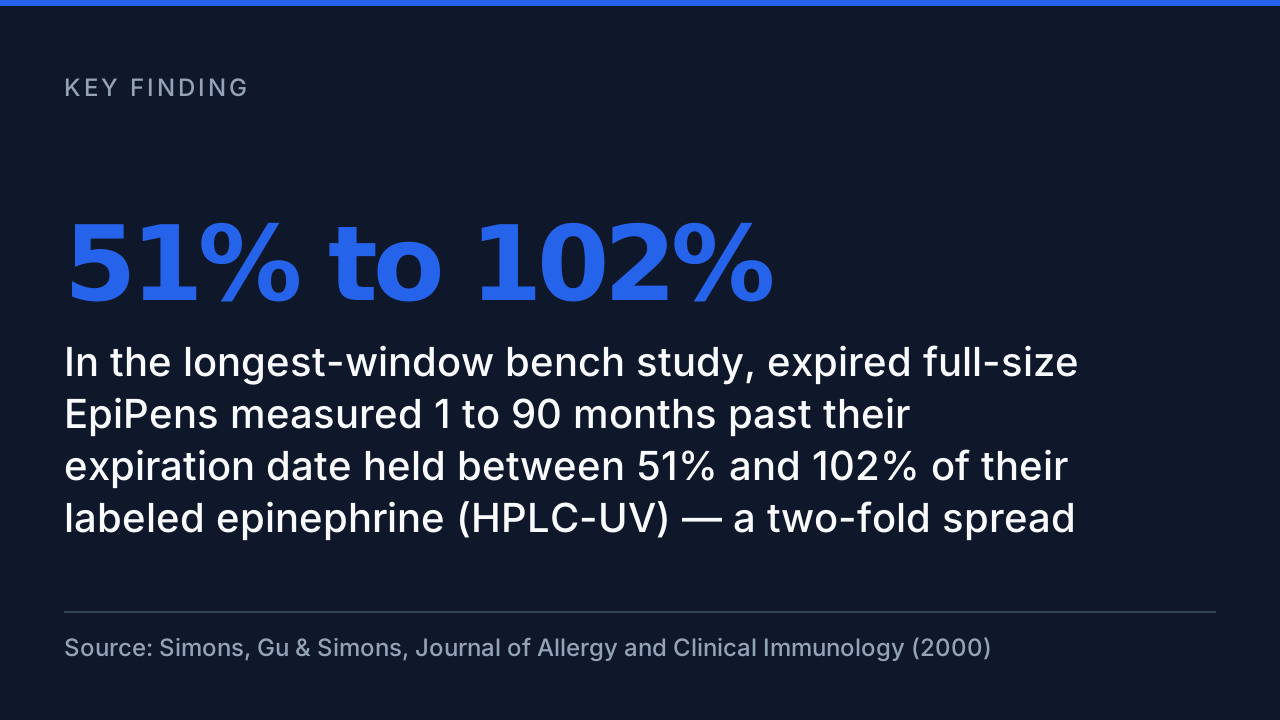
51% to 102%
In the longest-window bench study, expired full-size EpiPens measured 1 to 90 months past their expiration date held between 51% and 102% of their labeled epinephrine (HPLC-UV) — a two-fold spread between individual pens, not a promise about any one pen.
→ 10.8 ng/mL Content is not delivery: in the only study that injected expired pens and measured what reached the bloodstream (rabbits), peak plasma epinephrine from outdated EpiPens averaged 10.8 ng/mL against 26.2 ng/mL from in-date pens — lower, and significantly reduced (Simons 2000). (Simons, Gu & Simons, Journal of Allergy and Clinical Immunology (2000), 2000)
→ 80% Every one of the 40 expired devices in the most-cited study (Cantrell 2017, pens collected at a community clinic, storage uncontrolled) still contained at least 80% of its labeled epinephrine — the strongest 'floor' in the literature, and still a fifth of the dose gone at the worst-tested end. (Cantrell et al., Annals of Internal Medicine (2017), as reported by The Pharmaceutical Journal, 2017)
The standing guidance comes first, because it does not depend on any statistic on this page: replace epinephrine auto-injectors before they expire, store them as the label directs, and treat anaphylaxis immediately when it happens. Guideline bodies add one emergency exception, stated here as the guideline it is rather than as advice from this page: if a reaction is under way and the only auto-injector available is an expired one, using it is considered better than giving no epinephrine at all, followed at once by emergency care — StingHelp’s own guidance page on whether an expired EpiPen can still be used walks through that decision, and its guide to the warning signs of a systemic sting reaction covers recognition. If you are reading this during a reaction, stop reading: use the device you have and call 911.
What this page adds is the evidence underneath that guidance — the part that, until now, existed only as qualitative summaries. Five research groups have opened expired auto-injectors and measured what was inside, and their results are usually quoted as a single reassuring sentence. Read study by study, the record is less tidy and more useful. In the longest-window study, expired full-size EpiPens held between 51% to 102% of their labeled epinephrine (Simons, Gu & Simons, Journal of Allergy and Clinical Immunology (2000), 2000) — a spread so wide that where any individual pen sits inside it cannot be known without a laboratory. The studies also measured three different things that summaries collapse into one: what is chemically in the pen, what the pen delivers, and whether the machine still fires. This page keeps them separate, keeps every figure attached to its study, its months past expiry and its storage conditions, and states the limits of each dataset as plainly as its results.
1 The First Bench Study: Content Fell, and Delivery Fell Faster
In the Manitoba collection — 28 full-size pens and 6 Jr pens, 51% to 102% measured one to ninety months past expiry — content averaged 79% of label for the full-size pens (Simons, Gu & Simons, Journal of Allergy and Clinical Immunology (2000), 2000), and the same study’s injection experiment found delivery fell further than content: peak plasma levels from the outdated pens were significantly reduced against in-date controls.
METRIC
VALUE
SOURCE
Full-size EpiPens tested, collected from patients (Simons 2000)
The only delivery measurement in the literature: injected into rabbits, the outdated pens produced a peak plasma level less than half that of the in-date pens — the drug that was present arrived lower and later.
Simons, Gu & Simons, Journal of Allergy and Clinical Immunology (2000), 2000
Peak plasma epinephrine after injection, outdated vs in-date pens (rabbit study), ng/mL
Peak plasma epinephrine after injection from outdated EpiPen
10.8 ng/mL
Peak plasma epinephrine after injection from in-date EpiPen
26.2 ng/mL
These pens lived the way real pens live: in purses, briefcases, pockets, school bags, backpacks, cupboards and drawers, in a region whose outdoor temperatures swing from deep winter cold to summer heat — and their owners had been specifically instructed to avoid temperature extremes, which the study’s authors note may make their results more favourable than pens from households never given that instruction. The one pen stored intermittently in a car glove compartment measured 102% of label (Simons, Gu & Simons, Journal of Allergy and Clinical Immunology (2000), 2000), a result quoted endlessly and worth reading precisely: it was a single pen, barely past its date, and it proves that a bad storage story does not always mean a weak pen — not that storage does not matter. Against that sits the study’s quietest finding: most of the pens with reduced content showed no discolouration and no precipitate, so the viewing window could not identify them.
The delivery experiment is the part of this study that summaries drop, and it changes what the content numbers mean. Content is what a laboratory finds in the cartridge; bioavailability is what reached the bloodstream, and from the outdated pens it was significantly lower — peaking at 10.8 ng/mL against 26.2 ng/mL in the controls (Simons, Gu & Simons, Journal of Allergy and Clinical Immunology (2000), 2000) — and slower, taking 33.6 minutes to peak against 9.2 minutes. A pen can therefore hold a respectable fraction of its labeled epinephrine and still deliver a weaker, later dose than the same fraction suggests. That is the clinical context behind StingHelp’s guidance on when to give a second dose: the first dose, from any device, is not always the whole treatment.
2 The Florida Study: The Dose That Actually Comes Out
Ejection volume integrity survived intact three years past expiry — the dose that came out was smaller because the epinephrine in it had decomposed, not because the device delivered less liquid.
Rachid et al., Journal of Allergy and Clinical Immunology abstract (2012); full report Annals of Allergy, Asthma & Immunology (2015), 2015
The collection conditions matter here in the opposite direction from the Manitoba study: these pens came from Vero Beach, Florida, where it is warm all year, and the specific storage of individual pens was unknown to the researchers. Against that harsher backdrop, the mechanical result is unambiguous — every pen fired its full intended volume, a mean of 0.301 mL — and the chemical result is a gradient: colour intensity deepened and dose fell as months past expiry rose, with solutions showing no discolouration up to 20 months. The study’s full content range, carried here from a peer-reviewed review because the paper’s own abstract was never published, ran from 84% to 101% of labeled dose (Rachid et al. (2015), as summarised in Paauw, 'More on using expired medications', Federal Practitioner (2023), 2015).
Read beside the Manitoba data, this study draws the line this whole page is built on. A device has two separate ways to age: its mechanism, which in these tests barely aged at all, and its chemistry, which aged measurably in every collection ever tested. Any sentence that reports one of those as if it were the other — ‘the pens still worked’, drawn from a firing test, or ‘the drug was gone’, drawn from a content assay — is telling half the story.
3 The Most-Cited Study: A High Floor With a Junior-Shaped Hole
The California clinic study is the source of the famous reassurance, and its floor is real: every one of its 40 devices, collected with storage uncontrolled, still held at least 80% of its labeled epinephrine (Cantrell et al., Annals of Internal Medicine (2017), as reported by The Pharmaceutical Journal, 2017). Its least-quoted row is its most important one: the weakest pens in the building were the children’s pens, bottoming at 81%.
METRIC
VALUE
SOURCE
Expired devices tested — thirty-one full-size EpiPens and nine EpiPen Jrs (Cantrell 2017)
The floor of the most-cited dataset is a children’s pen: at thirty months past expiry, the three Jr pens in the collection clustered in the low-to-mid eighties as a share of label — figures the popular summary of this study leaves out.
Cantrell et al., Annals of Internal Medicine (2017), as reported by Medical Brief / MedPage Today, 2017
The band structure is the honest way to read this study. Early on, the pens cluster high: the full-size pens up to twenty-nine months past expiry held between 89% to 100%, and 22 of 24 of the pens expired twenty-five months or less contained a full dose (Cantrell et al., Annals of Internal Medicine (2017), as summarised by FARE (Food Allergy Research & Education), 2017). Later, the band slides down and narrows: at thirty-five to forty-nine months the range was 84% to 90%, and the two pens tested at fifty months held 84% and a little more. Nothing here collapses at the date line; everything here slopes. Even the study’s strongest share needs a footnote — two reports of it print different rounded percentages for the full-size pens holding at least ninety percent, while the count underneath them, nineteen pens, agrees exactly, which is why the count is what this page trusts.
The summaries that travel furthest quote this study as finding a tidy range with a floor in the mid-eighties. That floor belongs to the full-size pens only. The Jr pens — the devices dosed for children — measured lower at every point of comparison in the collection: a smaller share of them held ninety percent (56% against 65% for the full-size pens), and the single lowest reading in the study, 81%, was a Jr pen. A summary that drops the weakest devices from a dataset about emergency medicine is not a summary; it is an edit, and this page prints the unedited floor.
4 Four Brands, One Long Tail — and the Regulator's Reply
The same finding, read from the other end: about one in five of the tested devices — donated, stored who-knows-where — had already fallen below the ninety percent line the expiration date exists to guarantee.
Kassel, Jones & Mengesha, J Allergy Clin Immunol Pract (2019), as reported by Reuters, 2019
This is the dataset most often used to argue the dates themselves are wrong, and its authors did question them. The devices were not EpiPen-only — the collection included the products StingHelp compares in its EpiPen and Auvi-Q comparison — and the early numbers are the strongest in the literature: full content at six months past expiry, and at least 95% or better at one year (Kassel, Jones & Mengesha, J Allergy Clin Immunol Pract (2019), as reported by Reuters, 2019). But the collection’s centre of gravity is old (a median of 24 months past expiry), its far tail reaches 168 months, and across the whole collection the share above the line was 80% — which leaves the remainder below it, in unknown drawers, for unknown reasons.
The regulator’s reply is part of this dataset’s record and belongs beside its numbers. The FDA wrote that it was concerned the report might encourage use beyond the expiration date, and cautioned against exactly that, because it cannot ensure the pharmaceutical quality of an individual expired device. The agency also raised a measurement subtlety no content table can settle: epinephrine slowly converts to a less active mirror-image form, so a concentration reading can overstate the active drug even when the assay is accurate. Both things are in the literature, in the same journal, a few pages apart — the researchers’ question about the dates, and the regulator’s refusal to move them on this evidence.
5 Pooling Every Study: How Many Pens Stay Above the Line?
A systematic review pooled the published auto-injector studies — 8 met its criteria — and counted the share of devices still above ninety percent of label at three time points: 100% at four months, 75% at twelve months and 84% at twenty-four months past expiration (Systematic review, Journal of Allergy and Clinical Immunology (2020), 2020).
METRIC
VALUE
SOURCE
Studies meeting the review’s inclusion criteria (seven auto-injector studies, one vial study)
The pooled line does not glide: the share above ninety percent at twenty-four months is higher than at twelve, because different studies feed each time point — a pooled percentage is a property of the literature, not a decay curve for a pen.
Systematic review, Journal of Allergy and Clinical Immunology (2020), 2020
Devices still above 90% of labeled epinephrine, by months past expiration (pooled studies), percent
Devices still above 90% of labeled epinephrine at 4 months p
100%
Devices still above 90% of labeled epinephrine at 12 months
75%
Devices still above 90% of labeled epinephrine at 24 months
84%
Pooling is what turns five small, disagreeing studies into something quotable, and it deserves both its uses and its warnings. The uses: these shares are the best population-level answer available to the question people actually ask about pens like theirs, and they come with denominators — a handful of devices at the earliest point, dozens at the later ones. The warnings: the review analysed two studies separately from these pools (one of a device no longer marketed, one of pens carried on emergency vehicles and possibly exposed to extreme temperatures), the studies behind each time point are different studies with different storage and different assays, and a share of devices is not a probability for the next device. For readers whose risk is a sting rather than a food, the population these numbers describe is the same device in the same kinds of drawers — the trigger differs, as StingHelp’s overview of venom allergy and multiple stings sets out, but the pen on the shelf is the pen in these studies.
The pattern across all three time points, and across every study on this page, is consistent enough to state plainly: most expired auto-injectors that researchers have collected still held most of their epinephrine, a persistent minority had fallen well below the guaranteed line, and nothing in any dataset lets a owner tell which group their own pen belongs to without a laboratory. The data narrow the uncertainty. They do not remove it, and they were never collected from pens whose storage anyone controlled.
6 The Machine Still Fires; the Guarantee Still Ends at the Date
The newest measurements are mechanical, and they are nearly one-sided: 69 expired full-size pens and 61 expired Jr pens fired consistently in bench tests reported in October of this year. Set against them is the only occasion a regulator has ever moved a date on this evidence: 4 months, for named lots, during a shortage.
METRIC
VALUE
SOURCE
Expired full-size EpiPens that fired consistently in bench tests (CSACI 2026 poster)
The firing result comes with its own caveat, stated by the researchers and repeated here: a device that fires mechanically has not thereby proved its medicine is at full strength.
Wong et al., poster, 81st CSACI Annual Scientific Meeting (2026), as reported by ResQBand / Western Allergy Services, 2026
Three clocks run inside an auto-injector, and this page has now measured all of them. The chemical clock runs fastest and most unevenly — it is the spread in every table above. The mechanical clock barely runs at all: firing, ejection volume and needle deployment (out in 0.05 to 0.06 seconds on average) held up years past expiry in test after test. The regulatory clock is the one that governs what a patient is promised: an expiration date is the manufacturer’s guarantee that the device stays inside its compendial band — 90% to 115% of labeled strength — under the labeled storage of 15-30°C, protected from light. When stability data for specific lots justified it, the FDA moved that guarantee by 4 months for those lots only, EpiPen Jr excluded. Those are the terms on which dates move: lot data, reviewed, in months.
So the record, assembled, supports exactly the guidance it started with — and shows its working. Replace the device before it expires, because the guarantee, the delivery data and the weakest pens in every study all point the same way. Know what your action plan says before you need it — StingHelp’s sting allergy action plan checklist and its comparison of a large local reaction versus anaphylaxis exist for the recognition half of that moment, and its guide to what to do after using an EpiPen for the minutes after. And if the worst moment arrives with only an expired device in reach, the guideline position recorded at the top of this page — use it rather than nothing, then emergency care — stands on the data too: even the weakest measured pen in these studies still held half or more of its dose. What the data will never support is the plan to rely on that in advance.
Key statistics at a glance | Source: see numbered sources below
Explore every figure in this article
Metric
Value
Year
Source
Devices still above 90% of labeled epinephrine at 4 months past expiration, pooled studies
This page was built by the Data Gap Method in a degraded run, and the degraded stages are part of the record. Stage one demand for this topic was unmeasured: the cluster carries no usable thread counts (the Reddit route is blocked from this host and demand mining ran manually through web search), so the topic was carried on the strength of the studies themselves. Stage two ran on web search rather than a SERP API. The stage three format filter did not run. Stage four’s existence gate was applied manually against the site’s 689-URL sitemap corpus, which returned NEAR for this topic — the site already carries a qualitative page on using an expired EpiPen — so this article is restricted to the measured study-by-study table and links to that page rather than duplicating it; the corpus is also the only source of this page’s internal links. Stage six recency ran degraded: the sweep script returned no items because every leg is unavailable without API keys (its Reddit leg was blocked), so host web searches over the thirty-day window were used instead; they found one new dataset, the October 2026 CSACI conference posters on device function, and no new potency measurement that revises any figure here. On verification: of the sixty fact entries, twenty-one were verified by the scripted checker against their source pages, thirty-five sit on hosts the checker could not read from this machine — the journal platform blocked it or reported the pages unreachable — and every one of those values was read verbatim from the source through a browser before use; the four remaining entries are guidance FAQs whose source URLs were confirmed live. Two studies dominate the citations and both are paywalled as primary texts (the 2017 Annals of Internal Medicine letter and the 2019 Drake University study), so their figures are carried from independent secondary reports, cross-checked against at least one further report or a peer-reviewed summary for every value; where two reports of the same study disagree on a rounded percentage, the underlying count is used and the disagreement is stated. The 2026 firing data are preliminary conference posters known through a single secondary report and are labelled as such wherever they appear. Syringe and vial epinephrine stability studies were deliberately excluded: this page measures auto-injectors only. No paid API, tool or data source was used at any stage.
Sources consulted: 34
Sources cited: 13
Data freshness: current year: 1, last year: 0, older: 12
Data range: 2000-05-01 to 2026-11-13
Research date: 2026-11-13
Update schedule: Annual, or when a new measured auto-injector dataset appears
Limitations: Every dataset is small (34 to 46 devices per content study; 130 devices in the 2026 conference poster) and none measured a human anaphylaxis outcome; the only delivery evidence is a rabbit bioavailability study from 2000. The two most-cited content studies (Cantrell 2017, Kassel 2019) are paywalled as primary texts, so their figures are carried from independent secondary reports, cross-checked against at least one further report or a peer-reviewed summary for every value used. Storage histories in the patient-collected studies were self-reported and uncontrolled. The CSACI 2026 function data are preliminary conference posters known through a single secondary report. Syringe and vial epinephrine stability studies were deliberately excluded: this page is about auto-injectors only.
Frequently Asked Questions
If the only auto-injector available in a real emergency is expired, what does the guidance say?
Guideline bodies are consistent on this, and it is a guideline statement, not a finding of this page's data: FARE advises that if an in-date auto-injector is not available, it is better to use an expired auto-injector than to give no epinephrine at all — unless the medicine is pinkish, more than slightly yellow, cloudy or contains particles — and to call 911 immediately. The authors of the 2000 bench study reached the same position from their data. The standing guidance remains to replace devices before they expire: in the largest clinic-collected study, even the worst of 40 expired pens still held 80% of label, but no study can certify the pen in a particular drawer. (FARE (Food Allergy Research & Education), expired epinephrine guidance (2018), 2018)
How much weaker is an auto-injector two years past its expiration date?
There is no single number for a single pen, and that is the honest answer. Pooled across the published studies, 84% of devices tested at 24 months past expiration still held more than 90% of their labeled epinephrine — a population share, not a reading of your pen. In the oldest collection, pens of roughly that age ranged from near-full strength down to about two-thirds of label. Averages describe the studies; they cannot describe the device in your bag, whose storage history no laboratory has measured. (Systematic review, Journal of Allergy and Clinical Immunology (2020), 2020)
Can you tell whether an expired pen has lost strength by looking at it?
No — and this is one of the clearest findings in the record. In the 2000 study, most auto-injectors with reduced epinephrine content could not be identified by inspecting the colour window: the solution looked normal. The two pens that were visibly discolored did measure low — 66% of label at 20 months past expiry and 51% at 51 months — so discoloration is a warning when you see it, but its absence is not reassurance. Guidance is to replace a device if the medicine is pink or brown, cloudy, or contains particles, and to check the window regularly. (Simons, Gu & Simons, Journal of Allergy and Clinical Immunology (2000), 2000)
Does keeping a pen in a hot car ruin it?
The single most-quoted data point cuts against the simple story: one pen in the 2000 study that had spent time in a car glove compartment measured 102% of labeled strength — but it was only one month past expiry, and it is one pen, not a storage recommendation. The chemistry runs the other way over time: epinephrine degrades faster with heat and light, which is why labels specify room-temperature storage in the dark and no refrigeration. A pen's real history is the sum of every place it has been, and no study can rewind it. (Simons, Gu & Simons, Journal of Allergy and Clinical Immunology (2000), 2000)
Did the FDA ever extend an EpiPen expiration date?
Yes — once, narrowly, and in a way that shows how the system actually works. In August 2018, during a shortage, the FDA extended the expiry of specific lots of the 0.3 mg EpiPen and its authorized generics by 4 months, after reviewing stability data the manufacturer submitted for those lots. EpiPen Jr was not included, other lots were not covered, and the extension was months, not years. A year later the agency published its caution in the journal that carried the Kassel study: it cannot ensure the quality of devices used past their expiry date. (US Food and Drug Administration action (August 2018), as reported by Pharmacy Times, 2018)
Do expired auto-injectors still fire?
In the bench tests that checked, yes. The 2000 study's devices all fired and injected as designed in the bioavailability experiment. In the newest tests, reported at the CSACI meeting in October 2026, 69 expired EpiPens and 61 expired EpiPen Jr devices fired consistently, with the needle emerging in about 0.05 to 0.06 seconds on average. The researchers themselves added the limit that matters: a device that fires mechanically has not thereby proved its medicine is at full strength. Firing is the mechanical question; potency is the chemical one; they age on different clocks. (Wong et al., poster, 81st CSACI Annual Scientific Meeting (2026), as reported by ResQBand / Western Allergy Services, 2026)
Why do some articles say the 2017 study found 84% to 100% potency?
Because that range quietly leaves out the smallest pens. The 84% floor belongs to the full-size devices in Cantrell's 2017 collection. The same study's EpiPen Jr pens measured lower: at 30 months past expiry, three of them held 81%, 82% and 86% of label. Quoting 84% as the study's floor makes the data look tidier than it is — and the devices it tidies away are the children's ones. The full study range, Jr pens included, runs from 81% upward. (Cantrell et al., Annals of Internal Medicine (2017), as reported by Medical Brief / MedPage Today, 2017)
Sources & References
Simons FER, Gu X, Simons KJ. “Outdated EpiPen and EpiPen Jr autoinjectors: past their prime? Journal of Allergy and Clinical Immunology. 2000;105(5):1025-1030.” jacionline.org/article/S0091-6749%2800%2980028-7/fulltext. Accessed 2026-11-13.
Rachid O, Simons KJ, Rawas-Qalaji M, Wein M, Simons FER. “Outdated epinephrine autoinjectors: ejection volume integrity and epinephrine content and dose. Journal of Allergy and Clinical Immunology. 2012 (meeting abstract); full report: Annals of Allergy, Asthma & Immunology. 2015;114(4):354-356.” jacionline.org/article/S0091-6749(11)02200-7/fulltext. Accessed 2026-11-13.
Cantrell FL, Cantrell P, Wen A, Gerona R. “Epinephrine concentrations in EpiPens after the expiration date. Annals of Internal Medicine. 2017;166(12):918-919.” pubmed.ncbi.nlm.nih.gov/28492859/. Accessed 2026-11-13.
US Food and Drug Administration. “Evaluation of epinephrine's expiration date: a US Food and Drug Administration's perspective. Journal of Allergy and Clinical Immunology: In Practice. 2019.” jaci-inpractice.org/article/S2213-2198(19)30722-6/fulltext. Accessed 2026-11-13.
Systematic review (meeting abstract). “A systematic review of the concentration of epinephrine in auto-injectors after device expiration. Journal of Allergy and Clinical Immunology. 2020;145(2).” jacionline.org/article/S0091-6749(19)32538-2/fulltext. Accessed 2026-11-13.
Wong L, Duncan A, Bartlett A, Kim H, Kuprowski M (Western University). “Assessment of the functional characteristics of in-date and expired EpiPens and EpiPen Jr devices. Poster, 81st CSACI Annual Scientific Meeting, Toronto, 2026 (as reported by ResQBand / Western Allergy Services).” getresqband.com/questions/can-i-use-an-expired-epipen-in-an-emergency. Accessed 2026-11-13.
This article is for informational purposes only and isn’t medical advice. If you’re worried about a bite or sting, talk to a healthcare professional.
SJ
Dr. Sarah Jones, MD
MD — Medical Reviewer · Board-Certified Emergency Medicine Physician
Dr. Jones oversees StingHelp’s clinical verification process. Every guide is systematically evaluated against active Centers for Disease Control and Prevention (CDC), Environmental Protection Agency (EPA), and American Academy of Allergy, Asthma & Immunology (AAAAI) medical consensus standards to ensure symptom distinctions and care recommendations are clinically sound.
How this guide was prepared: Researched and structured by the StingHelp Editorial Team; verified against peer-reviewed dermatology literature; clinically reviewed November 2026.
RELATED CLINICAL GUIDES
More StingHelp guides
Explore physician-reviewed first-aid procedures, identification clues, and symptom comparisons for other common outdoor bites and stings.
Allergy, Anaphylaxis & Severe Reactions29 min read
Venom immunotherapy protects 91%-96% of wasp-venom patients but 77%-84% for bee venom — and only a fifth to two-thirds of patients finish the course. Protection, completion, relapse and cost data, split by venom, by years completed and by country.
Allergy, Anaphylaxis & Severe Reactions29 min read
A positive venom allergy test in someone who has never reacted is common, usually temporary, and a weaker prediction than it sounds: the measured prevalence, sting-outcome and fading data, with every population and year attached.
Allergy, Anaphylaxis & Severe Reactions27 min read
How many people with an epinephrine auto-injector actually carry it, have it at the scene, use it during anaphylaxis, and use it correctly? The joined study data — each rate with its population and year, sting-specific figures separated.
STAY INFORMED
Keep practical guidance close.
Seasonal bite forecasts, updated first-aid protocols, and evidence-based outdoor prevention tips delivered to your inbox.
Your information is handled under our Privacy Policy. For urgent symptoms, seek medical help rather than waiting for an email response.