Venom Immunotherapy in Numbers: Protection Rates, Completion Rates and Cost per Course (2026)
Venom immunotherapy protects 91%-96% of wasp-venom patients but 77%-84% for bee venom — and only a fifth to two-thirds of patients finish the course. Protection, completion, relapse and cost data, split by venom, by years completed and by country.
Venom Immunotherapy in Numbers: Protection Rates, Completion Rates and Cost per Course (2026)
By StingHelp Editorial Team11 min read
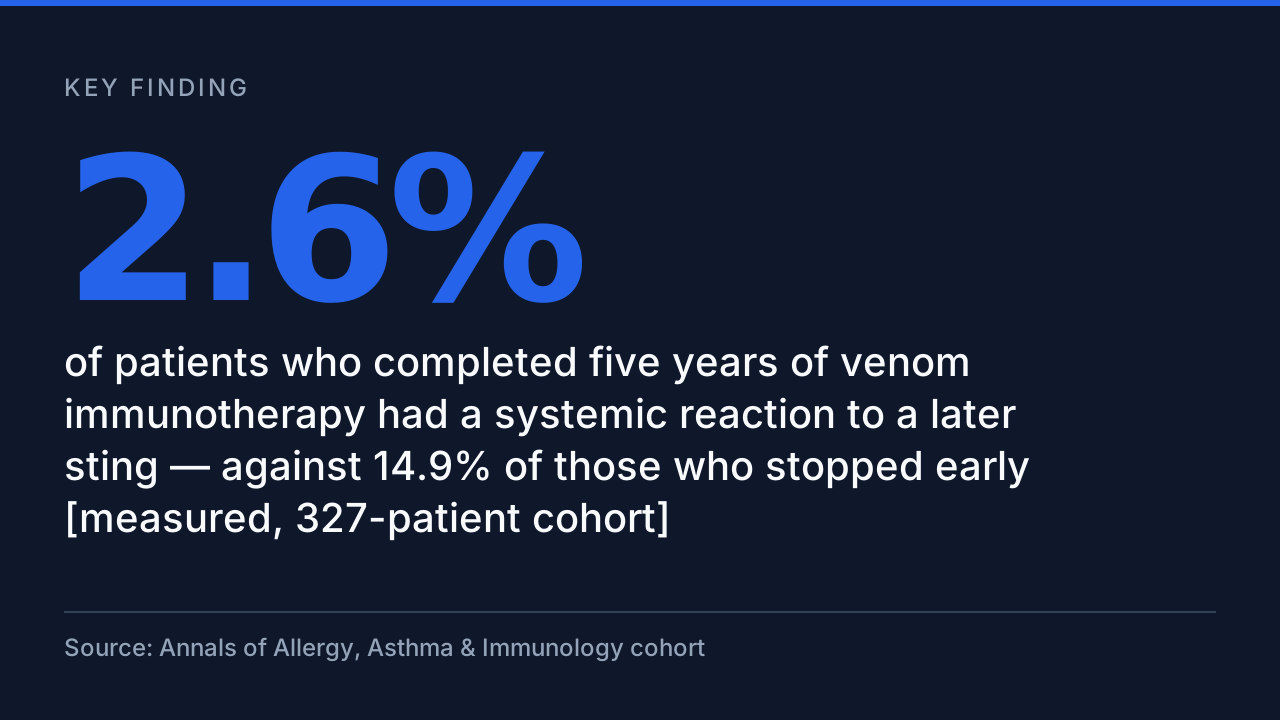
2.6%
Of patients who completed five years of venom immunotherapy and were later stung, only 2.6% (2 of 78) had a systemic reaction — against 14.9% (7 of 47) of patients who had discontinued the same therapy prematurely (327-patient long-term cohort).
→ 2,886 euros Calculated price of a complete five-year VIT course per patient in Slovenia (health-insurance price list, 514-patient Golnik cohort) — equal to about 16 emergency treatments for systemic reactions. (Kadivec & Kosnik 2017, Golnik, Slovenia (514-patient cost cohort), 2017)
Ask how well venom immunotherapy works and you will be quoted a single number — ‘about 98% effective’. Traced back to its sources, that number belongs to ant venom, effective in 97%-98% of patients (EAACI Guidelines on Allergen Immunotherapy: Hymenoptera venom allergy (Sturm et al. 2018), 2018); a classic Johns Hopkins paper describes the therapy more loosely as providing greater than 95% from sting anaphylaxis (Golden et al. 1998, J Allergy Clin Immunol (extended discontinuation observations), 1998). For the two venoms most people are actually treated for, the measured figures are lower and different from each other — and they describe patients who finished the course. In the largest recent cohort, patients who completed five years of therapy and were later stung had a systemic reaction in only 2.6% of cases, against a far higher rate in patients who stopped early (Annals of Allergy, Asthma & Immunology long-term VIT cohort (327 patients), 2024). This page publishes the numbers the slogan leaves out: protection by venom, what each course year adds, who finishes, what stopping costs, and what finishing costs.
One boundary before the data. Venom immunotherapy is a prescribed medical treatment, given under supervision because the injections themselves can cause reactions; whether to start, continue or stop it is a decision for the treating allergist, not for a statistics page. The numbers below also never reach complete protection — no venom, dose or duration in this data brings the risk to zero — so they are not a reason to set aside a prescribed adrenaline auto-injector. If a sting causes breathing difficulty, throat tightness, dizziness or collapse, that is an emergency: use the auto-injector and call 911. Our guides to the warning signs of anaphylaxis after a sting and to when a second EpiPen dose is needed cover the response itself; this page covers the arithmetic of the treatment that is meant to prevent it.
The data falls into five parts: protection first, because the honest headline is a table, not a slogan; then course length and completion — the two questions patients actually live with; then relapse after stopping; and finally what a finished course costs in the systems that have published a price. A sting allergy action plan is where these numbers end up being used; readers weighing allergy against sheer venom dose may also want our explainer on multiple stings, allergy and venom load.
1 How Much Protection Does Venom Immunotherapy Give? It Depends on the Venom
The famous figure is real — it just belongs to the venom fewest patients receive. Ant venom immunotherapy, used mainly for fire ant and jack jumper ant allergy, is the only one whose measured range reaches the high nineties.
EAACI Guidelines on Allergen Immunotherapy: Hymenoptera venom allergy (Sturm et al. 2018), 2018
The pooled claim deserves a fair reading before it is discounted. When Golden’s Johns Hopkins group wrote that standardised venom therapy provides greater than 95% from insect sting anaphylaxis (Golden et al. 1998, J Allergy Clin Immunol (extended discontinuation observations), 1998), they were summarising a clinic population treated mostly with vespid venoms — the group whose measured range, 91%-96%, genuinely sits in the mid-nineties. The distortion happens downstream, when the sentence is quoted without its population and applied to a beekeeper starting honeybee therapy, whose guideline range is 77%-84%. That gap is not a rounding error: roughly one in five honeybee patients who complete therapy are not fully protected by it.
The strength of the effect itself is not in doubt. The systematic review behind the guideline pooled the controlled evidence and found the odds of a severe systemic reaction on re-sting reduced to 0.08 of the untreated odds (Dhami et al. 2017, EAACI systematic review and meta-analysis (Allergy), 2017) — an order-of-magnitude change, and the same review is candid that the base is thin: only a small set of studies met its inclusion bar out of the many thousands screened. Two practical consequences follow. First, treat the ranges as ranges; the second decimal place does not exist in this literature. Second, remember what these rates are not: they are not the risk faced by someone with a large local reaction rather than anaphylaxis, a different and much lower-risk situation that immunotherapy is not usually prescribed for.
2 Does Course Length Change the Outcome? The Data Draw a Line Near Four Years
Four patients in the Turkish cohort developed anaphylaxis after a field re-sting. All four were in incomplete treatment. No completer who was re-stung in that cohort had anaphylaxis at all.
Istanbul Medical Journal 2025, single-centre VIT effectiveness cohort (71 patients, Türkiye), 2025
Read the duration data as a gradient, not a switch. Nothing in these cohorts says a patient is unprotected in year three and protected in year five; what the Turkish data show is that reaction severity on re-sting keeps improving with time on therapy, becoming statistically visible somewhere past four years. The Slovenian cohort shows why the question is not academic: 57% of patients were stung again within five years of starting (Kadivec & Kosnik 2017, Golnik, Slovenia (514-patient cost cohort), 2017), so for most patients the course is not a waiting room before real life resumes — the test arrives during treatment, when 86.3% of stung patients in that cohort tolerated their stings well (Kadivec & Kosnik 2017, Golnik, Slovenia (514-patient cost cohort), 2017).
The honest account also includes what the therapy itself does on the way. In the European adverse-events registry, systemic reactions to the injections were recorded in 17.2% of cases (Frontiers in Allergy 2026, Adverse Events Registry (ADER) latent class analysis, 2026), with honeybee venom and fast up-dosing schedules carrying the higher odds — which is why build-up happens in a clinic, and why a reaction during treatment is a clinical event to discuss, not a reason to quietly stop attending. The newest real-world snapshot, a small cohort published in October of this year, fits the pattern: no systemic reactions during build-up, then one during maintenance — 6.3% of its patients — after which the team discontinued that patient’s therapy (Toxins 2026, Istanbul real-world VIT cohort (16 adults), 2026). Duration, in other words, cuts both ways in the data: longer courses protect more, and every additional year is another year of supervised injections. Where the balance sits for one patient is exactly the judgement the treating allergist is for.
3 How Many Patients Finish the Five Years? Between a Fifth and Two-Thirds
In the cohort with the lowest completion rate, four out of five patients did not drop out — their treatment was interrupted because the venom product could not be supplied. A completion rate is a property of the system around the patient, not just of the patient.
Istanbul Medical Journal 2025, single-centre VIT effectiveness cohort (71 patients, Türkiye), 2025
Patients who completed the full five years of venom immunotherapy, by cohort
Completed the full five years — Turkish centre cohort
19.7%
Completed the full five years — Hacettepe cohort
34%
Completed the full five years — 327-patient cohort
64.5%
The middle cohort is the most instructive, because nothing dramatic happened to it. At Hacettepe, 34% of treated patients completed five years (Allergy and Asthma Proceedings 2024, Hacettepe University VIT cohort (105 patients, Türkiye), 2024) — no supply collapse, just the ordinary friction of a half-decade of clinic visits. The consequence of stopping there was measurable: of the premature stoppers who were re-stung, 44% developed a systemic reaction, while the completers who were re-stung had none (Allergy and Asthma Proceedings 2024, Hacettepe University VIT cohort (105 patients, Türkiye), 2024). Put the three cohorts together and the pattern is hard to miss: the therapy’s published protection rates are completion-weighted, and the weight varies by a factor of three between systems.
Behaviour after the course leaks in a second, quieter way. In the Turkish cohort, only 46.5% of patients on therapy carried an adrenaline auto-injector (Istanbul Medical Journal 2025, single-centre VIT effectiveness cohort (71 patients, Türkiye), 2025), and of the carriers who were re-stung, fewer than half used it. Finishing a course of injections and maintaining the rest of the safety routine are separate achievements — auto-injectors expire on the shelf whether or not they are carried, as our guide to whether an expired EpiPen still works explains, and the steps after one is used matter as much as carrying it, which is why we keep a walkthrough of what to do after using an EpiPen. The data asset here is uncomfortable but useful: the weak point in the chain is rarely the pharmacology.
4 What Happens After Stopping? Relapse Depends on the Venom and the Timing
Relapse is not evenly spread. Patients who had systemic reactions to the injections during therapy relapsed at 38%, against 7% for those who did not — one of the few relapse signals the guideline treats as consistent across studies.
EAACI Guidelines on Allergen Immunotherapy: Hymenoptera venom allergy (Sturm et al. 2018), 2018
Most of what is known about stopping comes from a small number of long-running cohorts, and the oldest of them still anchors the field. The Johns Hopkins programme challenged its graduates with supervised stings for years after discontinuation: systemic symptoms followed 3%(Golden et al. 1996, J Allergy Clin Immunol (Johns Hopkins discontinuation cohort), 1996), most of them mild, none life-threatening — the empirical basis for the now-standard view that five to six years of vespid therapy can be stopped with a single-digit residual risk. That view has a venom limit and a patient limit. The venom limit is the honeybee gap above. The patient limit is in the callout: a history of reacting to the treatment itself marks the group whose relapse risk stays high, and it is why guidelines carve out patients for longer or lifelong therapy rather than naming a universal stopping date.
Children are the clear exception in the other direction: 5% of children with moderate-to-severe reactions relapsed after stopping, in follow-up stretching to twenty years (EAACI Guidelines on Allergen Immunotherapy: Hymenoptera venom allergy (Sturm et al. 2018), 2018) — the best long-term numbers in this article, and a reminder that the adult ranges should not be read onto a treated child. What no study in this set can do is certify an individual. The guideline is blunt that no blood test, skin test or antibody level currently estimates one person’s relapse risk, which is why the post-treatment plan — including whether an auto-injector stays in the pocket, and which one, as our EpiPen and Auvi-Q comparison sets out — remains a clinical conversation rather than a calculation.
5 What Does a Full Course Cost? Four Systems, Four Prices
The Slovenian comparison reframes the price: the five-year course cost 1,905.6 euros more than equipping the same patient with auto-injectors for life — and the course, unlike the injectors, reduces the risk itself.
The labels are the content of this section. The Slovenian figure is a payer’s price list applied to a real cohort; the Zurich figures are one hospital’s internal costs for two different routes in one city; the Danish figures are outputs of a decision model, marked [modelled] in the table because no patient was ever billed them; and the American figure is a single clinic’s advertised price, the only venom-specific US number a patient can read — American cost data otherwise lives inside generic allergy-shot pages that do not price venom therapy separately. Averaging these four systems into one ‘typical cost’ would manufacture a fifth number that describes nowhere.
Cost-effectiveness is a different claim from cheap, and the Danish model makes it precisely: over ten years, depot venom therapy cost a payer EUR 7,428 more per patient than auto-injectors alone and bought health at EUR 15,550 per quality-adjusted life year (Sturm et al. 2026, Allergy — Danish payer cost-effectiveness model, 2026) — inside the range health systems usually call good value, for a treatment whose alternative is a lifetime of emergency risk. The Slovenian authors make the same point from the ward side: one course, at 2,886 euros, equals roughly sixteen emergency treatments for systemic reactions at their prices (Kadivec & Kosnik 2017, Golnik, Slovenia (514-patient cost cohort), 2017), in a cohort where the average index reaction — the sting that started everything — cost 180.4 euros to treat (Kadivec & Kosnik 2017, Golnik, Slovenia (514-patient cost cohort), 2017). Whether the arithmetic persuades a given payer is not this page’s call; that it exists, sourced and labelled, is the point of publishing it.
Key statistics at a glance | Source: see numbered sources below
Explore every figure in this article
Metric
Value
Year
Source
Protection rate, honeybee venom VIT [measured across trials/challenges]
This page was built with the DataGap Method, and its degraded stages are named here because they are part of the record. Stage 1 (demand mining) was degraded: Reddit is unreachable from the research host and no ScrapeCreators key was available, so demand for this topic is unmeasured — the cluster entered scoring on SERP and literature evidence, with a counted thread demand of zero. Stage 3 (the backlink format filter) did not run: it needs DataForSEO, which was not available, so no format percentages are claimed anywhere in this run. The Stage 4 existence gate ran manually over the site’s full sitemap corpus, because the vendor script crashes on this host, and returned CLEAR — this site had no immunotherapy page at all. The Stage 6 recency sweep ran as a manual web-search fallback after the script’s Reddit leg was blocked; it contributed the registry safety analysis and the October 2026 real-world cohort. All images are locally drawn charts (no image-generation API was available). Verification: ten of the thirteen source hosts blocked or defeated the automated checker, so every such source was opened and read in a browser in the same session and each value confirmed word for word — of the 51 facts in the underlying sheet, 9 were machine-verified and 42 browser-confirmed, and none was dropped. Three limits deserve emphasis. US cost data for venom immunotherapy specifically does not exist in the published literature we could find; the US figure here is one clinic’s list price and is labelled a vendor price. European costs come from three different systems and are never blended. And completion rates cannot be compared across cohorts without their causes — the lowest rate in this article was produced by a drug-supply failure, not by patients.
Sources consulted: 41
Sources cited: 13
Data freshness: current year: 4, last year: 2, older: 7
Data range: 1996-01-01 to 2026-11-13
Research date: 2026-11-13
Update schedule: Annual
Limitations: No US venom-specific course price exists in the published literature found: US cost appears only as one clinic's published list price and inside generic allergy-shot cost pages, so the US figure is labelled a vendor list price and never averaged with European costings. European cost figures come from three different systems (a Slovenian insurer price list, a Swiss hospital's internal costing, a Danish payer model) and are reported side by side, never blended. Completion rates are not comparable across cohorts without their causes: the lowest rate (19.7%) was driven by venom product unavailability, not patient dropout. Efficacy ranges descend from a small trial base — the EAACI systematic review found 17 includable studies from 16,950 screened. This run was degraded: Stage 1 demand was unmeasured (no Reddit access from this host, cluster thread count 0), Stage 3's backlink format filter did not run (no DataForSEO), the Stage 6a recency sweep ran as a manual web-search fallback because the script's Reddit leg is blocked, and all visuals are locally drawn SVGs (no image API).
Frequently Asked Questions
How effective is venom immunotherapy, really?
It depends on the venom, which is the part the slogans leave out. The EAACI guideline puts effectiveness at 91%-96% for vespid (wasp and yellow jacket) venom, 77%-84% for honeybee venom, and 97%-98% for ant venom. So 'about 98% effective' is true for the venom fewest people are treated for, and materially overstates the honeybee figure. (EAACI Guidelines on Allergen Immunotherapy: Hymenoptera venom allergy (Sturm et al. 2018), 2018)
What happens if you stop venom immunotherapy early?
The protection you banked is partial, and the shortfall shows up on the next sting. In a 71-patient Turkish cohort, all four patients who developed anaphylaxis after a field re-sting had incomplete treatment, and reaction type differed significantly only once patients passed four years of therapy. Whether and when to stop is an allergist's decision — but the data say the course length is not a formality. (Istanbul Medical Journal 2025, single-centre VIT effectiveness cohort (71 patients, Türkiye), 2025)
How many people actually finish the full course?
Fewer than the brochures imply, and the rate says as much about the system as the patient. In the largest recent cohort here — 327 patients — 64.5% completed five years. Other centres report far lower completion; in one Turkish cohort only 19.7% finished, because the venom product became unavailable, not because patients quit. (Annals of Allergy, Asthma & Immunology long-term VIT cohort (327 patients), 2024)
Does the protection last after the injections stop?
Mostly, but not completely, and not to zero-risk. In the Johns Hopkins cohorts, adults who stopped yellow jacket / mixed vespid VIT after five to six years kept a residual systemic-reaction risk of 5% to 10% — far below the untreated baseline, but not zero, and it did not disappear with longer follow-up. (Golden et al. 1998, J Allergy Clin Immunol (extended discontinuation observations), 1998)
How much does a full course of venom immunotherapy cost?
There is no single price — there is a price per system. The only full-course costing from a national insurer's price list (Slovenia) puts five years at 2,886 euros per patient. A Swiss university hospital's internal costing of bee-venom injections over five years is more than four times that. Any page quoting one 'cost of VIT' without naming the country and the payer is quoting a slogan, not a price. (Kadivec & Kosnik 2017, Golnik, Slovenia (514-patient cost cohort), 2017)
Do you still need an epinephrine auto-injector during and after VIT?
Follow your allergist on this — guidelines keep auto-injectors for patients at risk of multiple stings or with risk factors for relapse, because no venom's protection reaches 100%. Real-world carrying is patchy: in the 71-patient Turkish cohort only 46.5% of patients on VIT carried an auto-injector at all, and only 8 of the 20 carriers who were re-stung actually used it. (Istanbul Medical Journal 2025, single-centre VIT effectiveness cohort (71 patients, Türkiye), 2025)
Is venom immunotherapy itself risky?
The injections can cause reactions, which is why build-up happens under supervision. In the European Adverse Events Registry analysis (398 treatments, 8 countries), systemic adverse events were recorded in 17.2% of cases, with honeybee venom and rush up-dosing carrying higher odds. Most reactions are managed in clinic, but the number is part of an honest account of what the course involves. (Frontiers in Allergy 2026, Adverse Events Registry (ADER) latent class analysis, 2026)
Sources & References
Sturm GJ et al., EAACI Guidelines on Allergen Immunotherapy: Hymenoptera venom allergy. “EAACI guidelines on allergen immunotherapy: Hymenoptera venom allergy.” onlinelibrary.wiley.com/doi/10.1111/all.13262. Accessed 2026-11-13.
Dhami S et al., Allergen immunotherapy for insect venom allergy: a systematic review and meta-analysis. “Allergen immunotherapy for insect venom allergy: a systematic review and meta-analysis.” bdi.ox.ac.uk/publications/2040647. Accessed 2026-11-13.
Golden DBK et al., Discontinuing venom immunotherapy: outcome after five years. “Discontinuing venom immunotherapy: outcome after five years.” jacionline.org/article/S0091-6749(96)70302-0/fulltext. Accessed 2026-11-13.
Golden DBK et al., Discontinuing venom immunotherapy: extended observations. “Discontinuing venom immunotherapy: extended observations.” jacionline.org/article/S0091-6749(98)70239-8/fulltext. Accessed 2026-11-13.
From Treatment to Protection: Long-Term Impact of Venom Immunotherapy on Hymenoptera Allergy. “From Treatment to Protection: Long-Term Impact of Venom Immunotherapy on Hymenoptera Allergy.” sciencedirect.com/science/article/abs/pii/S1081120624006057. Accessed 2026-11-13.
Sturm G et al., Cost-Effectiveness of Venom Immunotherapy in Preventing Severe Bee and Wasp Sting Reactions. “Cost-Effectiveness of Venom Immunotherapy in Preventing Severe Bee and Wasp Sting Reactions.” pubmed.ncbi.nlm.nih.gov/41410197/. Accessed 2026-11-13.
Allergenix — published clinic pricing (venom immunotherapy programme). “Pricing | Allergenix — Direct Specialty Allergy Care.” allergenix.com/pricing. Accessed 2026-11-13.
Real-life safety of venom immunotherapy in children and adults: latent class analysis from the Adverse Events Registry. “Real-life safety of venom immunotherapy in children and adults: latent class analysis from the Adverse Events Registry.” frontiersin.org/journals/allergy/articles/10.3389/falgy.2026.1972766/full. Accessed 2026-11-13.
Venom Immunotherapy in Clinical Practice: A Retrospective Real-World Cohort. “Venom Immunotherapy in Clinical Practice: A Retrospective Real-World Cohort.” mdpi.com/2072-6651/18/10/447. Accessed 2026-11-13.
Last updated:
This article is for informational purposes only and isn’t medical advice. If you’re worried about a bite or sting, talk to a healthcare professional.
SJ
Dr. Sarah Jones, MD
MD — Medical Reviewer · Board-Certified Emergency Medicine Physician
Dr. Jones oversees StingHelp’s clinical verification process. Every guide is systematically evaluated against active Centers for Disease Control and Prevention (CDC), Environmental Protection Agency (EPA), and American Academy of Allergy, Asthma & Immunology (AAAAI) medical consensus standards to ensure symptom distinctions and care recommendations are clinically sound.
How this guide was prepared: Researched and structured by the StingHelp Editorial Team; verified against peer-reviewed dermatology literature; clinically reviewed November 2026.
RELATED CLINICAL GUIDES
More StingHelp guides
Explore physician-reviewed first-aid procedures, identification clues, and symptom comparisons for other common outdoor bites and stings.
Allergy, Anaphylaxis & Severe Reactions35 min read
What laboratories actually measured inside expired EpiPens and other auto-injectors: epinephrine content by months past expiry, study by study, with storage conditions, the one delivery study, the firing tests — and why no individual pen's strength can be assumed.
Allergy, Anaphylaxis & Severe Reactions29 min read
A positive venom allergy test in someone who has never reacted is common, usually temporary, and a weaker prediction than it sounds: the measured prevalence, sting-outcome and fading data, with every population and year attached.
Allergy, Anaphylaxis & Severe Reactions27 min read
How many people with an epinephrine auto-injector actually carry it, have it at the scene, use it during anaphylaxis, and use it correctly? The joined study data — each rate with its population and year, sting-specific figures separated.
STAY INFORMED
Keep practical guidance close.
Seasonal bite forecasts, updated first-aid protocols, and evidence-based outdoor prevention tips delivered to your inbox.
Your information is handled under our Privacy Policy. For urgent symptoms, seek medical help rather than waiting for an email response.