Bird Mites After a Nest Removal — and Rodent Mites After the Mice Are Gone: Why the Bites Start When the Host Leaves
The fast answer: If itchy bites began right after a bird nest was removed (or the fledglings left), or right after mice or rats were trapped, poisoned, or died in your walls, you are very likely dealing with the mites those animals left behind. Bird mites and rodent mites live on their animal hosts. When the host disappears, thousands of hungry mites wander off in search of a blood meal — and the nearest warm body is you. The good news is real: these mites cannot reproduce on human blood, so the problem is self-limiting. Once the source is fully removed and the home is cleaned, bird mite problems typically fade within days to about three weeks, and rodent mites usually die off within a couple of weeks. This guide explains how to tell which mite you have, what to do this week, and how to make sure it actually ends.
The Removal Paradox: Why Solving One Problem Starts Another
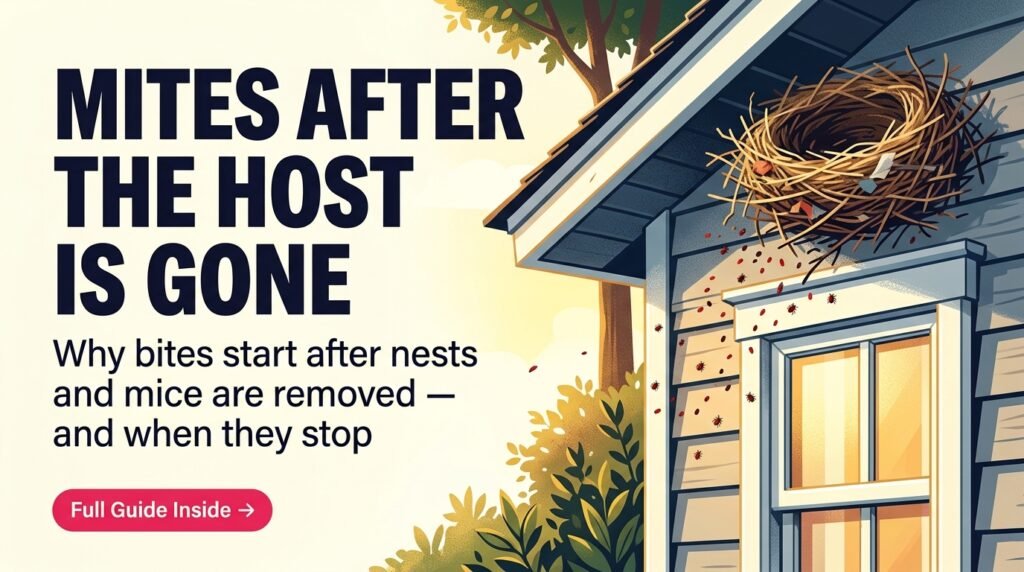
This is the part that confuses everyone, including many pest control customers: the bites start because you did the right thing. While the birds or rodents are present, their mites feed on them and stay in the nest. The mites have no reason to visit you. But the moment the host leaves, dies, or is removed, every mite in that nest loses its food supply at the same time. Driven by hunger, they disperse — crawling along walls, pipes, wiring, and window frames, following warmth and carbon dioxide toward the people inside.
That is why the timeline is so distinctive. People describe it the same way again and again: “We never had a single bite while the mice were here. We trapped them, and three days later we were covered in bites.” Or: “The baby birds left the nest over the porch, and within the week we had tiny specks crawling on the windowsill and bites every night.” If your biting problem began within days of a host-removal event, you are not looking at bed bugs. You are looking at orphans.
Bird Mites: The Nest Is Gone, the Mites Are Moving In
Where bird mites come from
Bird mites are parasites of wild birds that become a household problem when birds nest in or on the home: under eaves and soffits, in chimneys and attic vents, on porch light fixtures, in gutters, in a shrub pressed against a bedroom window, or around a window air-conditioning unit. University extension specialists note that mite problems typically explode at one specific moment — when the young birds fledge and leave the nest, or when the nest is removed or the birds die. A nest that sat quietly for months can release a flood of mites in a single week.
What bird mite bites are like
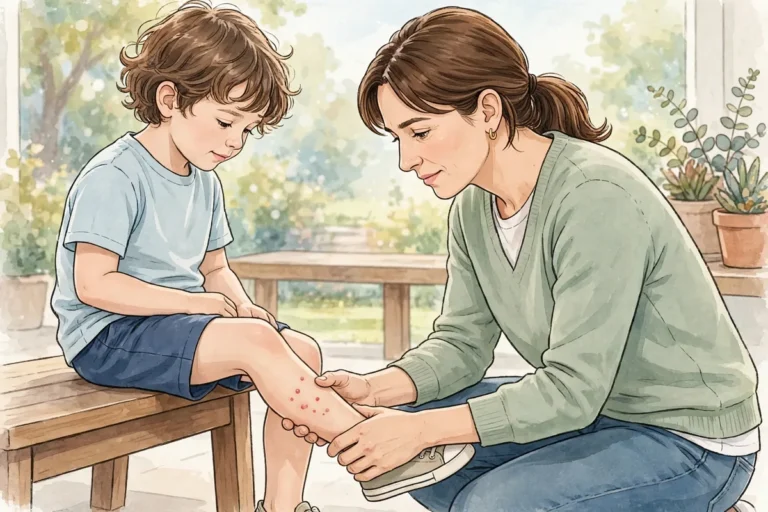
The mites themselves are barely visible — tiny moving specks, grayish-white before a meal and reddish after feeding. People often notice a crawling or tingling sensation on the skin, especially in the evening, before they ever see a mite. The bites produce small, intensely itchy red bumps, often in clusters, frequently on the neck, shoulders, arms, and upper body — the parts closest to a window, headboard wall, or nest site. Some people develop a more widespread itchy rash. Symptoms usually peak quickly and each individual bite settles within days, but new bites keep appearing as long as mites keep arriving.
How long do bird mites live without a bird?
This is the question everyone asks, and the honest answer is: not long, but longer than you’d like. Bird mites cannot survive or reproduce on humans — human blood does not sustain them, and they do not infest people, live in skin, or set up colonies in mattresses. Extension literature indicates that off their bird hosts, common bird mites survive a few days under the dry conditions of most modern, air-conditioned homes, and up to a matter of weeks only under ideal, humid conditions. In practice, once the nest is removed and no new birds return, mite activity indoors typically drops sharply within a day or two and the problem burns itself out within roughly two to three weeks at most. If bites are still going strong a month after the nest is gone, another source is almost certainly still feeding them — usually a second nest nobody found.
Rodent Mites: The Bites Nobody Warns You About After Extermination
The two species that matter
Rodent mites are the least-discussed cause of indoor mystery bites in American health writing — most of what exists comes from pest control companies and state health departments, which is exactly why so many sufferers end up misdiagnosed with bed bugs, eczema, or hives. Two species account for nearly all human cases:
- Tropical rat mite (Ornithonyssus bacoti): Despite the name, it is neither truly tropical nor limited to rats — it is found across North America on rats and mice. It is the rodent mite most often linked to itchy indoor bites. Los Angeles County’s public health department notes that these mites usually enter homes after treatment for rodents has been done: the rats are gone, so the mites go looking.
- House mouse mite (Liponyssoides sanguineus): A nest-dweller most common in the northeastern United States that feeds on mice and will bite people when mice are unavailable. This species is of medical interest because it can carry the bacterium behind rickettsialpox, a generally mild illness that is fortunately rare in the United States.
What rodent mite bites are like
Rodent mite bites cause a condition sometimes called rat mite dermatitis: intense itching with small red bumps or tiny clear blisters, often with a rash. The marks tend to appear on the neck, upper trunk, arms, and face, and frequently where clothing constricts the skin — waistbands, elastic edges, and under straps — because wandering mites get trapped and feed there. Mites leaving a dead rodent in a wall void may pour into living spaces in large numbers, and they tend to congregate near heat sources such as hot pipes and stoves before dispersing. People commonly report the worst biting in the first several days after a rodent dies in a wall or is trapped, exactly when the animal’s body cools and its mites abandon it all at once.
How long do rodent mites live without rodents?
The tropical rat mite can survive roughly ten days off its host, traveling surprisingly far in search of food, and most rodent mites die off within a couple of weeks when no rodent blood is available. Rodent mites cannot reproduce on human blood and are not known to transmit diseases to humans in the ordinary course of these household outbreaks (the house mouse mite’s link to rare rickettsialpox is the exception to note, not the rule). What this means practically: after the rodents and their nests are completely removed, the biting should wind down within about two weeks. If it doesn’t, rodents — or at least their nests — are still in the structure, and the mites are still being replenished.
Recent Event → Likely Culprit: The Quick Table
| What Just Happened | Likely Culprit | Typical Duration After Source Removal | First Fix |
|---|---|---|---|
| Fledglings left the nest over the porch, or a nest was removed from eaves/chimney/attic | Bird mites | Activity drops in 1–2 days; gone within ~2–3 weeks | Remove all nest material, seal the site so birds can’t rebuild, vacuum and wipe down indoor mites |
| Mice or rats trapped, poisoned, or a dead-animal smell came from a wall | Rodent mites (often tropical rat mite) | Usually dies off within ~1–2 weeks | Complete rodent removal including nests and carcasses, seal entry points, vacuum and hot-launder |
| Rodents excluded from the attic but still heard overhead | Rodent mites, ongoing | Will not end until the hosts do | Finish the rodent job first — mite treatments alone cannot work while hosts remain |
| No host event at all; bites came out of nowhere | Probably not host mites — revisit other causes | — | Work through the broader mystery-bite checklist |
How to End It: A Step-by-Step Plan
- Remove the source completely — hosts, nests, and remains. For birds: once the birds have left, remove all nest material (wear gloves; bag it and discard it outside the home) and clean the site. For rodents: the job is not done when the last trap snaps. Nests in attics, wall voids, and crawl spaces must come out, carcasses must be removed, and entry points sealed so a new generation doesn’t move in. Every control source agrees on this point: source removal, not spraying, is what ends a mite problem.
- Block re-entry. Seal gaps around eaves, vents, pipes, and window frames with caulk, mesh, or steel wool as appropriate. If birds can rebuild the same nest next month, the mites can return next month. Where active bird nests are involved, note that many wild birds are legally protected while nesting — time removal for after the young have left, or ask your local wildlife or extension office what is allowed.
- Vacuum like you mean it. Vacuum carpets, upholstered furniture, mattresses, and along baseboards in the affected rooms — daily at first. Mites are not necessarily killed by vacuuming, so empty the canister or remove the bag into an outdoor trash bin immediately afterward (some extension guidance suggests freezing the bag first to keep mites from crawling back out).
- Wipe up the wanderers. Visible mites on windowsills, walls, and hard surfaces can be removed with a damp, soapy cloth. Clear tape pressed on a surface also picks up specimens — useful if you want an identification from your local extension service.
- Hot-wash fabrics. Launder bedding, clothing, and washable items from the affected rooms in hot water and dry on high heat.
- Use the air conditioner. Bird and rodent mites do poorly in dry conditions. Running the AC or a dehumidifier makes your home hostile territory and shortens their survival.
- Treat your skin, not yourself with pesticides. Never apply insecticides to skin or bedding meant for sleeping. For the itching: wash with soap and water, use a cold compress, apply 1% hydrocortisone cream or calamine lotion, and take an oral antihistamine if itching is widespread or disrupts sleep, following label directions.
Why the Bed Bug Treatment Failed (If You Already Tried One)
A very common story in these cases: the family assumes bed bugs, pays for treatments, and the biting continues — because nothing about a bed bug treatment removes a nest full of mites from the eave or a mouse nest from the wall void. The treatments weren’t necessarily done badly; they were aimed at the wrong target. If you’ve already spent money on bed bug treatment without results, that failure is itself diagnostic information. It means the source lives somewhere the treatment never reached — most often on the structure (a nest) or in the structure (rodents), not in the bed. Our general explainer on bird mite bite treatment covers day-to-day bite care, and if your “bites” are happening with no removal event at all, another hidden home source worth checking is carpet beetle dermatitis — a rash caused by larval hairs rather than anything feeding on you.
When to See a Doctor
Most bird and rodent mite bites settle with home care. Seek medical attention if:
- Redness spreads, the skin becomes warm, swollen, painful, or develops pus or red streaks — signs of bacterial infection
- You develop fever, or a bite area becomes severely swollen or blistered
- Swelling involves the face or lips, or you have any difficulty breathing — emergency care
- The rash is severe, widespread, or not improving after the source has been removed and a week of home care has passed
- Itching and bites continue beyond about three weeks after complete source removal — at that point, either a source remains or the cause is something else, and both possibilities deserve a professional look (a dermatologist for the skin, a pest professional for the structure)
For more on how these mites compare with another itchy indoor mite problem, see our guide to oak mite bite treatment.
Frequently Asked Questions
Can bird mites or rodent mites live on me or infest my body?
No. Both groups are nest parasites of animals. They bite people when desperate, but they cannot reproduce on human blood, do not burrow into skin, and do not establish infestations on people or in beds. Every mite biting you came from the nest or the walls — which is why removing the source ends the problem.
How long will the biting last after the nest or mice are removed?
Bird mite activity usually drops sharply within a day or two of nest removal and the problem typically ends within about two to three weeks, as stragglers die without a bird to feed on. Rodent mites generally die off within roughly one to two weeks of complete rodent and nest removal. Biting that continues at full strength beyond those windows almost always means a source remains — a second nest, a missed carcass, or rodents still present.
I can’t see anything biting me. How can I confirm it’s mites?
Look for the mites themselves at the source and along the route: windowsills near a nest site, walls near attic hatches, around hot pipes, and along baseboards often show tiny moving specks. Press clear tape to surfaces to collect specimens, and take the sample to your local cooperative extension office or a pest professional for identification under magnification. Confirmation matters, because mite outbreaks are frequently misdiagnosed as bed bugs, scabies, or allergies.
Do I need to throw away my mattress or furniture?
Almost never. These mites do not live or breed in mattresses or furniture — they only pass through. Thorough vacuuming, wiping surfaces, and hot-laundering fabrics, combined with removing the nest or rodent source, is enough in the overwhelming majority of cases.
Should I use a bug bomb or fogger for mites?
Foggers are a poor tool for this problem: they don’t reach mites inside wall voids or nests, and the source keeps producing mites regardless. Money and effort are far better spent on source removal, sealing, vacuuming, and laundering. If a pest professional recommends a targeted residual treatment around the source area after removal, that is a different, more sensible use of pesticide.
Can my dog or cat bring these mites in or keep them going?
Pets can be bitten by wandering bird and rodent mites just as people are, and they can occasionally carry a few mites indoors on their fur after investigating a nest or a rodent run. But pets are not the sustaining host — bird mites need birds and rodent mites need rodents. If your pet is scratching heavily or losing hair, a veterinarian should check for the pet’s own parasites, which are a separate issue.
By Dr. Sarah Jones