Blister Beetle “Bite”: Why a Blister Appeared Overnight (It Wasn’t a Bite)
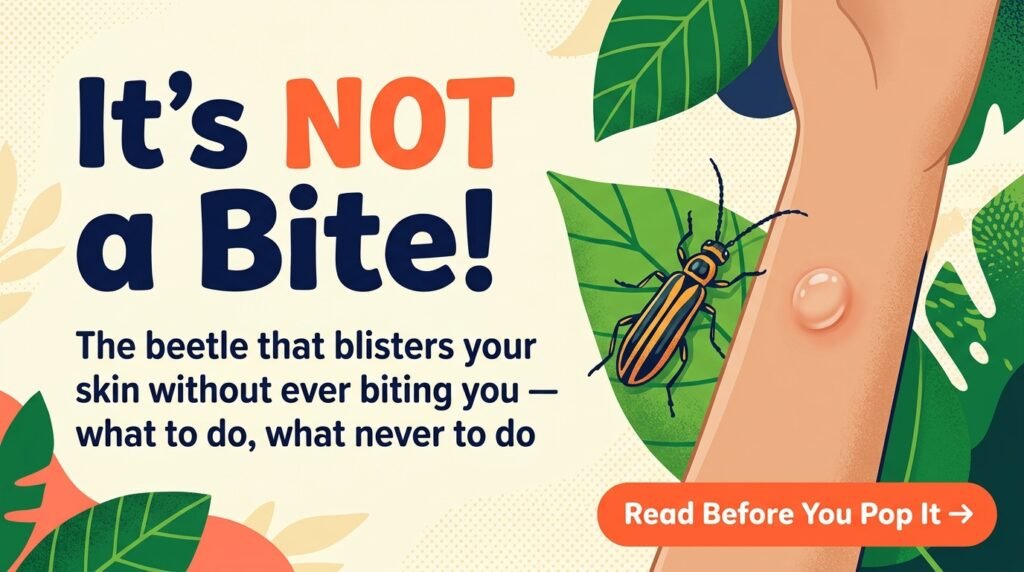
The fast answer: Blister beetles do not bite. They have no stinger, and their jaws can’t break your skin. That fluid-filled blister is a mild chemical burn. When a blister beetle is crushed or pressed against skin — usually when someone swats it, rolls over on it in bed, or brushes it off a neck or arm — it leaks a defensive chemical called cantharidin from its leg joints. Cantharidin raises a blister within hours, often overnight. The right response is simple: wash the skin gently, leave the blister intact, protect it, and let it heal — most cases resolve in about a week without scarring. Never crush one of these beetles against your skin, and never pop the blister.
The Overnight Mystery, Explained
The classic blister beetle story goes like this: you spend a summer evening outdoors — gardening, sitting on the porch, camping. Nothing bites you; you’d swear to it. You go to bed fine. In the morning there’s a red welt, and by the next day it has tightened into a clear, fluid-filled blister, sometimes in a strange streak or smear shape. Naturally, you assume something bit you in your sleep.
What almost certainly happened instead: a beetle wandered onto your skin or clothing, and at some point it was crushed against you — by a swat, a sleeve, a collar, or the weight of your own body as you shifted in sleep. Blister beetles don’t need to attack, or even to be fully crushed. When threatened or pressed, they reflexively bleed a droplet of cantharidin-laced fluid from their leg joints. Cantharidin is colorless and odorless, and the contact usually causes no sensation at all in the moment. There is no sting, no pinch, no itch to warn you. The chemical quietly goes to work on the top layers of skin, and the blister is the delayed receipt.
National Capital Poison Center (Poison Control) describes cantharidin as a toxic, blistering body fluid — and notes that skin contact can produce burns and blisters “immediately or in a delayed fashion.” That delay, plus the total absence of a biting moment, is exactly why these injuries get blamed on spiders, bed bugs, and mystery allergies.
Meet the Beetle
Blister beetles (family Meloidae) are plant-eating insects native to the eastern United States and parts of Europe, Africa, and Asia. Poison Control’s description is a good field guide: they measure about 1 to 2.5 centimeters long (roughly half an inch to an inch), with soft, leathery bodies, a large head relative to a small torso, and a noticeably narrow “neck” between them. Colors vary widely by species — some are a dull gray or black, others are conspicuous, like bright yellow with black stripes. You’ll most often find them on flowering plants in summer: gardens, fields, and anywhere blooms are open. Gardeners, farmers working hay or alfalfa, and anyone who sits in grass near flowering plants are the people most likely to meet one.
Two habits make encounters common. First, a beetle exploring a plant can just as easily explore you. Second, a beetle that gets inside clothing, a sleeping bag, or bedding doesn’t have to bite anyone to cause trouble — it only has to get pressed.
What a Blister Beetle Injury Looks Like, Hour by Hour
- At contact: usually nothing. No pain, no mark. This is the biggest clue it’s not a bite — real bites announce themselves.
- Within a few hours: redness and a burning or tingling feeling develop where the beetle touched. A raised red welt, like a mild burn, often forms.
- By about 24 hours: the welt typically tightens into a tense blister filled with clear fluid. If the beetle was dragged across the skin as it was brushed away, the injury forms a line or streak — dermatologists call this pattern dermatitis linearis. It’s a signature of cantharidin: biting insects don’t leave streaks.
- Days 2–4: the blister may grow slightly, then stabilizes. It can be sore, especially if it’s somewhere clothing rubs.
- About a week: the fluid reabsorbs, the blister roof dries and flakes off, and new skin is revealed underneath. Most uncomplicated cases heal in roughly a week and don’t scar, provided the blister wasn’t popped or infected.
Equally important is what you won’t see: no puncture marks, no twin fang dots, no central bite crater. If there’s a blister but no bite point, think chemical, not creature.
Blister Beetle Injury vs. the Usual Suspects
| Suspect | Was there a painful moment? | Shape and signs | Key difference |
|---|---|---|---|
| Blister beetle | No — contact is painless and unnoticed | Red welt, then a clear-fluid blister; often a streak or smear | No puncture; delay of hours before anything appears; chemical burn, not a bite |
| Bed bugs | No bite felt, but itching follows | Small itchy red bumps, often in lines or clusters | Bumps, not true fluid blisters; recur night after night in the same home |
| Fire ants | Yes — immediate burning sting | White pustules on red skin within a day | You feel fire ant stings the moment they happen, usually several at once outdoors |
| Spider bite (suspected) | Sometimes | A single lesion, sometimes with a pale or dark center | Most “spider bites” are actually skin infections or other causes; a painless overnight blister with a streak pattern points to cantharidin instead |
| Carpet beetle larvae | No | Itchy rash of small bumps, no true blister | Larvae don’t bite either — their hairs irritate skin. See our guide to carpet beetle dermatitis |
Skin reactions get misattributed constantly — the browntail moth caterpillar causes another rash routinely blamed on bites (see browntail moth rash vs. bug bites), and garden exposure can also mean straw itch mite bites. The overnight-blister-with-no-bite pattern, though, is blister beetle territory.
What to Do (and What Not to Do)
Do this
- Wash the skin gently with soap and water as soon as you suspect contact — even before a blister forms. Per Poison Control, the best initial treatment is removing the cantharidin from the skin by rinsing gently with water. This limits how much chemical stays in contact with skin.
- If a beetle is on you now: flick it off. Use a leaf, a card, a quick flick — anything except crushing it against your skin or squeezing it with your fingers. Walk it onto a leaf if you’re feeling kind.
- Leave the blister intact. The blister roof is a sterile, natural bandage. Cover it loosely with a clean bandage or gauze if it’s somewhere that will rub.
- Cool it and calm it. A cool compress eases the burn. Over-the-counter pain relievers can help soreness, per label directions.
- Wash your hands after any handling — of the beetle, of clothing it was on, of bedding from a campsite. Cantharidin transferred from fingers to eyes is one of the more serious routes of exposure (see below).
- Shake out clothing, towels, and sleeping gear used outdoors before bringing them against your skin again.
Never do this
- Never crush or slap a blister beetle on your skin. That swat is precisely the mechanism of injury — it ruptures the beetle and paints cantharidin across the contact area.
- Don’t pop the blister. Draining it removes your best protection and opens a door to bacterial infection, which is what turns a one-week nuisance into a doctor visit.
- Don’t rub your eyes after gardening or handling outdoor gear until your hands are washed. Eye exposure to cantharidin can cause severe irritation, pain, tearing, decreased vision, and damage to the cornea.
- Don’t apply folk remedies or home chemicals to “draw out” the toxin. There is no specific antidote for cantharidin — Poison Control is explicit that care is supportive, aimed at the symptoms — and harsh home treatments only add a second injury.
When to See a Doctor — or Call Poison Control
Most blister beetle encounters are, in Poison Control’s words, benign and non-life-threatening; the blisters are uncomfortable but usually not serious. Do get professional advice promptly for:
- Any eye involvement — pain, tearing, redness, or vision changes after rubbing your eyes. Poison Control notes an eye doctor may need to evaluate the exposure.
- Blisters on the face, lips, or genitals, or a very large blister or many blisters over a wide area
- Signs of infection: spreading redness, increasing pain after the first couple of days, warmth, pus, red streaks, or fever
- A blister that isn’t healing after about a week, or that keeps recurring with no new outdoor exposure
- A child who put a beetle in their mouth, or anyone with mouth, throat, or stomach symptoms after suspected ingestion — this is genuinely urgent; cantharidin severely irritates the digestive and urinary tracts
- Diabetes or a weakened immune system plus any broken skin — lower your threshold for being seen
For anything on this list — or simple uncertainty — call Poison Control at 1-800-222-1222, free and available 24 hours a day, or use the webPOISONCONTROL online triage tool. Doctors can prescribe corticosteroids for inflammation or antibiotics if the skin becomes infected, and Poison Control also advises making sure your tetanus vaccination is up to date when skin is broken.
Keeping Blister Beetles Off Your Skin
- Look before you brush. If something is crawling on your neck or arm outdoors, a half-second glance before swatting prevents the one move that causes injury.
- Gloves and sleeves for garden work among flowering plants in summer, especially when harvesting or handling cut flowers and hay.
- Check bedding and clothing at camp. Shake out sleeping bags, clothes, and towels that have been on the ground or a picnic table.
- Don’t handle interesting beetles bare-handed — and teach kids the same. Long body, narrow neck, on a flower? Admire it, photograph it, leave it alone.
- Skip the pesticide overreaction. Blister beetles are occasional visitors, not home invaders; they don’t nest in houses or bite their way through a summer. Awareness beats chemicals here.
Frequently Asked Questions
Do blister beetles bite humans?
No. They cannot bite through skin and have no stinger or venom. Every “blister beetle bite” is actually a cantharidin chemical burn from a beetle that was pressed or crushed against the skin. The beetle doesn’t even have to die — it leaks the chemical from its leg joints when threatened.
How long after contact does the blister appear?
Redness and burning can start within a few hours, and a formed blister commonly appears within about 24 hours — which is why so many people wake up to one and conclude they were bitten in bed. Poison Control notes the reaction can be immediate or delayed, so a blister on day two is still consistent with beetle contact from the day or evening before.
Should I pop a blister beetle blister?
No. Keep the roof intact, protect it with a loose bandage, and let the fluid reabsorb. If it breaks on its own, wash gently, keep it clean and covered, and watch for infection signs — increasing pain, spreading redness, pus, or fever.
Why is my blister in a line or streak?
Because the beetle was dragged across your skin as it was brushed or swatted away, smearing cantharidin along the path. Doctors call the pattern dermatitis linearis. A streak-shaped blister with no bite mark is one of the strongest clues a blister beetle — not a biting insect — was responsible.
Is cantharidin dangerous?
On skin, in the small amounts involved in typical encounters, it causes a painful but usually self-limited burn and blister; Poison Control considers most encounters benign. It becomes dangerous when it reaches the eyes, is swallowed, or covers a very large area — those situations need prompt medical care. There is no antidote; treatment is supportive.
Can my dog or cat be hurt by a blister beetle?
Yes — pets that snap at or eat beetles can get blistering in the mouth or skin irritation from contact, and livestock eating hay containing blister beetles face serious risk. If your pet is drooling, off its food, or has mouth sores after a beetle encounter, call your veterinarian.
By Dr. Sarah Jones