Seed Ticks and “Tick Bombs”: Hundreds of Tiny Ticks on Your Legs — What to Do Now
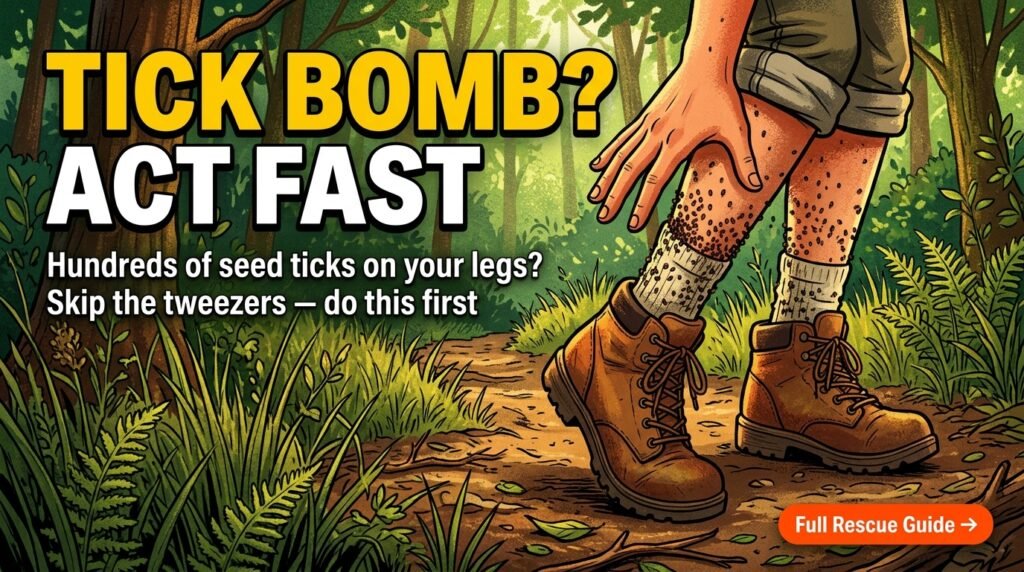
The fast answer: Put the tweezers down. When you walk through a cluster of freshly hatched seed ticks — the event people call a “tick bomb” — you may have dozens or hundreds of poppy-seed-sized ticks crawling up your legs, and removing them one by one is the slowest, least effective option. The right first move is tape: press duct tape or a sticky lint roller over your skin and clothing to lift off the masses, then shower and scrub, treat your clothes with dryer heat so no survivors ride into your laundry pile, and save tweezers for the few that actually attached. Then expect itching — possibly a lot of it — for up to two weeks, and know what would turn this nuisance into a medical visit.
What a Tick Bomb Actually Is
“Seed ticks” are not a species. They are ticks in the larval stage — the first stage after hatching — of ordinary species such as the lone star tick, the American dog tick, and the blacklegged (deer) tick. Larvae are tiny, about the size of a poppy seed or a grain of sand, and they have six legs instead of the eight that nymphs and adults have. The mass-encounter part comes from how ticks reproduce: a single female lays her eggs in one cluster, and according to the University of Rhode Island’s TickEncounter program, the larvae can hatch in clumps of up to 3,000. Those thousands of larvae wait together on low vegetation and leaf litter, and when a warm body brushes past, they swarm aboard en masse — a few seconds of contact can mean hundreds of ticks on your shoes and legs.
Timing matters. Lone star tick larvae — the species behind most tick bomb stories in the South, Southeast, and mid-Atlantic — peak from late July through September, which is why seed tick season is a late-summer problem exactly when people are mowing, hiking, hunting the early seasons, and cleaning up yards. In some regions the same pests are called “turkey mites,” which they are not — they are baby ticks, not mites at all.
The First 10 Minutes: Your Step-by-Step Removal Protocol
- Stay outside if you can. Do the mass removal on a porch, in a garage, or at the trailhead — not over carpet or bedding where dropped larvae can linger.
- Tape them off. Press a strip of duct tape firmly over the affected skin and clothing, then peel it away; the adhesive lifts the tiny larvae right off. A sticky lint roller works the same way and is easy to run repeatedly over legs, socks, and shoes, though plain tape is stickier. Repeat with fresh tape until passes come away clean.
- Strip carefully. Remove outer clothing and shoes, shaking them out vigorously outdoors. Bag the clothes for the moment — do not toss them in a hamper with the family laundry.
- Shower and scrub. A shower within two hours of coming inside is standard tick advice for good reason: it washes off unattached ticks and gives you a structured full-body check. Use a washcloth and scrub — larvae that haven’t latched on rinse away easily. Pay attention to ankles, behind knees, the waistband line, groin, armpits, and the scalp.
- Tweeze only the stragglers that attached. For any tick that has actually bitten in, use fine-tipped tweezers: grasp it as close to the skin surface as possible and pull upward with steady, even pressure. Don’t twist, don’t squeeze the body, and skip the folklore — no burning, nail polish, peppermint oil, or dish soap. Clean each bite site and your hands with soap and water or rubbing alcohol.
- Check the kids and the dog. Anyone (or any pet) who walked the same ground walked through the same hatch. Dogs pick up seed ticks on legs, belly, and ears; check them before they bring the swarm to the couch.
For the fine points of removing a single attached tick properly, see our guide to removing an attached tick safely, and for larvae that cluster-bite a smaller patch of skin, our seed tick cluster bite treatment guide.
Your Clothes Are Still Carrying Them
The most common tick bomb mistake happens after the shower, when the “cleaned” clothes go back on or get draped over a chair. Larvae that survived your tape pass are still on that fabric, and they are patient. Handle it in this order:
- Heat first. Put the clothes straight into the dryer on high heat for at least 10 minutes. Dry heat at dryer temperatures kills ticks; this is the CDC’s recommended first step for clothing after tick exposure.
- Then wash hot. If the clothes still need washing after drying, use hot water. If a garment can’t tolerate dryer heat, a hot wash is the fallback — cold or warm water alone may not kill ticks.
- Treat tomorrow’s outfit. For the rest of seed tick season, treat shoes, socks, and work or hiking pants with 0.5% permethrin spray made for clothing. Permethrin is applied to fabric only — never to skin — it kills ticks on contact, and it stays effective through several washings. Let treated clothing dry completely before wearing, and keep it away from cats while it is wet, since permethrin is toxic to them.
Treating the Bites (and the Itch That Follows)
Once the ticks are off, wash every bite area with soap and water. Then manage the reaction like any other bite cluster: a cold compress for the first wave of itching, calamine lotion or 1% hydrocortisone cream on the bumps, and an oral antihistamine if itching is keeping you awake. Be honest with yourself about the timeline — with dozens of bites, itching commonly builds over the first day or two and can take up to two weeks to fully fade, and lone star tick bites in particular are notorious for itching longer and harder than people expect. What you must not do is scratch the tops off: hundreds of tiny open wounds are an open invitation to a bacterial skin infection, which is the most common real complication of a tick bomb.
Our seed tick bite removal guide covers one-by-one larva removal in more detail if you are dealing with a small number of attached larvae rather than a swarm.
Seed Ticks vs. Chiggers: The Other Tiny-Bite Suspect
Clusters of itchy ankle bites after time in grass get blamed on chiggers just as often as seed ticks, and telling them apart matters less than people think — the first response is identical. But there are real differences:
| Feature | Seed ticks (tick larvae) | Chiggers (mite larvae) |
|---|---|---|
| Can you see them? | Yes — visible dark specks, like moving poppy seeds, often by the dozen or hundred | Almost never — at about 1/150 of an inch, they look like specks of red dust at most |
| Do they stay attached? | Yes — they latch on and feed for days if not removed | No — they feed briefly through a tiny feeding tube in the skin, then drop off; the itch is a reaction to their saliva |
| Typical bite pattern | Wherever they swarm: ankles and legs first, then anywhere they crawl, including waistband and beyond | Where clothing presses tight: sock tops, waistbands, underwear lines, behind knees |
| Itch timing | Builds over the first day; may last up to two weeks | Starts within hours, is often most intense at 24–48 hours, can last about two weeks |
| Disease concern | Low for freshly hatched larvae (see below), but the same ground holds disease-carrying nymphs and adults | Chiggers in the U.S. do not transmit disease to people |
| First response | Tape/lint roller, shower and scrub, dryer heat for clothes, tweezers for attached ones | Shower and scrub, wash clothes in hot water — the mites are usually already gone |
A note of honesty from North Carolina State University’s review of these pests: the bite marks left by seed ticks and chiggers are nearly impossible for a non-professional to distinguish by appearance alone. The reliable tell is the pest itself — if you can see dozens of tiny crawling specks on your legs, those are seed ticks. If you saw nothing at all, chiggers are the likelier story.
Can Seed Ticks Make You Sick?
Here is the reassuring fact, stated carefully: a newly hatched larva has never taken a blood meal, so it has not yet had the chance to pick up the bacteria and viruses that ticks normally acquire by feeding on an infected animal first. That is why freshly hatched larvae are considered far less likely to transmit disease than nymphs and adults. But “far less likely” is not “impossible,” and a tick bomb rarely travels alone — the grass that held the larvae also holds older ticks, some of which may have attached unnoticed during the same walk. So the plan is: get everything off, care for the bites, note the date, and watch yourself over the following weeks rather than either panicking or forgetting the episode entirely.
When a Tick Bomb Becomes a Medical Concern
- Signs of skin infection at the bite sites: spreading redness, increasing pain or warmth, swelling that grows instead of shrinking, pus, or red streaks — or a fever. With hundreds of bites, infection is the complication to take most seriously.
- Flu-like symptoms in the following weeks: fever, headache, muscle aches, unusual fatigue, or a new rash — including a single expanding red patch anywhere on the body. Mention the tick exposure and its date; timing is valuable information for the clinician.
- A child with a heavy infestation. Small children covered in larvae, or with ticks attached around the ears, eyes, or genitals, are worth a prompt call to the pediatrician for help with complete removal and a check of the skin.
- Attached ticks you cannot remove, or mouthparts left behind after a difficult removal.
- You are immunocompromised — a lower threshold for getting checked after a mass exposure is sensible.
Late-Summer Prevention: Don’t Get Bombed Again
- Permethrin-treated shoes and socks are the MVP of seed tick season. Larvae board at ground level, and treated footwear kills them on contact before they climb.
- Add an EPA-registered skin repellent (DEET, picaridin, IR3535, oil of lemon eucalyptus, or 2-undecanone) on exposed skin, and wear long pants tucked into socks in tall grass and brush — unfashionable and highly effective.
- Respect the habitat in late July through September: stay out of leaf litter, avoid sitting directly on logs and ground cover at field edges, and walk in the center of trails rather than brushing through grass.
- Carry a lint roller in the car or pack during larval season. Used in the first minutes, it turns a tick bomb into a non-event.
- Do the home routine every time: outdoor tape-and-strip, shower and scrub, dryer on high heat for the clothes, and a deliberate tick check — in that order.
Frequently Asked Questions
Does a lint roller really work on seed ticks?
Yes — it is one of the methods the University of Rhode Island’s TickEncounter program recommends for exactly this situation. Duct tape is stickier and better for a heavy swarm; a lint roller is more convenient for repeated passes over clothing and legs. Use whichever you have, and use it immediately, before the larvae attach.
Should I go to the ER for hundreds of seed tick bites?
Usually not. If you have removed the ticks, washed up, and feel otherwise well, home care plus watching for infection and later flu-like symptoms is the standard approach. Do seek care promptly for a heavy infestation on a small child, ticks attached near the eyes, signs of skin infection, fever, or if you are immunocompromised — and call emergency services for any allergic emergency signs such as lip or tongue swelling or trouble breathing.
How long will seed tick bites itch?
Longer than you’d like. With a large cluster, itching typically peaks in the first couple of days and most marks fade within about a week, but mild itching for up to two weeks is common — and lone star bites are known for lingering itch. Itching that is still getting worse after several days, or bites that look angrier instead of calmer, should be checked for infection.
Will seed ticks infest my house?
No. Seed ticks do not set up breeding colonies indoors the way bed bugs or fleas can. Larvae that come in on clothing are looking for a blood meal, and they dry out and die indoors without one. The dryer-heat step for clothes, a shower, and a normal laundering of bedding if it was in contact with the swarm clothes close the issue.
My dog walked through the same patch. What should I do?
Run the same play: lint-roll or tape the dog’s legs and belly outdoors, check ears, armpits, and between the toes, and bathe the dog if the swarm was heavy. Keep up vet-approved tick prevention — pets are a common way ticks of all ages travel indoors. Never apply a dog tick product to a cat, and ask your vet before using any product on a very young or small pet.
This article is general information, not medical advice. When in doubt about an exposure — especially involving a child — a clinician or your local health department can advise you the same day.
By Dr. Sarah Jones