
You pulled a tick off your leg after a hike — a big, brown, ornate one with patterned markings on its back. Is it a Rocky Mountain wood tick or an American dog tick? Rocky Mountain wood tick vs American dog tick is one of the most common tick ID questions in the US, because these two Dermacentor cousins look remarkably alike. Both are large, ornate hard ticks with mottled shield markings, both feed on dogs and people, and both can transmit serious diseases.
Correct identification matters because the disease watch-list differs: the Rocky Mountain wood tick is the main carrier of Colorado tick fever, while the American dog tick is the primary eastern vector of Rocky Mountain spotted fever. This guide gives you a side-by-side comparison — appearance, range, habitat, and diseases — plus exactly what to do after a bite from either one. Neither tick can be identified from a bite mark alone, and no article can diagnose you, so treat this as ID education and see a doctor after any bite.
Side-by-Side Identification: What Each Looks Like
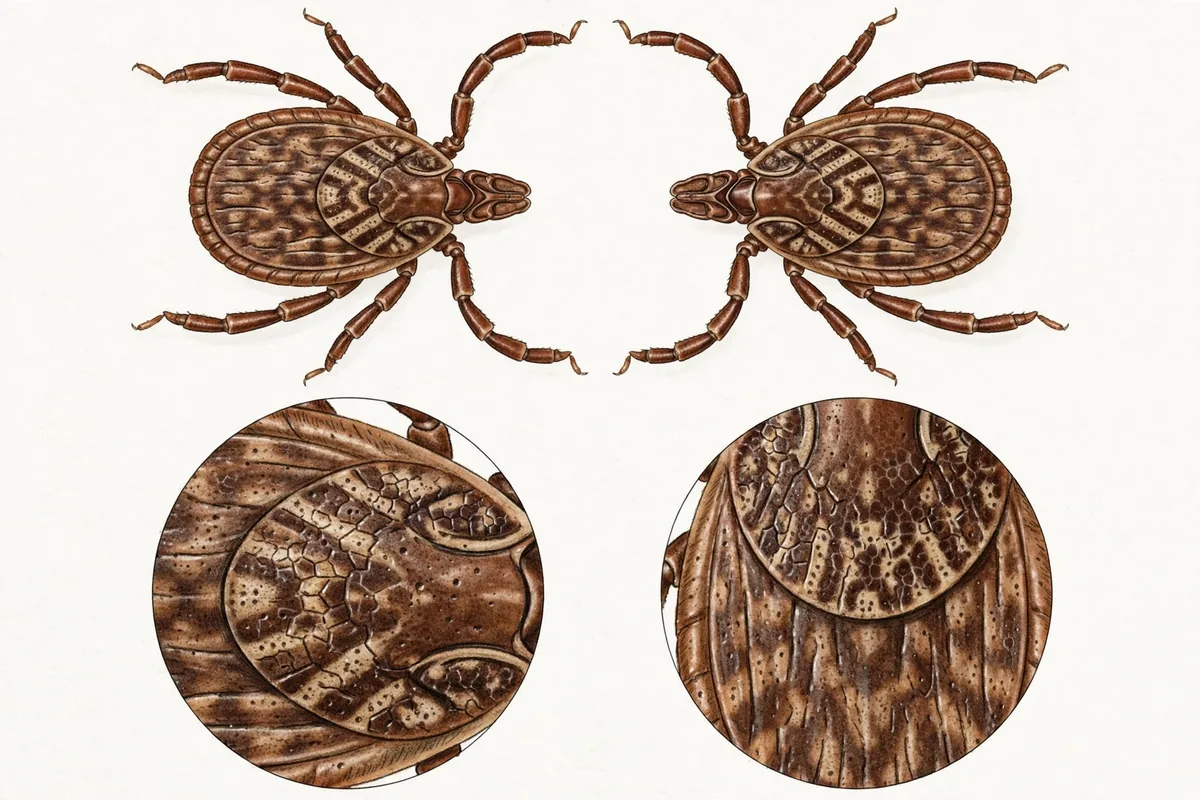
Both ticks belong to the genus Dermacentor, and their shared traits are what cause the confusion: both are relatively large (2–5 mm unfed, much larger when engorged), flat and pear-shaped, with ornate (mottled or patterned) scuta — the hard shield behind the head. Both have short mouthparts and festoons (small ridges along the rear edge of the body).
Here’s how they differ:
Rocky Mountain wood tick (Dermacentor andersoni)
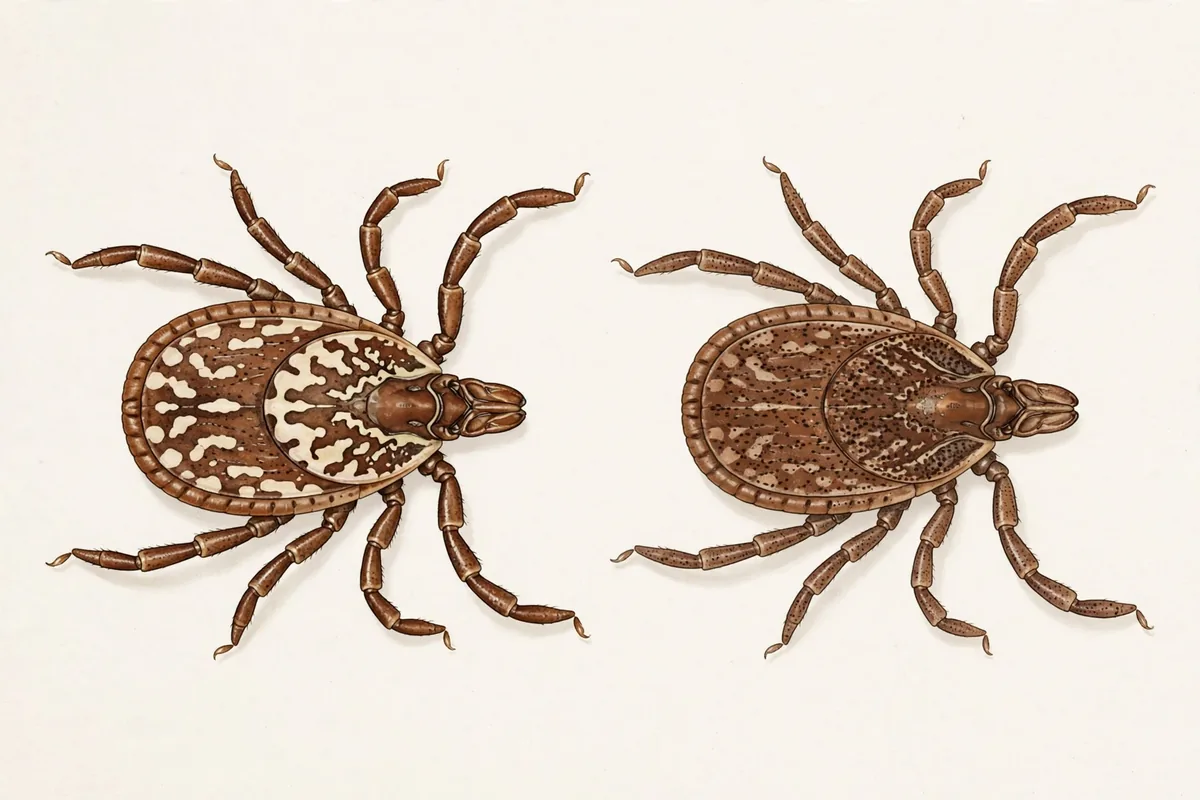
- Color: brown to reddish-brown. Females show a distinct silvery-gray ornamentation on the scutum that turns more gray as the tick feeds; males are mottled gray and white across the back.
- Shape: flat, pear- or teardrop-shaped. The adventure and extension literature often describes the wood tick’s bright reddish teardrop body as a field mark.
- Size: 2.0–5.3 mm unfed; females can roughly triple in size when fully engorged.
American dog tick (Dermacentor variabilis)
- Color: dark brown to reddish-brown body. Adult females have a distinctive whitish shield (scutum) with darker mottling — the pale “shield” against the dark body is the classic field mark. Males have more extensive mottled white-gray patterning across the whole back.
- Shape: similar oval, flat body — which is why the two get confused.
- Size: comparable to the wood tick; engorged females become large and gray-blue.
The honest caveat: engorged ticks, damaged specimens, and individual variation make visual ID unreliable for non-experts. Nymphs of both species are even harder to distinguish. If a tick bit you, the safest move is to save it (see below) and let the location where you picked it up do most of the identification work — which brings us to geography.
Where They Live: Geography Is the Biggest Clue
In practice, where you were bitten is the most reliable way to tell these two apart, because their ranges barely overlap:
Rocky Mountain wood tick — western North America. Found across the western US (Colorado, Wyoming, Montana, Utah, Idaho, and parts of California, Washington, and Oregon) and western Canada (southwestern Saskatchewan, southern Alberta, British Columbia). It favors grassy areas near sagebrush and other brush, typically at elevations of 4,000–10,000 feet, and is most active from March through July. If you found your tick west of the Missouri River — often used as a rough boundary between the two species — the wood tick is the likely candidate.
American dog tick — eastern and central North America. Found throughout the eastern and central US and parts of eastern Canada. It prefers grasslands, forest edges, trails, and — true to its name — backyards and areas where dogs roam. It’s the Dermacentor tick most suburban and rural easterners encounter. Dog tick season skews warm: adults are most active from around mid-April through early September, peaking in late spring and early summer (per University of Florida entomology extension data), with larvae active from March and nymphs from June. So a tiny, immature tick found on you in July is harder to pin to either species — another reason to save the specimen.
Ranges are shifting as climates change and more people recreate in tick habitat, so geography is a strong clue, not an absolute rule. But combined with appearance, it usually settles the question.
The Diseases Each One Carries
This is the part that makes correct ID genuinely useful: the two ticks carry different primary disease risks.
Rocky Mountain wood tick (D. andersoni) is the principal vector of Colorado tick fever — a rare viral illness found in the western US and Canada. According to the CDC, symptoms include fever, chills, headache, body aches, and fatigue, typically starting 1–14 days after the bite. About half of patients experience a “biphasic” fever: several days of fever, a few days of feeling better, then a second short round. Most people recover completely, though weakness and fatigue can linger for weeks. There is no vaccine and no specific medicine for it; care is supportive (rest, fluids, over-the-counter pain relief as directed). The wood tick can also transmit tularemia and is a possible vector of Rocky Mountain spotted fever, though less commonly than the dog tick. It can additionally cause tick paralysis — a rare condition, most often reported in children, caused by a neurotoxin in tick saliva, which resolves after the tick is removed.
American dog tick (D. variabilis) is the primary eastern vector of Rocky Mountain spotted fever (RMSF), caused by the bacterium Rickettsia rickettsii. Early symptoms are non-specific — sudden fever, headache, muscle soreness — usually starting 3–14 days after the bite. A rash may appear 2–4 days after fever begins, often starting on the extremities and sometimes spreading to the palms and soles, but not everyone develops one. RMSF can become life-threatening quickly, which is why early medical evaluation matters so much. The dog tick also transmits tularemia and can cause tick paralysis.
What the comparison means for you: a bite from a wood tick in Colorado puts Colorado tick fever on the watch-list; a bite from a dog tick in Oklahoma puts RMSF at the top. Tell your doctor which tick you found and where — that information genuinely shapes the clinical conversation.
How Common Are These Illnesses? Some Perspective
Reported case numbers for both diseases are modest — which cuts two ways. Colorado tick fever runs on the order of a few hundred reported US cases per year (clinical reviews put it at roughly 200–400), concentrated in the summer months. RMSF cases are reported across most of the contiguous US, with the highest counts historically in the south-central and southeastern states.
The honest read: most tick bites never cause illness, and no one expects you to rush to urgent care after every bite. But these are exactly the kinds of diseases where a two-sentence heads-up changes care — telling your clinician “Dermacentor bite, in [state], on [date]” is what early-treatment guidance is built around. Watchful isn’t the same as worried.
What to Do After a Bite From Either Tick
Tick species doesn’t change the removal steps. Do this the same way for both:
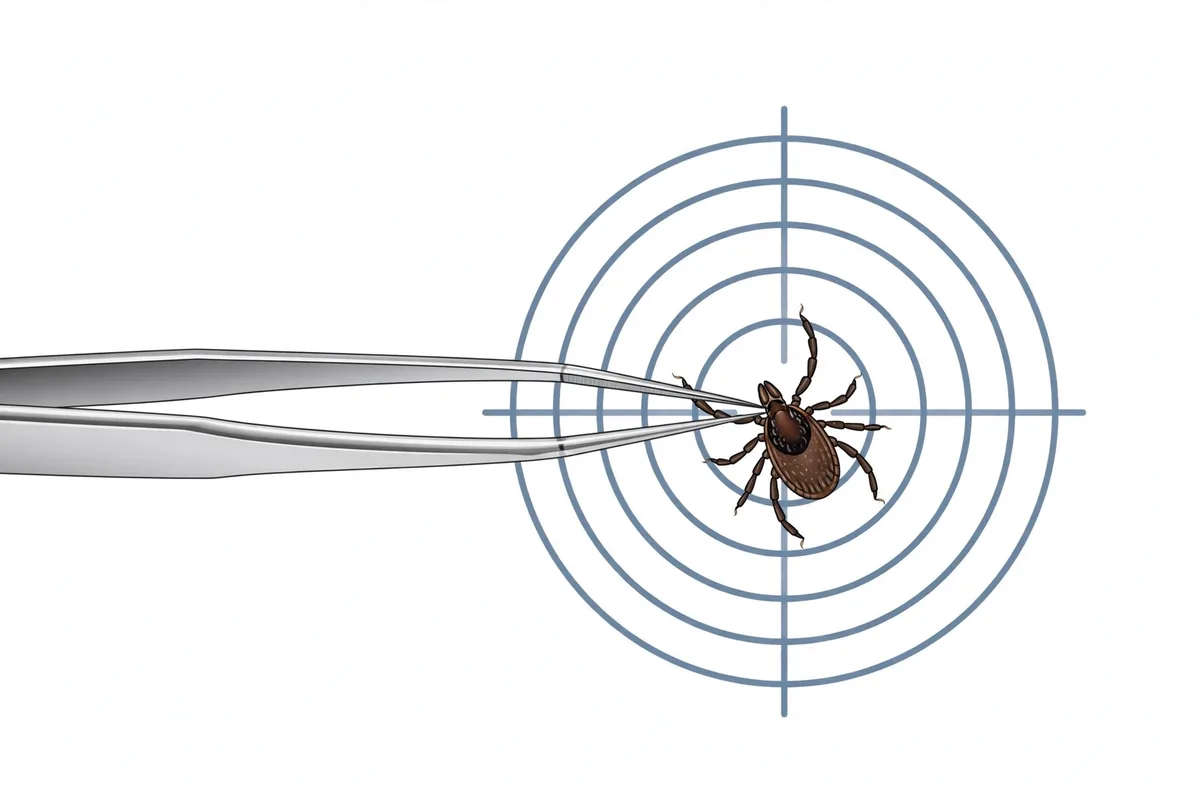
- Remove with fine-tipped tweezers. Grasp the tick as close to the skin as possible and pull straight up with steady pressure. Don’t twist, squeeze the body, or use heat, nail polish, petroleum jelly, or other folk methods — these can irritate the tick and are discouraged by public health sources.
- Save the tick. Put it in a sealed bag or small container with a little rubbing alcohol, and note the date and where on your body (and where outdoors) you found it. If symptoms develop, an identified tick helps your doctor enormously.
- Clean the bite. Wash the area and your hands with soap and water.
- Watch the calendar. Note the bite date. Colorado tick fever symptoms typically start 1–14 days after a bite; RMSF usually 3–14 days. A symptom diary (date, fever readings, rash notes, photos) is genuinely useful if you end up seeing a doctor.
- Know your tetanus status. Any bite that breaks the skin is a reason to confirm your tetanus booster is up to date.
Prevention for next time: tuck pants into socks in tick habitat, use EPA-registered repellents on skin and permethrin-treated clothing, do full-body tick checks (scalp, ears, armpits, waistband, behind knees) after every outing, and shower within a couple of hours of coming indoors. A a hiking first-aid kit with tick tools — fine-tipped tweezers and antiseptic — belongs in every trail pack.
When to See a Doctor for a Tick Bite
Don’t wait for a rash. See a doctor promptly after a tick bite — especially a Dermacentor bite in an endemic area — if any of the following occur:
- Fever, headache, body aches, or unusual fatigue in the 1–14 days after the bite. Early treatment of RMSF is critical, and doctors treat based on clinical suspicion — tell them about the tick exposure immediately.
- Any rash developing after a tick bite, particularly one starting on the wrists, ankles, palms, or soles.
- A “biphasic” pattern — fever that improves then returns days later — after a western tick bite.
- Signs of tick paralysis: progressive weakness, unsteady walking, or difficulty speaking/swallowing, most often in children — seek emergency care and check the whole body (especially the scalp) for an attached tick.
- Signs of infection at the bite site: expanding redness, warmth, swelling, or pus. Learn the signs of bite infection and cellulitis.
- You couldn’t remove the whole tick, the bite area looks unusual, or you’re unsure how long the tick was attached.
Bring the saved tick and your symptom timeline to the appointment.
Frequently Asked Questions
Can you tell these ticks apart from the bite itself?
No. Tick bites from different species look essentially the same — a small red bump, sometimes with a darker center. Species ID requires the tick itself (appearance plus where you found it), not the bite mark.
Which tick is more dangerous?
Neither is “safe,” and danger depends on your location. In the East, the American dog tick’s RMSF risk is the bigger concern because RMSF can turn serious fast. In the West, the Rocky Mountain wood tick’s Colorado tick fever is rarer but worth knowing about. Both can transmit tularemia and cause tick paralysis.
How long does a tick need to be attached to transmit disease?
It varies by disease. For RMSF, public health sources note that roughly 4–6 hours of attachment and feeding are usually required for transmission — one reason prompt tick checks and same-day removal matter so much.
I found a tick on my dog. Is it the same risk?
Dogs are common hosts for both species, especially the American dog tick. Ticks found on pets signal ticks in your yard or on your trails — check yourself too. The same careful removal and save-the-tick advice applies; your vet can advise on pet-specific prevention.
Do these ticks transmit Lyme disease?
No — Lyme disease is transmitted by Ixodes ticks (deer ticks/black-legged ticks), not by Dermacentor species. That’s another reason correct ID matters: it tells you which diseases to watch for and which you can set aside.
Medically reviewed by Dr. Sarah Jones, MD.
This article is for informational purposes only and isn’t medical advice. If you’re worried about a bite or sting, talk to a healthcare professional.