
Soft Tick vs Hard Tick: Bites, Looks, and Risks
Most people picture the same creature when they hear "tick" — the flat, shield-backed insect that latches on after a hike. But ticks come…
A dark spider in a messy cobweb in the garage, and the first thought is the worst one: black widow. Here is the direct answer to the common house spider…
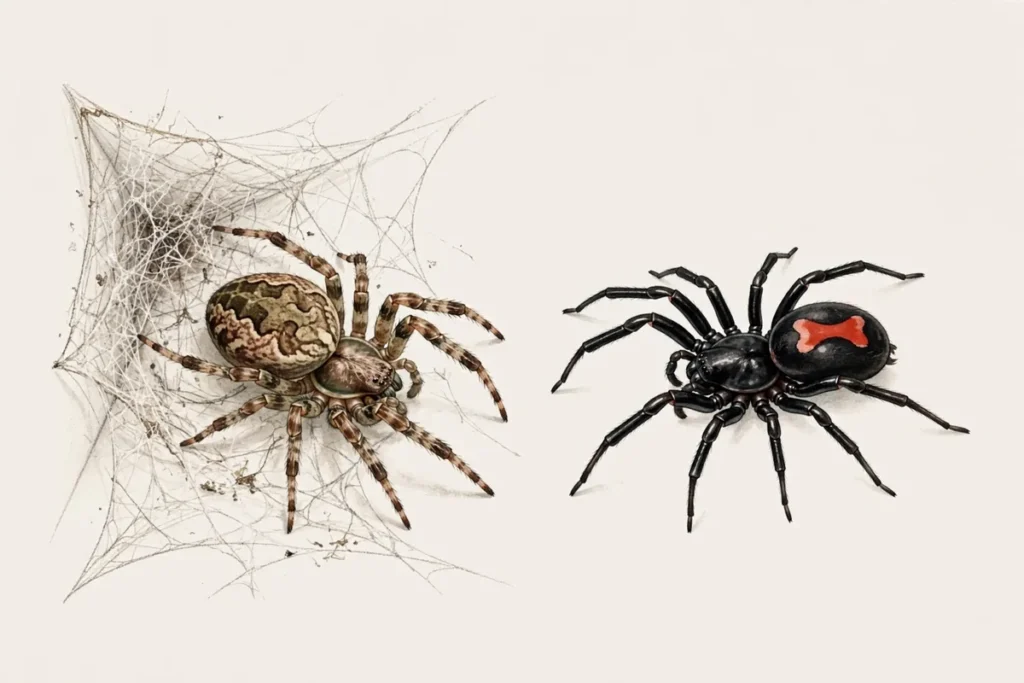
A dark spider in a messy cobweb in the garage, and the first thought is the worst one: black widow. Here is the direct answer to the common house spider vs black widow question: the spider you are looking at is almost certainly a common house spider (Parasteatoda tepidariorum), a harmless cobweb spider living in millions of American homes. A true black widow (Latrodectus spp.) looks very specific — glossy coal-black with a red hourglass on the underside of its abdomen — and builds low webs in dark, undisturbed outdoor spots rather than living-room corners.
The confusion is understandable: the two belong to the same spider family, share a similar body shape, and both spin messy, tangled webs. But one is a free pest-control service and the other deserves genuine caution.
The common house spider, Parasteatoda tepidariorum — also called the American house spider — is, statistically, the spider Americans encounter most. The Missouri Department of Conservation describes it as drab yellowish, tan, brown, or gray with darker mottling, a round abdomen higher than long, usually with a whitish patch behind the abdomen’s highest point, and legs ringed with dark color. Females measure about ⅛ to ⅜ of an inch in body length; males are smaller, around ⅛ inch.
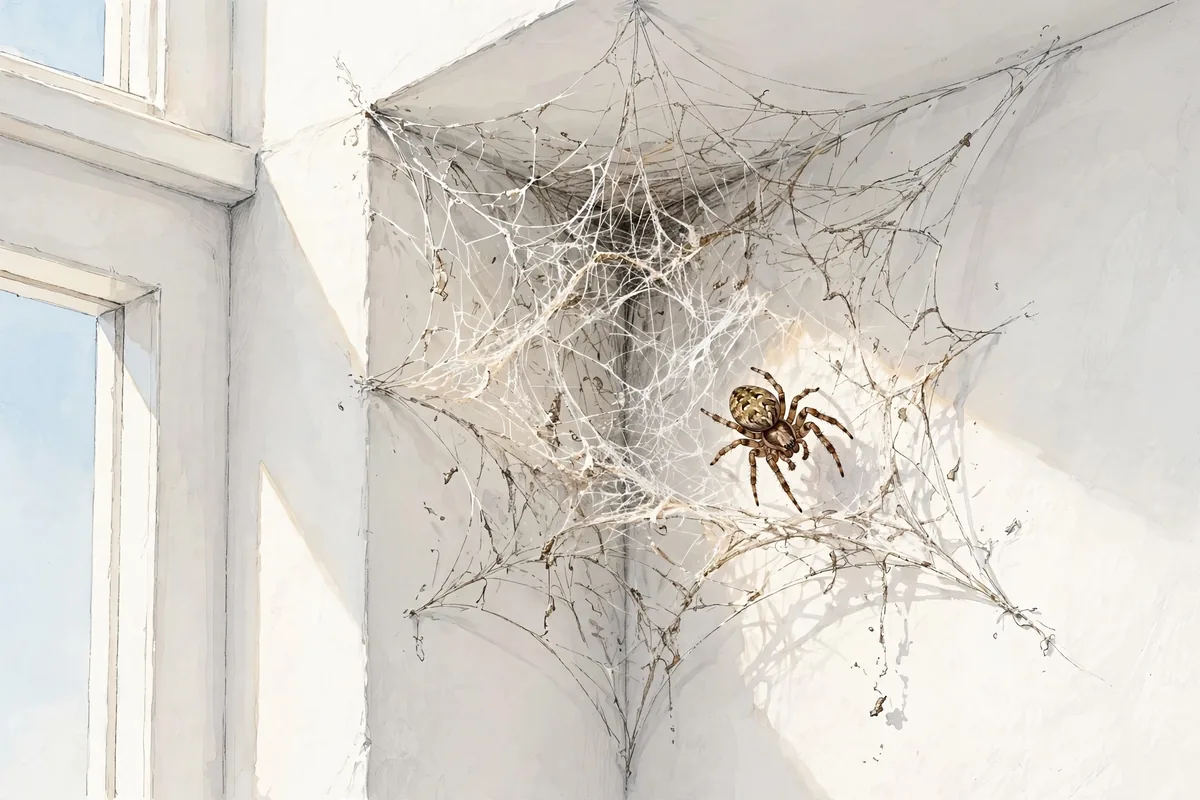
It is a cobweb spider in the family Theridiidae — the same family as the black widow, which explains the family resemblance. Its webs are messy, three-dimensional tangles, never neat circular orbs, tucked into room corners, behind furniture, under shelves, and around windows. Teardrop-shaped egg sacs often hang in the web. A telltale sign: the ground beneath an established web is littered with the husks of consumed insects, which the spider cuts loose and drops.
The common house spider is effectively harmless. The University of Florida’s featured-creatures profile notes it is not known to be dangerous to humans, with only a single documented case of a serious allergic reaction to its bite. It is among the least defensive spiders around — its first response to disturbance is to flee or drop from the web, not to bite. Each web is a small insect trap catching flies, mosquitoes, and other household pests. Our guide on identifying spider bites notes how rarely house spiders cause mystery bites.
Black widows are a group of closely related US species in the genus Latrodectus — southern (L. mactans), western (L. hesperus), and northern (L. variolus). Only the females are medically significant; males are smaller, duller, and harmless.
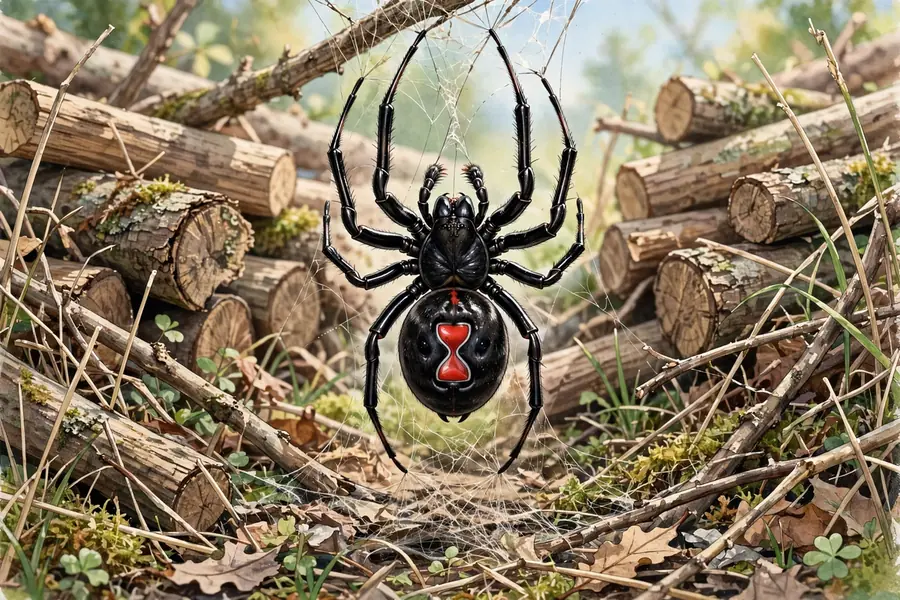
The female is unmistakable once you know the markers: a shiny, coal-black, almost glossy body about half an inch long (up to 1½ inches with legs extended), long legs, and the famous red or orange-red hourglass on the underside of the abdomen. Note the word underside — the marking faces the ground, so a spider viewed from above may show no red. Markings vary by species: southern widows may show a row of red spots along the top of the abdomen, and northern widows often have a broken hourglass. Juveniles and males show more varied patterns, another reason not to guess from a quick glance.
Black widows live low and dark: coarse, messy, irregular webs near the ground in undisturbed places — woodpiles, rock walls, sheds, garages, crawl spaces, under porches and patio furniture, inside meter boxes and grills. MedlinePlus notes they occur throughout the United States but predominantly in the South and West. Unlike house spiders, they rarely settle in the open corners of lived-in rooms.
Black widows are not aggressive and rarely bite unless startled or threatened — a female’s first response to a hand in her web is usually to drop, curl up, and play dead. Bites happen when a spider is squeezed against skin, in a shoe, a glove, folded laundry, or firewood, or when she is defending an egg sac. The venom contains the neurotoxin latrotoxin; bites can cause significant symptoms, but deaths are extraordinarily rare — the American Association of Poison Control Centers records no US deaths from black widow bites since 1983 (a figure cited by Penn State Extension).
Run through these markers in order, from a safe distance:
Overall color and shine. House spider: dull, mottled brown, tan, or gray — camouflaged, never glossy. Black widow: shiny, jet-black, almost polished. If the spider is not glossy black, it is not an adult female widow. This single check rules out most false alarms.
The abdomen marking. House spider: mottled, often with a pale patch on top — no red hourglass underneath. Black widow: red, orange, or yellowish hourglass (or separated spots) on the underside. Never flip a spider over with your fingers to check.
Size and build. Both have the rounded cobweb-spider abdomen, but the widow is stockier with longer, more robust legs. A female widow’s body alone is about half an inch — noticeably heftier than most house spiders.
Where it lives. House spider: room corners, window frames, behind furniture, basements — the lived-in parts of the house, webs at any height. Black widow: ground-level, dark, undisturbed spots — woodpiles, under porches, meter boxes, cluttered sheds. A cobweb spider in a high living-room corner is behaving like a house spider, not a widow.
Egg sacs. House spider sacs are teardrop-shaped with a point, often several per web. Widow sacs are smooth, round, papery balls guarded inside the web. Do not handle either.
If you cannot confidently match the widow markers, treat the spider as unidentified rather than assuming the worst. A photo from a few feet away is enough for an extension entomologist or pest professional to confirm.
Both spiders build messy, irregular cobwebs rather than orb webs — a major source of the confusion — but the webs differ. House spider webs are three-dimensional tangles in corners and crevices at any height, often with egg sacs and discarded prey husks below. Black widow webs sit low near the ground, anchored by taut, sticky trip lines, with notably coarse, strong silk, in dark cover rather than out in the open. A low, tough, irregular web under a woodpile with a glossy black spider in it deserves respect and distance. A dusty tangle in the top corner of a bookshelf does not.
First: do not handle it, and do not try to catch it barehanded for a closer look or a photo. Most widow bites happen during exactly that kind of contact — a spider pressed against skin. Observe from several feet away; a phone photo with zoom is plenty for identification.
If the spider matches the house spider profile — dull, mottled, in a high corner web — you can leave it alone or relocate it. House spiders are beneficial predators of household insects. To relocate, cover the spider and web with a large jar, slide stiff paper underneath, and release it outside away from the house.
If the spider matches the widow profile — glossy black with a red hourglass, in a low web in a dark, undisturbed spot — give it space and keep children and pets away. Do not try to trap it barehanded. For a single outdoor spider, many people leave it alone and reduce the habitat: clear clutter, move woodpiles away from the house, seal cracks, and wear gloves handling firewood or working in sheds. For spiders inside living spaces or where children and pets play, call a pest professional.
To make your home less inviting to cobweb spiders generally, reduce clutter in basements and garages, vacuum corners and behind furniture regularly — which removes spiders and egg sacs alike — and seal gaps around doors, windows, and utility entries. Our bite-and-sting clue checklist can help you sort out which creature you are dealing with.
Let us be direct and honest. Common house spider bites are vanishingly rare and medically insignificant. These spiders do not seek out people, their first instinct is flight, and documented significant reactions are limited to a single known allergy case. If you have a spider bite and a house spider is the suspect, the spider is very likely innocent — most “spider bites” turn out to be other insects or skin conditions.
Black widow bites are a different category, and this is red-flag education, not diagnosis. The bite itself is often felt as a pinprick or not felt at all, with minor redness at the site. Within 30 to 60 minutes, characteristic symptoms can develop: severe cramping muscle pain starting near the bite and spreading to large muscle groups, rigid board-like abdominal muscles, heavy sweating, nausea, headache, and restlessness. Pain typically peaks in the first several hours and settles over one to three days, though aching can persist longer. Children, elderly adults, and pregnant people face higher risk.
Any suspected black widow bite warrants prompt medical evaluation — do not wait to see how it develops. Wash the area, apply a cold pack, keep the limb still, and get to urgent care or an emergency department. If the spider can be captured safely in a sealed container, bring it — identification changes treatment — but never risk a second bite. Our black widow bite treatment guide covers the red flags in full.
I found a dark spider in a cobweb in my garage. Is it a black widow?
Probably not. Check from a safe distance: a true adult female black widow is glossy jet-black with a red hourglass on the underside of her abdomen. Dull, mottled brown or gray with no red marking means it is not a widow. When uncertain, photograph it from a few feet away and ask an extension entomologist.
Can a common house spider bite me?
Essentially, no — not in any way that matters. They are non-aggressive, their first response to people is to flee, and significant reactions are extraordinarily rare. If you are getting bitten regularly, a house spider is very unlikely to be the cause; look to bed bugs, fleas, or other biting insects instead.
Do black widows come inside houses?
Occasionally, but they prefer dark, undisturbed, ground-level spots — basements, crawl spaces, cluttered garages. They sometimes arrive in firewood, boxes, or patio furniture. The cobweb spider in your high living-room corner is behaving like a house spider, not a widow.
Should I kill every spider I find?
No. Common house spiders are beneficial predators of household pests and pose no meaningful risk. Even black widows in low-traffic outdoor areas are often best left alone once the habitat is tidied. Reserve professional removal for widows inside living spaces or where children play.
What should I do if I think a black widow bit me?
Wash the area, apply a cold pack, keep the limb still, and seek medical care promptly — urgently for children, elderly adults, or pregnant people. If you can safely photograph or contain the spider in a sealed container, do so, since identification guides treatment. Do not cut the wound, apply a tourniquet, or try to suck out venom — none of that helps and some of it causes harm.
Medically reviewed by Dr. Sarah Jones, MD.
This article is for informational purposes only and isn’t medical advice. If you’re worried about a bite or sting, talk to a healthcare professional.
Dr. Jones oversees StingHelp’s clinical verification process. Every guide is systematically evaluated against active Centers for Disease Control and Prevention (CDC), Environmental Protection Agency (EPA), and American Academy of Allergy, Asthma & Immunology (AAAAI) medical consensus standards to ensure symptom distinctions and care recommendations are clinically sound.
Explore physician-reviewed first-aid procedures, identification clues, and symptom comparisons for other common outdoor bites and stings.
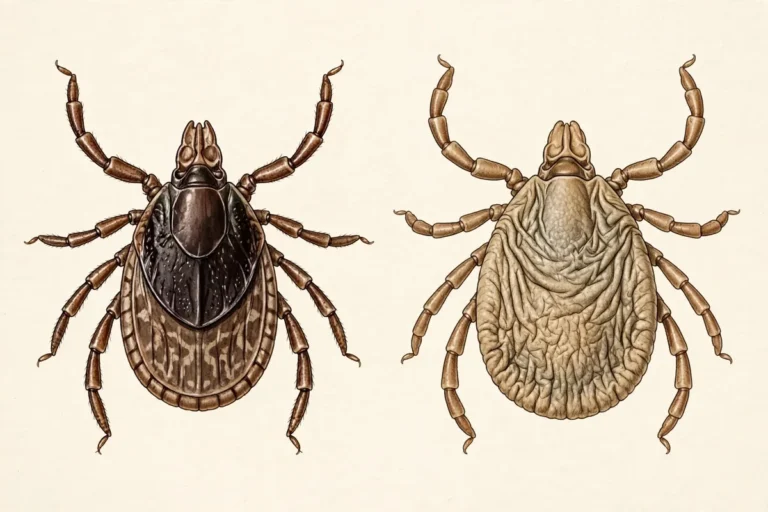
Most people picture the same creature when they hear "tick" — the flat, shield-backed insect that latches on after a hike. But ticks come…

You come home from the beach with clusters of ferociously itchy red welts around your ankles, and everyone has a different theory: sand fleas,…

If you live along the Gulf Coast, your yard may be hosting a quiet turf war. Fire ants built the mounds you have dodged…