
Sand Flea vs Sand Fly: What’s Biting You at the Beach?
You come home from the beach with clusters of ferociously itchy red welts around your ankles, and everyone has a different theory: sand fleas,…
Most people picture the same creature when they hear "tick" — the flat, shield-backed insect that latches on after a hike. But ticks come in two fundamentally different families, and…
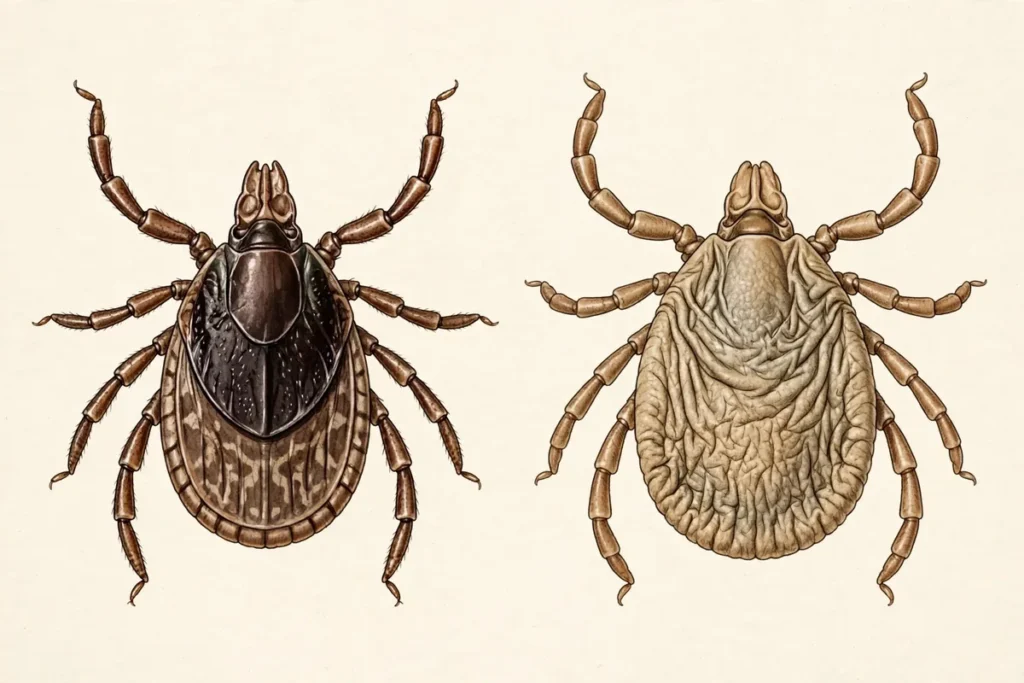
Most people picture the same creature when they hear “tick” — the flat, shield-backed insect that latches on after a hike. But ticks come in two fundamentally different families, and knowing which one you found changes what the bite means. The soft tick vs hard tick distinction matters because these two groups look different, feed differently, live in different places, and carry different diseases.
Hard ticks (family Ixodidae) are the familiar ones: they have a hard shield on their backs, attach for days, and transmit Lyme disease and Rocky Mountain spotted fever. Soft ticks (family Argasidae) are leathery, lack the shield, feed in minutes — usually at night while you sleep — and are the main carriers of tick-borne relapsing fever.
This guide explains how to tell them apart on sight, how their feeding and disease risks differ, what to do after any tick bite, and when a bite warrants a call to your doctor.
Ticks are arachnids — relatives of spiders — and all of them feed on blood. The roughly 900 described tick species worldwide split into two main families. Hard ticks (Ixodidae) include nearly all the ticks most Americans encounter: blacklegged (deer) ticks, American dog ticks, and lone star ticks. Soft ticks (Argasidae) are fewer but medically important, especially in the West, where Ornithodoros species live in rodent burrows, caves, and rustic cabins.
The evolutionary split between the families is ancient, and it shows in body structure, feeding strategy, and lifespan. Hard ticks are built for long, committed meals — a female may stay attached for days, swelling enormously. Soft ticks are built for speed: they sneak in, feed for minutes to about an hour, and drop off before the host fully wakes.
The single most reliable visual difference is the scutum — the hard shield on the back. Hard ticks have it: a smooth, rigid plate covering the entire back in males and the front portion in females. It is the feature that makes a hard tick look armored and gives the family its name. Soft ticks have no scutum at all; their bodies are leathery, wrinkled, and flexible, often described as looking like a wrinkled raisin or a deflated leather pouch.
The second test is the mouthparts. In hard ticks, the mouthparts project forward and are clearly visible from above — you can see the “head” end when looking down at the tick. In soft ticks, the mouthparts are tucked underneath the body and are not visible from a dorsal (top-down) view. If you flip the tick over, you will find them; from above, a soft tick looks mouthless.
Body shape offers a third clue. Hard ticks are relatively flat and teardrop-shaped when unfed. Soft ticks are more rounded and oval, with a wrinkled, leathery surface — often described as looking like a raisin.
A practical note: never handle an unidentified tick with bare fingers if you can avoid it — use tweezers or gloves, and save the specimen (more on that below). Identification is much easier with the tick contained and magnified. If you are unsure, your local health department or extension office can often identify a tick from a clear photo.
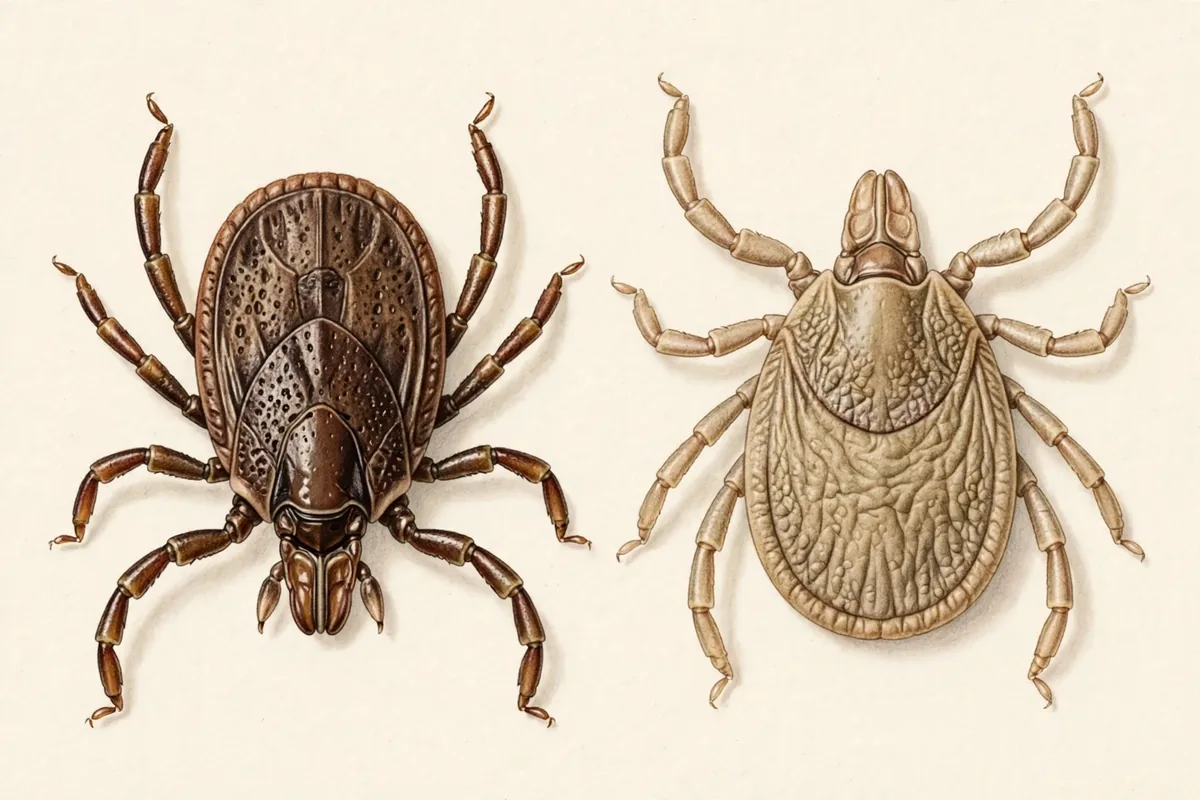
Feeding behavior is where the two families diverge most dramatically — and where disease risk follows. Hard ticks are slow, committed feeders: they insert barbed mouthparts, secrete a cement-like substance to lock in, and feed for three to ten days. This long attachment is why hikers find ticks embedded days after a walk, and why “check yourself after being outdoors” is the cornerstone of hard tick prevention.
Soft ticks feed with hit-and-run speed. Most species attach, feed for minutes up to about an hour, and drop off — often before the host notices. Many feed primarily at night, emerging from hiding places in walls, floors, or bedding to bite sleeping people. Because the bite is brief and often painless, victims frequently never see the tick at all — they may wake with an itchy bite and no idea what caused it, a scenario our bite-sting clue checklist can help you work through.
This speed difference drives the disease-transmission difference. Hard ticks that carry Lyme disease typically must be attached for 36 to 48 hours before the bacteria transfer, according to CDC guidance — which is why prompt removal is so protective. Soft ticks that carry relapsing fever bacteria can transmit within minutes of starting to feed; the CDC has documented transmission within 30 seconds of feeding initiation for some Borrelia strains. With soft ticks, there is no grace period — the bite itself is the exposure.
Each tick family carries its own roster of pathogens. Hard ticks cause the tick-borne diseases most Americans know: Lyme disease (blacklegged ticks), Rocky Mountain spotted fever, ehrlichiosis, and anaplasmosis. These typically develop over days to weeks after the bite, with symptoms like rash, fever, fatigue, and joint pain.
Soft ticks are primarily associated with tick-borne relapsing fever (TBRF), caused by Borrelia bacteria — principally B. hermsii, B. parkeri, and B. turicatae in the United States, each tied to specific Ornithodoros soft tick species. As the name suggests, TBRF causes recurring episodes of high fever, headache, and muscle aches, with symptoms that fade and then return. It is most reported in the western states — particularly in people who have slept in rustic cabins, especially at higher elevations where rodent-associated soft ticks thrive.
Two nuances worth knowing. First, hard ticks are far more likely to make people sick overall — more species, more bites, more pathogens. Soft tick disease is less common but can be severe and is under-recognized: a fever that keeps coming back after a cabin trip deserves mention of possible tick exposure to your doctor. Second, one form of relapsing fever (Borrelia miyamotoi disease) is carried by the same hard blacklegged ticks that transmit Lyme, so relapsing fever is not exclusively a soft tick story.

Hard ticks quest; soft ticks lurk. Hard ticks practice a behavior called questing: they climb to the tips of grasses and shrubs, extend their front legs, and wait for a passing mammal to brush against them. This is why hard tick exposure happens outdoors — hiking, gardening, playing in tall grass — and why protective clothing and repellents are the main defenses. After feeding, hard ticks drop off wherever they happen to be.
Soft ticks are nest-dwellers. They live in the cracks of rodent burrows, caves, and rustic cabins, sheds, and outbuildings in the West. They spend the day hidden and emerge at night to feed on whatever warm-blooded animal is sleeping nearby, then retreat. A cabin that sits empty all winter can harbor soft ticks that have waited months for occupants to return; some species can survive many years between meals.
This habitat difference changes the prevention playbook. For hard ticks: treat clothing, use repellent, do full-body checks after outdoor activity. For soft ticks: when staying in a rustic cabin, avoid sleeping on the floor, inspect bedding and mattress seams, seal rodent entry points, and consider that a cabin with a known rodent problem is also a potential soft tick habitat. If you own a cabin, rodent-proofing is tick prevention.
The response protocol is the same regardless of which family bit you: remove carefully, save the tick, clean up, and watch. Do not try to identify the tick while it is still attached — removal comes first.
After a hard tick bite, watch the site for several weeks for expanding redness, and note any fever, fatigue, or joint aches. For minor local soreness while you watch, a cold compress applied for short sessions can ease discomfort — never as a substitute for medical evaluation. After possible soft tick exposure — especially following nights in a rustic cabin — watch for recurring fevers over the following one to two weeks. Bring the saved tick (or clear photos) to your appointment; it genuinely helps the clinician.
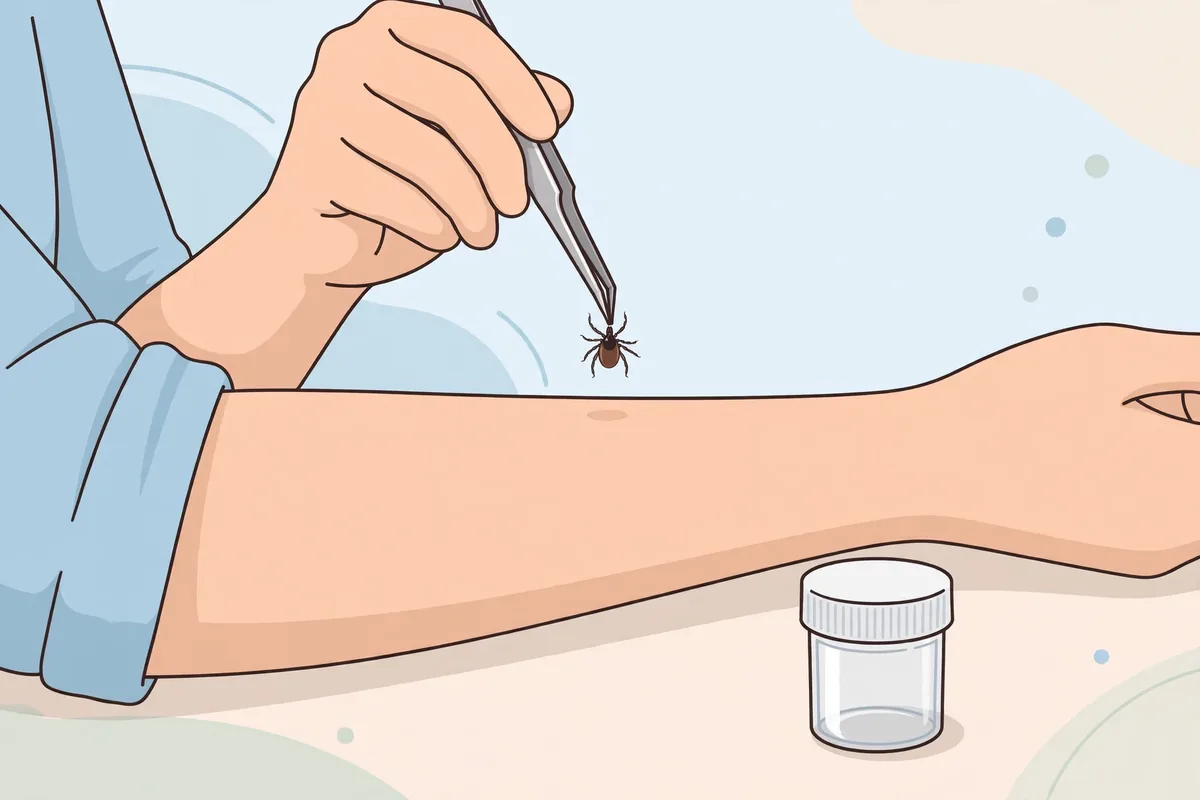
Tick bites deserve a lower threshold for medical attention than most insect bites, because the diseases they carry are treatable but time-sensitive:
Which is more dangerous, a soft tick or a hard tick?
Hard ticks cause far more human illness overall because they bite people more frequently and carry more diseases, including Lyme disease. Soft ticks are less commonly encountered but their bites can transmit relapsing fever very quickly — within minutes — and the disease is often under-recognized. Both deserve respect and prompt medical attention when bites occur.
What does a soft tick bite feel like?
Many people do not feel it at all. Soft ticks often feed at night on sleeping people, and their bites can be painless. You may notice an itchy red bump afterward, sometimes with a small central mark. Because victims rarely see the tick, soft tick bites are frequently mistaken for bed bug bites or unexplained rashes.
Can soft ticks live in my house?
They can live in rustic structures — cabins, sheds, and outbuildings — especially where rodents are present. They hide in cracks in walls, floors, and foundations during the day. Modern, well-sealed homes without rodent problems are unlikely habitats. If you own a cabin, sealing rodent entry points and inspecting sleeping areas are the best defenses.
Do soft ticks spread Lyme disease?
No. Lyme disease is transmitted by hard blacklegged ticks. Soft ticks transmit tick-borne relapsing fever, caused by different Borrelia bacteria. The diseases share a bacterial genus but are distinct illnesses with different symptoms and treatments — another reason saving the tick for identification matters.
How long can a soft tick survive without feeding?
Remarkably long. While hard ticks typically die within months to a few years without a blood meal, some soft tick species can survive many years — over a decade in extreme cases — waiting in their hiding places for a host to return. This is why an old, long-vacant cabin can still harbor active soft ticks.
Medically reviewed by Dr. Sarah Jones, MD.
This article is for informational purposes only and isn’t medical advice. If you’re worried about a bite or sting, talk to a healthcare professional.
Dr. Jones oversees StingHelp’s clinical verification process. Every guide is systematically evaluated against active Centers for Disease Control and Prevention (CDC), Environmental Protection Agency (EPA), and American Academy of Allergy, Asthma & Immunology (AAAAI) medical consensus standards to ensure symptom distinctions and care recommendations are clinically sound.
Explore physician-reviewed first-aid procedures, identification clues, and symptom comparisons for other common outdoor bites and stings.

You come home from the beach with clusters of ferociously itchy red welts around your ankles, and everyone has a different theory: sand fleas,…
If you live along the Gulf Coast, your yard may be hosting a quiet turf war. Fire ants built the mounds you have dodged…
# What Is Biting Me in Bed If Not Bed Bugs? A 48-Hour Detective Guide You have checked the mattress seams, looked behind the…