
Soft Tick vs Hard Tick: Bites, Looks, and Risks
Most people picture the same creature when they hear "tick" — the flat, shield-backed insect that latches on after a hike. But ticks come…
You come home from the beach with clusters of ferociously itchy red welts around your ankles, and everyone has a different theory: sand fleas, sand flies, no-see-ums, sea lice. The…

You come home from the beach with clusters of ferociously itchy red welts around your ankles, and everyone has a different theory: sand fleas, sand flies, no-see-ums, sea lice. The sand flea vs sand fly debate is one of the most confusing naming messes in the biting-bug world, because both names get applied to several completely different creatures — and the one that actually bit you is usually not what you think.
This guide untangles the terminology, identifies the real culprits, compares their bites, and gives you treatment and prevention for your next shoreline trip.
The core problem: “sand flea” and “sand fly” are folk names, not scientific ones, and regions use them for different animals. The name “sand flea” has been applied to true insects, to crustaceans that aren’t insects at all, and to biting midges, depending on who’s talking and which coast they’re on.
In short: “sand flea” can mean (1) amphipod crustaceans — the hopping “beach hoppers” in seaweed wrack that mostly don’t bite people; (2) mole crabs (Emerita), the burrowing surf-zone crustaceans used as fishing bait; (3) the chigoe flea (Tunga penetrans), a true flea of tropical beaches that burrows into skin and is genuinely dangerous; or (4) Culicoides biting midges, which the southeastern US colloquially calls “sand fleas.” Meanwhile “sand fly” can mean (1) true sand flies (Phlebotomus and Lutzomyia), tropical insects that can transmit leishmaniasis; or (2) the very same biting midges someone else calls sand fleas.
The practical upshot: when your ankles are covered in itchy welts after an evening on a US beach, the culprit is overwhelmingly likely to be biting midges — tiny flies variously called no-see-ums, sand flies, sand fleas, or punkies depending on the state. Everything else is either harmless, geographically restricted, or a special case. Once you know that, the rest is about telling the special cases apart and handling the common one.
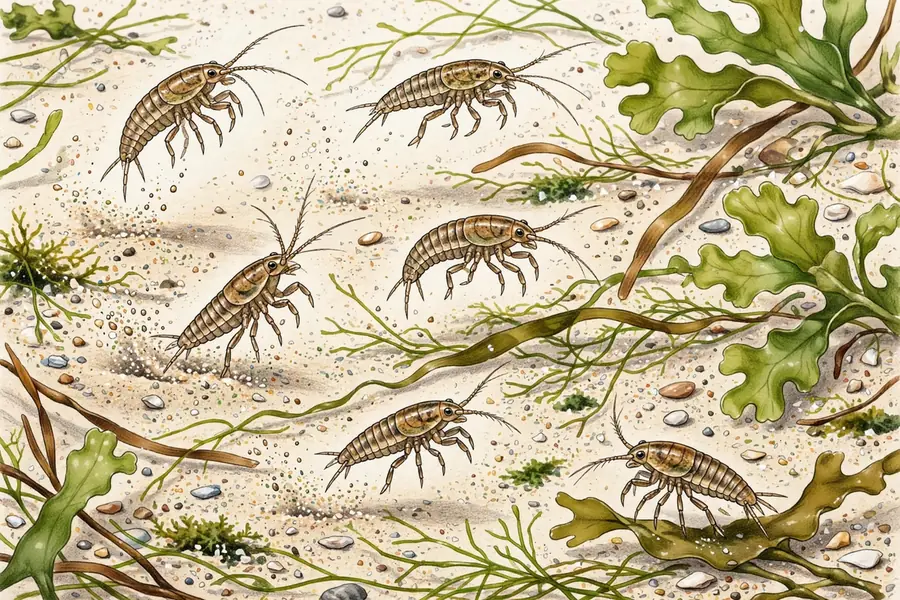
Beach hoppers (amphipod crustaceans) are the most literal “sand fleas”: small shrimp-like crustaceans in the family Talitridae living in damp sand and seaweed wrack along the high-tide line, named for their jumping. The key fact most beachgoers get wrong: beach hoppers are scavengers eating decaying matter, and they do not bite people. Feeling something ping off your legs in piled seaweed was likely a beach hopper — startling, but not the source of your welts.
Mole crabs (Emerita), also called sand fleas or sand crabs on many coasts, are the egg-shaped burrowers at the surf’s edge prized as fishing bait. They’re filter feeders. They don’t bite people either.
Biting midges called “sand fleas” — Culicoides species, especially Culicoides furens — are the southeastern US usage. These true biting flies, 1–3 millimeters long, absolutely do bite, leaving the classic clusters of itchy welts. When a Floridian complains about “sand fleas” at dusk, this is almost certainly what they mean. Note the irony: the biting “sand flea” is entomologically closer to what others call a “sand fly.”
The chigoe flea (Tunga penetrans) is the genuinely dangerous “sand flea,” relevant for tropical travel. Found in parts of Latin America, the Caribbean, and sub-Saharan Africa, the female chigoe burrows into skin — usually the feet — swelling with eggs and causing a painful, enlarging nodule called tungiasis, which can lead to secondary infection. This is nothing like an itchy welt. A growing, painful foot bump after a tropical beach trip needs a clinician, not home treatment. For US beach trips, chigoes aren’t a concern.
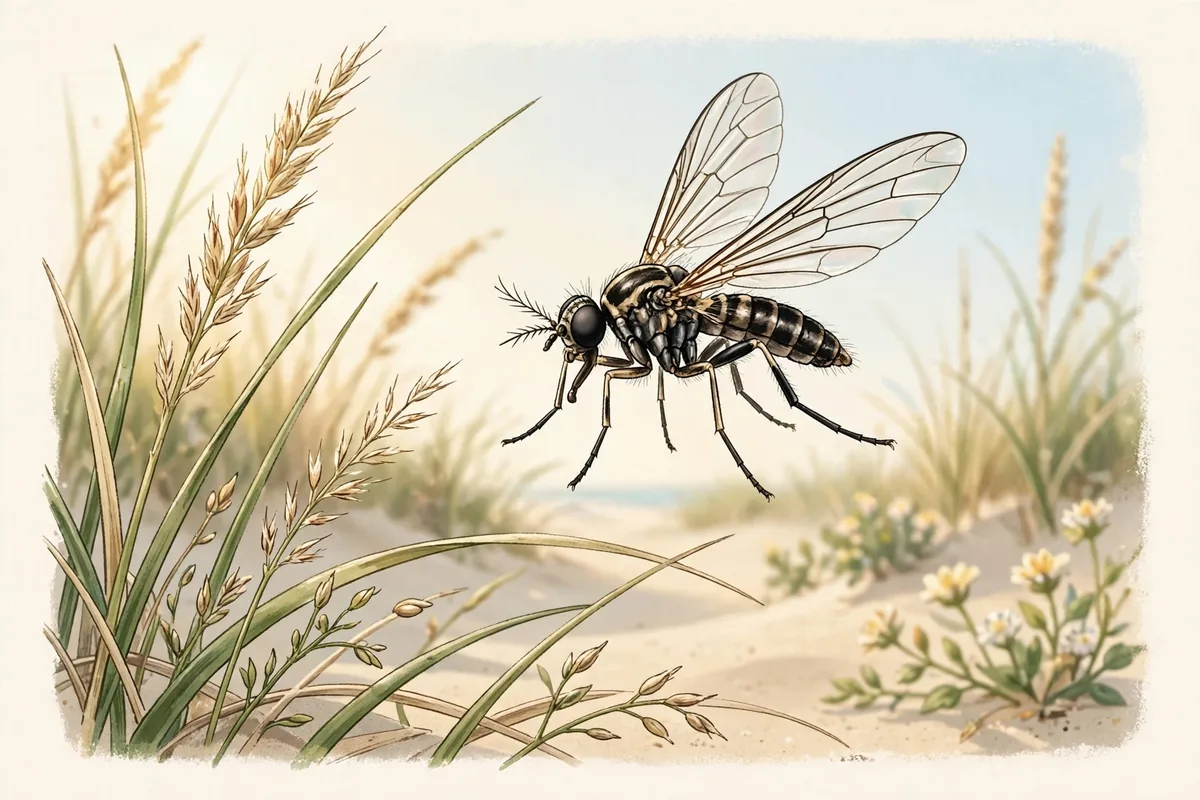
True sand flies are small, hairy, moth-like flies in the genera Phlebotomus (Old World) and Lutzomyia (New World) — primarily a tropical and subtropical concern. They matter medically because some species transmit Leishmania parasites, causing leishmaniasis, which ranges from skin sores to serious systemic illness. True sand flies are weak fliers, bite mostly at dusk and dawn, and are largely silent. For travelers to parts of Latin America, the Middle East, or South Asia, sand fly precautions (fine-mesh nets, repellent, covering up at dusk) are legitimate travel-medicine advice. For a US beach weekend, they’re not your problem.
Biting midges called “sand flies” are, again, the Culicoides no-see-ums. On many beaches from the Carolinas to Texas, “sand flies” means the same tiny biting midges someone two states over calls “sand fleas.” These drive the vast majority of US beach-bite complaints: nearly invisible (1–3 mm), most active at dawn and dusk on calm, humid evenings, breeding in moist sand, mud, and marsh edges. Their bites produce small, intensely itchy red welts, often clustered around ankles and lower legs — the classic “I can’t see anything biting me but I’m covered in welts” experience.
One more name in the mix: “sea lice” or “sea bather’s eruption” is different entirely — usually thimble jellyfish larvae trapped under swimsuits — unrelated to sand fleas or sand flies.
So the honest answer to “which bit me?” for a US beachgoer: probably biting midges, whatever your neighbors call them. The distinctions that matter are the special cases — chigoe fleas and true sand flies on tropical trips — and recognizing when a bite pattern doesn’t fit the usual itchy-welt picture.
Biting midge (no-see-um) bites — the common case — appear as small red welts, often in clusters or lines on exposed skin. Ankles and lower legs are classic since midges fly low, but arms, neck, and waistbands get hit too. The itch is disproportionate to welt size: intense and burning, peaking within hours, lingering for days. Some people develop larger local reactions with significant swelling. Welts typically resolve within a week without scarring if left alone.
True sand fly bites look similar — small itchy red papules — which is why travelers can’t distinguish them from midge bites by appearance. The difference that matters is geography and aftermath: in a leishmaniasis-endemic region, a bite developing into a persistent sore or ulcer that doesn’t heal over weeks needs medical evaluation.
Chigoe flea lesions look nothing like midge welts: a firm, growing, often painful nodule, usually on the foot, sometimes with a dark central spot. This is a parasite embedded in skin, requiring clinical removal — not an itchy welt.
Beach hopper and mole crab “bites” don’t exist. If welts appeared after walking the beach, these crustaceans are innocent bystanders.
A useful rule: itchy clusters of small welts on exposed lower legs after a calm beach evening, resolving in days = biting midges. Anything that grows, ulcerates, or fails to improve over a week or two = see a clinician, and mention your travel history.
For standard midge-welt aftermath, treatment is straightforward supportive care. Wash bites with soap and water when you get in — beach sand and saltwater aren’t sterile, and clean skin heals better. Apply a cold compress ten minutes at a time to calm itch and swelling. Over-the-counter hydrocortisone cream or calamine lotion takes the edge off itching over following days, and an oral antihistamine at bedtime helps if itch keeps you awake (follow package directions; some cause drowsiness).
The most important rule is the hardest: don’t scratch. Scratching relieves for seconds and worsens everything for days — driving inflammation deeper, breaking skin, and opening the door to bacterial infection. Keep nails short; for a child who can’t stop, cover the worst spots with bandages. Our guide on leaving bites alone explains why this matters more than any cream.
Watch for infection like with any bite: expanding redness after the first day, increasing pain or warmth, pus, red streaks, or fever mean possible cellulitis — see a clinician. Learn the infection warning signs before your trip.
For chigoe nodules or non-healing tropical sores, skip home treatment and see a healthcare professional promptly — these need clinical management, and digging out a chigoe yourself risks breaking the flea and worse infection.
You can’t eliminate biting midges from a beach, but you can sharply cut your bite count.
Time your beach hours. Midges are worst at dawn and dusk and on still, humid evenings. Midday beach time with a breeze is dramatically less buggy. Sunset on the sand is the highest-risk hour — plan protection accordingly.
Use a real repellent. EPA-registered repellents with DEET or picaridin work against biting midges, not just mosquitoes. Apply to exposed skin, especially ankles and lower legs, and reapply after swimming per the label. For young children, choose age-appropriate formulations and apply it yourself.
Cover the ankles. Since midges fly low, long lightweight pants or a blanket tucked around your legs during dusk hours prevents a large share of bites. Sitting directly on damp sand near dune vegetation at dusk is maximum exposure — a chair and a breeze help enormously.
Choose your spot. Avoid settling against dune grass, marsh edges, or decaying seaweed piles at dawn and dusk — prime midge habitat. Open airflow away from vegetation has far fewer biters. For evening beach camping, zip tents shut; standard mosquito mesh may not stop no-see-ums, so look for fine “no-see-um” grade mesh where midges are a known problem.
For tropical trips, add special-case precautions: closed shoes where chigoe fleas occur (never barefoot in endemic areas), fine-mesh bed nets where true sand flies occur, repellent at dusk. A little destination research before flying beats a clinic visit after landing.
Most beach bites are a miserable week, not a medical emergency — but know the exceptions.
Are sand fleas and sand flies the same thing?
Not exactly, but the names overlap so much people often mean the same insect. Both are folk names applied to multiple creatures. In most US beach contexts, both terms refer to biting midges (no-see-ums). True sand flies and the crustaceans called sand fleas are different animals.
Do sand fleas bite humans?
Depends which “sand flea” you mean. Beach hoppers and mole crabs — the crustaceans — don’t bite people. Biting midges colloquially called sand fleas in the Southeast absolutely do. The tropical chigoe flea burrows into skin rather than just biting.
Why can’t I see what’s biting me at the beach?
Biting midges are 1–3 millimeters long — small enough to pass through standard window screens. Their bites announce themselves hours later as clusters of itchy welts, usually on ankles and lower legs, after dawn or dusk beach time.
How long do sand fly bites last?
Typical midge welts itch intensely for a few days and resolve within about a week if you don’t scratch them open. Scratching prolongs healing and risks infection. Welts worsening after a week, or any sore that ulcerates instead of healing, should be evaluated.
What repellent works against sand flies?
EPA-registered repellents with DEET or picaridin are effective against biting midges. Apply to exposed skin — especially lower legs and ankles — and reapply after swimming per the label. For evening outings, combine repellent with covering up and choosing breezy, open spots away from dune vegetation.
Medically reviewed by Dr. Sarah Jones, MD.
This article is for informational purposes only and isn’t medical advice. If you’re worried about a bite or sting, talk to a healthcare professional.
Dr. Jones oversees StingHelp’s clinical verification process. Every guide is systematically evaluated against active Centers for Disease Control and Prevention (CDC), Environmental Protection Agency (EPA), and American Academy of Allergy, Asthma & Immunology (AAAAI) medical consensus standards to ensure symptom distinctions and care recommendations are clinically sound.
Explore physician-reviewed first-aid procedures, identification clues, and symptom comparisons for other common outdoor bites and stings.
Most people picture the same creature when they hear "tick" — the flat, shield-backed insect that latches on after a hike. But ticks come…
If you live along the Gulf Coast, your yard may be hosting a quiet turf war. Fire ants built the mounds you have dodged…
# What Is Biting Me in Bed If Not Bed Bugs? A 48-Hour Detective Guide You have checked the mattress seams, looked behind the…