
What Is Biting Me in Bed If Not Bed Bugs? A 48-Hour Detective Guide
# What Is Biting Me in Bed If Not Bed Bugs? A 48-Hour Detective Guide You have checked the mattress seams, looked behind the…
If you live along the Gulf Coast, your yard may be hosting a quiet turf war. Fire ants built the mounds you have dodged for years, but in parts of…

If you live along the Gulf Coast, your yard may be hosting a quiet turf war. Fire ants built the mounds you have dodged for years, but in parts of Texas, Louisiana, and Florida, a newer arrival is pushing them out: the tawny crazy ant. Residents often ask which ant they are dealing with, because the two can look nearly identical at a glance and both ruin a barefoot afternoon.
The short answer to tawny crazy ant vs fire ant comes down to one big difference: fire ants sting, and tawny crazy ants do not. Tawny crazy ants (scientific name Nylanderia fulva) lack a stinger entirely; their defense is formic acid, which they spray or smear on threats. Fire ants (Solenopsis invicta, the red imported fire ant) grip with their jaws and sting repeatedly, injecting venom that typically raises itchy white pustules a day later.
This guide covers how to tell the two apart by sight and behavior, what each one does to people, and which first-aid steps fit each situation.
Understanding the weapon each ant carries is the fastest way to answer the tawny crazy ant vs fire ant question.
Red imported fire ants sting. A single fire ant grabs the skin with its jaws, anchors itself, and pivots to sting multiple times in a circular pattern. The venom contains alkaloid compounds, and in most people the result is a burning sting followed by small, itchy white pustules within about a day. Those pustules are distinctive and sterile — scratching or popping them invites infection.
Tawny crazy ants do not sting. Texas A&M AgriLife Extension and University of Texas at Austin researchers confirm they are stingless. Instead, they swarm in enormous numbers and use formic acid. When fire ants attack them, tawny crazy ants coat themselves in their own abdominal-gland acid, which researchers found can neutralize fire ant venom on contact. Against people, the acid may cause mild skin irritation if large numbers crawl on you, but it does not inject venom the way a sting does.
One more practical difference: fire ants are the ones that leave you with a cluster of pustules a day after a yard encounter. A seething mass of ants with crawling sensations but no stings points to tawny crazy ants.

Side by side, the two ants are easy to confuse. Both are small, reddish-brown, and about one-eighth of an inch long (around 3 millimeters). With a little practice, three visual cues separate them.
Body uniformity. Fire ant workers are polymorphic, meaning workers in the same colony come in noticeably different sizes, from tiny minors to chunky majors with big heads. Tawny crazy ant workers are monomorphic — every worker looks roughly the same size. If the ants marching across your patio all appear identical, that points toward crazy ants.
Color and sheen. Red imported fire ants run coppery reddish-brown with a noticeably darker brown-black abdomen (the rear segment). Tawny crazy ants are a more uniform tawny or reddish-brown with a slight golden sheen, and the color contrast between segments is subtler. Tawny crazy ants also tend to look a touch “hairier,” with fine hairs visible under magnification.
Legs and movement. Tawny crazy ants have relatively long legs and antennae for their body size. Fire ants march in orderly foraging trails; tawny crazy ants do not trail — they scatter and zigzag at high speed. That erratic, frenzied running earned them the name “crazy ants” and is the most reliable field cue for a homeowner without a magnifying lens.
Observed from a safe distance, the movement test settles most debates. Neat columns heading somewhere with purpose suggest fire ants; ants sprinting every which way, covering ground like spilled coffee, point to tawny crazy ants.
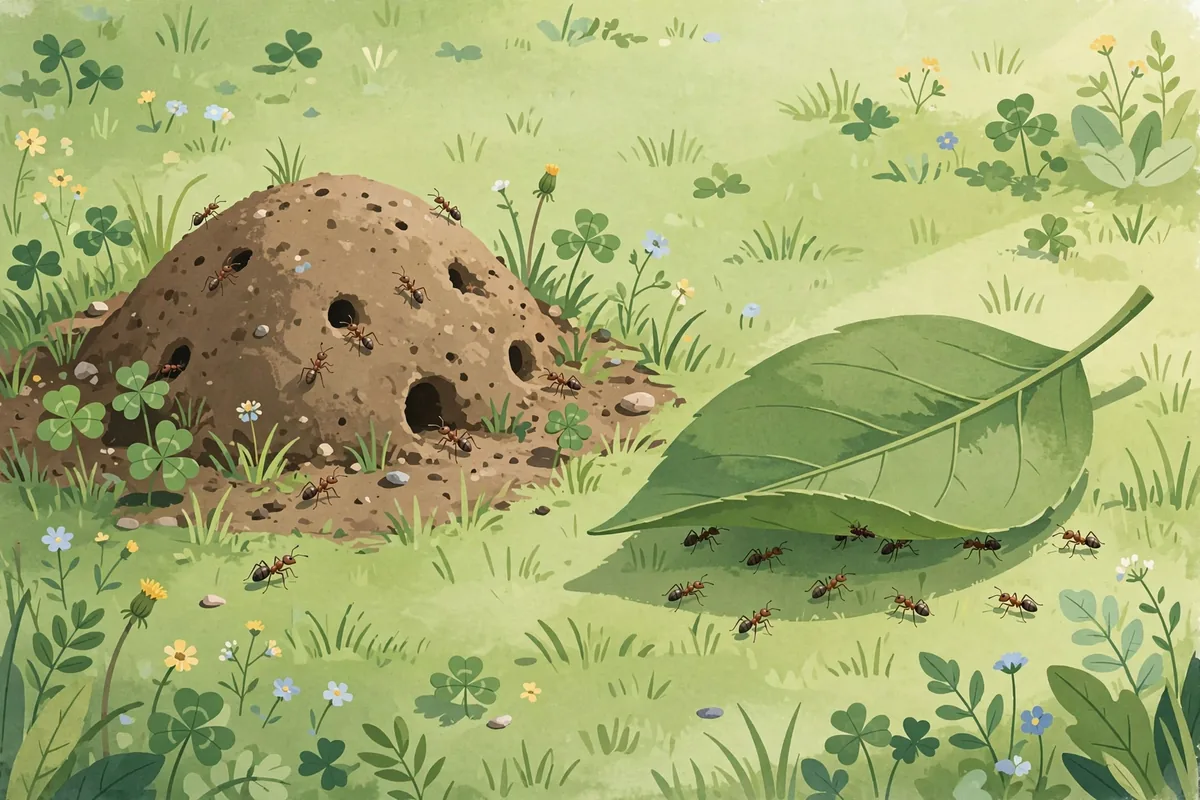
The second reliable test is architectural. Red imported fire ants are famous mound builders. A disturbed fire ant mound erupts within seconds: thousands of ants boil to the surface and spread outward, ready to climb anything touching the mound. That explosive defensive response is why fire ants sting so many people — stepping on or even nudging a mound triggers an instant swarm.
Tawny crazy ants rarely build visible mounds at all. They are opportunistic nesters, forming colonies under logs, landscape timbers, potted plants, mulch, leaf litter, and even inside wall voids and electrical boxes. Instead of one defensible fortress, they maintain sprawling networks of nests with multiple queens, functioning like a supercolony spread across a whole property.
This matters for your yard strategy. Ants streaming out of a crack, under a stepping stone, or from inside an outdoor outlet box point to tawny crazy ants. A distinct mound that erupts defensively when nudged is classic fire ant behavior.
It also explains the turf war across the Southeast. As tawny crazy ant colonies expand, fire ants disappear from the area — one University of Texas ecologist found crazy ants living in what used to be fire ant nests. For a fire-ant-allergic resident, that swap sounds like good news. For the average homeowner it usually is not: tawny crazy ants can carpet floors, invade pantries, and short out air conditioners and breaker boxes.
Fire ant attacks follow a script. The ants climb quickly — up a shoe, a leg, a hand on a mound — then sting in unison. Victims describe a sharp burn, and the skin often shows a cluster of stings arranged in a small arc or circle, matching the pivot-and-sting motion of one ant. Within a day, white pustules form at each sting site. They itch intensely for several days, and they must not be popped. For the full picture of what those pustules mean and what not to do with them, see our guide to fire ant sting pustules.
Tawny crazy ant encounters look different. There is no sting and no pustule. The ants swarm over skin in huge numbers, and their formic acid can cause a mild burning or itching sensation, especially on sensitive skin or in large numbers. People sometimes report a faint vinegar-like sharp smell from heavy infestations. Because the ants do not grip and sting in a coordinated way, the experience is more “crawling everywhere” than “attacked.”
A yard can host both species at once, so mixed encounters happen. If you are unsure which ant got you, treat the reaction, not the ant: stings with pustules get fire-ant first aid regardless of which colony the ant came from.
The right first aid depends on what happened, not on the species name. Use this split:
After fire ant stings:
After tawny crazy ant exposure (no stings):
Keep our bite and sting first-aid checklist handy for a quick sequence to follow. If ants get near your eyes, rinse gently with clean water and seek care if irritation persists.

Most fire ant stings and crazy ant exposures resolve with basic first aid at home. Seek medical care promptly if any of the following occur:
People with a diagnosed fire ant allergy often carry epinephrine. If you have been prescribed it, use it according to your action plan and call emergency services — do not wait to see whether symptoms improve on their own.
Can tawny crazy ants sting you?
No. Tawny crazy ants have no stinger. Their defense is formic acid, which they spray or smear on threats, including rival fire ants. The acid can cause mild skin irritation when large numbers crawl on you, but it does not inject venom the way a fire ant sting does.
Do tawny crazy ants bite?
They can nip with their jaws when handled, but their jaws are small and the nip is not the source of venom. Any burning sensation from a tawny crazy ant encounter comes from formic acid on the skin, not from a bite or sting. Washing the skin with soap and water usually resolves it.
Are tawny crazy ants worse than fire ants?
It depends on what you fear most. A University of Texas researcher put it plainly: if you are allergic to fire ants, tawny crazy ants are a vast improvement, because the sting hazard disappears. For the average homeowner, though, tawny crazy ants are often worse as a household pest — they invade homes in far greater numbers, nest in walls and electrical equipment, and are harder to control because of their sprawling multi-nest colonies.
Why are tawny crazy ants displacing fire ants?
Researchers discovered that tawny crazy ants coat themselves in formic acid after being stung by fire ants, neutralizing the fire ant’s venom — the first known case of one insect detoxifying another’s venom. In the University of Texas experiments, about 98 percent of crazy ants that used this detox behavior survived fire ant encounters — versus roughly half when their acid glands were blocked — which is why crazy ants win the territory battles and move into abandoned fire ant nests.
How do I get rid of tawny crazy ants?
Control is genuinely difficult. Extension entomologists have tested multiple insecticides without finding one that provides effective long-term control, because the colonies are so large and spread out. Removing outdoor harborages (mulch, debris, landscape timbers) near the home helps, and sealing entry points reduces indoor invasion. For established infestations, contacting a licensed pest professional experienced with tawny crazy ants is the practical route — standard fire ant baits are often less effective against them.
Medically reviewed by Dr. Sarah Jones, MD.
This article is for informational purposes only and isn’t medical advice. If you’re worried about a bite or sting, talk to a healthcare professional.
Dr. Jones oversees StingHelp’s clinical verification process. Every guide is systematically evaluated against active Centers for Disease Control and Prevention (CDC), Environmental Protection Agency (EPA), and American Academy of Allergy, Asthma & Immunology (AAAAI) medical consensus standards to ensure symptom distinctions and care recommendations are clinically sound.
Explore physician-reviewed first-aid procedures, identification clues, and symptom comparisons for other common outdoor bites and stings.
# What Is Biting Me in Bed If Not Bed Bugs? A 48-Hour Detective Guide You have checked the mattress seams, looked behind the…
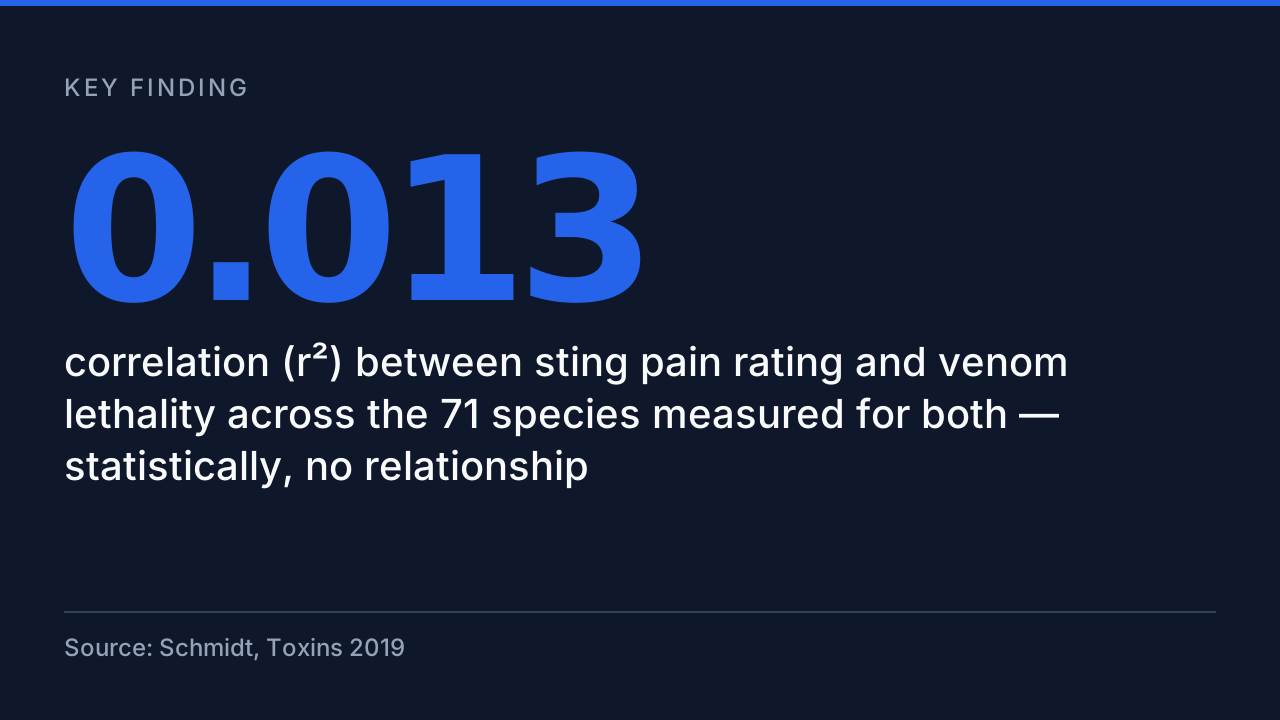
Schmidt rated sting pain for 96 species and venom lethality for 90. Joined, the two rankings are effectively unrelated — the most painful sting carries one of the weakest venoms measured, and the most toxic venoms barely hurt.
# Kissing Bug vs Look-Alikes: Is This a Kissing Bug? If you found a dark bug in your bedroom at night and you are…