Direct answer: The main asian tiger mosquito bite vs paper wasp sting treatment differences are pain timing, venom exposure, and allergy risk. Asian tiger mosquito bites often become itchy after feeding. Paper wasp stings are usually immediately painful, inject venom, can happen more than once, and require close monitoring for a large local reaction or anaphylaxis.
Both exposures can leave redness and swelling, but they usually feel very different. An Asian tiger mosquito lands, feeds, and flies away. A paper wasp may sting defensively—especially near a nest—and can retain its stinger, allowing repeated stings. That makes the moment of exposure and the presence of a nest more useful than the skin mark alone.
Fastest practical clue
A sudden sharp or burning pain near an open paper comb nest strongly favors a paper wasp sting. A later itchy bump after seeing a small black-and-white mosquito feed favors Asian tiger mosquito exposure. Do not rely on redness alone; both reactions can swell and itch.
Asian tiger mosquito bite vs paper wasp sting: quick comparison
| Clue | Asian tiger mosquito | Paper wasp |
|---|---|---|
| Arthropod | Aedes albopictus, small black-and-white mosquito | Polistes species, slender wasps with long legs and narrow waists |
| Typical sensation | Tiny prick or unnoticed feeding; itching often develops later | Immediate sharp, burning, or painful sting is common |
| Stinger left behind | No | Usually no retained stinger; paper wasps can sting repeatedly |
| Skin reaction | Itchy papule or wheal, localized redness/swelling | Pain, redness, swelling, itching; sometimes a large local reaction |
| Major emergency risk | Severe allergy is uncommon; disease risk depends on infected mosquitoes | Venom allergy can cause life-threatening anaphylaxis |
| Best exposure clue | Seeing the striped mosquito or having mosquito-heavy outdoor exposure | Disturbing or approaching a paper nest, roof eave, railing, shrub, or sheltered structure |
A skin photo cannot reliably identify either exposure. A painful wasp sting may later itch, and a mosquito bite can sometimes swell dramatically. The insect, timing, and setting remain the strongest practical clues.
What an Asian tiger mosquito looks like
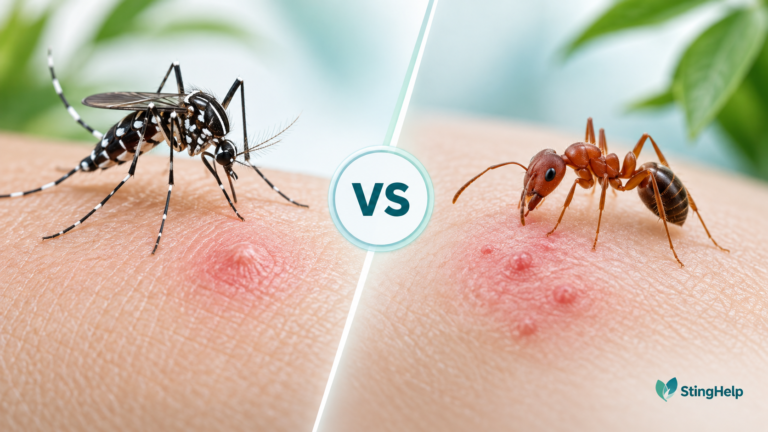
The Asian tiger mosquito, Aedes albopictus, is a small dark mosquito with conspicuous white bands on the legs and a white stripe on the upper body. It commonly breeds in small containers of standing water and may be active around yards, gardens, patios, shaded vegetation, and residential areas.
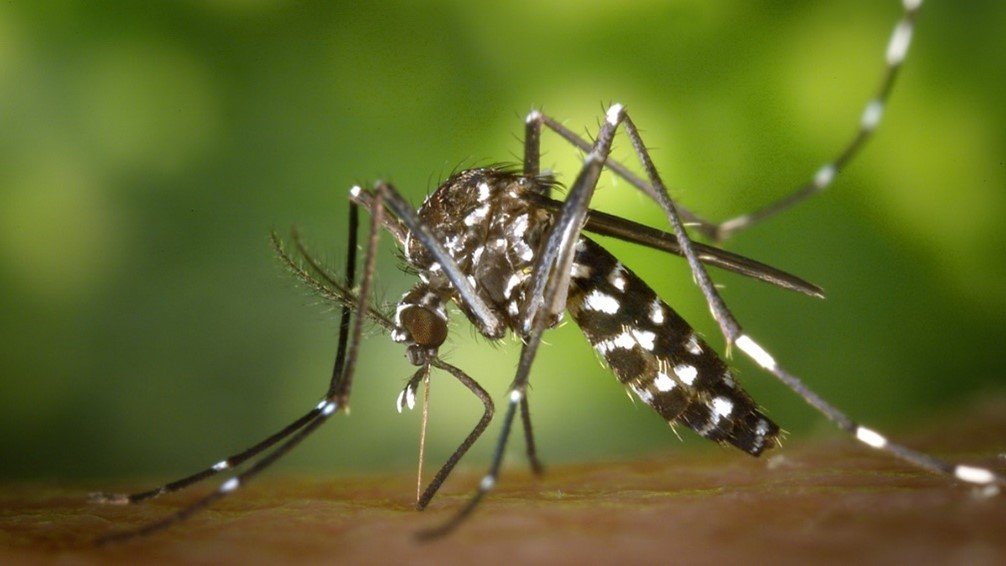
The bite can feel like a tiny prick or may go unnoticed. Itching, redness, and localized swelling often become more obvious after the mosquito has already flown away.
What does a paper wasp look like?
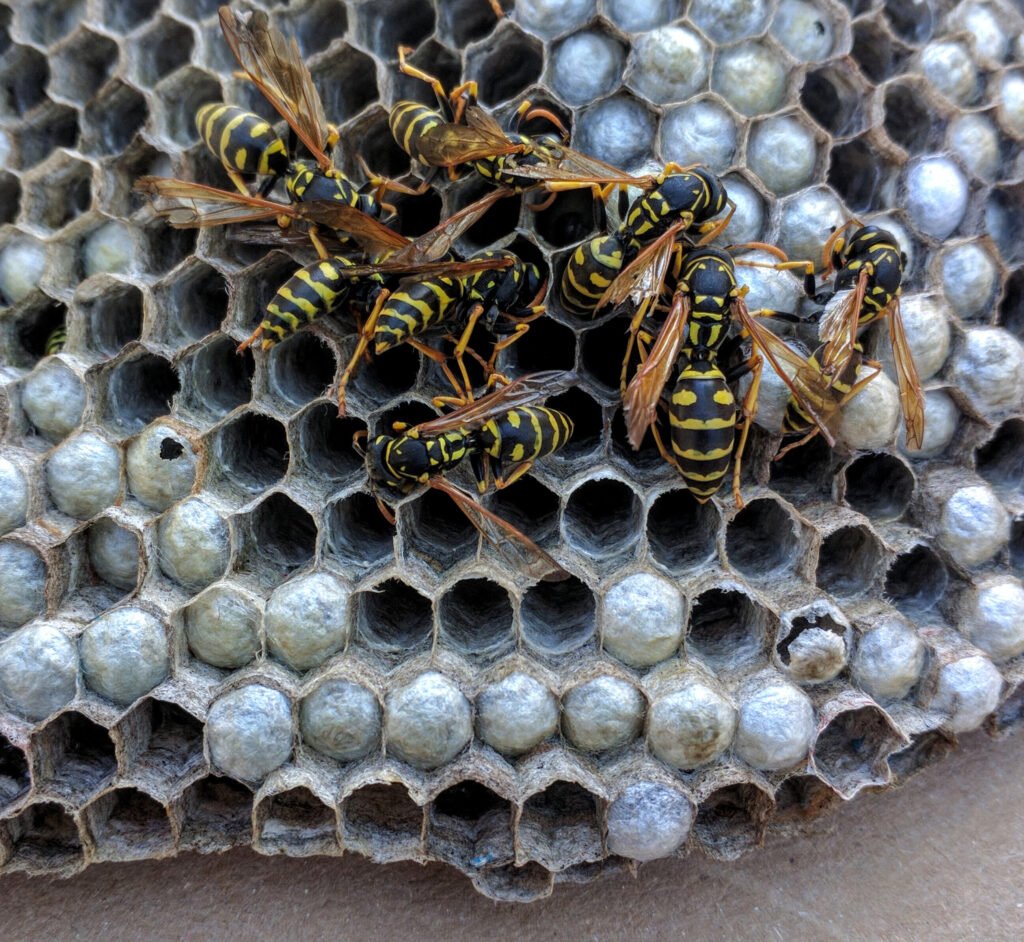
Paper wasps are members of the genus Polistes. They are generally slender, long-legged wasps with a narrow waist. Their nests are usually made of a gray or brown paper-like material and contain exposed hexagonal cells in a single open comb, often suspended from a small stalk.
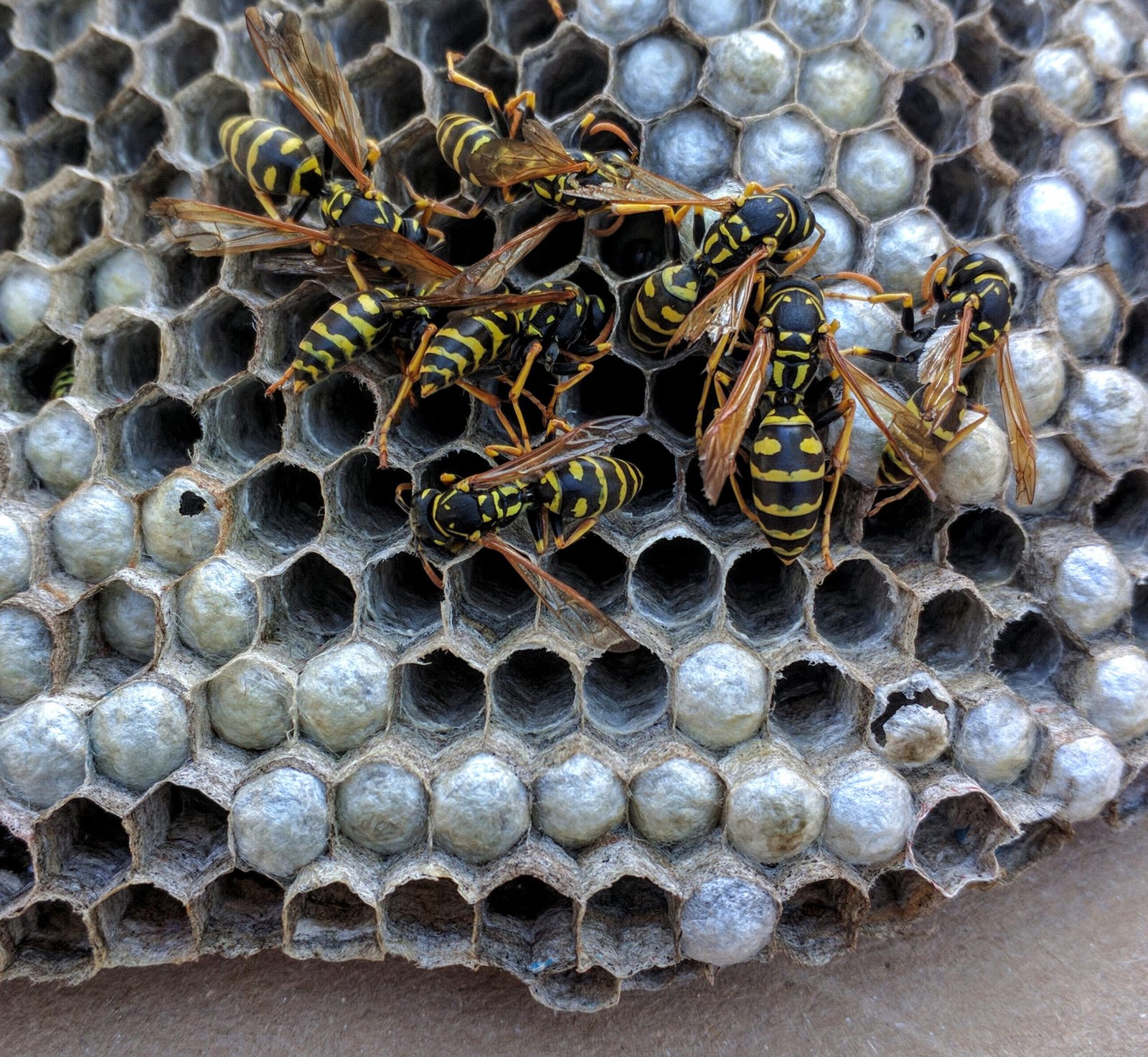
Penn State Extension’s 2026 guidance emphasizes identifying the insect and the nest before choosing a management approach. Paper wasps often defend their nest area, especially as a colony grows, although individual wasps away from the nest may be less defensive.
Where do paper wasps build nests?
Paper wasps commonly attach nests under roof eaves, deck rails, porch ceilings, window ledges, utility boxes, sheds, branches, shrubs, and other sheltered surfaces. The open comb is an important clue because yellowjacket nests and hornet nests are built differently.
A sting is more likely when a person accidentally approaches, bumps, trims around, or otherwise disturbs an active nest. Lawn care, pruning, home maintenance, painting, and moving stored objects can all create unexpected close contact.
Paper wasp exposure timeline
Immediate: a sharp or burning sting may be felt.
Minutes to hours: localized redness, warmth, itching, tenderness, and swelling may develop.
Next 1–2 days: a local reaction may remain uncomfortable or become larger before improving.
Any time soon after the sting: generalized hives, breathing difficulty, throat/facial swelling, dizziness, fainting, or collapse can indicate a systemic allergic reaction.
Asian tiger mosquito bite vs paper wasp sting symptoms
Both exposures can cause redness, itching, and swelling, but the dominant early symptom is often different.
Typical Asian tiger mosquito reaction
- Small itchy papule or wheal.
- Localized redness and swelling.
- Several bites can occur on exposed skin.
- Itching may become more noticeable after the mosquito leaves.
Typical paper wasp sting reaction
- Immediate pain or burning.
- Localized redness, tenderness, and swelling.
- Itching may develop as the local reaction evolves.
- Some people develop a large local reaction extending well beyond the sting site.
- People with venom allergy may develop generalized symptoms far from the sting.
University of Minnesota Extension notes that nonallergic sting reactions can range from burning, itching, redness, and tenderness to extensive local swelling that may persist for days. The size of local swelling alone does not prove anaphylaxis, but rapidly developing systemic symptoms are an emergency.
Pictures: can the skin tell you what caused it?
No. For asian tiger mosquito bite vs paper wasp sting pictures, the arthropod and exposure setting are much more informative than the skin. A visible open-comb paper wasp nest, a photographed wasp, or an observed black-and-white mosquito gives far stronger evidence than the shape of redness.
Use skin photographs mainly to track progression—whether swelling, redness, blistering, or drainage is improving or worsening. If no insect was seen, use the StingHelp What Bit Me? identification guide and keep other possibilities open.
Asian tiger mosquito bite vs paper wasp sting treatment differences
For a mild mosquito bite, care focuses on itching and preventing additional mosquito exposure. After a paper wasp sting, the immediate priorities are leaving the nest area, treating the local sting, and watching closely for venom-allergy symptoms. Unlike a honey bee, a paper wasp usually does not leave a barbed stinger behind and may sting repeatedly.
What to do after a likely paper wasp sting
- Move calmly away from the nest or wasp activity to reduce the chance of additional stings.
- Wash the sting site with soap and water.
- Apply a cool compress or wrapped cold pack for pain and swelling.
- Do not cut, squeeze, or attempt to remove venom.
- Use an appropriate over-the-counter pain or itch treatment only if safe for you and according to the label.
- Watch for generalized hives, throat or facial swelling, breathing difficulty, severe dizziness, vomiting with systemic symptoms, fainting, or collapse.
What to do after a likely Asian tiger mosquito bite
- Wash the area gently with soap and water.
- Apply a cool compress for itching or swelling.
- Avoid scratching and keep broken skin clean.
- Use an appropriate OTC anti-itch product only if safe for you and according to the label.
- Prevent more bites with EPA-registered repellent, protective clothing, screens, and standing-water control.
- If significant illness develops, mention recent travel and local mosquito-borne disease activity when seeking medical advice.
For broader first-aid principles, use the StingHelp bite and sting first-aid guide.
Why paper wasps can sting more than once
Paper wasps have smooth stingers that are generally retained after a sting, so an individual wasp can sting repeatedly. This is a practical difference from worker honey bees, whose barbed stingers often remain in human skin.
If a stinger is visibly embedded after what you thought was a paper wasp encounter, remove the visible stinger promptly and consider whether the insect may have been a honey bee. Do not delay emergency care while trying to determine the exact species.
For the bee comparison, see the Asian tiger mosquito vs honey bee sting guide.
What are the warning signs of anaphylaxis?
Hymenoptera venom allergy can be life-threatening. Seek emergency care for difficulty breathing, wheezing, throat tightness, swelling of the lips, tongue, or face, fainting, severe dizziness, rapidly spreading hives, confusion, collapse, or another rapidly progressing whole-body reaction.
CDC/NIOSH advises workers with severe insect-sting allergy to carry prescribed epinephrine and medical identification. Someone who has an epinephrine autoinjector should follow their clinician’s emergency plan and obtain emergency medical help after use.
Decision guide: what should you do next?
Small itchy bump after visible black-and-white mosquito exposure: routine mosquito-bite care and prevention are usually reasonable.
Immediate sharp sting near an open paper comb nest: move away, wash, cool, and monitor the reaction.
Large swelling remains local but is very painful or worsening: contact a healthcare professional for advice.
Breathing trouble, throat/facial swelling, fainting, widespread hives, severe dizziness, or collapse: seek emergency care immediately.
Large local reaction vs systemic allergy
A large local reaction can spread well beyond the sting site and may remain swollen for several days. It can be uncomfortable and alarming, but it is different from a systemic allergic reaction involving distant skin, breathing, circulation, or the gastrointestinal system.
The distinction is not always easy outside a medical setting. If swelling is progressing rapidly, involves the face or throat, or occurs with breathing symptoms, faintness, or widespread hives, treat it as an emergency rather than waiting for certainty.
What if there were multiple paper wasp stings?
Multiple stings increase the total venom exposure and deserve more caution than one uncomplicated local sting. Seek medical advice when many stings occur, when the person is a child or otherwise medically vulnerable, or when symptoms are substantial.
If wasps are actively attacking, move away from the nest area first. Do not remain beside a disturbed nest while trying to treat the first sting.
Paper wasp vs honey bee: practical differences
Honey bees are generally hairier and more robust, and worker honey bees may leave a barbed stinger after stinging a person. Paper wasps are smoother, more slender, have long legs, and typically retain the stinger.
The emergency allergy signs are similar for both. Species identification should never delay treatment of a severe systemic reaction.
Paper wasp vs yellowjacket: practical differences
Paper wasps have more slender bodies and characteristically open-comb nests. Yellowjackets are more compact and often build enclosed nests in the ground, wall voids, or protected cavities. Both can defend nests and deliver painful stings.
If nest removal is needed, identify the insect first and use appropriate local pest-management guidance. Penn State specifically recommends assessing colony size, nest location, and risk before deciding whether intervention is necessary.
USA: common paper wasp context
Several Polistes species occur across the United States. The northern paper wasp is native, while the European paper wasp, Polistes dominula, has become widespread in many parts of North America. Exact species identification can be difficult without a clear view.
For personal safety, the practical question is often simpler: is there an active paper wasp nest in a place where people must work or walk, and does anyone nearby have a history of serious venom allergy?
Europe: paper wasp allergy is clinically important
Paper wasps are also important across Europe, especially Polistes dominula in Mediterranean and other regions. EAACI notes that vespid stings are a major cause of systemic sting reactions and that Hymenoptera venom allergy is an important cause of anaphylaxis in Europe.
People with a history of systemic wasp-sting reactions may be referred to an allergy specialist. EAACI guidance supports venom immunotherapy for selected patients with clinically significant Hymenoptera venom allergy. That is specialist preventive treatment—not a decision based on the appearance of one sting.
How Asian tiger mosquito disease risk differs
Asian tiger mosquitoes are medically important for a different reason: infected Aedes albopictus can transmit dengue, chikungunya, and Zika where those viruses are circulating. A mosquito bite itself does not prove infection, and actual risk depends on travel, geography, season, and local transmission.
Paper wasp stings do not transmit these mosquito-borne viruses. Their main medical concerns are venom injury and allergic reaction.
How to prevent paper wasp stings
Avoid disturbing active nests, inspect sheltered structures before painting or repair work, and be cautious around eaves, railings, sheds, porch ceilings, shrubs, and outdoor equipment. If a nest is in a high-traffic area or creates a safety risk, use a qualified pest professional or appropriate local extension guidance rather than approaching it without protection.
More wasp-specific information is available in the StingHelp Wasp, Hornet & Yellowjacket Stings hub.
How to prevent Asian tiger mosquito bites
Use EPA-registered or locally approved insect repellent, wear protective clothing when practical, maintain screens, and remove standing water from buckets, plant saucers, toys, gutters, tires, and other containers around the home.
For more mosquito-specific guidance, browse the StingHelp Mosquito Bites hub. If the sting occurred around an ant mound rather than a wasp nest, compare the fire-ant guide.
Frequently asked questions
How can you tell an Asian tiger mosquito bite from a paper wasp sting?
A paper wasp sting is usually immediately painful and often occurs near an active nest. An Asian tiger mosquito bite may be barely noticed during feeding and become itchy later. Seeing the arthropod or nest is more reliable than the skin reaction.
Do paper wasps leave a stinger in the skin?
Usually not. Paper wasps generally retain their stinger and can sting more than once. A visible retained stinger is more typical of a worker honey-bee sting, although species identification should not delay treatment of a severe reaction.
Which paper wasp sting symptoms are an emergency?
Breathing difficulty, throat tightness, tongue or facial swelling, fainting, severe dizziness, widespread hives, collapse, or another rapidly worsening generalized reaction requires emergency evaluation.
Is a large swollen area always anaphylaxis?
No. A large local reaction can cause substantial swelling near the sting without becoming systemic anaphylaxis. However, swelling involving the face or throat, breathing problems, faintness, or symptoms throughout the body need urgent assessment.
Can a paper wasp sting more than once?
Yes. Unlike a worker honey bee, a paper wasp usually retains its stinger and can sting repeatedly. Move away from an active nest rather than staying nearby after the first sting.
When should someone seek medical care after a mosquito bite or paper wasp sting?
Seek medical advice for severe or worsening swelling, increasing pain, signs of infection, multiple wasp stings, or significant systemic symptoms. Emergency allergy symptoms after a sting require immediate emergency care.
Authoritative references
- Penn State Extension — Paper Wasps, Yellowjackets, and Other Stinging Insects, updated January 29, 2026
- University of Minnesota Extension — Wasps and Bees
- CDC/NIOSH — Insects and Scorpions at Work
- EAACI — Hymenoptera Venom Allergy Guidance
- CDC — Asian Tiger Mosquito
Bottom line
The practical asian tiger mosquito bite vs paper wasp sting treatment differences are immediate pain, venom exposure, and allergy monitoring. A mosquito bite mainly needs itch relief and mosquito prevention. A paper wasp sting needs local sting care, rapid movement away from the nest, and close attention to anaphylaxis warning signs—especially after multiple stings.
Educational information for a U.S.- and Europe-focused audience. This article cannot diagnose an insect species, allergic reaction, infection, or mosquito-borne illness from a photograph and does not replace professional medical care.