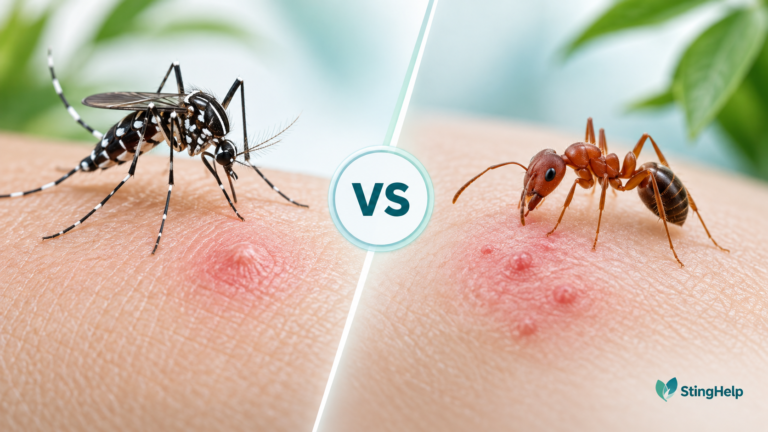
Direct answer: The key asian tiger mosquito bite vs kissing bug bite treatment differences are exposure pattern and disease mechanism. Asian tiger mosquitoes usually cause itchy bites and can transmit viruses through infected saliva. Kissing bugs often feed at night, and Chagas disease risk comes mainly when infected bug feces contaminate broken skin, the eyes, or the mouth.
Asian tiger mosquito bites and kissing bug bites can both leave red, itchy bumps, but the insects—and the public-health risks—are very different. The Asian tiger mosquito is a small black-and-white mosquito that actively feeds on people. Kissing bugs are much larger blood-feeding true bugs in the triatomine group, often active at night and sometimes found near sleeping areas, animal shelters, woodpiles, or cracks around buildings.
Fastest practical clue
A small black-and-white mosquito seen feeding outdoors supports Asian tiger mosquito exposure. A larger dark bug with orange, red, or yellow markings found indoors at night—especially near a sleeping area—raises suspicion for a kissing bug. Skin appearance alone cannot reliably tell the two apart.
Asian tiger mosquito bite vs kissing bug bite: quick comparison
| Clue | Asian tiger mosquito | Kissing bug |
|---|---|---|
| Arthropod | Aedes albopictus, a small black-and-white mosquito | Triatomine true bug, often Triatoma species in the U.S. |
| Typical activity | Often active outdoors in daytime and shaded residential areas | Usually nocturnal and feeds while people or animals are resting |
| Typical bite sensation | May be a tiny prick or unnoticed; itching often develops later | Often painless enough to go unnoticed during feeding |
| Skin pattern | Itchy papule or wheal; several bites may occur | Variable local redness, itching, swelling, or sometimes little visible reaction |
| Major disease concern | Dengue, chikungunya, Zika where infected mosquitoes and transmission are present | Chagas disease where infected triatomine feces contaminate broken skin or mucosa |
| Best identification clue | Seeing the striped mosquito feed | Capturing or clearly photographing the suspected triatomine bug |
The table is a guide, not a diagnosis. Some people react strongly to insect bites while others show almost no skin reaction. The insect, timing, geography, and exposure setting matter more than the shape of the bump alone.
What an Asian tiger mosquito looks like
The Asian tiger mosquito, Aedes albopictus, is a small dark mosquito with bright white bands on the legs and a white stripe on the upper body. It commonly breeds in small artificial containers of standing water and can be found around yards, gardens, patios, vegetation, and residential neighborhoods.
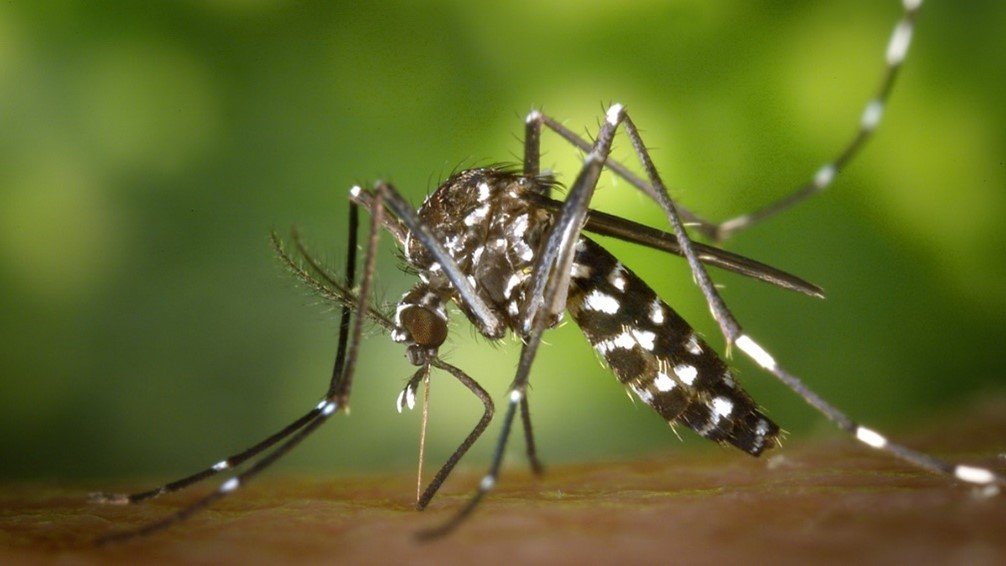
Its bite may feel like a tiny prick or may be missed entirely. Itching and localized swelling often become more noticeable after the mosquito has already flown away. When mosquitoes are abundant, several exposed-skin bites can occur during the same outdoor period.
What does a kissing bug look like?
Kissing bugs are blood-feeding members of the subfamily Triatominae. In the United States, several species occur. CDC describes Triatoma sanguisuga, one U.S. species, as a roughly 0.6- to 0.9-inch bug with orange-red or yellow markings along the abdomen and reports it from Texas northward and eastward as far as Pennsylvania.
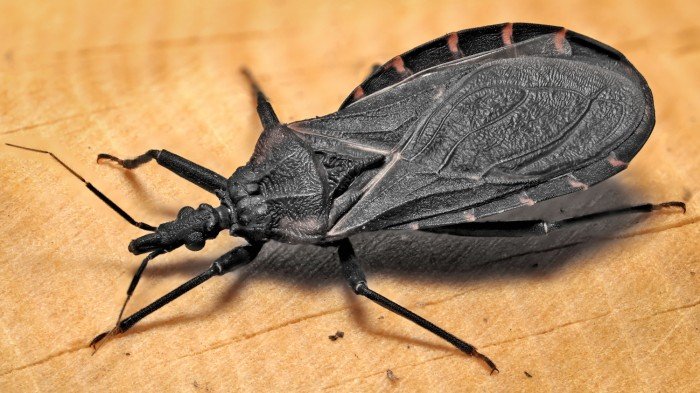
Kissing bugs have an elongated, cone-shaped head and a piercing-sucking mouthpart. They should not be confused with every assassin bug. Kissing bugs are a specialized blood-feeding subgroup within the broader reduviid family, while many other assassin bugs prey on insects and are not Chagas vectors.
Does a kissing bug inject Chagas disease when it bites?
No—not in the same way a mosquito can transmit a virus through saliva. This is one of the most important distinctions in this comparison.
CDC explains that the parasite that causes Chagas disease, Trypanosoma cruzi, is mainly spread when an infected kissing bug defecates during or after feeding and parasite-containing feces are rubbed or otherwise introduced into the bite wound, broken skin, the eyes, or the mouth. The bite itself does not automatically inject the parasite.
Chagas transmission pathway
Step 1: an infected kissing bug takes a blood meal.
Step 2: the bug passes feces containing T. cruzi near the feeding site.
Step 3: scratching, rubbing, or direct contact moves contaminated material into broken skin, the eye, or the mouth.
Important: a kissing bug bite does not mean Chagas disease was transmitted, and not every kissing bug is infected.
Asian tiger mosquito bite vs kissing bug bite symptoms
The local reactions overlap enough that symptoms alone cannot reliably identify the insect. Both can cause itching, redness, and swelling. The exposure history remains essential.
Typical Asian tiger mosquito reaction
- Small itchy papule or wheal.
- Localized redness and swelling.
- Itching that may become more noticeable after feeding.
- Several bites on exposed skin when mosquitoes are active.
Typical kissing bug reaction
- The feeding event may be painless and go unnoticed.
- Some people develop local itching, redness, or swelling.
- Others may show little or no obvious skin reaction.
- Allergic reactions can occur, including rare severe reactions.
A facial or eyelid swelling sometimes discussed in Chagas disease, known as Romaña sign when related to conjunctival entry of the parasite, is not a routine sign after every kissing bug bite and should not be used to diagnose Chagas from a photograph.
Pictures: can the skin tell you which insect caused it?
Usually not with confidence. For asian tiger mosquito bite vs kissing bug bite pictures, the insect itself is far more informative than the skin. A clear photograph showing an Asian tiger mosquito’s black-and-white pattern or a triatomine’s elongated head and colored abdominal margin can help narrow the identification.
Skin photographs are useful for tracking whether swelling, redness, blistering, drainage, or other changes are getting better or worse. They are poor tools for species-level diagnosis.
If the culprit was not seen, start with the StingHelp What Bit Me? identification guide and keep the differential diagnosis open.
Asian tiger mosquito bite vs kissing bug bite treatment differences
For a mild local skin reaction, basic care overlaps: wash gently, use a cool compress, avoid scratching, and use an appropriate over-the-counter anti-itch treatment only if safe for you and used according to the label. The key difference is what you do with the suspected insect and the disease-risk context.
What to do after a likely Asian tiger mosquito bite
- Wash the skin with soap and water.
- Use a cool compress for itching or swelling.
- Avoid scratching and keep broken skin clean.
- Use an appropriate OTC anti-itch product only if safe for you and according to the label.
- Prevent more bites with EPA-registered repellent, protective clothing, screens, and standing-water control.
- If significant fever or systemic illness develops, consider travel history and local mosquito-borne disease activity when seeking medical advice.
What to do after a suspected kissing bug bite
- Wash the bite area and your hands with soap and water.
- Avoid rubbing or scratching contaminated material into the skin or eyes.
- If the bug is still present, do not crush it with bare fingers.
- Capture it safely in a closed container or take clear photographs if this can be done without additional contact.
- Contact local public health, a state health department, or extension/entomology service if identification or testing is appropriate in your area.
- Discuss credible exposure with a healthcare professional if you are concerned about Chagas disease, especially after exposure in an endemic region.
For general local bite care, use the StingHelp bite and sting first-aid guide.
When is a kissing bug exposure medically important?
Most people who find a kissing bug in the United States will not develop Chagas disease. CDC notes that vector-borne transmission risk in the U.S. is much lower than in many endemic parts of Latin America. The medically important question is not simply “was I bitten?” but whether there was credible exposure to an infected triatomine and possible contact with contaminated feces.
Medical advice is more important when a suspected triatomine exposure occurred in an endemic area, when the bug was reliably identified, when there is concern that fecal material contacted a bite wound or mucous membrane, or when systemic illness develops.
What are the warning signs after any insect bite?
Seek medical evaluation for rapidly worsening redness, increasing warmth, severe pain, pus or drainage, fever, progressive swelling, blistering, or a lesion that is not improving as expected.
Seek emergency care for difficulty breathing, throat tightness, swelling of the lips, tongue, or face, fainting, severe dizziness, rapidly spreading hives, confusion, or collapse. Severe allergic reactions can occur after many arthropod exposures and should not be managed as a routine bite.
Decision guide: what should you do next?
Black-and-white mosquito seen feeding outdoors + mild itchy bump: routine mosquito-bite care and mosquito prevention are usually reasonable.
Large suspected kissing bug found near a bed or resting area: avoid bare-hand crushing, capture or photograph it safely, and seek local identification guidance.
Credible triatomine exposure in an endemic area or possible fecal contamination of eye/mouth/broken skin: discuss the exposure with a healthcare professional or public-health service.
Breathing trouble, facial/throat swelling, fainting, collapse, or rapidly worsening systemic symptoms: seek emergency care.
USA: where are kissing bugs found?
Multiple triatomine species occur in the United States, particularly across the southern half of the country. CDC’s current species information documents Triatoma sanguisuga from Texas to Pennsylvania, while other species occur in the Southwest and additional regions.
Finding a kissing bug in the U.S. does not prove Chagas transmission occurred. The risk depends on the species, whether the bug is infected with T. cruzi, whether infected feces reached broken skin or a mucous membrane, and the person’s exposure circumstances.
Latin America: why Chagas context is different
Chagas disease is endemic in parts of Mexico, Central America, and South America, where sustained domestic or peridomestic triatomine exposure has historically created much greater vector-borne risk. Travelers staying in poorly constructed rural housing in endemic areas may face a different exposure profile than most U.S. residents.
CDC prevention guidance emphasizes avoiding contact with triatomine bugs in endemic settings. Well-constructed or screened accommodations and appropriately used bed nets can reduce exposure in higher-risk environments.
Europe: vector-borne Chagas is not endemic
European readers should interpret kissing-bug risk differently. ECDC describes Europe as a non-endemic region for vector-borne Chagas transmission. Chagas cases in the EU/EEA are mainly relevant through migration from endemic areas and non-vector routes such as congenital transmission, blood transfusion, or organ transplantation.
That means an unexplained European skin lesion should not be casually labeled a “Chagas kissing bug bite.” Travel history and confirmed triatomine exposure are essential context.
Kissing bug vs assassin bug: why the distinction matters
Kissing bugs belong to the assassin-bug family Reduviidae, but not every assassin bug is a kissing bug. Many assassin bugs are predators of other insects and may deliver a painful defensive bite, yet they are not the specialized blood-feeding triatomines associated with Chagas transmission.
If the insect was a predatory assassin bug rather than a triatomine, compare the Asian tiger mosquito vs assassin bug guide. The shape of the head, feeding biology, body proportions, and expert identification matter.
How Asian tiger mosquito disease risk differs
Asian tiger mosquitoes can transmit dengue, chikungunya, and Zika when infected mosquitoes are present and local transmission occurs. Unlike Chagas transmission from triatomines, mosquito-borne viruses are transmitted through the mosquito’s feeding process.
A routine itchy mosquito bite does not mean a virus was transmitted. Actual risk depends on geography, travel, season, local public-health activity, and whether infected mosquitoes are circulating.
For more species-specific prevention and bite guidance, browse the StingHelp Mosquito Bites hub.
How to prevent Asian tiger mosquito bites
Use EPA-registered insect repellent, wear protective clothing when practical, maintain window and door screens, and remove standing water from buckets, plant saucers, gutters, toys, tires, and other containers around the home.
How to reduce kissing bug exposure
CDC recommends reducing opportunities for triatomine bugs to enter living spaces. Seal cracks and gaps where practical, repair screens, reduce clutter and animal nesting close to sleeping areas, and use appropriate pest-management advice when kissing bugs are repeatedly found around a home.
When traveling in rural endemic areas, sleeping in well-constructed screened housing and using bed nets when appropriate can reduce nighttime exposure.
Frequently asked questions
How can you tell an Asian tiger mosquito bite from a kissing bug bite?
The insect and exposure pattern are more useful than the skin. Asian tiger mosquitoes are small, black-and-white, and commonly bite outdoors. Kissing bugs are much larger nocturnal true bugs. Both bites can be itchy or minimally noticeable, so a skin photo alone cannot reliably distinguish them.
Does every kissing bug bite transmit Chagas disease?
No. Not every kissing bug is infected, and the parasite is not simply injected by the bite. CDC explains that transmission mainly occurs when infected bug feces contaminate broken skin, the eyes, or the mouth.
What should you do if you find a kissing bug?
Do not crush it with bare hands. If safe, capture it in a closed container or take clear photographs. Local public-health or extension services may help identify the insect and advise whether testing or further action is appropriate.
Which warning signs matter most?
Seek medical care for worsening redness, heat, pain, drainage, fever, or progressive swelling. Breathing difficulty, throat or facial swelling, fainting, severe dizziness, rapidly spreading hives, or collapse requires emergency evaluation.
Is Chagas disease common in Europe?
Vector-borne Chagas transmission is not endemic in Europe. ECDC focuses on imported infections and other routes such as congenital transmission, blood transfusion, and organ transplantation among people with links to endemic regions.
When should someone seek medical care after a mosquito or kissing bug exposure?
Seek care for severe or worsening local reactions, systemic illness, emergency allergy symptoms, or a credible triatomine exposure with possible fecal contamination—especially after exposure in an endemic region. For mosquito illness, mention travel and local disease activity.
Authoritative references
- CDC — How Chagas Disease Spreads, updated February 4, 2026
- CDC — Triatomine Bugs in the United States, updated February 10, 2026
- CDC — Preventing Chagas Disease
- ECDC — Chagas disease in non-endemic countries
- CDC — Asian Tiger Mosquito
Bottom line
The practical asian tiger mosquito bite vs kissing bug bite treatment differences come down to exposure and disease mechanism. A typical mosquito bite mainly needs itch relief and mosquito prevention. A credible kissing-bug exposure requires safe insect handling, attention to possible fecal contamination, and Chagas-risk assessment based on geography and exposure—not the bite mark alone.
Educational information for a U.S.- and Europe-focused audience. This article cannot diagnose an insect species, Chagas disease, allergic reaction, infection, or mosquito-borne illness from a photograph and does not replace professional medical care.