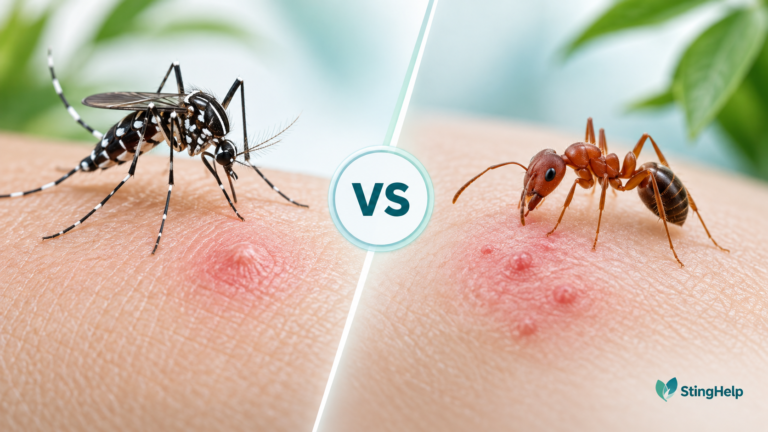
Direct answer: Asian tiger mosquito bites and bird mite bites can both produce small itchy red bumps, so the skin reaction alone usually cannot identify the culprit. Mosquito exposure is more likely after outdoor contact with a black-and-white Aedes albopictus; bird mites are more likely when tiny crawling mites appear near a bird nest, poultry area, pet bird, attic, vent, window, or wall opening.
When comparing asian tiger mosquito bite vs bird mite bite treatment differences, the first step is to separate skin care from source control. Mild bites from either source can often be managed with basic itch care. The bigger difference is what you need to solve afterward: preventing further mosquito bites versus finding and addressing a bird or nest source that is allowing mites to enter the building.
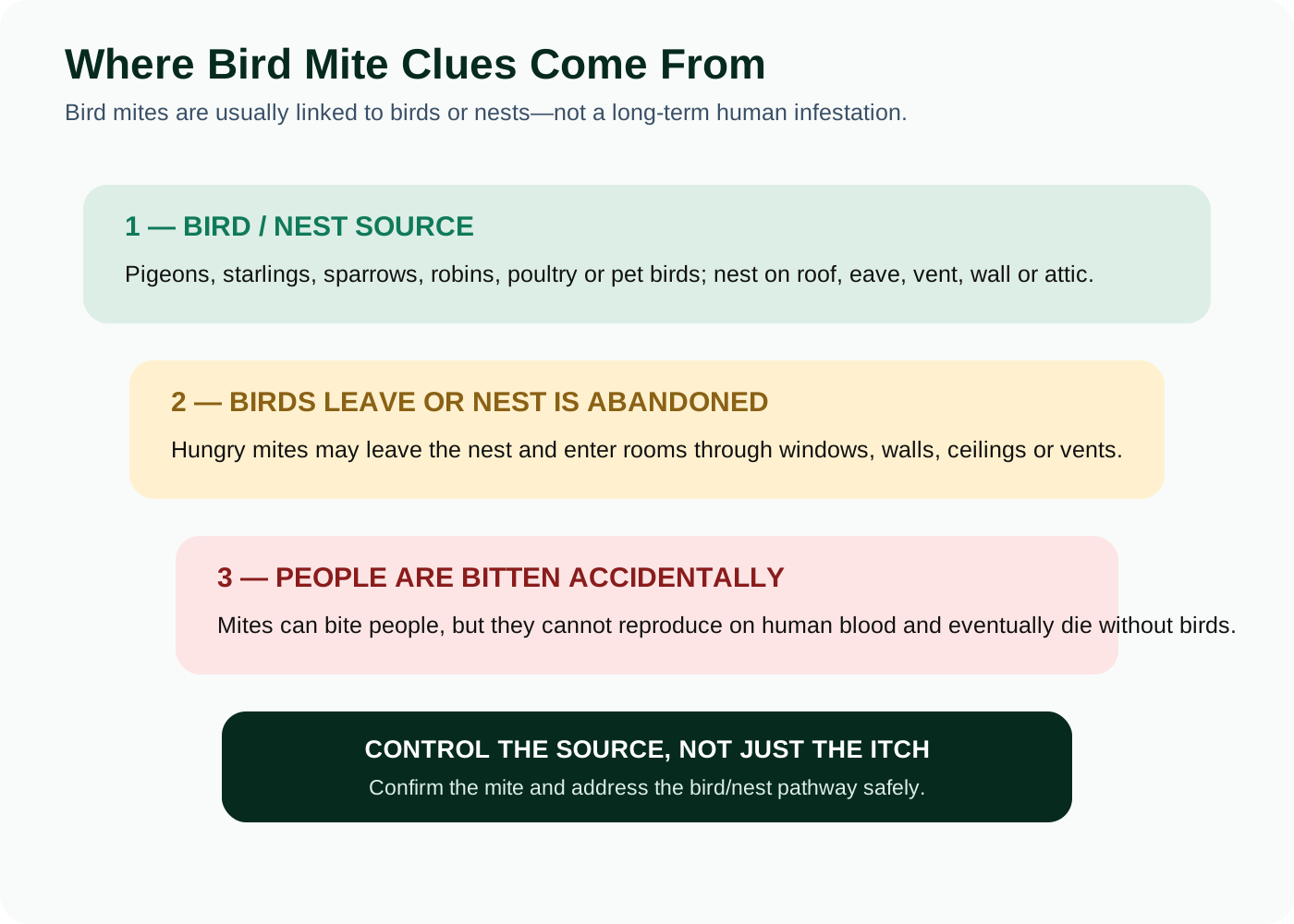
Bird mites are parasites of birds. Common examples include the northern fowl mite and chicken mite. University extension sources explain that these mites may bite people when birds leave a nest or die, but they cannot reproduce on human blood. That makes bird-mite problems very different from infestations such as scabies or bed bugs.
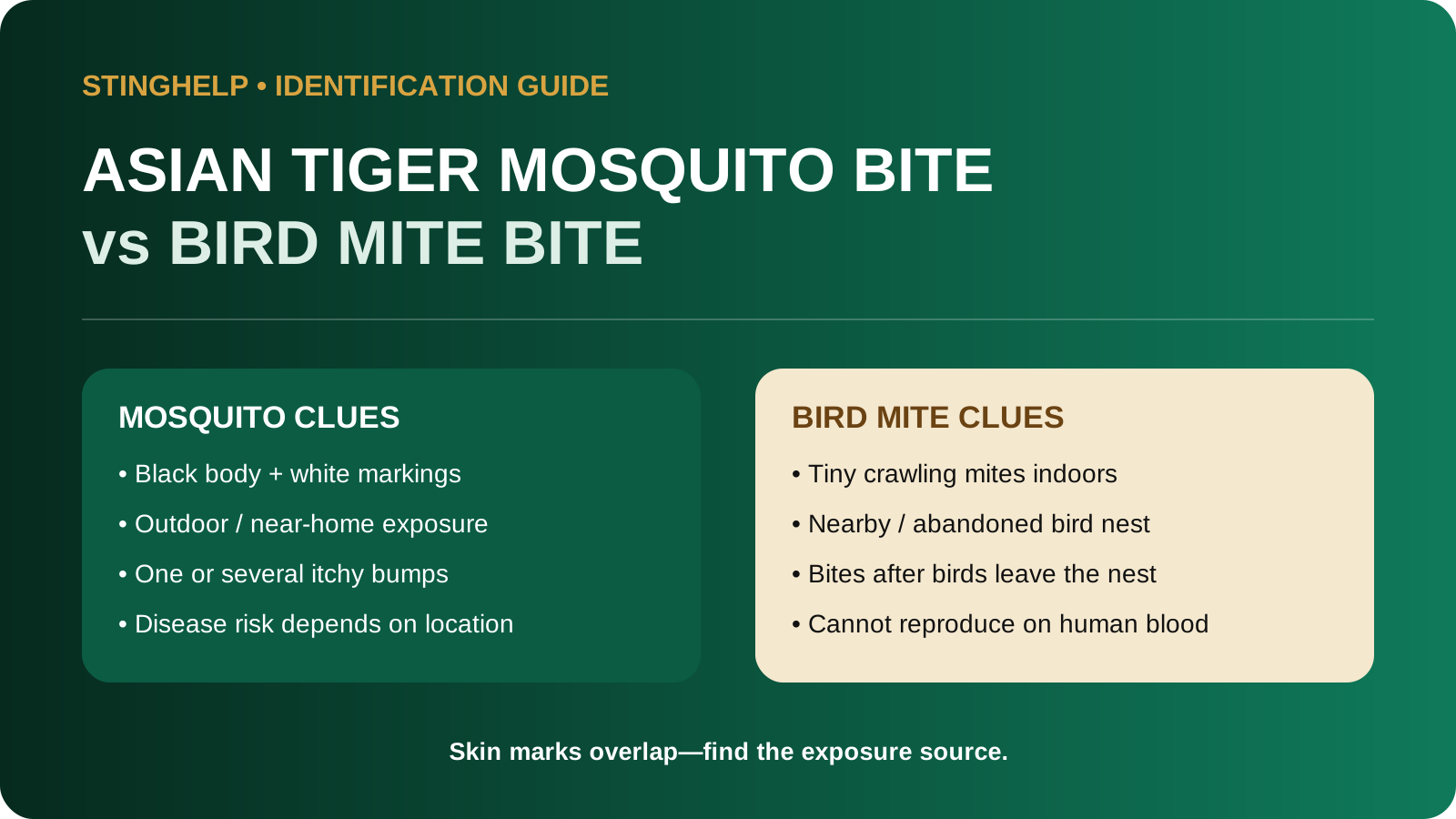
Asian tiger mosquito bite vs bird mite bite: quick comparison
| Clue | Asian tiger mosquito bite | Bird mite bite |
|---|---|---|
| Typical culprit | Aedes albopictus, a small black mosquito with white bands and markings. | Very small mites associated with wild birds, poultry, pet birds, or bird nests. |
| Likely exposure | Outdoors, yards, gardens, porches, vegetation, or mosquito-prone areas near homes. | Near a bird nest, attic, vent, roofline, window, wall void, poultry area, or pet-bird enclosure. |
| Visibility | Clearly mosquito-shaped if seen. | Tiny but often visible as moving specks; close identification may require magnification. |
| Skin reaction | Itchy red bump or wheal; one or several bites possible. | Small irritating bites; reaction varies and can be difficult to distinguish from other arthropod bites. |
| Environmental clue | Standing water and visible mosquito activity. | Bird nest on/in building, birds recently left, or mites crawling from nest area. |
| Can it reproduce on humans? | Not applicable; mosquito develops separately in aquatic habitats. | No. Common bird mites cannot reproduce on human blood. |
| Disease context | Infected mosquitoes can transmit dengue, Zika, or chikungunya depending on geography and transmission. | Bird mites have not been found to transmit disease to people. |
What does an Asian tiger mosquito look like?
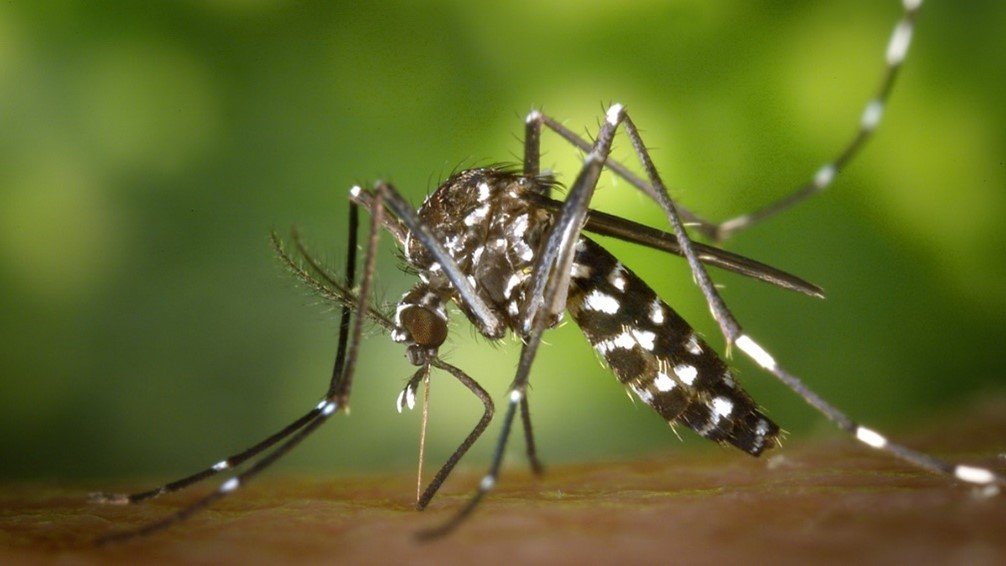
The Asian tiger mosquito is a small black mosquito with distinctive white bands on the legs and white markings on the body. CDC identifies Aedes albopictus as an important vector that can spread dengue, Zika, and chikungunya when infected. It occurs in tropical, subtropical, and some temperate areas, including parts of the United States and southern Europe.
It commonly uses water-filled containers for breeding. Buckets, plant saucers, birdbaths, toys, gutters, bowls, and other small water sources can support mosquito development. If you spent time outdoors and saw black-and-white mosquitoes, that history strongly favors mosquito exposure over bird mites.
What does an Asian tiger mosquito bite feel like?
A bite may feel like a tiny prick or may go unnoticed. Itching often becomes more obvious later. Some people develop only a small red bump, while others develop a larger wheal or localized swelling. Multiple bites can occur when several mosquitoes are present or when feeding attempts happen more than once.
What are bird mites?
Bird mites are tiny mites that normally live on birds or in bird nests. University of Minnesota Extension lists northern fowl mites and chicken mites among the common species involved. They may be associated with poultry, pigeons, starlings, sparrows, robins, pet birds, and other avian hosts.
Adult mites have eight legs and are extremely small, often around a millimeter or less. Their color can vary from pale or grayish to darker brown or red-black after feeding. Because they are so small, accurate species identification may require an entomologist, extension office, or qualified pest specialist.
Why do bird mites suddenly appear inside homes?
A typical scenario begins with a nest on or inside the building. When nestlings leave, the nest is abandoned, or a bird dies, mites that depended on the birds may start wandering in search of another host. They can enter through window frames, vents, attic gaps, ceiling openings, wall voids, eaves, or other pathways close to the nest.
This pattern often creates a sudden indoor problem. A person may notice tiny moving specks on a wall, desk, windowsill, bed, or nearby surface. The bites are accidental; humans are not a suitable long-term reproductive host for the common bird mites described by extension sources.
Can you identify bird mite bites from pictures?
Usually not with confidence. Bird-mite bites can look like other small arthropod bites and itchy skin conditions. Redness, small papules, irritation, and scratch marks are nonspecific. The strongest evidence is the combination of symptoms with actual mites and a plausible bird source.
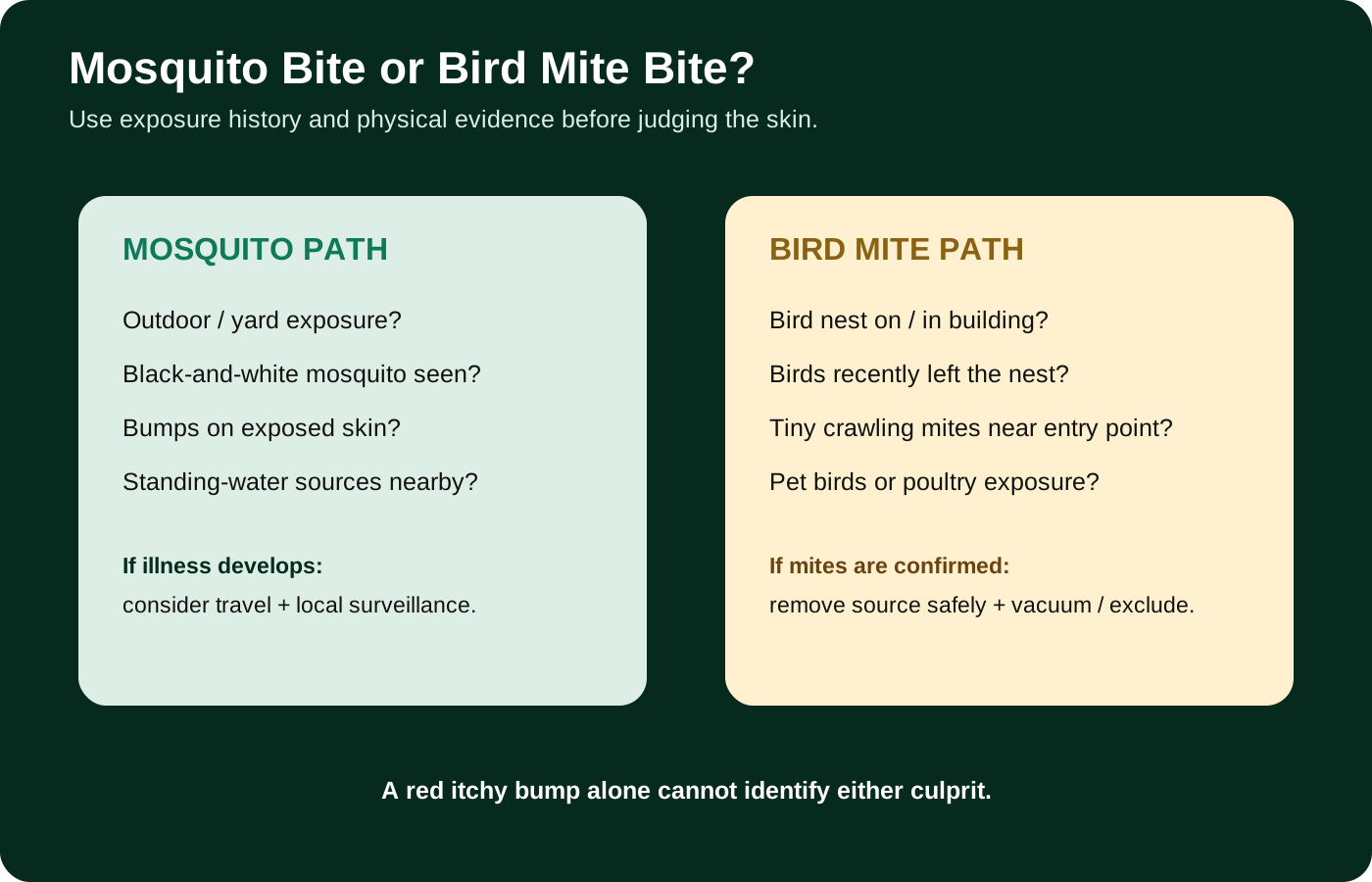
For asian tiger mosquito bite vs bird mite bite pictures, insect and environmental photos are more useful than skin photos. A black-and-white mosquito is visually different from a tiny eight-legged mite. A photograph of an abandoned nest near the affected room or a sample of the crawling mite can make the investigation much more informative.
Which exposure pattern points toward bird mites?
Bird mites become more plausible when symptoms start around the same time that birds leave a nest on the building. Common locations include nests under eaves, in roof spaces, inside vents, near air-conditioning openings, behind shutters, in attics, or in wall cavities. Poultry and pet birds can also provide the primary host source.
The affected area may be concentrated near the entry pathway. For example, mites coming from an exterior nest may appear near a window or wall, while mites from an attic nest may enter through ceiling fixtures or gaps. This source pattern is more useful than whether the bites appear in a line, cluster, or random distribution.
Which exposure pattern points toward Asian tiger mosquitoes?
Mosquitoes are more likely when the bites follow time outdoors or in a building where mosquitoes were clearly present. Asian tiger mosquitoes are often associated with vegetation and container water around homes. Exposed ankles, legs, arms, neck, or shoulders may be bitten while a person gardens, walks, works outdoors, or sits outside.
Because mosquitoes can enter homes through open doors or damaged screens, indoor bites are possible too. The key difference is that there is no bird-nest pathway or crawling mite evidence.
Asian tiger mosquito bite vs bird mite bite treatment differences
For mild local bites, skin care is similar. Gently wash the area, use a cool compress, avoid scratching, and follow product directions if using an over-the-counter anti-itch treatment. The practical treatment difference is environmental: bird-mite bites may continue until the bird/nest source and entry route are addressed, while mosquito prevention focuses on reducing bites and breeding sites.
Basic care for a typical mosquito bite
- Wash the bite gently with soap and water.
- Use a cool compress for itch or swelling.
- Avoid scratching and keep broken skin clean.
- Use appropriate over-the-counter itch relief only when safe for you and according to the label.
- Prevent additional bites with repellent, clothing, screens, and standing-water control.
- Monitor for systemic illness in the context of travel or known local mosquito-borne disease activity.
Basic care for a suspected bird mite bite
- Wash irritated skin gently and avoid aggressive scrubbing.
- Use a cool compress and appropriate itch relief as needed.
- Avoid scratching to reduce skin damage and infection risk.
- Look for tiny moving mites and a nearby bird or nest source.
- Vacuum or wipe up confirmed wandering mites rather than relying only on skin treatment.
- Seal likely entry points after the bird source has been resolved safely and legally.
Bird mites cannot reproduce on human blood
This is one of the most important distinctions. University extension guidance states that common bird mites can bite people but cannot reproduce on human blood. Without their normal avian host, they eventually die. That means persistent symptoms should trigger a careful search for the environmental source and a reconsideration of other possible causes if no mites can be found.
It is also important not to assume every tiny speck is a bird mite. Other mites, insects, fibers, debris, or non-arthropod skin conditions can be mistaken for a pest problem. If identification is uncertain, collect a sample with clear tape or in a secure container and seek qualified identification.
Do bird mites transmit disease to people?
University of Minnesota Extension reports that bird mites have not been found to transmit diseases to people. Their main impact is nuisance biting and skin irritation. This differs from the disease context of Asian tiger mosquitoes, which can transmit certain viruses when the mosquito itself is infected.
That does not mean every Asian tiger mosquito bite is dangerous. Disease transmission requires an infected mosquito, and risk depends on geography, season, outbreaks, and travel. Most individual mosquito bites result only in a local itchy reaction.
How to control bird mites safely
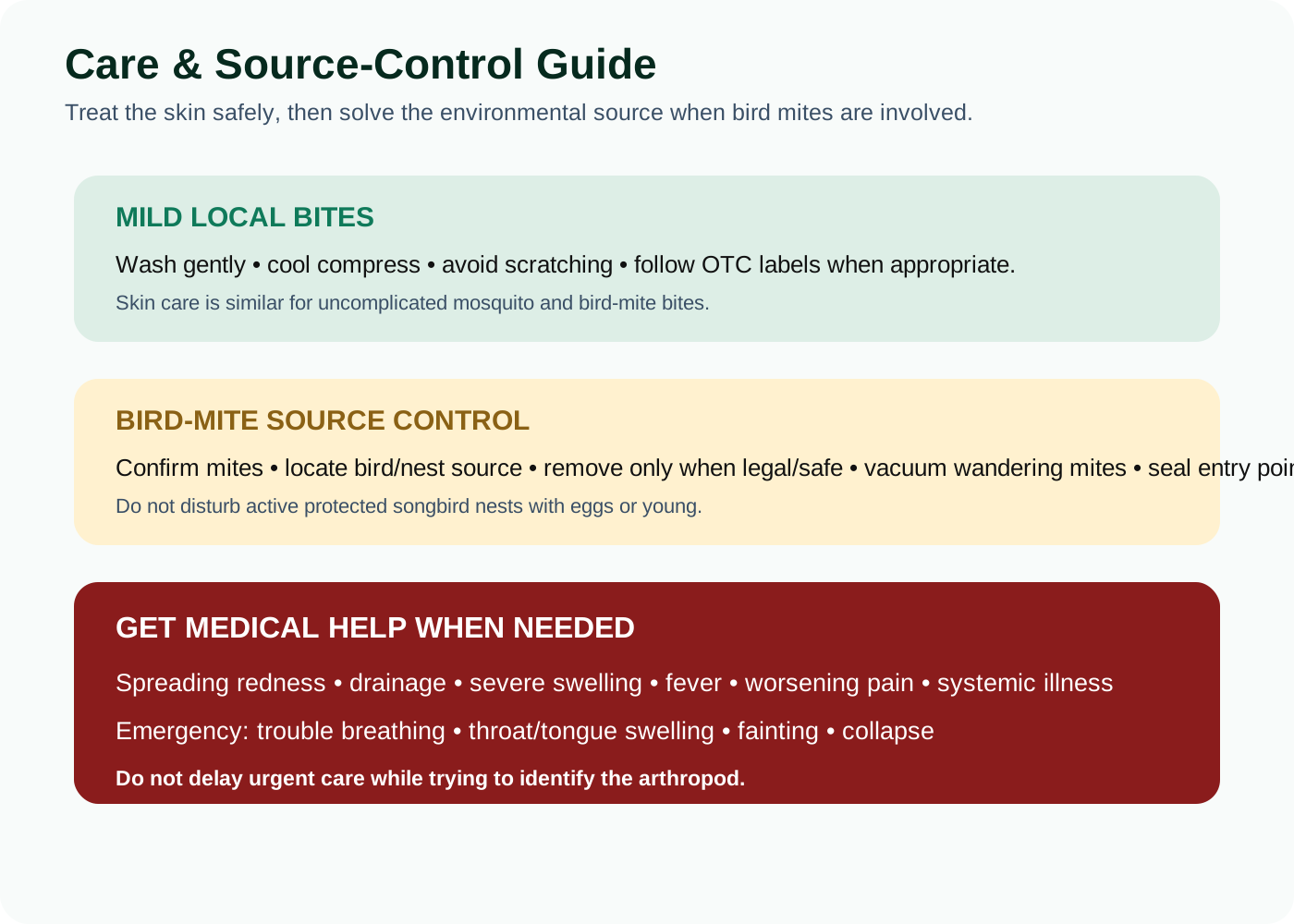
Source control is more important than treating random indoor surfaces. Confirm the mite if possible, locate the bird or nest source, and determine whether the nest is still active. University extension guidance warns not to disturb active nests of protected songbirds when eggs or young are present. Local wildlife rules can also apply.
When a nest is abandoned and removal is legal and safe, the nest can be removed and disposed of. Wandering mites can be vacuumed or wiped up with a damp cloth. Seal entry gaps around windows, vents, eaves, rooflines, and wall openings after the source is resolved. If the problem is extensive or the nest is inaccessible, a licensed pest-management professional can help.
Do not apply pesticides directly to the skin or use products in a manner not allowed by the label. If chemical control is considered for the building, follow the product label exactly or use a professional.
How to prevent Asian tiger mosquito bites
CDC recommends EPA-registered insect repellent, loose long-sleeved shirts and pants when practical, intact screens, and removal of standing water. Because Aedes mosquitoes can use small containers, check yards and patios regularly rather than focusing only on large water sources.
Travelers should also check current public-health guidance for destinations with dengue, Zika, chikungunya, or other mosquito-borne disease activity. If illness develops, the travel history may be more clinically important than the appearance of the original bite.
When should you seek medical care?
Seek medical advice for spreading redness, increasing warmth or pain, drainage, fever, extensive swelling, blistering, or symptoms that are worsening rather than improving. Scratching either mosquito or mite bites can damage the skin and increase the chance of secondary infection.
After mosquito exposure, systemic illness such as fever, rash, marked joint pain, severe headache, unusual bleeding, or neurologic symptoms deserves medical evaluation, especially after travel or during known transmission. Bird-mite bites do not have the same vector-borne disease pathway.
Call emergency services for trouble breathing, swelling of the throat or tongue, fainting, collapse, severe confusion, or another rapidly progressive life-threatening reaction.
What if you cannot find any mites?
Do not assume bird mites solely because bites are itchy or because birds live nearby. Search carefully for moving mites around the suspected entry point and inspect the building for nests. If repeated inspections and samples find no arthropods, keep other explanations open and consider medical evaluation for persistent skin symptoms.
A qualified pest professional, extension entomologist, or diagnostic laboratory can help with specimens. Correct identification prevents unnecessary pesticide use and helps avoid spending time treating the wrong source.
Related StingHelp guides
For more help, use the What Bit Me? identification guide, review the mosquito bites hub, and see our bite and sting first-aid guide. You can also check emergency warning signs, explore the prevention hub, and browse more comparison guides in the StingHelp library.
Frequently asked questions
How can you tell an Asian tiger mosquito bite from a bird mite bite?
Use the exposure source rather than the skin mark alone. Asian tiger mosquitoes are black-and-white mosquitoes associated with outdoor or near-home exposure. Bird mites are tiny crawling mites usually linked to birds, bird nests, poultry, or pet birds, especially after a nest is abandoned.
Can bird mites live on humans?
Bird mites can bite people, but university extension sources report that common bird mites cannot reproduce on human blood. They normally depend on birds and bird nests for their life cycle.
Do bird mites spread disease to people?
University extension guidance states that bird mites have not been found to transmit diseases to people. Their main human impact is irritating bites and the nuisance caused by mites entering buildings.
Can Asian tiger mosquito bites appear in groups?
Yes. Multiple mosquitoes or repeated feeding attempts can create several nearby itchy bumps, so grouped bites do not automatically indicate mites.
How do you get rid of bird mites in a home?
Confirm the mite and locate the bird or nest source. When legally and safely appropriate, remove abandoned nests, vacuum or wipe up wandering mites, and seal entry points. Active protected bird nests with eggs or young should not be disturbed.
When should you seek medical care after an unexplained bite?
Seek medical advice for spreading redness, drainage, severe swelling, worsening pain, fever, or significant systemic illness. Call emergency services for breathing difficulty, throat or tongue swelling, fainting, collapse, or another rapidly progressive severe reaction.
Authoritative references
- University of Minnesota Extension — Bird Mites
- University of Maryland Extension — Bird Mites
- CDC — Aedes albopictus / Asian Tiger Mosquito
- American Academy of Dermatology — Bug Bites and Stings
Bottom line
The key asian tiger mosquito bite vs bird mite bite treatment differences come from the exposure source. Asian tiger mosquito bites point toward mosquito prevention and, when illness develops, consideration of local or travel-related mosquito-borne disease. Bird-mite bites point toward finding the bird or nest source, removing wandering mites, and sealing entry routes. In both cases, avoid diagnosing from the skin mark alone.
Educational information for a U.S.- and Europe-focused audience. This article cannot diagnose an arthropod, infestation, infection, allergic reaction, or mosquito-borne illness from a photograph and does not replace professional medical care.