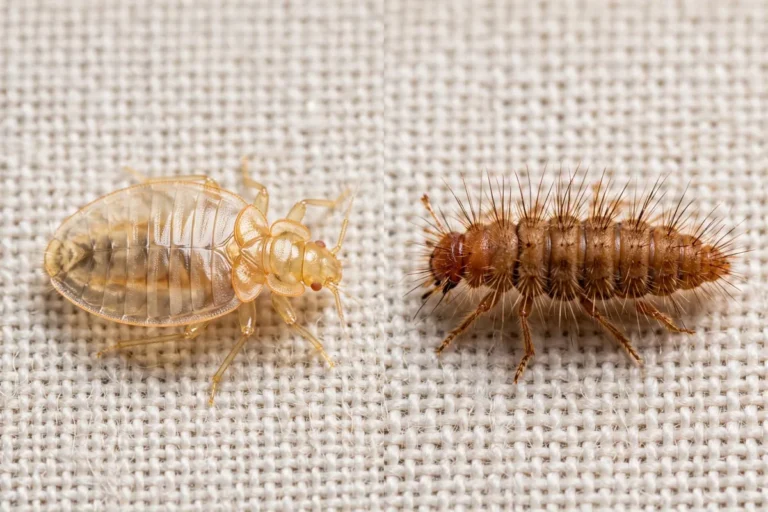
You spot a small, flat, reddish-brown bug crawling up your bedroom wall, or worse, on the ceiling, and the question hits you immediately: can bed bugs climb walls? The direct…
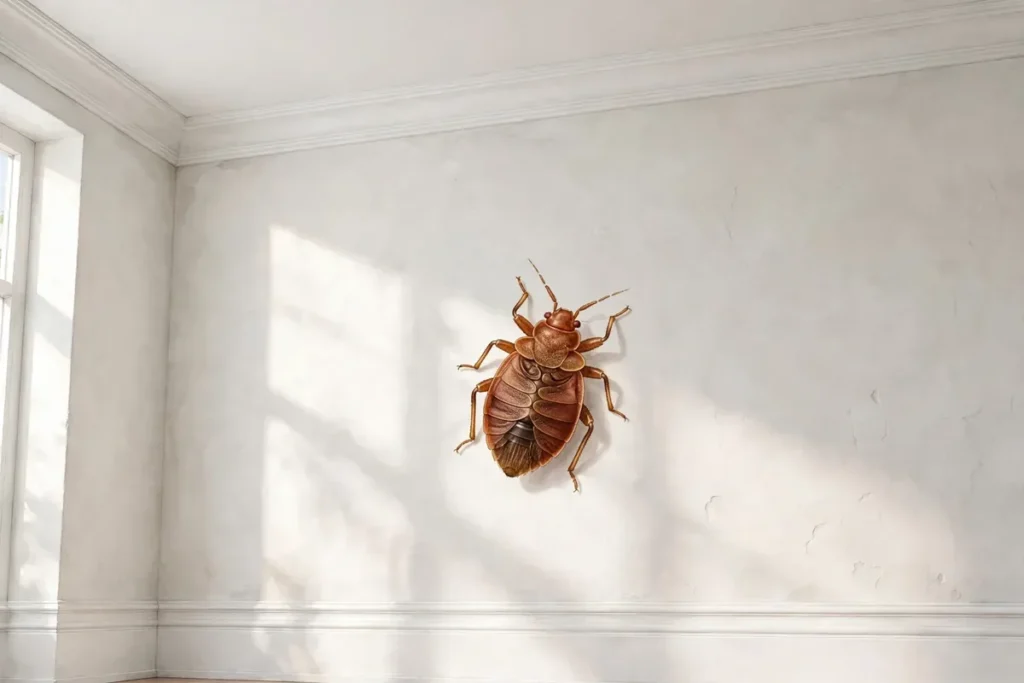
You spot a small, flat, reddish-brown bug crawling up your bedroom wall, or worse, on the ceiling, and the question hits you immediately: can bed bugs climb walls? The direct answer is yes. Bed bugs are wingless crawlers, but they are skilled climbers. They scale walls, baseboards, bed frames, and even ceilings, and they use that ability to move around rooms and between apartments. Understanding how they climb, and which surfaces slow them down, is the key to making sense of where they come from and whether your defenses will hold.
This article is about movement biology, not myths about cleanliness. Bed bugs show up in spotless five-star hotels as well as cluttered apartments; the CDC notes that how clean a place is does not determine whether bed bugs are present. What matters is how they travel, and climbing is central to their travel plans. Below, we cover the mechanics of the climb, the surfaces that defeat them, the tropical bed bug exception, how they move between units in multi-unit buildings, and what all of this means for monitoring and next steps.
The Direct Answer: Yes, Bed Bugs Climb Walls
Bed bugs cannot fly and cannot jump. They get everywhere by crawling, and they are good at it. In laboratory settings, bed bugs have been clocked walking about one meter per minute, which means a hungry bug can cross a room in the time it takes you to brush your teeth. Walls are not an obstacle to them. They climb vertical surfaces routinely, moving up walls to reach ceilings, harboring in cracks along baseboards and behind headboards, and traveling down again when it is time to feed.
This is why finding a bed bug on a wall or ceiling does not mean you are dealing with some unusual super-bug. It is normal behavior. Bed bugs spend most of their time hidden in harborages: mattress seams, box springs, bed frames, headboards, nightstands, cracks in baseboards, and the gaps behind loose wallpaper. When they are hungry, they travel from the harborage to the host, feed for several minutes, and crawl back. Walls and ceilings are simply part of their highway system. A bug on the ceiling above your bed may well be commuting to or from a meal.
It is also worth knowing that bed bugs can go a long time between meals. The CDC notes that they can live several months without a blood meal. That endurance, combined with their climbing skill, is what makes them such persistent building-wide pests. A bug that cannot reach you tonight because you isolated your bed can wait in a wall crevice, or move to the neighboring unit where the pickings are easier.
How They Do It: Tarsal Claws and Crawling Mechanics
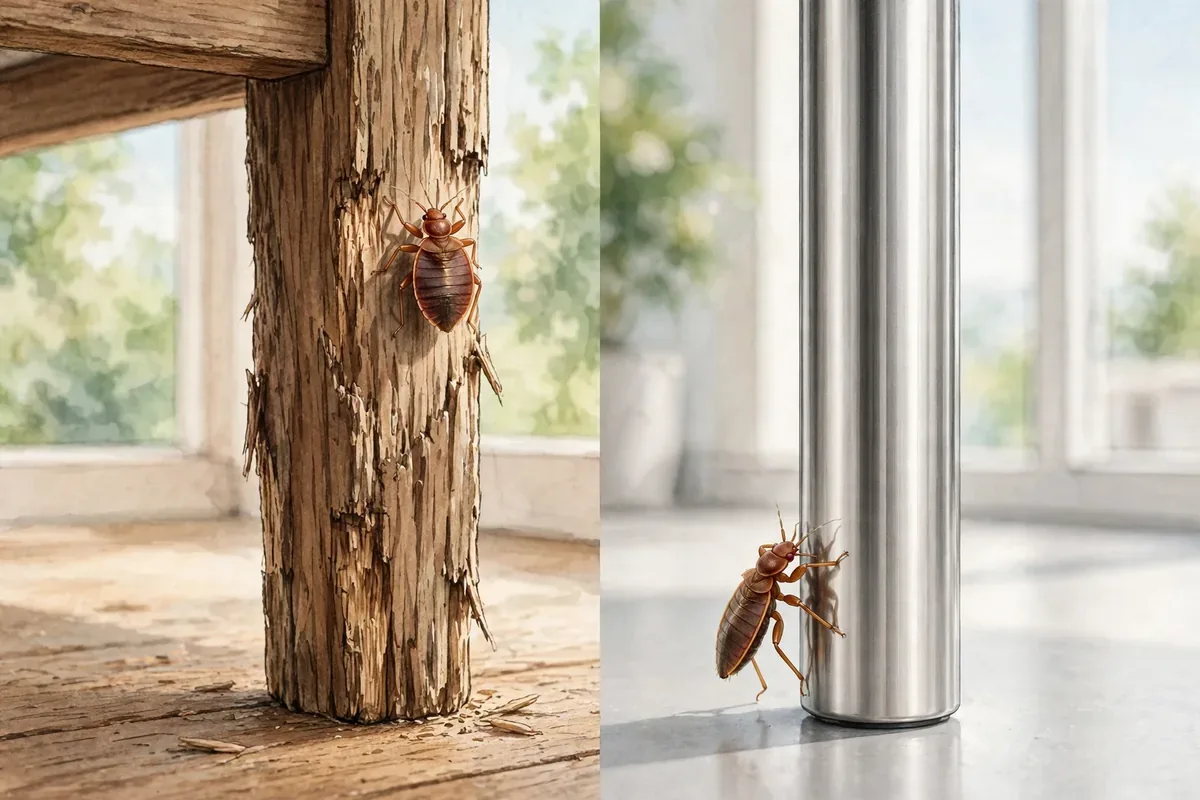
Bed bugs climb the way many small insects do: with grip. Each of their six legs ends in a pair of tiny claws, called tarsal claws, that catch on microscopic texture. On rough surfaces like unfinished wood, fabric, paper, and most painted drywall, those claws find plenty to hold. The bug essentially hauls itself upward, claw over claw, the same way a rock climber uses handholds. Their flat bodies keep their center of gravity close to the surface, which helps on vertical climbs, and their relatively light weight means the grip of those tiny claws is more than enough.
Texture is the deciding factor. The rougher the surface at a microscopic level, the easier the climb. That is why bed bugs favor fabric and wood for harborages: mattress seams, wooden bed frames, wicker furniture, and upholstered headboards all offer excellent grip. It is also why they travel along baseboards, carpet edges, and the texture of standard interior paint without difficulty. From the bug’s perspective, your bedroom wall is not a smooth cliff. It is a climbing wall full of handholds.
Speed matters too, because it shapes what you can expect. At roughly a meter per minute under laboratory conditions, a bed bug is not winning any races, but it does not need to. It travels at night, in the dark, while you sleep. A bug harboring in a baseboard crack three meters from your pillow has plenty of time to make the trip, feed, and return before dawn. This slow, steady, nocturnal travel is exactly why infestations can grow for weeks before anyone notices a single bite.
One honest caveat: while climbing walls is well documented, claims about bed bugs deliberately dropping from ceilings onto sleepers are harder to pin down. Entomologists do find bed bugs harboring in ceilings and crown molding, and bugs certainly can fall or crawl down from above. Whether ceiling-dropping is a deliberate hunting strategy or just incidental movement is not firmly established in the research. What is established is that a bug found on the ceiling is a real bed bug behaving normally, and it got up there by climbing.
Surfaces That Give Bed Bugs Trouble: Smooth Metal and Glass
If rough surfaces are a climbing wall, smooth surfaces are a sheet of ice. Bed bug claws need texture to grip, and on very smooth materials like polished metal, glass, and glossy hard plastic, there is almost nothing to catch. The bugs slip, struggle, and generally cannot make progress. This is not a folk remedy claim. It is the same principle behind bed bug interceptor traps, which are built around it, and it is consistent with advice from university entomologists.
Michael Potter, a University of Kentucky entomologist who researches bed bugs, has described keeping his suitcase zipped on a metal luggage rack when traveling, precisely because bed bugs have a hard time climbing smooth metal. That single habit captures the whole principle: deny them texture and you deny them the route. It is also why bed bugs tend to hide in fabric and wood rather than metal or plastic, as extension specialists note. Given a choice of harborage, they pick the surfaces their claws can use.
This matters for your defenses in a few concrete ways. A bed with a smooth metal frame is harder for bed bugs to climb than a wooden one, though it is not a guarantee on its own. Interceptor traps placed under bed legs work because their inner walls are smooth and slippery: the bug climbs the textured outer wall, falls into the pit, and cannot climb back out. Pulling the bed away from the wall and keeping bedding off the floor removes the textured bridges that would otherwise let bugs bypass the smooth barriers. None of this eliminates an infestation by itself, but it stacks the physics in your favor.
There is an important nuance, though. “Struggle with smooth surfaces” is not the same as “cannot ever cross smooth surfaces.” A published study in PLOS ONE found that bed bugs, particularly newly molted adults, could sometimes climb smooth glass, and warned that products designed around the assumption that bed bugs cannot climb smooth surfaces may not be entirely effective. Dust, wear, or a slightly textured finish can also give a smooth surface enough grip for a determined bug. Treat smooth barriers as strong friction, not as force fields.
The Tropical Bed Bug Exception
Most of the bed bug climbing research and most US infestations involve the common bed bug, Cimex lectularius. But there is a second species worth knowing about: the tropical bed bug, Cimex hemipterus. It is spreading in warmer regions, including parts of the southern United States, and it brings a climbing upgrade.
Research on interceptor traps has shown that the tropical bed bug is notably better at escaping them than the common bed bug. The difference comes down to the fine structure of their feet and the hairs on their legs, which give Cimex hemipterus better purchase on slippery surfaces. In practical terms, a smooth-walled trap that reliably holds common bed bugs may not hold tropical ones. Pest management sources note that interceptors can be less effective where the tropical species is present.
This does not change the core advice, but it adds a caveat for people in warmer climates, particularly Florida, Texas, and the Gulf states where the tropical bed bug has been documented. If you are using interceptor traps as monitors and catching nothing while bites continue, the species in your home is one of several possible explanations worth raising with a pest professional. Identification matters: your county extension office can often identify a specimen from a clear photo, and a professional can adjust the strategy to the species they are actually dealing with.
How Climbing Helps Them Move Between Apartments
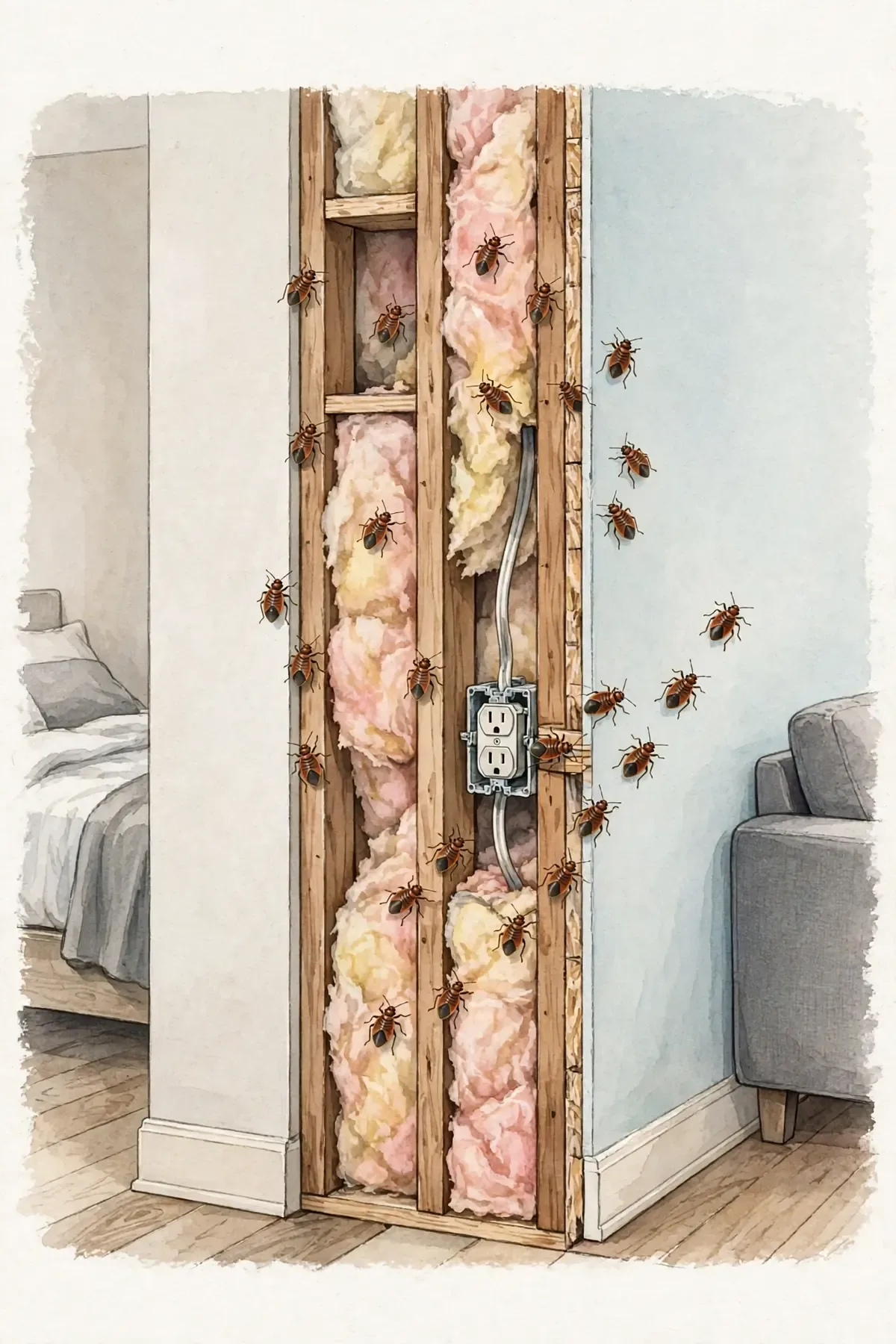
Climbing ability becomes a building-wide problem in multi-unit housing. Bed bugs do not chew through solid drywall, but they do not need to. Apartment buildings are full of ready-made routes: the gaps around electrical outlets and light switches on shared walls, the openings where plumbing and cables pass through, cracks in baseboards, and the hollow wall voids behind the drywall itself. Bed bugs crawl through these openings into the wall void and from there into the units beside, above, or below. Health Canada lists electrical outlets among the places bed bugs hide, and researchers have found them inside outlets in apartment buildings.
Doors and hallways are routes too. Studies in apartment buildings have found bed bugs regularly leaving infested units through the entry door into the hallway, with some crossing the hall into other apartments. A single pregnant female can start a whole new infestation, and pest control sources note that under good conditions a population can double roughly every 16 days. What begins as one unit’s problem can become a building-wide issue in a matter of months if neighboring units are not inspected and addressed.
This is also why partial or do-it-yourself treatments can backfire. General-use sprays and bug bombs can scatter bed bugs deeper into wall voids and push them into adjacent units instead of eliminating them, a pattern researchers have documented. The standard professional recommendation is to inspect the units surrounding an infested apartment, not just the one that reported the problem, and to coordinate treatment across affected units. If you rent, this is a landlord conversation: report suspected bed bugs in writing, ask for inspection of adjacent units, and do not try to solve a building-wide problem from inside a single apartment.
Sealing helps at the margins. Tightening outlet cover plates on shared walls, sealing gaps around pipes with caulk, and keeping door frames in good repair reduce the number of routes, though they will not stop a determined population on their own. Think of sealing as slowing the spread while the real solution, professional coordinated treatment, is arranged.
What Their Climbing Ability Means for Your Defenses
Knowing that bed bugs climb freely changes how you set up monitoring and how you interpret what you find. The goal of most home-level defenses is not to kill the population. It is to detect it early, slow its access to you, and get a professional involved while the problem is still small.
Interceptor traps: monitors, not solutions
Interceptor traps are the most useful home tool, and now you understand why they work: they exploit the texture rule. The textured outer wall is easy to climb; the smooth inner walls of the pit are not. Placed under every leg of the bed and upholstered furniture, they act as passive monitors, catching bugs traveling to or from the furniture. They work best when the bed is truly isolated: pulled away from the wall, with no bedding touching the floor and no clutter bridging the gap. Check them regularly. A bug in the outer ring was traveling from the floor toward the furniture; a bug in the inner ring was traveling from the furniture down. Either way, a caught bug is information, not a solution.
Isolation: remove the textured bridges
Isolation is the companion strategy. Keep luggage on metal racks rather than on the bed or floor when traveling, and inspect hotel mattress seams and box springs on arrival. At home, reduce the textured bridges: bedding that puddles on the floor and a bed pushed against the wall are invitations. These steps do not replace treatment, but they make monitoring honest. If interceptors stay empty for weeks and bites stop, that is meaningful data for your pest professional. If they keep filling, that is meaningful data too.
When monitoring says yes: call a professional
When monitoring says you have bed bugs, the next step is a licensed pest management professional, not a home remedy plan. This article deliberately gives no pesticide or heat-treatment instructions: misapplied products scatter bed bugs into wall voids and neighboring units, making professional treatment harder and more expensive. A professional will identify the species, map the harborages, and coordinate treatment, including adjacent units in multi-unit buildings. Your job is early detection and honest monitoring. Theirs is elimination.
Can Bed Bugs Climb It? A Surface-by-Surface Guide
Surface
Can they climb it?
Why
Painted drywall and wallpaper
Yes
Microscopic texture gives claws plenty of grip
Wood (bed frames, baseboards, furniture)
Yes, easily
Rough grain is ideal climbing texture and preferred harborage
Fabric and upholstery
Yes, easily
Woven fibers are perfect grip; also where they prefer to hide
Carpet and carpet edges
Yes
Fibers provide continuous handholds
Brick and concrete
Yes
Rough, porous surfaces are easy climbing
Ceilings and crown molding
Yes
Reached by climbing walls; documented harborage sites
Smooth polished metal
Poorly
Almost no texture for claws; the basis of the luggage-rack trick
Glass
Poorly, with exceptions
Very smooth, but studies show some bed bugs can occasionally manage it
Glossy hard plastic (interceptor inner walls)
Poorly
Smooth pitfall walls trap common bed bugs; tropical bed bugs escape more often
Taped or dusty smooth surfaces
Sometimes
Dust, wear, or texture can add just enough grip
The pattern is simple: the rougher the surface, the surer the climb. When you are setting up defenses, you are really just managing texture.
When to See a Doctor About Bed Bug Bites
The CDC states that bed bugs are not known to spread diseases to people. That is genuinely reassuring, and it is one of the few comforting facts in this topic. But bites can still cause problems worth a clinician’s attention:
Intense itching leads to heavy scratching and the skin breaks open, raising the risk of a secondary skin infection
Bite areas show signs of infection: spreading redness, warmth, swelling, increasing pain, or pus
You develop hives, swelling beyond the bite sites, trouble breathing, or other signs of an allergic reaction (seek urgent care for breathing difficulty)
Bites are numerous, blistering, or not improving after a week or two of basic care
Sleep loss and anxiety from the infestation are significantly affecting your daily life; this is a legitimate health impact and worth discussing
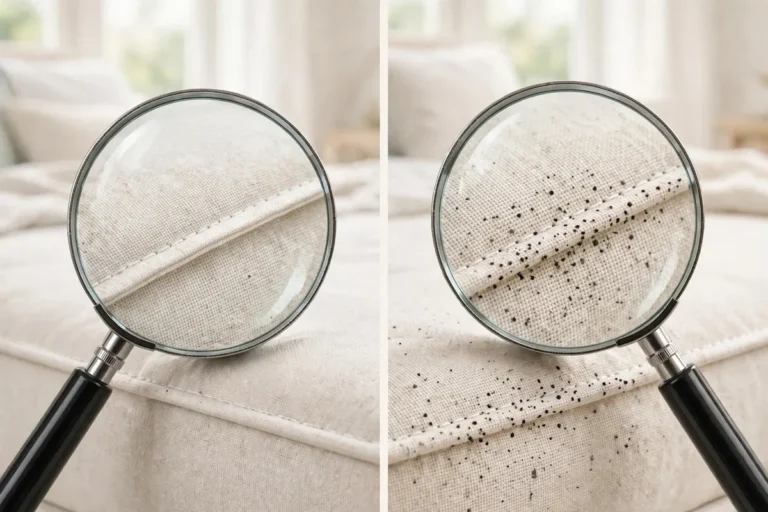
If you suspect the bites might be from something else, our guide on whether bed bugs can bite through clothes covers how exposure happens, and bed bugs on public transit explains another common travel route. Never try to diagnose an infestation from bites alone; bites resemble mosquito or flea bites, and confirmation requires finding the bugs or their signs.
Frequently Asked Questions
Can bed bugs climb walls to get to the ceiling?
Yes. Bed bugs routinely climb walls, baseboards, and bed frames, and they are found harboring in ceilings and crown molding. They reach the ceiling by climbing the wall, using their tarsal claws to grip the wall’s texture. A bed bug on your ceiling is behaving normally, not displaying unusual abilities.
Does this mean bed bugs can drop from the ceiling onto me?
They can end up on you from above, since bugs harboring in ceilings can crawl down or fall. Whether ceiling-dropping is a deliberate hunting strategy is not firmly established in the research. What is well established is that they climb up there easily and that isolating your bed, keeping it away from walls with bedding off the floor, removes the easy routes regardless of which direction they travel.
Can bed bugs climb smooth surfaces like glass or metal?
Poorly, in most cases. Their claws need microscopic texture to grip, so polished metal, glass, and glossy plastic defeat most climbing attempts. This is the principle behind interceptor traps and the luggage-rack travel habit. However, research has shown that some bed bugs, especially newly molted adults, can occasionally climb smooth glass, and the tropical bed bug species escapes smooth traps more readily. Treat smooth barriers as strong deterrents, not guarantees.
How do bed bugs get from one apartment to another?
Mainly through gaps rather than through solid walls. They crawl through openings around electrical outlets and light switches on shared walls, gaps where pipes and cables pass through, cracks in baseboards, and hollow wall voids, reaching the units beside, above, or below. They also travel under entry doors into hallways and hitchhike on clothing, bags, and used furniture. This is why professionals recommend inspecting adjacent units, not just the one that reported the problem.
If bed bugs climb so well, do interceptor traps actually work?
They work as monitors, which is their real job. Interceptors exploit the texture rule: the rough outer wall is easy to climb and the smooth inner pit is hard to escape, so they passively catch bugs traveling to or from furniture. Studies have found them more effective than visual inspection for detecting low-level activity. They do not eliminate an infestation on their own, and they are less reliable against the tropical bed bug species, but a trap that catches a bug has given you early warning, which is exactly what you need to get professional help while the problem is small.
This article is for informational purposes only and isn’t medical advice. If you’re worried about a bite or sting, talk to a healthcare professional.
SJ
Dr. Sarah Jones, MD
MD — Medical Reviewer · Board-Certified Emergency Medicine Physician
Dr. Jones oversees StingHelp’s clinical verification process. Every guide is systematically evaluated against active Centers for Disease Control and Prevention (CDC), Environmental Protection Agency (EPA), and American Academy of Allergy, Asthma & Immunology (AAAAI) medical consensus standards to ensure symptom distinctions and care recommendations are clinically sound.
How this guide was prepared: Researched and structured by the StingHelp Editorial Team; verified against peer-reviewed dermatology literature; clinically reviewed November 2026.
RELATED CLINICAL GUIDES
More StingHelp guides
Explore physician-reviewed first-aid procedures, identification clues, and symptom comparisons for other common outdoor bites and stings.
Bed bug treatment, measured: 20,000x deltamethrin resistance ratios, the 54.8 °C egg lethal temperature, fogger trial results and field elimination rates — every figure from a primary source.