Among all the DIY bed bug advice online, steam stands out because it actually works — with caveats. The direct answer to does steam kill bed bugs is yes: steam kills bed bugs and their eggs on direct contact, because sustained heat is lethal to every life stage. Research on thermal death points shows bed bugs die within 90 minutes at 113°F, within 20 minutes at 118°F, and in under a minute at 122°F — and steam from a cleaner’s nozzle is far hotter than that at the point of contact.
The catch is the word “contact.” Steam only kills what it actually reaches, at temperature, for long enough. Used correctly, it is one of the best non-chemical tools available. Used as a quick wave over a mattress, it accomplishes almost nothing. This guide covers the science, the technique, and the limits.
The Temperatures That Kill Bed Bugs and Eggs
Bed bugs are vulnerable to heat, but “heat” is a function of two variables: temperature and time. The landmark laboratory work by Kells and Goblirsch (2011, University of Minnesota) nailed down the numbers under controlled conditions:
- 113°F (45°C): adults die after about 90 minutes of sustained exposure. Eggs are far tougher — they survived around 7 hours at this temperature.
- 118°F (48°C): adults die within about 20 minutes; eggs need roughly 70 to 90 minutes for full mortality.
- 122°F (50°C): rapid mortality — under a minute for both adults and eggs.
These figures explain why professional whole-room heat treatments aim high (typically 130–140°F held for hours, with fans circulating the heat): lower temperatures demand exposure times that are impractical room-wide, while higher temperatures kill fast.
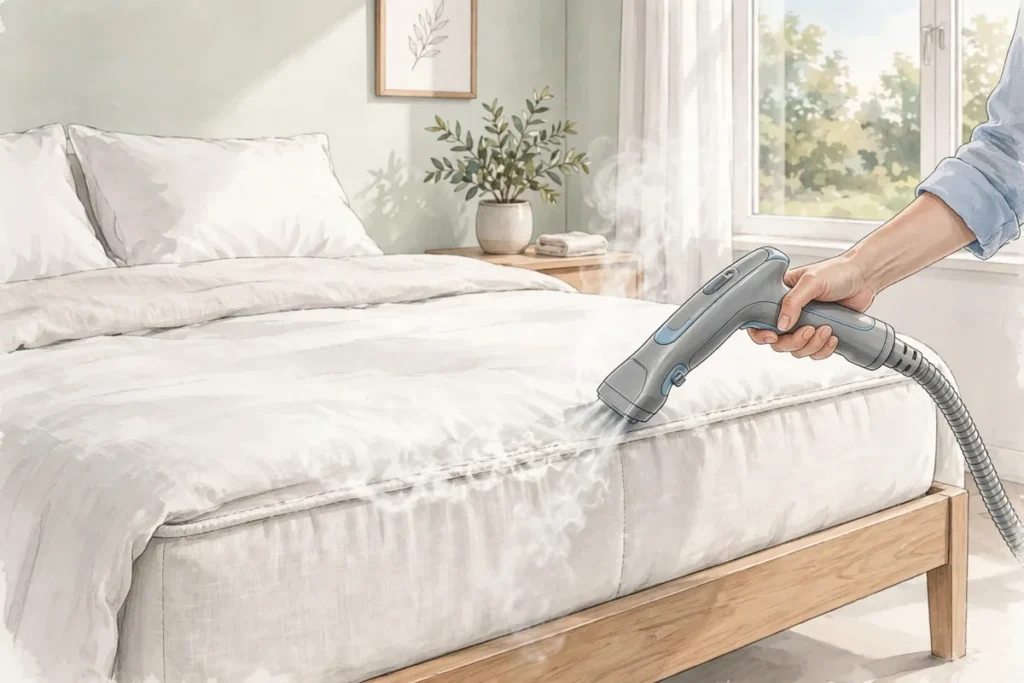
Steam changes the equation because it delivers heat far above those thresholds instantly. A steam cleaner’s nozzle typically produces steam at 200°F or more at the tip. The moment that steam contacts a bed bug or egg at close range, the lethal temperature-time requirement is satisfied in seconds. Virginia extension guidance summarizes the practical rule this way: keep the steam head in close contact with the surface, because heat dissipates rapidly as the head moves away. Distance is the enemy — a nozzle held six inches off the mattress is delivering warm air, not lethal steam.
The EPA’s bed bug guidance recognizes steam as a legitimate non-chemical control for treating fabrics, cracks, and crevices. It is not a folk remedy; it is established pest-management science.
Why Steam Works Where Sprays Fail
Steam has three advantages that explain its popularity with both professionals and serious DIYers.
First, it kills eggs. Most insecticides struggle with bed bug eggs, which is why chemical treatments typically require multiple visits spaced weeks apart. Steam’s heat penetrates and kills eggs on contact, breaking the hatch-and-reinfest cycle in the areas you treat thoroughly.
Second, it reaches harborages. Bed bugs hide in mattress seams, tufts, buttons, box spring edges, headboard joints, and baseboard cracks — places where sprays cannot always be applied safely or effectively. A steam nozzle with a crevice or upholstery attachment can drive heat directly into those hiding spots.
Third, it leaves no chemical residue. You can steam a mattress, pillows, upholstered furniture, and curtains, then sleep on them the same night. For people wary of pesticides — households with small children, pregnant people, or chemically sensitive individuals — steam offers a treatment option with no re-entry wait and no residue concerns.
The honest counterweight: steam has no residual effect. A sprayed surface keeps killing bugs that cross it for weeks; a steamed surface is safe for bugs again the moment it cools. That is why steam is a contact-kill tool, not a protective barrier — and why it works best as part of a combined approach.
How to Steam-Treat Correctly
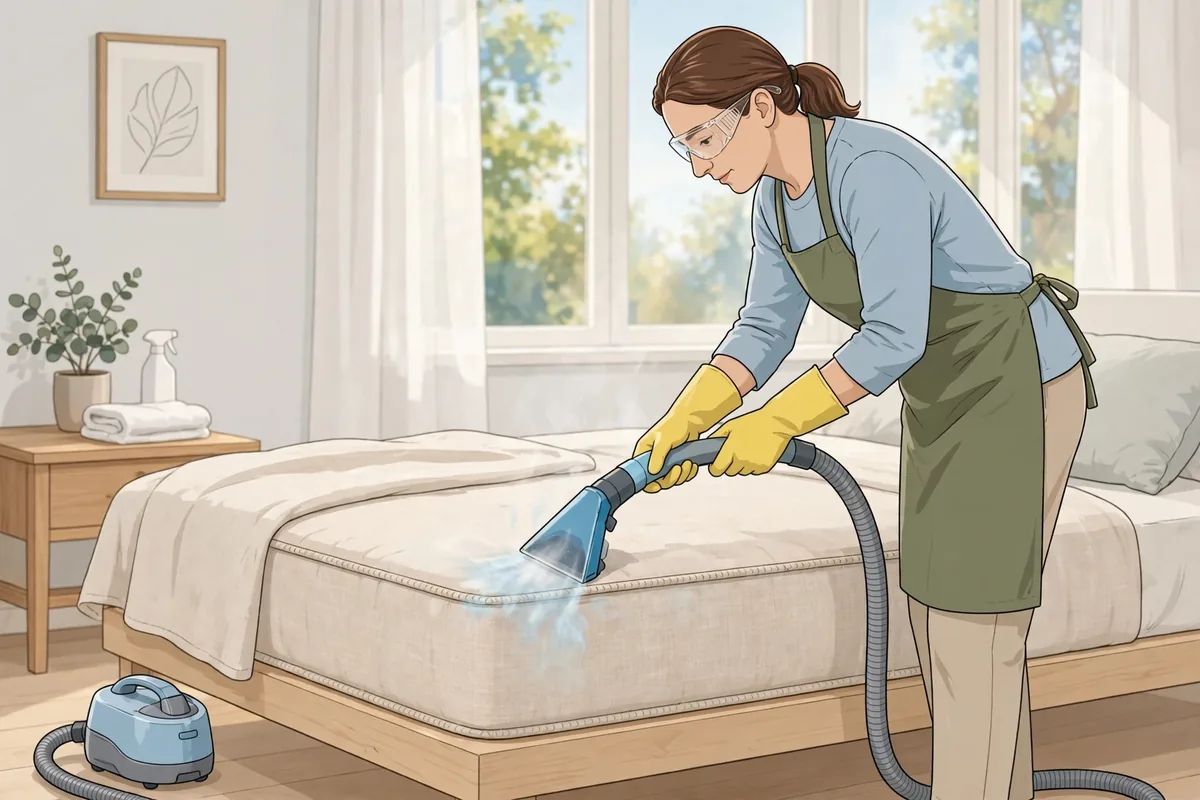
Technique is everything. A rushed pass with a garment steamer will not cut it. Here is the method pest professionals and extension services describe:
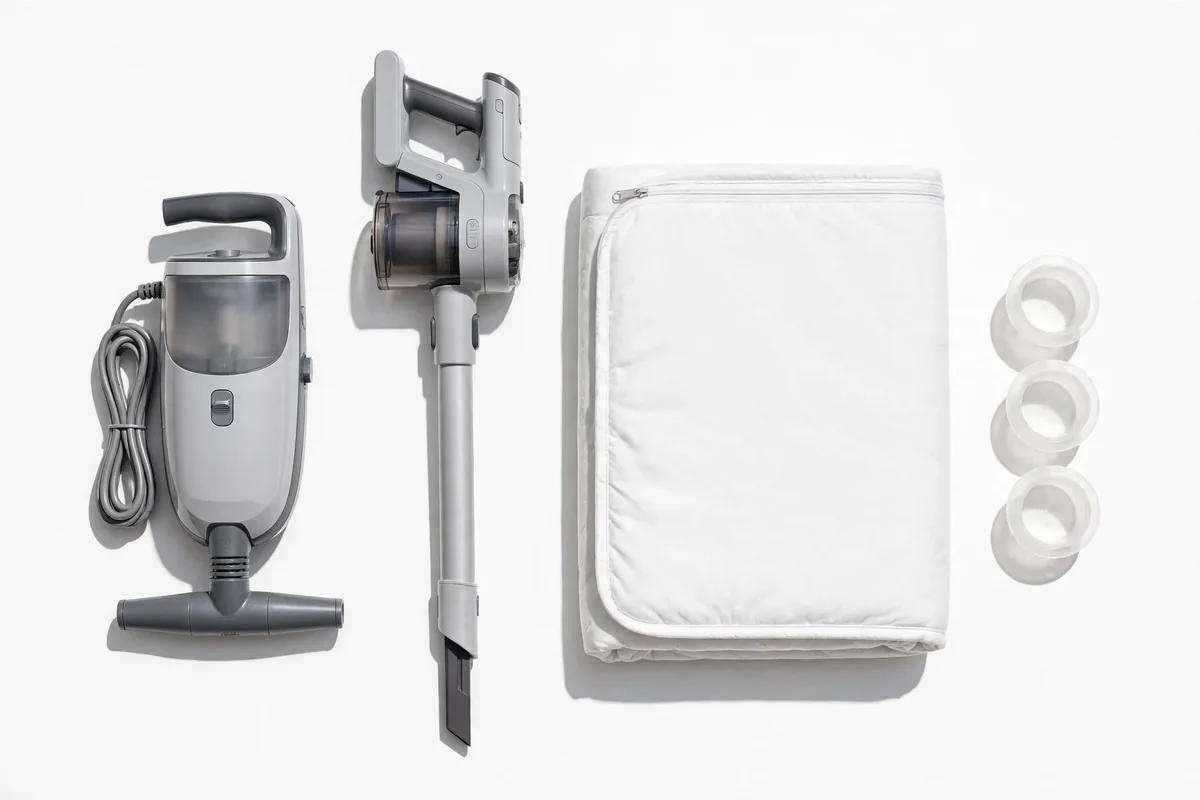
- Use a real steam cleaner, not a garment steamer. You need a unit that produces dry, high-temperature steam with adjustable output — ideally with upholstery and crevice attachments. Small handheld garment steamers often lack the sustained heat and pressure control needed.
- Vacuum first. Vacuum mattress seams, the box spring, bed frame joints, and baseboards with a crevice tool. This removes bugs, eggs, shed skins, and debris so steam reaches surfaces directly. Empty the vacuum into a sealed bag outdoors.
- Keep the nozzle in close contact. Hold the steam head about an inch from the surface — close enough that the steam hits at full temperature. Heat falls off fast with distance.
- Move slowly. Roughly a foot every 10 to 15 seconds along seams and cracks. Fast passes warm the surface without sustaining lethal temperatures underneath. Slow and steady wins.
- Work systematically. Mattress seams, tufts, and buttons; box spring edges and underside; bed frame joints and screw holes; headboard cracks; baseboards; the edges of upholstered furniture. Treat every harborage you can reach.
- Use low pressure or a diffuser. High-pressure steam can blow bugs and eggs out of harborages and scatter them to new hiding spots. A towel or diffuser attachment over the nozzle softens the blast while letting heat through.
- Let everything dry. Steamed mattresses and upholstery need airflow to dry fully — damp padding grows mold. Treat on a day you can ventilate the room.
Repeat the treatment. One thorough session kills what it contacts, but you will miss some harborages. Plan on re-treating every week or two, and monitor with interceptor traps between sessions to judge progress.
Where Steam Helps Most (and Where It Doesn’t)
Steam excels on: mattresses and box springs (seams, tufts, edges), upholstered furniture, curtains and drapes, carpet edges and baseboards, luggage, and clutter items like books and shoes that cannot go in a dryer. It is also the go-to for items you cannot treat chemically — children’s car seats, pet bedding (check manufacturer guidance), and electronics-adjacent areas where sprays are inappropriate.
Do not steam: electrical outlets, switches, and electronics (water and electricity are a dangerous combination, and steam can damage devices); leather, suede, and silk, which heat and moisture can ruin; waxed or polished wood furniture, which steam can cloud or strip; and freshly painted or wallpapered surfaces. Pest trade guidance specifically flags leather, suede, silk, and waxed/polished wood as damage risks — test an inconspicuous spot first whenever you are unsure.
Also understand steam’s blind spots. It cannot reach inside wall voids, behind heavy fixed furniture you cannot move, or deep inside cluttered storage. If bed bugs are established inside walls or spreading between apartment units, steaming the bedroom treats the symptoms while the source persists — that is a professional-treatment situation.
Steamers: What to Look For, What to Skip

If you are buying a steamer specifically for bed bugs, prioritize function over marketing. Look for: continuous-fill or large tank capacity (you do not want to stop every ten minutes), adjustable steam output with a low-pressure setting, a range of attachments including a crevice tool and upholstery/triangle head, and a dry-steam output — wetter steam soaks fabrics without adding killing power.
Skip: garment steamers and wallpaper steamers marketed as bed bug solutions (wrong tool, wrong attachments, often insufficient sustained heat), and any device promising to “eliminate infestations” by itself. No steamer eliminates an infestation alone — the limitation is coverage, not the machine.
Cost-wise, a capable canister steam cleaner runs roughly in the low hundreds of dollars — comparable to a single professional treatment visit in many markets, and reusable. For a light, early infestation caught quickly, a steamer plus diligent technique plus monitoring can genuinely resolve the problem. For heavy or widespread infestations, the steamer becomes a supplement to professional treatment rather than a replacement.
Steam as Part of a Bigger Plan
The most effective bed bug strategies layer multiple methods — what professionals call integrated pest management. Steam slots in as the contact-kill and egg-kill component:
- Encase mattresses and box springs in bed-bug-proof encasements after steaming them — this traps any survivors inside and makes future inspection easy.
- Isolate the bed: interceptors under every leg, bedding off the floor, bed away from the wall. This both monitors progress and cuts the bugs’ access to you.
- Heat-treat what you can: dryers on high heat for 30 minutes kill all life stages in clothing and bedding — the simplest heat treatment there is. (Bed bugs can bite through thin clothing, so treat everything you wore, not just bedding.)
- Declutter ruthlessly around sleeping areas. Every box and pile is harborage that steam cannot fully reach.
- Call a professional if monitoring shows the problem is not shrinking after several weeks of diligent effort, or if bugs are appearing in multiple rooms. There is no shame in it — bed bugs are among the hardest household pests to eliminate, and pros have tools (including whole-room heat) that homeowners cannot replicate.
Keep monitoring with interceptors for several months after the last sign of bugs. Bed bugs can survive weeks without feeding, so a quiet month is encouraging, not conclusive. Build the habits that keep them from returning — luggage protocols, secondhand furniture inspection, and early-detection routines.
When to See a Doctor for a Bug Bite
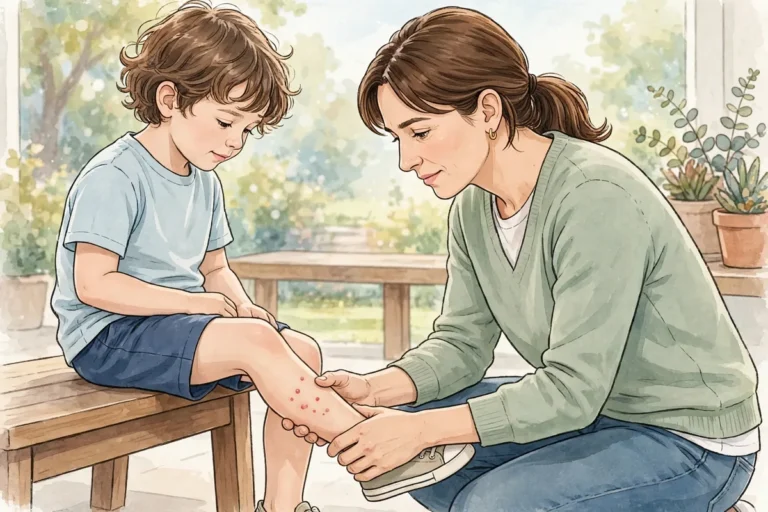
Steam treatment is about the bugs, not the bites — but if you are steaming, you have probably been bitten. Bed bugs are not known to transmit diseases. See a doctor if:
- Bite marks show infection signs: spreading redness, increasing warmth, worsening swelling after several days, pus, or red streaks (possible cellulitis from scratching).
- You develop a severe or widespread rash, blistering, or intense swelling beyond the bite sites.
- Broken, scratched skin is not healing.
- You are unsure the marks are bed bug bites at all — small red bumps in lines or clusters are the classic pattern, but a clinician can rule out lookalikes like scabies or folliculitis. If a bite looks like it may be getting infected, see bug bite infection warning signs.
Severe allergic symptoms after any insect encounter — trouble breathing, throat swelling, dizziness — are a 911 emergency.
Frequently Asked Questions
Does steam kill bed bug eggs, or just live bugs?
Both. This is one of steam’s biggest advantages: at close range, steam temperatures far exceed the ~122°F threshold at which eggs die in under a minute. Most insecticides struggle with eggs, which is why steam is valued as the egg-killing component of a treatment plan.
How close should the steamer nozzle be to the surface?
About an inch. Heat dissipates extremely fast as the nozzle moves away from the surface, so a hovering pass delivers far less killing power than most people assume. Keep the head in close contact and move slowly — roughly a foot every 10 to 15 seconds.
Can I use a clothes steamer for bed bugs?
Not effectively. Garment steamers are designed to relax wrinkles, not to sustain the high, dry heat needed to kill bugs in cracks and seams, and they lack the right attachments. Use a canister steam cleaner with adjustable output and upholstery/crevice tools.
Will one steam treatment get rid of bed bugs?
Almost certainly not. One thorough session kills everything it contacts, but you will miss harborages — inside the box spring, behind the headboard, in wall-adjacent cracks. Plan on repeated treatments every week or two, combined with encasements, bed isolation, and monitoring, and reassess after several weeks.
Is steam safe to use around kids and pets?
The steam itself leaves no chemical residue, which is a plus. But the nozzle and freshly steamed surfaces are burn hazards — keep children and pets out of the room during treatment and until surfaces cool. Never steam electrical outlets or electronics, and keep people and pets off treated carpet until it is fully dry.
Medical review pending: this article has not yet completed qualified human medical review and should not be published until it does.
This article is for informational purposes only and isn’t medical advice. If you’re worried about a bite or sting, talk to a healthcare professional.