Every spring, the North Woods stage one of nature’s great bait-and-switches. The snow melts, the trails dry out, the black flies hatch by the billions — and the year’s best hiking weather arrives wrapped in a cloud of tiny, biting insects. Locals in the Adirondacks call it the fifth season. If you’re planning a spring trip to the Adirondacks, the White Mountains, Maine’s woods, or the Upper Peninsula, understanding black fly season is the difference between a glorious trip and a miserable one. If you found this page by searching black fly season Adirondacks spring hikers, you’re asking exactly the right question.
This guide covers when black fly season hits, why these particular woods breed such legendary swarms, the gear that actually works, and how to treat bites when prevention falls short. Plan well, and spring in the North Woods is absolutely worth it.
When Is Black Fly Season, Exactly?
Black fly season in the northern forest runs roughly from mid-May through mid-July, with the worst of it concentrated in a brutal 4-to-6-week window. The local shorthand in the Adirondacks is “Mother’s Day to Father’s Day” — black flies become a serious problem around Mother’s Day in May and typically fade by Father’s Day in late June, though in cool, wet years they can linger into early July.
The peak is usually the weeks around Memorial Day through mid-June. This is the period when some Adirondack inns have historically just closed up for a few weeks, when golf courses go quiet, and when even lifelong locals plan indoor projects. A 1993 Philadelphia Inquirer feature memorably called the black fly the “bloodsucking scourge of the Adirondacks,” describing a season that arrives in late May and lasts up to a month, shaping everything from tourism to gardening schedules. Three decades later, the timing hasn’t changed.
Year-to-year variation is real. A warm, early spring can push the season forward; a cold, wet spring delays it and can stretch it out. Elevation matters too — black flies emerge earlier in the valleys and later at higher elevations, so a June hike that starts buggy at the trailhead may improve (or worsen) as you climb. If your dates are flexible and bugs are a dealbreaker, the single most reliable advice from experienced North Woods hikers is simple: come in August or September instead. By late summer, black flies are essentially gone, replaced by far more manageable mosquitoes.
Why the North Woods Breed Legendary Swarms

Black flies (family Simuliidae) need exactly what the North Woods provide in abundance: clean, fast-moving water. Females lay their eggs in rushing streams and rivers, and the larvae develop attached to rocks in the current, filtering food from the flow. The Adirondacks’ thousands of miles of cold, clear streams, the White Mountains’ steep brooks, and Maine’s river systems are ideal nurseries.
When spring runoff peaks, entire stream systems hatch simultaneously, producing the famous swarms. Adult black flies are small — just a few millimeters — but they compensate with numbers and aggression. Unlike mosquitoes, which pierce the skin with a needle-like proboscis, black flies cut the skin with blade-like mouthparts and lap up the blood, which is why their bites hurt out of proportion to the insect’s size and tend to bleed slightly.
Black flies are daytime biters, worst in calm, humid conditions — the still air of a sheltered forest trail on a warm June morning is their ideal hunting ground. They’re less active in wind, in direct hot sun, and after dark. They target the head and neck especially: ears, hairline, the back of the neck, and around the eyes. Anyone who’s hiked the North Woods in June knows the particular misery of black flies orbiting your head for hours.
One more thing worth knowing: black flies in North America are primarily a pain-and-itch problem, not a disease threat to people. (In parts of Africa and Latin America, certain black fly species transmit the parasite that causes river blindness — but that’s a different species complex in a different hemisphere, not something Adirondack hikers need to worry about.)
The Gear That Actually Works
Veteran North Woods hikers have strong opinions about black fly defense, and the consensus is refreshingly practical:
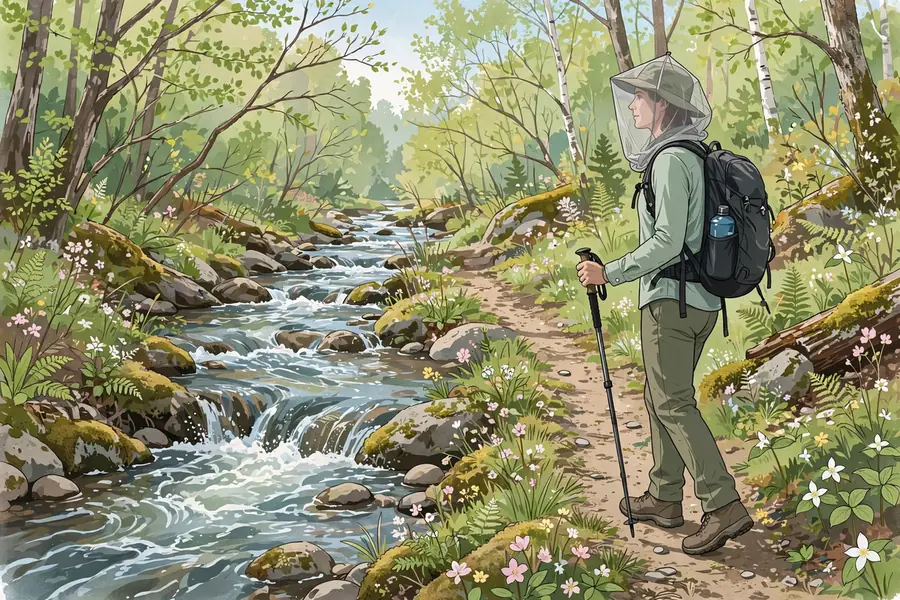
- A head net is non-negotiable. This is the single highest-value item. A lightweight head net worn over a hat keeps flies off your face, ears, and neck — their favorite targets — for a few dollars and a few ounces. Hikers who own one wonder how they ever went without it.
- Cover your skin. Long sleeves and long pants in lightweight, breathable fabric. Light colors are better — biting flies of many kinds are attracted to dark colors. Tuck pants into socks in the worst conditions.
- EPA-registered repellent on exposed skin. DEET and picaridin both work against black flies. Apply to exposed skin, including often-missed spots: the back of the neck along the hairline, behind the ears, and around the ankles.
- Permethrin-treated clothing. Treating your hiking clothes with permethrin (applied to fabric, never skin) adds a strong layer of defense that lasts through several washes. It’s one of the most effective tools against biting flies generally.
- Choose your timing and route. Hike in breezy, exposed areas when you can; avoid still, humid hollows and stream banks during peak hours. Black flies ease off in wind and strong sun.
- Bring a backup plan for camp. A screened dining shelter or tent with good mesh turns a buggy evening into a pleasant one. Camp away from fast water if you have the choice.
What doesn’t work as well as people hope: citronella candles and wristbands (limited evidence against determined biters), and bug zappers (they kill mostly harmless insects, not the flies biting you). Spend the money on the head net and the permethrin instead.
Planning Your Trip Around the Flies

Practical trip-planning advice for black fly season:
- Check recent trail reports. Hiking forums and regional message boards carry real-time black fly reports every spring — hikers post exactly how bad the flies are on specific trails, which beats any calendar prediction.
- Book refundable or flexible lodging. If you’re traveling specifically to hike, having the option to shift dates by a week or two can dodge the worst of a late or extended season.
- Plan high and windy. Exposed ridgelines and summits are consistently less buggy than sheltered valleys and stream corridors. Plan routes that spend midday on open ridges.
- Start early, but know the tradeoff. Black flies build through the morning; very early starts can beat the worst of them, but dawn also brings mosquitoes. There’s no perfect hour — just less-bad ones.
- Warn your group. If you’re bringing first-timers or kids, set expectations honestly and pack kid-safe repellents in appropriate concentrations. A prepared group laughs about the head nets; an unprepared group cuts the trip short.
- Pack a real first-aid kit. However well you prepare, you’ll get bitten. Include antihistamines, hydrocortisone cream, and cold-compress supplies, plus basics for blisters and sprains — a stocked first-aid kit is non-negotiable in June.
Treating Black Fly Bites on the Trail
Black fly bites are small but disproportionately annoying: they itch intensely, swell into firm red bumps, and the tiny cut can bleed or weep slightly at first. Here’s the trail-tested treatment sequence:
- Don’t scratch. Black fly bites itch fiercely, but scratching breaks the skin and invites infection — and these bites are already tiny open cuts. Keep nails trimmed and consider covering the worst bites with a bandage.
- Cool it down. A cold compress, a cold stream (clean water), or even a cool wet bandana reduces swelling and numbs the itch. Fifteen minutes on, fifteen off.
- Calm the inflammation. Hydrocortisone cream or calamine lotion on the bites; an oral antihistamine if you’re dealing with many bites or a strong reaction.
- Keep them clean. Wash bites with soap and clean water, especially any that bled. On multi-day trips, re-clean daily — trail grime plus open bite wounds is how infections start.
- Watch for infection. Increasing redness, warmth, swelling that grows after a day or two, red streaks, pus, or fever mean a bite has become infected and needs medical attention — don’t wait until you’re home if you can reach an urgent care clinic.
Most black fly bites resolve within a few days to a week. Some people react more strongly, developing larger swollen welts — if that’s you, antihistamines early and consistently make a real difference.
When to See a Doctor for a Bug Bite

Black fly bites rarely need medical care, but see a clinician — or urgent care if you’re still traveling — when:
- Anaphylaxis signs (call 911): difficulty breathing, throat or facial swelling, dizziness, or hives spreading widely. Anyone can develop a severe reaction; know the anaphylaxis warning signs.
- Infection signs: spreading redness, red streaks, increasing warmth or pain, pus, or fever — likely cellulitis, which needs antibiotics.
- Black fly fever (rare): after very numerous bites, some people develop headache, fever, and swollen lymph nodes — sometimes called “black fly fever.” It usually resolves on its own but deserves medical evaluation.
- Eye involvement: bites very near the eye with significant swelling should be checked promptly.
- Bites that don’t improve: any bite still worsening after 48 hours or not healing after a week warrants a look.
Frequently Asked Questions
Are black flies worse than mosquitoes?
Different, not necessarily worse. Black fly bites hurt more at the moment and itch intensely, but black flies don’t transmit human diseases in North America, while mosquitoes can. Most North Woods hikers fear black fly season more simply because the swarms are so relentless during the day.
Can you build immunity to black fly bites?
Longtime residents often report reacting less over the years, and there’s some truth to it — repeated exposure can desensitize the immune response in some people. But it’s unreliable and partial; even old-timers wear head nets in June.
Do black flies bite at night?
Rarely. Black flies are daytime feeders, most active in calm, humid daylight hours. As evening falls, mosquitoes take over the biting shift. If you’re being eaten after dark in the North Woods, that’s mosquitoes, not black flies.
What’s the single best month for an Adirondack hiking trip?
September, by most hikers’ reckoning: black flies gone, mosquitoes fading, cooler temperatures, fewer crowds, and early fall color at elevation. August is excellent too. June has the longest days and the lushest trails — but also the flies.
Will a campfire keep black flies away?
Smoke helps somewhat — black flies dislike smoke and moving air — but a campfire is not a force field. It takes the edge off in the immediate vicinity; it won’t protect you on the trail or across the campsite. Pair it with repellent and covering up.
Medically reviewed by Dr. Sarah Jones, MD.
This article is for informational purposes only and isn’t medical advice. If you’re worried about a bite or sting, talk to a healthcare professional.