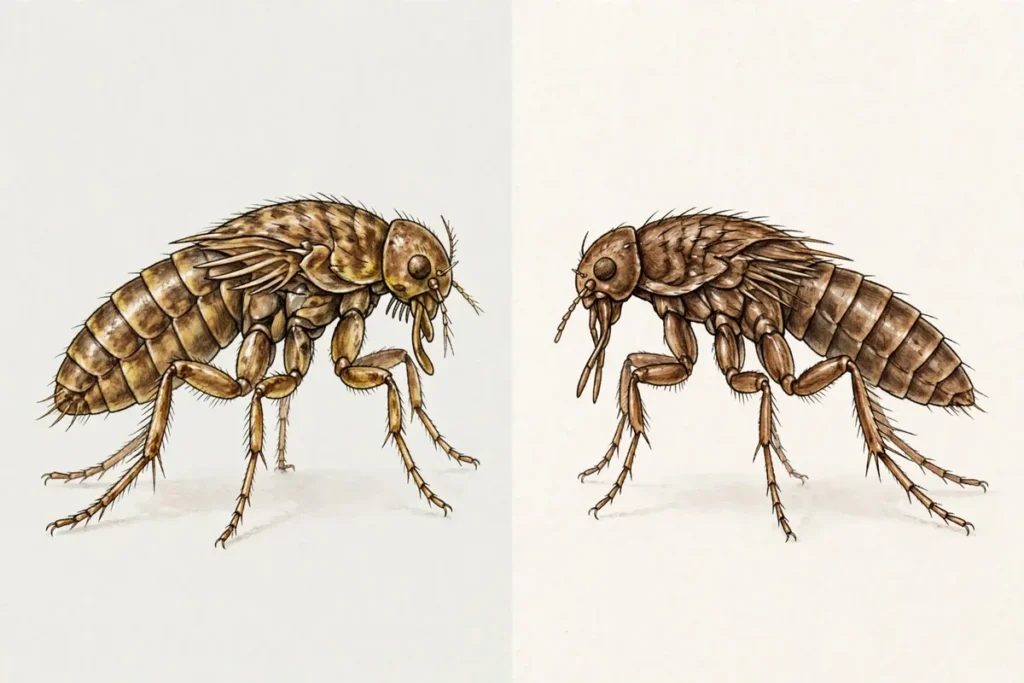
Here is a fact that surprises almost every dog owner: the fleas on your dog are probably cat fleas — Ctenocephalides felis. An epidemiologic survey found that 96% of fleas collected in the United States were cat fleas, and global research has shown the cat flea to be the most prevalent flea species found on domestic dogs worldwide. The dog flea, Ctenocephalides canis, exists — but in North America it is a bit player, more commonly encountered in Europe.
So what is the actual answer to cat flea vs dog flea? They are two distinct but closely related species that look nearly identical to the naked eye, can both infest both cats and dogs (and bite humans), and can only be reliably told apart under a microscope. The species matters less for how you kill them — flea control works the same — and more for understanding disease risks and having informed conversations with your veterinarian.
The Surprise Answer: Your Dog Probably Has Cat Fleas
The names are the source of the confusion. “Cat flea” and “dog flea” sound like strict host assignments — cats get one, dogs get the other. In reality, neither species is host-specific. Both will feed on dogs, cats, and other mammals, including foxes, rabbits, rodents, and humans.
What the names reflect is history and prevalence, not exclusivity. The cat flea (felis is Latin for cat, its principal described host) turned out to be the ultimate generalist: adaptable, thriving on many host species, and extraordinarily successful in the indoor environments where pets live. That is why it dominates — the 96% US survey figure matches what veterinarians see in practice.
The dog flea has a different stronghold. It predominates on dogs in parts of Europe — surveys have found it dominant on dogs in Ireland, Greece, Hungary, and Albania — and occurs worldwide at lower rates than the cat flea. One UK study found 93% of fleas on British dogs were cat fleas and only about 1.5% were dog fleas.
Meet the Two Species
The cat flea, Ctenocephalides felis felis. The most common domestic flea in the world. Adults are 1.5 to 2.5 mm long, reddish-brown, wingless, and laterally flattened — the classic flea shape built for navigating fur. Unlike some fleas that visit briefly to feed, adult cat fleas tend to remain on the host, feeding repeatedly; females need fresh blood meals to reproduce and can lay up to 50 eggs per day. Those eggs fall off into the environment — carpets, bedding, floor cracks — where they hatch into larvae feeding on organic debris (including the dried blood-rich feces of adult fleas, called “flea dirt”), then pupate. The pupal stage is the survivor: protected in a sticky cocoon, pupae can wait months for a passing host before emerging. This is why infestations are an environmental problem, not just a pet problem.
The dog flea, Ctenocephalides canis. Slightly smaller on average (around 1.5 to 2.0 mm), similarly reddish-brown, cosmopolitan but more common in Europe. It feeds on dogs and other mammals and follows the same basic life cycle — in behavior, reproduction, and habitat, the two species are near-twins.
Telling Them Apart: A Microscope’s Job
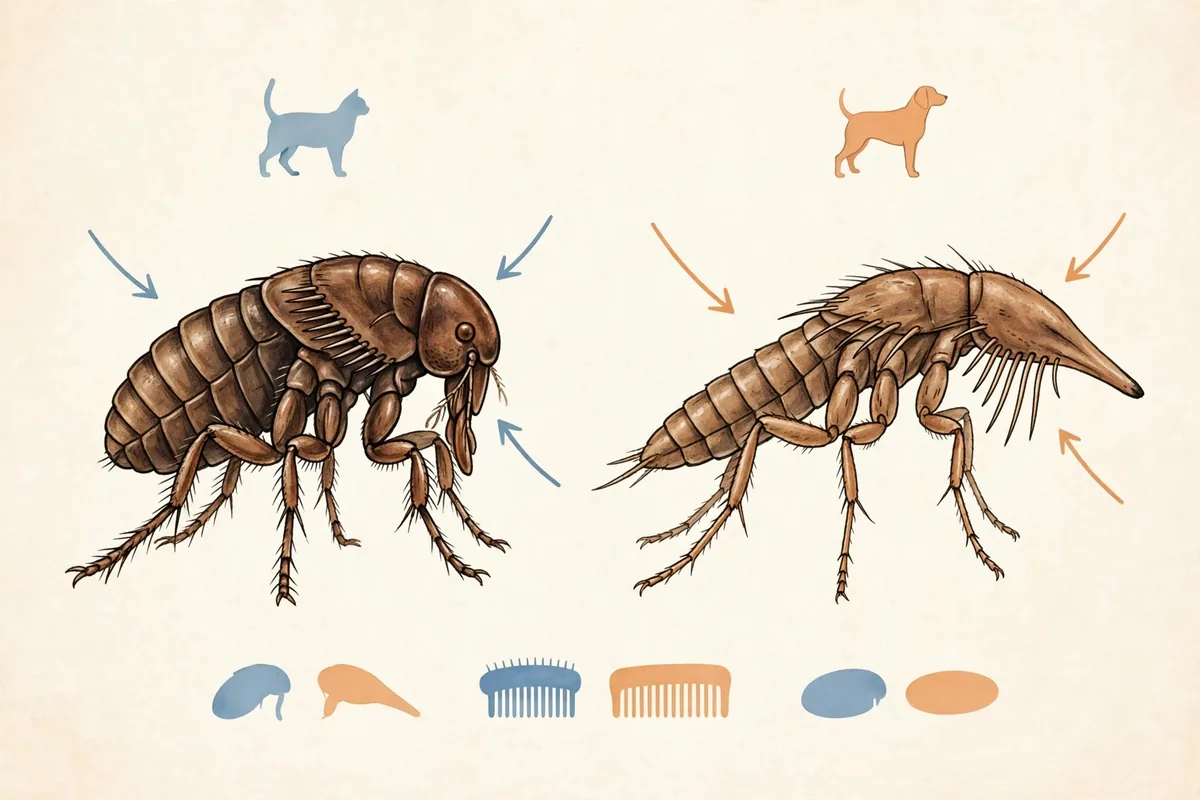
You cannot tell a cat flea from a dog flea with the naked eye, a phone camera, or a drugstore magnifying glass. Entomology references are unanimous: the differences are detectable only under high magnification. Anyone online claiming to identify the species from a blurry photo is guessing. Here is what specialists actually examine:
Head shape. The cat flea’s forehead is low and sloping; the dog flea’s head is more rounded at the front. This is the first character in most identification keys, and it is subtle.
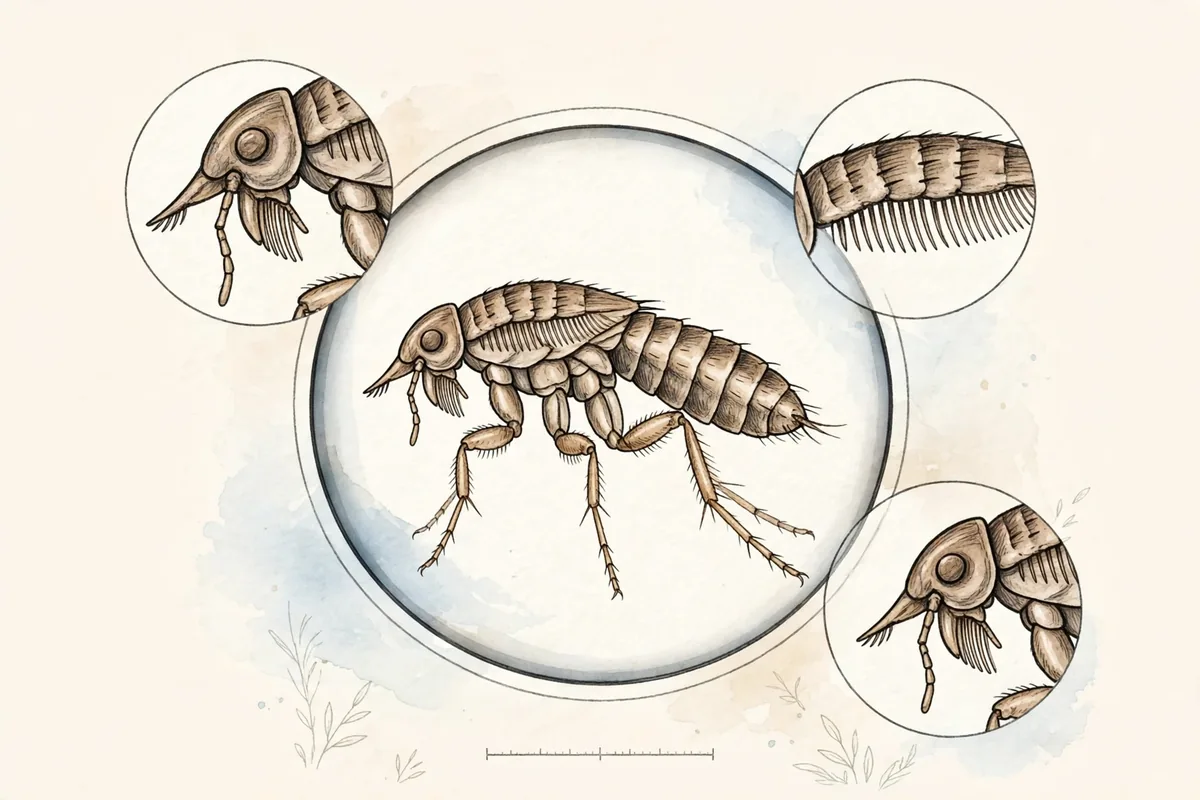
The genal comb. Both species carry combs of spines — the pronotal comb behind the head (like a mane) and the genal comb on the cheek (like a mustache). In the cat flea, the genal comb has 7 to 8 sharp teeth, with the first tooth about equal in length to the second. In the dog flea, the first genal spine is noticeably shorter than the rest of the row. Comb-tooth proportions are the most practical diagnostic character.
Hind-leg bristles. The number of notches on the dorsal hind tibia (six in the cat flea, eight in the dog flea) can confirm identification using published keys — a character for the specialist with a properly mounted specimen.
Researchers have noted that intermediate forms exist and the genus taxonomy remains unsettled in some respects. For pet owners, the message is simpler: do not try this at home. Identification belongs to a veterinarian or diagnostic lab — and for treatment purposes it rarely changes anything, since flea control works against both species identically.
Why the Species Actually Matters
If treatment is the same either way, why care which flea it is? Three reasons — all legitimate, none urgent for the average pet owner.
1. Disease transmission profiles differ. Both cat and dog fleas can transmit the common tapeworm Dipylidium caninum — pets become infected by swallowing an infected flea during grooming (look for rice-grain-like segments near your pet’s rear). Beyond that, the cat flea carries the heavier documented portfolio: Bartonella henselae (cat-scratch disease), Rickettsia felis (flea-borne spotted fever), and Rickettsia typhi (murine typhus — implicated in transmission in south Texas, California, and Hawaii). The cat flea’s broader host range and sheer abundance make it the more significant vector in practice.
2. It informs the conversation with your vet. When your veterinarian knows the infestation is C. felis, that frames discussions about preventive products, diseases to watch for, and whether tapeworm treatment is warranted. The species question also matters for multi-pet households: because cat fleas move happily between cats and dogs, finding fleas on the dog means the cat needs treatment too, and vice versa. Treating only the visibly affected animal is a classic reason flea problems persist.
3. It corrects a myth that affects behavior. Believing in strict host specificity (“my dog can’t get cat fleas”) leads people to skip treating the cat or blame the wrong source for reinfestation. The reality — one adaptable species infesting everything furry in the house — points to the correct strategy: treat all pets simultaneously and treat the environment.
For human health, the distinction matters little day to day: both species bite people, typically as small, itchy red papules clustered around the ankles and lower legs. Our bed bug vs flea bite comparison can help you work out which pest is doing the biting.
Flea Allergy Dermatitis: When Flea Saliva Becomes the Problem
For many pets, the worst part of an infestation is not the blood loss — it is the allergy. Flea allergy dermatitis (FAD) is a hypersensitivity reaction to proteins in flea saliva and one of the most common skin conditions veterinarians diagnose in dogs and cats. Both cat fleas and dog fleas can trigger it; the species of the biter does not change the condition.
The cruel arithmetic of FAD: severely allergic animals react to very few bites — a single bite can trigger days of intense itching, and the animal may show dramatic symptoms while the owner insists “but I hardly see any fleas.” In dogs, FAD classically affects the rear half — base of the tail, back legs, belly — with hair loss, redness, scabs, and thickened skin from chronic scratching. In cats, it often shows as tiny scabs around the neck and back, overgrooming, and patchy hair loss.
If your pet is scratching intensely, losing hair, or developing sores, see your veterinarian rather than just buying a flea product and hoping. FAD often needs more than flea control: vets may prescribe anti-itch therapy, treat secondary skin infections, and set up rigorous year-round prevention — because for an allergic animal, even occasional exposure restarts the cycle.
What to Do If Your Pet Has Fleas
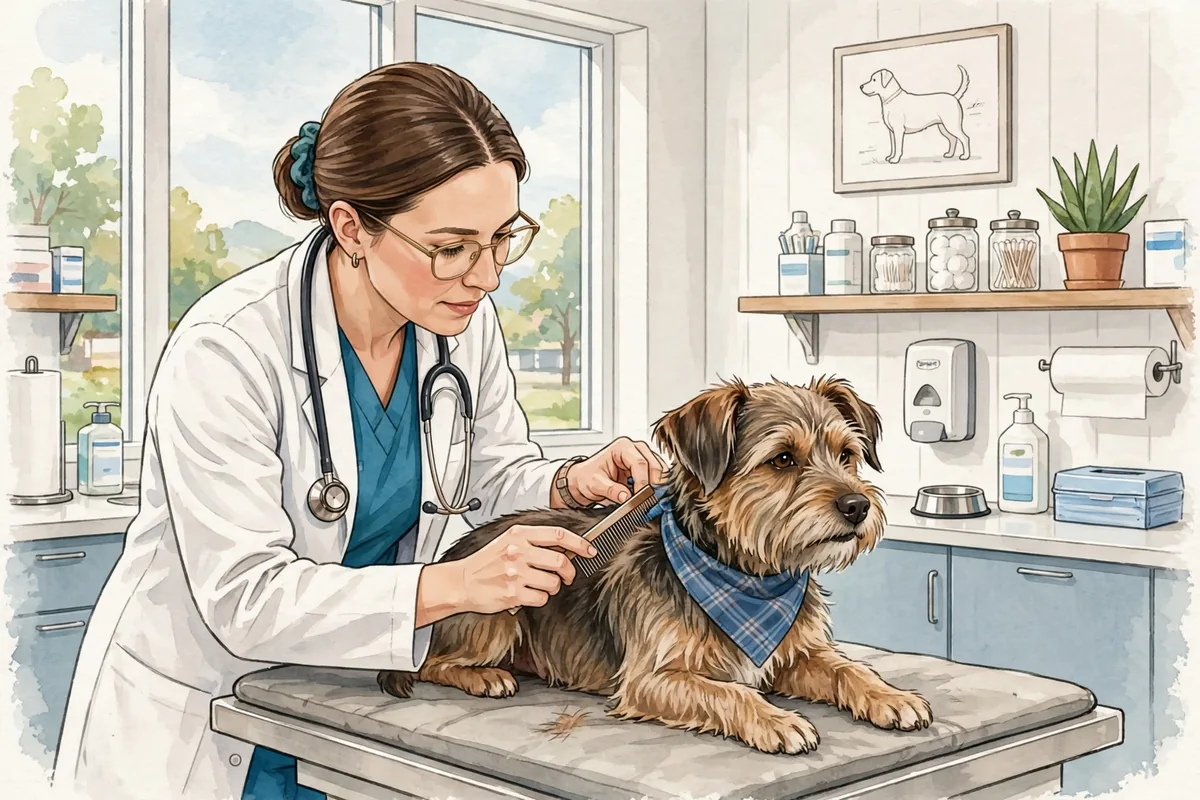
1. Confirm what you are seeing. Adult fleas are tiny, fast, and hard to catch. Easier evidence: “flea dirt” — black pepper-like specks in the fur that turn reddish-brown when wet (digested blood). A flea comb through the fur around the neck, tail base, and belly catches adults and dirt. Pair the pet check with a room-by-room inspection of the places fleas hide — pet bedding, carpets, upholstery, and floor cracks.
2. See your veterinarian. Your vet will confirm the infestation, check for tapeworms and skin disease, and recommend a preventive suited to your pet’s species, age, weight, and health. Never use dog flea products on cats — some canine topicals contain permethrin, which is toxic to cats — and never guess at dosing from internet charts.
3. Treat all pets, simultaneously. Because cat fleas infest every furry host in the home, treating only the itchy dog while the cat goes untreated guarantees reinfestation. Every dog and cat goes on prevention at the same time — usually year-round, since indoor pupae do not respect seasons.
4. Treat the environment. Most of the flea population is in your home, not on your pet. Vacuum thoroughly and often — carpets, upholstery, pet bedding, floor cracks — and empty the vacuum outside. Wash pet bedding and your bedding in hot water. For severe infestations, your vet or a pest professional can advise on environmental products — and if you consider diatomaceous earth, research its safety profile and follow product directions carefully first.
5. Be patient. The pupal stage resists nearly everything and can wait months — which is why infestations seem to “come back” weeks after treatment. Keep every pet on preventive without gaps; each emerging adult that feeds on a treated pet dies before reproducing, and the cycle winds down. Expect full resolution to take weeks to a few months, not days.
6. Prevent reintroduction. After the infestation clears, keep every pet on year-round prevention. Fleas arrive via other animals — the neighbor’s cat, wildlife, boarding stays, parks.
One final myth to retire: decades-old flea collars, ultrasonic repellers, and home remedies like garlic in food have no reliable evidence behind them. The products with actual data are the veterinary preventives your vet stocks.
When to See a Doctor for a Bug Bite
Flea bites on humans are usually a self-care matter, but see a healthcare provider if:
- Bites become severely swollen, blistered, or intensely painful beyond ordinary itching
- You develop skin-infection signs from scratching: increasing redness, warmth, swelling, pus, or red streaks
- You develop fever, swollen lymph nodes, or a spreading rash after flea exposure
- Bites are numerous and recurrent despite pet treatment — a clinician can help rule out other causes
- Anyone in the household has a known insect-bite allergy and shows systemic symptoms — call 911 for difficulty breathing, facial swelling, or dizziness. Our anaphylaxis warning signs guide lists the emergency signs
Frequently Asked Questions
Are cat fleas and dog fleas actually different species?
Yes. The cat flea is Ctenocephalides felis felis and the dog flea is Ctenocephalides canis — distinct species in the same genus. They look nearly identical without a microscope, but specialists separate them by head shape, genal comb tooth proportions, and hind-leg bristle patterns. Despite the names, neither is restricted to its namesake host.
My dog has fleas but we do not own a cat. How is that possible?
Because the fleas are almost certainly cat fleas, which infest dogs readily. Your dog likely picked them up from another animal, a yard visited by wildlife or neighborhood pets, or a boarding or daycare environment.
Do cat fleas and dog fleas need different treatments?
No. Flea preventives and environmental control work against both species identically. The species distinction matters for disease-risk assessment and veterinary discussions, not product choice. What matters far more is consistency: treating all pets simultaneously, year-round, plus environmental measures.
How long does it take to get rid of fleas completely?
Typically weeks to a few months. The pupal stage resists insecticides and can lie dormant for months, so new adults keep emerging after treatment begins. Keep every pet on preventive without gaps. Stopping prevention early is the most common reason infestations rebound.
Medically reviewed by Dr. Sarah Jones, MD.
This article is for informational purposes only and isn’t medical advice. If you’re worried about a bite or sting, talk to a healthcare professional.