
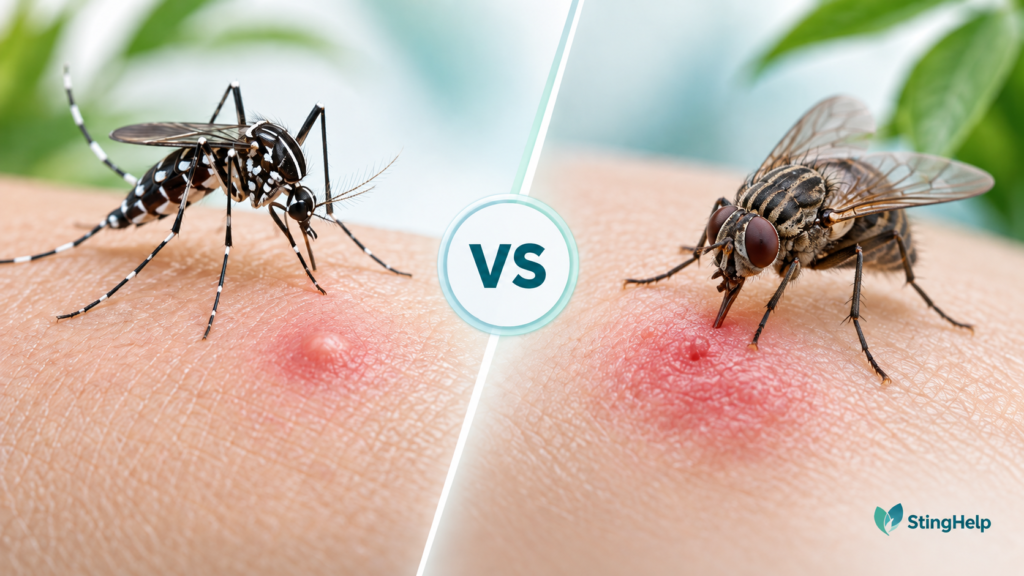
Direct answer: The main asian tiger mosquito bite vs stable fly bite treatment differences are pain timing and exposure control. Asian tiger mosquito bites may be barely noticed during feeding and become itchy later. Stable flies use a stiff piercing mouthpart, usually cause an immediate painful bite, and often attack the ankles or lower legs.
Stable flies and Asian tiger mosquitoes are both blood-feeding insects, but the feeding experience is usually different. The Asian tiger mosquito is a small black-and-white mosquito that lands briefly and flies away. The stable fly, Stomoxys calcitrans, resembles a house fly but has a projecting, bayonet-like mouthpart that pierces skin and draws blood.
Fastest practical clue
A painful “house-fly-looking” insect repeatedly biting around the ankles, especially near livestock, beaches, wet grass clippings, manure, hay, or decaying organic matter, strongly supports stable fly exposure. A small black-and-white mosquito producing an itchy wheal is more consistent with Asian tiger mosquito exposure.
Asian tiger mosquito bite vs stable fly bite: quick comparison
| Clue | Asian tiger mosquito | Stable fly |
|---|---|---|
| Insect | Aedes albopictus, black-and-white mosquito | Stomoxys calcitrans, house-fly-like blood-feeding fly |
| Mouthparts | Slender mosquito proboscis for blood feeding | Rigid projecting piercing-sucking proboscis |
| Typical sensation | Tiny prick or unnoticed feeding; itching often develops later | Immediate painful bite is common |
| Common human feeding site | Exposed arms, legs, neck, and other uncovered skin | Often ankles and lower legs |
| Disease context | Can transmit dengue, chikungunya, Zika where infected mosquitoes circulate | Not considered an important human-disease vector in U.S. extension guidance |
| Source control | Remove standing water and prevent mosquito entry | Reduce moist decaying breeding material and livestock-associated sources |
What an Asian tiger mosquito looks like
The Asian tiger mosquito, Aedes albopictus, is a small dark mosquito with conspicuous white bands on the legs and a white stripe on the upper body. It commonly breeds in small containers of standing water and can be active around yards, gardens, patios, vegetation, and residential neighborhoods.
The bite may feel like a tiny prick or may be missed entirely. Itching, redness, and localized swelling often become more obvious after the mosquito has already flown away.
What does a stable fly look like?
The stable fly, Stomoxys calcitrans, can easily be mistaken for a common house fly at first glance. University of Minnesota and Utah State guidance describe stable flies as gray flies with dark stripes on the thorax and a long, stiff, forward-projecting mouthpart used to pierce skin and suck blood.
This mouthpart is the most practical visual difference from a house fly. House flies have sponging mouthparts and do not bite people. Stable flies are true blood feeders, and both males and females take blood meals.
Why stable fly bites hurt
USDA Agricultural Research Service describes stable flies as persistent blood feeders whose bites are painful. Unlike a mosquito, which may feed with little immediate sensation, the stable fly mechanically pierces the skin with a rigid proboscis.
Colorado State Extension notes that stable flies commonly attack people around the ankles and can be aggressive daytime feeders. The insect may repeatedly attempt to feed if disturbed before it has taken a full blood meal.
Stable fly feeding pattern
1. Fly lands on the lower leg or other exposed skin.
2. Projecting proboscis pierces the skin.
3. Pain is often immediate.
4. The fly may leave when disturbed and return or attempt another bite.
Where do stable flies come from?
Stable fly larvae develop in moist, decaying organic material. Common breeding substrates include wet hay, straw, grass clippings, manure mixed with bedding, compost-like material, and other damp plant-animal waste.
This ecology explains why stable flies are often associated with cattle, horses, dairies, stables, farms, kennels, compost areas, and rural-urban boundaries. They can also become serious nuisance pests at beaches and recreational areas when environmental conditions support large populations.
Asian tiger mosquito bite vs stable fly bite symptoms
Both exposures can cause local redness, itching, swelling, and irritation, but the immediate sensation often differs.
Typical Asian tiger mosquito reaction
- Small itchy papule or wheal.
- Localized redness and swelling.
- Several bites may occur on exposed skin.
- Itching often becomes more noticeable after the mosquito has left.
Typical stable fly bite reaction
- Immediate sharp or painful bite.
- Small red spot or local irritation may follow.
- Localized itching or swelling can develop.
- Multiple painful bites may occur around ankles or lower legs during heavy fly activity.
The skin reaction is not species-specific. Deer flies, horse flies, black flies, biting midges, mosquitoes, and other insects can produce overlapping local lesions.
Pictures: can you identify a stable fly bite from the skin?
No. For asian tiger mosquito bite vs stable fly bite pictures, the insect itself is much more useful than the bite mark. Stable flies can often be recognized by their house-fly-like body and prominent forward-pointing proboscis.
Skin photographs are useful for documenting whether redness, swelling, drainage, or other changes are improving or worsening. They are not reliable for proving that a stable fly caused the bite.
If the insect was not seen, use the StingHelp What Bit Me? identification guide and consider other biting flies as well.
Asian tiger mosquito bite vs stable fly bite treatment differences
For a mild local reaction, first aid is similar: wash the skin, use a cool compress, avoid scratching, and use an appropriate over-the-counter anti-itch or pain treatment only if it is safe for you and used according to the label. The prevention strategy is different.
What to do after a likely Asian tiger mosquito bite
- Wash the area gently with soap and water.
- Use a cool compress for itching or swelling.
- Avoid scratching and keep broken skin clean.
- Use an appropriate OTC anti-itch product if safe for you and according to the label.
- Prevent more bites with repellent, protective clothing, screens, and standing-water control.
- If significant systemic illness develops, mention travel and local mosquito-borne disease activity when seeking medical advice.
What to do after a likely stable fly bite
- Move away from the area if flies are repeatedly attacking.
- Wash the bite with soap and water.
- Apply a cool compress for pain, itching, or swelling.
- Avoid scratching and keep any broken skin clean.
- Use an appropriate pain or itch treatment only if safe for you and according to the label.
- Use protective clothing or an appropriate repellent to reduce repeat bites.
Do stable flies transmit disease to people?
Stable flies can mechanically carry or transmit some pathogens in animal settings, and they are important veterinary pests. However, Colorado State Extension states that they do not appear to be important vectors of human disease.
This is an important difference from the Asian tiger mosquito. Aedes albopictus is a recognized vector of viruses including dengue, chikungunya, and Zika where infected mosquitoes and local transmission are present.
A painful stable fly bite therefore does not carry the same established human vector-borne disease profile as an Asian tiger mosquito bite.
Why stable flies often bite the ankles and lower legs
Stable flies commonly feed low on large animal hosts and show a preference for legs and lower-body regions. Colorado State specifically notes that they prefer attacking people around the ankles.
This can help distinguish the exposure pattern from mosquitoes, although it is not diagnostic. Fleas, biting midges, black flies, and other insects can also affect the lower legs.
Decision guide: what should you do next?
Small black-and-white mosquito seen feeding + itchy bump: routine mosquito-bite care and mosquito prevention are usually appropriate.
Painful house-fly-like insect repeatedly attacking ankles: stable fly becomes more likely; leave the area and use protection against repeat bites.
Many painful bites near livestock, wet hay, manure, or decaying vegetation: investigate stable-fly breeding sources.
Breathing difficulty, facial/throat swelling, fainting, rapidly worsening swelling, or collapse: seek emergency care.
When should you seek medical care?
Most uncomplicated stable fly and mosquito bites improve with supportive care. Seek medical evaluation when redness is spreading, pain is worsening, swelling is extensive, pus or drainage appears, fever develops, or the bite site is not improving as expected.
Seek emergency care for breathing difficulty, throat or facial swelling, fainting, severe dizziness, rapidly spreading hives, confusion, or collapse.
Can stable fly bites become infected?
Any break in the skin can become secondarily infected, especially if repeatedly scratched. Increasing warmth, tenderness, expanding redness, pus, drainage, or fever are reasons to seek medical advice.
Keep the area clean and avoid squeezing or cutting the bite site.
Stable fly vs house fly: why the confusion matters
A common house fly does not bite people. If a fly that looks similar to a house fly is causing painful bites, stable fly is an important possibility.
The forward-projecting proboscis is the key visual clue. Stable flies also tend to be more strongly associated with outdoor livestock and decaying organic breeding material.
Stable fly vs deer fly: practical differences
Stable flies are smaller and more house-fly-like, with a straight projecting proboscis. Deer flies are generally more robust, often have patterned wings or prominent eyes, and use cutting mouthparts that can produce a more tearing or bleeding bite.
If the bite was strongly painful outdoors near wet habitats and the insect was larger or patterned, use the existing Asian tiger mosquito vs deer fly comparison.
USA: where stable fly exposure is common
Stable flies occur widely across the United States. USDA identifies them as major livestock pests, but human bites can also become a problem around farms, rural-residential areas, recreation sites, and beaches.
Population size depends heavily on breeding material. Wet organic waste, bedding, hay, grass clippings, and manure mixtures can support larval development.
Europe: the same species is widespread
Stomoxys calcitrans is cosmopolitan and occurs widely in Europe as well as North America. European readers may encounter the same species around livestock, stables, farms, horses, and other suitable breeding environments.
The medical distinction remains similar: painful biting and nuisance exposure are the main human concerns, while the species is much more important as a veterinary pest and mechanical disease vector among animals.
How to prevent stable fly bites
Wear socks, long pants, and other protective clothing when practical. Use an appropriate insect repellent according to the label. Because stable flies often attack ankles and lower legs, covering those areas can make a practical difference.
For property control, remove or dry out breeding materials such as wet hay, manure-bedding mixtures, rotting vegetation, and grass-clipping accumulations. Sanitation is usually more important than trying to kill every adult fly.
How to prevent Asian tiger mosquito bites
Use EPA-registered or locally approved repellent, maintain window and door screens, wear protective clothing when practical, and remove standing water from buckets, plant saucers, toys, gutters, tires, and other containers.
For additional fly comparisons, link to the Deer Fly and Black Fly guides plus the Biting Flies/Midges category hub. For mosquito-specific prevention, link to the Mosquito Bites hub.
Frequently asked questions
How can you tell an Asian tiger mosquito bite from a stable fly bite?
Stable fly bites are usually immediately painful and often occur around ankles or lower legs. Asian tiger mosquito bites may be barely noticed during feeding and become itchy later. Seeing the insect is more reliable than comparing the skin marks.
Do stable flies bite people?
Yes. Both male and female stable flies feed on blood, and they can bite people as well as livestock and other warm-blooded animals. Their bites are characteristically painful.
Why do stable flies bite ankles?
Stable flies commonly feed on the lower legs of large animal hosts and often attack people around the ankles. Covering the lower legs and using appropriate repellent can help reduce bites.
Do stable flies spread disease to humans?
Stable flies can mechanically carry pathogens and are important veterinary pests, but Colorado State Extension states that they do not appear to be important vectors of human disease in the United States.
What should you do after a stable fly bite?
Wash the bite, apply a cool compress, avoid scratching, and use an appropriate pain or itch treatment if safe for you. Move away from heavy fly activity and use protective clothing or repellent to prevent repeated bites.
When should someone seek medical care after a mosquito or stable fly bite?
Seek care for severe or worsening swelling, increasing pain, spreading redness, drainage, fever, or significant systemic illness. Breathing difficulty, throat or facial swelling, fainting, or collapse requires emergency evaluation.
Authoritative references
- Oklahoma State University Extension — Stable Flies
- Colorado State University Extension — Biting Flies
- USDA ARS — Stable Fly Biology and Blood Feeding
- University of Minnesota Extension — Flies
- CDC — Asian Tiger Mosquito
Bottom line
The practical asian tiger mosquito bite vs stable fly bite treatment differences are pain timing and source control. A mosquito bite mainly needs itch relief and mosquito prevention. A stable fly bite is more likely to be immediately painful, especially around the ankles, and prevention depends on personal protection plus reducing moist decaying breeding material.
Educational information for a U.S.- and Europe-focused audience. This article cannot diagnose an insect species, allergic reaction, infection, or mosquito-borne illness from a photograph and does not replace professional medical care.
How to document the exposure without over-identifying the insect
If you are trying to distinguish a mosquito exposure from a stable fly exposure, record the circumstances rather than relying on the skin mark alone. Note whether the bite was painful at the exact moment it happened or became itchy later, which part of the body was exposed, whether several insects were repeatedly landing, and whether the setting included livestock, wet hay, manure, decaying vegetation, a beach, yard vegetation, or standing water. If the insect is still present, a clear photograph of the insect can be more useful than a close-up of the bite.
Also document how the skin changes over the next day or two. A simple photo taken at roughly the same distance can help you notice whether redness or swelling is stable, improving, or expanding. Do not use a changing skin lesion as proof of the insect species, because many bites and stings overlap in appearance. The purpose of the record is to support safer decisions about symptom progression, repeat exposure, and whether medical evaluation is needed.
For people who develop fever, marked swelling, spreading redness, worsening pain, drainage, breathing difficulty, fainting, or other significant symptoms, the priority is medical assessment rather than insect identification. Exposure details can still be useful to a clinician, especially when mosquito-borne illness, allergy, or secondary infection is a concern.
Related StingHelp guides
- Asian tiger mosquito bite vs deer fly bite
- Asian tiger mosquito bite vs black fly bite
- Asian tiger mosquito bite vs blacklegged tick bite
- Asian tiger mosquito bite vs paper wasp sting
{
“@context”:”https://schema.org”,
“@type”:”FAQPage”,
“mainEntity”:[
{“@type”:”Question”,”name”:”How can you tell an Asian tiger mosquito bite from a stable fly bite?”,”acceptedAnswer”:{“@type”:”Answer”,”text”:”Stable fly bites are usually immediately painful and often occur around ankles or lower legs. Asian tiger mosquito bites may be barely noticed during feeding and become itchy later. Seeing the insect is more reliable than comparing the skin marks.”}},
{“@type”:”Question”,”name”:”Do stable flies bite people?”,”acceptedAnswer”:{“@type”:”Answer”,”text”:”Yes. Both male and female stable flies feed on blood, and they can bite people as well as livestock and other warm-blooded animals. Their bites are characteristically painful.”}},
{“@type”:”Question”,”name”:”Why do stable flies bite ankles?”,”acceptedAnswer”:{“@type”:”Answer”,”text”:”Stable flies commonly feed on the lower legs of large animal hosts and often attack people around the ankles. Covering the lower legs and using appropriate repellent can help reduce bites.”}},
{“@type”:”Question”,”name”:”Do stable flies spread disease to humans?”,”acceptedAnswer”:{“@type”:”Answer”,”text”:”Stable flies can mechanically carry pathogens and are important veterinary pests, but Colorado State Extension states that they do not appear to be important vectors of human disease in the United States.”}},
{“@type”:”Question”,”name”:”What should you do after a stable fly bite?”,”acceptedAnswer”:{“@type”:”Answer”,”text”:”Wash the bite, apply a cool compress, avoid scratching, and use an appropriate pain or itch treatment if safe for you. Move away from heavy fly activity and use protective clothing or repellent to prevent repeated bites.”}},
{“@type”:”Question”,”name”:”When should someone seek medical care after a mosquito or stable fly bite?”,”acceptedAnswer”:{“@type”:”Answer”,”text”:”Seek care for severe or worsening swelling, increasing pain, spreading redness, drainage, fever, or significant systemic illness. Breathing difficulty, throat or facial swelling, fainting, or collapse requires emergency evaluation.”}}
]
}
