
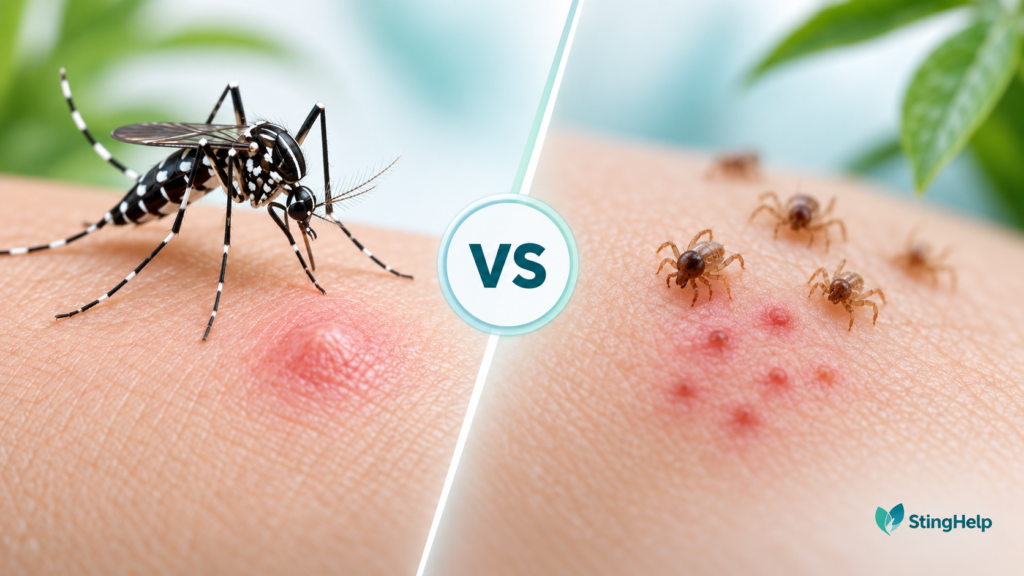
Direct answer: The main asian tiger mosquito bite vs seed tick bite treatment differences are attachment and removal. An Asian tiger mosquito feeds briefly and flies away. A “seed tick” usually means a tiny six-legged larval tick that may remain attached to the skin, so prompt physical removal is the priority before routine bite care.
“Seed tick” is not one tick species. It is a common name often used for very small larval ticks. In the United States, people frequently use the term for larval lone star ticks, but larvae of other hard-tick species also have six legs and can bite. That means species identification cannot be made from the words “seed tick” alone.
Fastest practical clue
A mosquito bite usually leaves no arthropod attached. If you can see or feel one or more tiny ticks physically anchored to the skin after walking through grass, brush, leaf litter, or woodland edges, think larval ticks and remove them promptly.
Asian tiger mosquito bite vs seed tick bite: quick comparison
| Clue | Asian tiger mosquito | Seed tick / larval tick |
|---|---|---|
| What it is | Aedes albopictus, one mosquito species | A larval life stage; not one species |
| Legs | Six legs, like other adult insects | Six legs in the larval tick stage; nymphs and adults have eight |
| Feeding behavior | Brief blood meal, then flies away | Attaches to skin and may remain feeding for hours or longer depending on species |
| Typical exposure | Yards, gardens, shaded vegetation, container-water habitats | Grass, brush, woodland edges, leaf litter, animal trails |
| Immediate action | Wash, cool, relieve itch, prevent more bites | Remove every attached tick as soon as possible, then clean skin |
| Disease context | Dengue, chikungunya, Zika where infected mosquitoes circulate | Depends on actual tick species, life stage, attachment, geography, and pathogen |
What an Asian tiger mosquito looks like
The Asian tiger mosquito, Aedes albopictus, is a small dark mosquito with conspicuous white bands on its legs and white markings on the body. It breeds in small containers of standing water and is commonly found around homes, yards, gardens, patios, and vegetation.
A bite may feel like a tiny prick or may go unnoticed. Itching, redness, and localized swelling often become more obvious after the mosquito has already left. Several bites can occur on exposed skin during one period outdoors.
What is a seed tick?
“Seed tick” usually refers to a larval tick—the stage that hatches from the egg before becoming a nymph. CDC parasitology guidance confirms that tick larvae have six legs. After a blood meal and a molt, the tick becomes an eight-legged nymph.
The term can be misleading because it sounds like a species name. It is better to think of “seed tick” as a size-and-life-stage description. Different tick species have larval stages, and the disease risk is not identical across them.
Important identification rule
Six legs strongly supports a larval tick. Eight legs suggests a nymph or adult tick. However, counting legs on an extremely tiny attached tick may require magnification, and species-level identification can still be difficult.
Are lone star tick larvae called seed ticks?
Yes, in U.S. field and extension usage, larval lone star ticks are commonly called seed ticks. Mississippi State University Extension specifically notes that larval Amblyomma americanum are sometimes called “seed ticks” and can be active in late summer and early autumn.
But this does not mean every seed tick is a lone star tick. CDC also documents that blacklegged and western blacklegged tick larvae can bite people. The safest wording is therefore: many “seed tick” encounters involve larval ticks, and the actual species must be determined separately.
Why seed ticks can appear in clusters
Larval ticks hatch from egg masses containing many offspring. As a result, a person brushing against a patch of vegetation where larvae are questing may pick up multiple tiny ticks at once. This can create a frightening cluster of small attached ticks on ankles, lower legs, waistlines, or other areas contacted by vegetation.
A cluster does not by itself identify the tick species. Lone star larvae are well known for occurring in large numbers, but other larval ticks can also be encountered in vegetation.
Asian tiger mosquito bite vs seed tick bite symptoms
Both exposures can produce localized redness and itching, but the attached arthropod is the strongest practical difference.
Typical Asian tiger mosquito reaction
- Small itchy papule or wheal.
- Localized redness and swelling.
- Several scattered bites on exposed skin are possible.
- No tick remains physically anchored to the skin.
Typical larval tick / seed tick reaction
- A tiny attached tick may be visible as a speck.
- Localized redness or itching may develop around the attachment site.
- Multiple tiny attached ticks may occur after brushing vegetation.
- Skin irritation can persist after removal.
The bite mark after removal cannot reliably identify the species. Tick species and disease-risk assessment depend on the tick itself, geography, attachment details, and symptoms—not only on the red spot.
Pictures: can you tell a seed tick from a skin photo?
Usually not after the tick is gone. For asian tiger mosquito bite vs seed tick bite pictures, photographs of the actual arthropod are more useful than photographs of the skin.
A magnified larval tick may show six legs. A nymph or adult tick has eight. A clear image of the tick’s body can sometimes help an expert narrow the species, but many larvae are extremely small and difficult to identify from casual phone photos.
If the culprit was not seen, use the StingHelp What Bit Me? identification workflow rather than diagnosing a seed tick solely from an itchy bump.
Asian tiger mosquito bite vs seed tick bite treatment differences
The treatment difference is immediate and important: there is no attached mosquito to remove after a mosquito bite, but any attached tick should be removed as soon as possible.
What to do after a likely Asian tiger mosquito bite
- Wash the area gently with soap and water.
- Use a cool compress for itching or swelling.
- Avoid scratching and keep broken skin clean.
- Use an appropriate over-the-counter anti-itch treatment only if safe for you and according to the label.
- Prevent more bites with repellent, protective clothing, screens, and standing-water control.
- Seek medical advice for significant systemic illness when travel or local mosquito-borne disease activity is relevant.
What to do when seed ticks are attached
- Remove attached ticks as soon as possible.
- Use clean fine-tipped tweezers if available.
- Grasp each tick as close to the skin surface as possible.
- Pull upward with steady, even pressure without twisting or jerking.
- Do not use petroleum jelly, heat, nail polish, or other substances to force detachment.
- After removal, clean the bite area and your hands with soap and water, rubbing alcohol, or hand sanitizer.
- Check the rest of the body carefully because other tiny larvae may be attached.
CDC’s June 2026 guidance specifically says not to wait for a healthcare visit just to remove an attached tick. Prompt removal matters.
What if dozens of seed ticks are attached?
Multiple larval ticks can be difficult to see and remove. Start with a careful full-body check in good light, using magnification if available. Check ankles, behind knees, waistline, groin, armpits, hairline, behind ears, and other areas where clothing fits tightly or vegetation contacted the body.
Remove attached ticks individually when possible. Afterward, shower and wash clothing. If you cannot safely remove all attached ticks, if they are near the eyes or another difficult location, or if there are many attached ticks on a child or medically vulnerable person, professional help may be appropriate.
Decision guide: what should you do next?
Itchy bump after seeing a black-and-white mosquito: routine mosquito-bite care and prevention are usually appropriate.
Tiny specks are physically attached after grass/brush exposure: treat them as possible ticks and remove them promptly.
Many tiny ticks are present: perform a complete tick check, remove attached ticks, shower, and launder clothing.
Rash or fever develops in the following days or weeks: contact a healthcare professional and mention the tick exposure, date, and likely location.
Do seed ticks carry disease?
There is no single answer because “seed tick” is not one species. Disease risk depends on the tick species, geography, pathogen, host history, and stage of infection.
For blacklegged ticks, Penn State explains that larvae are generally not infected with the major pathogens at hatching and can acquire pathogens while feeding on an infected host, then potentially transmit them during a later life stage. This is one reason nymphs are especially important in human Lyme disease transmission.
However, pathogen biology differs among tick species and diseases. Do not assume that every larval tick is harmless, and do not assume that every larval tick is infected. If symptoms develop, the clinical picture and exposure history matter more than generalized statements about “seed ticks.”
Can blacklegged tick larvae bite humans?
Yes. CDC’s May 2026 blacklegged tick surveillance page states that nymphs and adult females are more often reported on people, but larvae also bite people. CDC says the same for western blacklegged ticks.
This is important because “seed tick” searches often focus only on lone star ticks. In reality, larval Ixodes ticks can also attach to people.
Seed tick vs nymph: what is the difference?
A true larval tick has six legs. A nymph has eight. Nymphs are often extremely small too—sometimes around poppy-seed size—so people can easily call any tiny tick a “seed tick.”
That is why the label should not be used as proof of life stage unless the tick has actually been examined. If a tiny tick has eight legs, it is not a larva.
USA: lone star seed ticks
The lone star tick, Amblyomma americanum, is widely distributed across the Northeast, South, and Midwest. CDC describes it as an aggressive human-biting tick. Its larvae can occur in large groups and are commonly called seed ticks in extension literature.
CDC notes that nymphs and adult females most frequently bite humans and spread disease. That does not mean larvae never bite; it means human disease risk is strongly influenced by stage, species, and pathogen.
USA: blacklegged and western blacklegged larvae
Blacklegged tick larvae also bite people, although nymphs and adult females are more frequently reported. Blacklegged ticks occur broadly across the eastern U.S., while western blacklegged ticks are concentrated along the Pacific coast, particularly northern California.
If the tiny tick is an Ixodes species, the dedicated blacklegged-tick comparison provides more species-specific context without pretending that every seed tick is a deer tick.
Europe: “seed tick” is less species-specific
In Europe, the common castor bean/sheep tick Ixodes ricinus also has a six-legged larval stage. ECDC notes that larvae feed primarily on smaller hosts, while later stages use progressively larger hosts, and the species can bite humans.
European readers should treat “seed tick” as an informal size/stage description rather than a local species name. Species identification and regional disease context remain necessary.
When should you seek medical care?
CDC advises seeking medical care if a rash or fever develops within several days to weeks after removing a tick. Tell the clinician about the tick bite, when it happened, and where the exposure likely occurred.
Seek earlier evaluation if there is rapidly worsening swelling, severe pain, pus or drainage, spreading redness, neurologic symptoms, severe headache, marked weakness, breathing difficulty, fainting, or another serious systemic reaction.
Should you test the removed tick?
CDC generally does not recommend using commercial tick testing to make treatment decisions. A positive tick result does not prove the person was infected, and a negative result can provide false reassurance because another unnoticed tick may have bitten.
If you keep the removed tick for identification, place it in a sealed container or follow local guidance. Do not delay medical evaluation of symptoms while waiting for a tick test.
How to prevent seed tick bites
Avoid brushing directly against tall grass and dense vegetation when practical. Walk near the center of trails, use EPA-registered repellent, and consider 0.5% permethrin-treated clothing or gear according to the product label.
After outdoor exposure, perform a full-body tick check, shower, and inspect clothing and gear. Tiny larvae are easy to miss, so good lighting and careful inspection matter.
How to prevent Asian tiger mosquito bites
Use EPA-registered or locally approved repellent, wear protective clothing when practical, maintain screens, and remove standing water from buckets, plant saucers, toys, tires, gutters, and other containers around the home.
For more tick-specific information, link this article to the existing Blacklegged Tick comparison and the StingHelp tick category. For mosquito prevention, link to the Mosquito Bites hub.
Frequently asked questions
Is a seed tick a specific species?
No. “Seed tick” is an informal term commonly used for tiny larval ticks. In U.S. extension usage it often refers to lone star tick larvae, but larvae of other species also have six legs and can bite people.
How many legs does a seed tick have?
A true larval tick has six legs. After the larva feeds and molts into a nymph, it has eight legs. Counting legs can help distinguish a larva from a tiny nymph when the tick is visible under magnification.
Can seed ticks bite humans?
Yes. Larval ticks can attach to people. CDC specifically notes that blacklegged and western blacklegged tick larvae can bite humans, although nymphs and adult females are reported more often.
What should you do if seed ticks are attached?
Remove every attached tick as soon as possible. Use fine-tipped tweezers, grasp close to the skin, and pull upward with steady pressure. Clean the skin and hands afterward and perform a complete tick check for additional tiny ticks.
Do seed ticks transmit Lyme disease?
The answer depends on the species and infection history. Blacklegged tick larvae are generally not infected with Lyme bacteria at hatching and usually acquire pathogens during feeding, which can make later life stages more important for transmission. Do not generalize this to every tick-borne pathogen or species.
When should someone seek medical care after a mosquito bite or seed tick bite?
Seek care for severe or worsening local symptoms or systemic illness. After a tick bite, CDC specifically advises medical evaluation if rash or fever develops in the following days or weeks, and the clinician should be told when and where the bite occurred.
Authoritative references
- CDC — What to Do After a Tick Bite, June 9, 2026
- CDC DPDx — Tick Life Cycles and Six-Legged Larvae
- CDC — Blacklegged Tick Surveillance, May 14, 2026
- CDC — Lone Star Tick Surveillance, May 26, 2026
- ECDC — Ixodes ricinus Factsheet
Bottom line
The most important asian tiger mosquito bite vs seed tick bite treatment differences are that a mosquito leaves after feeding, while a larval tick may remain attached and should be removed promptly. Treat “seed tick” as a life-stage term—not a species diagnosis—and base disease risk on the actual tick, geography, attachment, and symptoms.
Educational information for a U.S.- and Europe-focused audience. This article cannot identify a tick species or diagnose a tick-borne or mosquito-borne illness from a photograph and does not replace professional medical care.
Related StingHelp guides
- Asian tiger mosquito bite vs blacklegged tick bite
- Asian tiger mosquito bite vs oak mite bite
- Asian tiger mosquito bite vs deer fly bite
- Asian tiger mosquito bite vs black fly bite
{
“@context”:”https://schema.org”,
“@type”:”FAQPage”,
“mainEntity”:[
{“@type”:”Question”,”name”:”Is a seed tick a specific species?”,”acceptedAnswer”:{“@type”:”Answer”,”text”:”No. Seed tick is an informal term commonly used for tiny larval ticks. In U.S. extension usage it often refers to lone star tick larvae, but larvae of other species also have six legs and can bite people.”}},
{“@type”:”Question”,”name”:”How many legs does a seed tick have?”,”acceptedAnswer”:{“@type”:”Answer”,”text”:”A true larval tick has six legs. After the larva feeds and molts into a nymph, it has eight legs. Counting legs can help distinguish a larva from a tiny nymph when the tick is visible under magnification.”}},
{“@type”:”Question”,”name”:”Can seed ticks bite humans?”,”acceptedAnswer”:{“@type”:”Answer”,”text”:”Yes. Larval ticks can attach to people. CDC specifically notes that blacklegged and western blacklegged tick larvae can bite humans, although nymphs and adult females are reported more often.”}},
{“@type”:”Question”,”name”:”What should you do if seed ticks are attached?”,”acceptedAnswer”:{“@type”:”Answer”,”text”:”Remove every attached tick as soon as possible. Use fine-tipped tweezers, grasp close to the skin, and pull upward with steady pressure. Clean the skin and hands afterward and perform a complete tick check for additional tiny ticks.”}},
{“@type”:”Question”,”name”:”Do seed ticks transmit Lyme disease?”,”acceptedAnswer”:{“@type”:”Answer”,”text”:”The answer depends on the species and infection history. Blacklegged tick larvae are generally not infected with Lyme bacteria at hatching and usually acquire pathogens during feeding, which can make later life stages more important for transmission. Do not generalize this to every tick-borne pathogen or species.”}},
{“@type”:”Question”,”name”:”When should someone seek medical care after a mosquito bite or seed tick bite?”,”acceptedAnswer”:{“@type”:”Answer”,”text”:”Seek care for severe or worsening local symptoms or systemic illness. After a tick bite, CDC specifically advises medical evaluation if rash or fever develops in the following days or weeks, and the clinician should be told when and where the bite occurred.”}}
]
}
