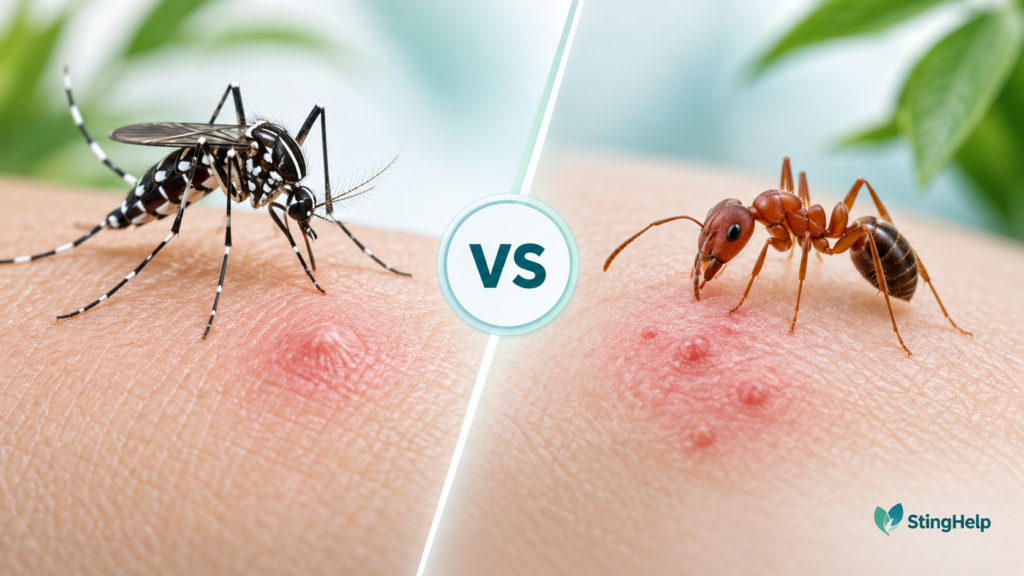
Direct answer: The safest way to understand asian tiger mosquito bite vs red ant bite treatment differences is to identify what “red ant” means first. That name can describe fire ants, harvester ants, thatching ants, or European red ants. Some bite, some sting, and some do both, so treatment and risk cannot be based on color alone.
An Asian tiger mosquito is one specific species, Aedes albopictus. “Red ant,” by contrast, is a loose common name used for several unrelated or only distantly related ants. That makes this comparison different from a normal species-versus-species guide. Before deciding what to do, look at the ant’s behavior, nest type, geography, pain timing, and whether a pustule or other distinctive reaction develops.
Fastest practical clue
If the exposure caused immediate burning and later a white fluid-filled pustule after disturbing a mound in an imported-fire-ant area, fire ant becomes more likely. If a reddish ant came from a gravelly harvester mound, thatching nest, or northern European-red-ant colony, the culprit—and medical risk—may be different.
Asian tiger mosquito bite vs “red ant” bite: quick comparison
| Clue | Asian tiger mosquito | “Red ant” |
|---|---|---|
| What the name means | One species: Aedes albopictus | A non-specific color/common name used for multiple ant species |
| Typical injury | Blood-feeding bite | May be a bite, sting, venom injection, or bite plus formic-acid spray depending on species |
| Typical sensation | May be barely noticed; itching often dominates later | Can range from mild irritation to immediate burning or painful stinging |
| Useful skin clue | Itchy papule or wheal | Depends on species; fire ants may produce white pustules, while other red ants may not |
| Main emergency risk | Severe allergy is uncommon; virus risk depends on infected mosquitoes | Venom allergy or many stings can be serious for some red-ant species |
| Best next step | Basic bite care + mosquito prevention | Identify the ant/nest as well as possible, then use species-appropriate care |
The biggest mistake is assuming that every reddish ant is a red imported fire ant. Current extension guidance specifically warns that several aggressive native ants can be mistaken for imported fire ants.
What an Asian tiger mosquito looks like
The Asian tiger mosquito, Aedes albopictus, is a small black mosquito with bright white bands on its legs and distinctive white markings on the body. It often occurs around yards, gardens, patios, vegetation, and small containers that hold standing water.
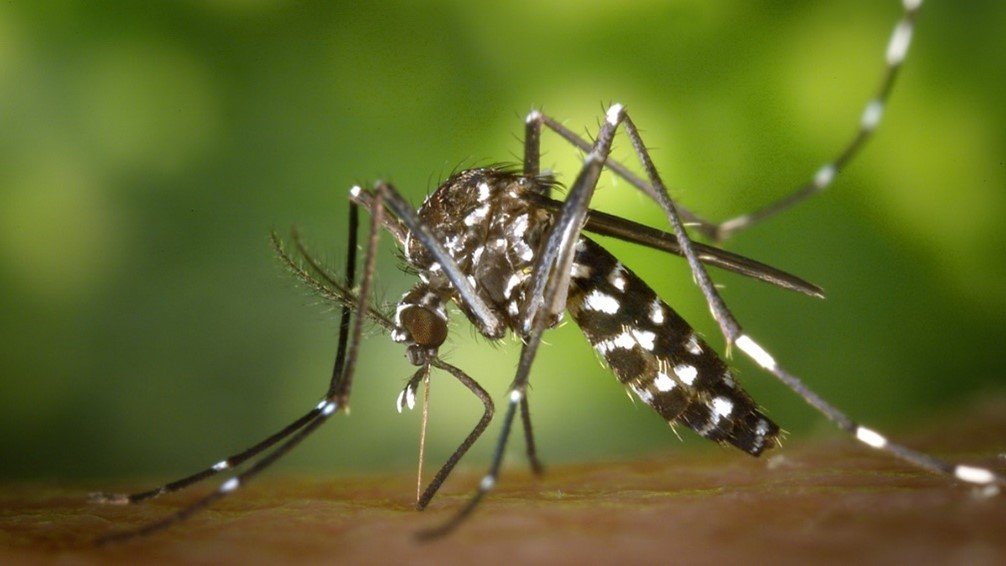
The bite may feel like a tiny prick or may not be noticed. Itching, redness, and localized swelling often become more obvious after the mosquito has left.
Why “red ant” is not a species
People use “red ant” for ants with reddish, orange-brown, or rust-colored bodies, but color does not identify a medical risk. Utah State University Extension notes that imported fire ants can be confused with aggressive native harvester ants—some of which are also called red ants—and with thatching or field ants.
In the northeastern United States and parts of Canada, the European fire ant, Myrmica rubra, is also called the European red ant. University of Maine Extension emphasizes that it is only distantly related to the “true” Solenopsis fire ants of the southern United States and Latin America.
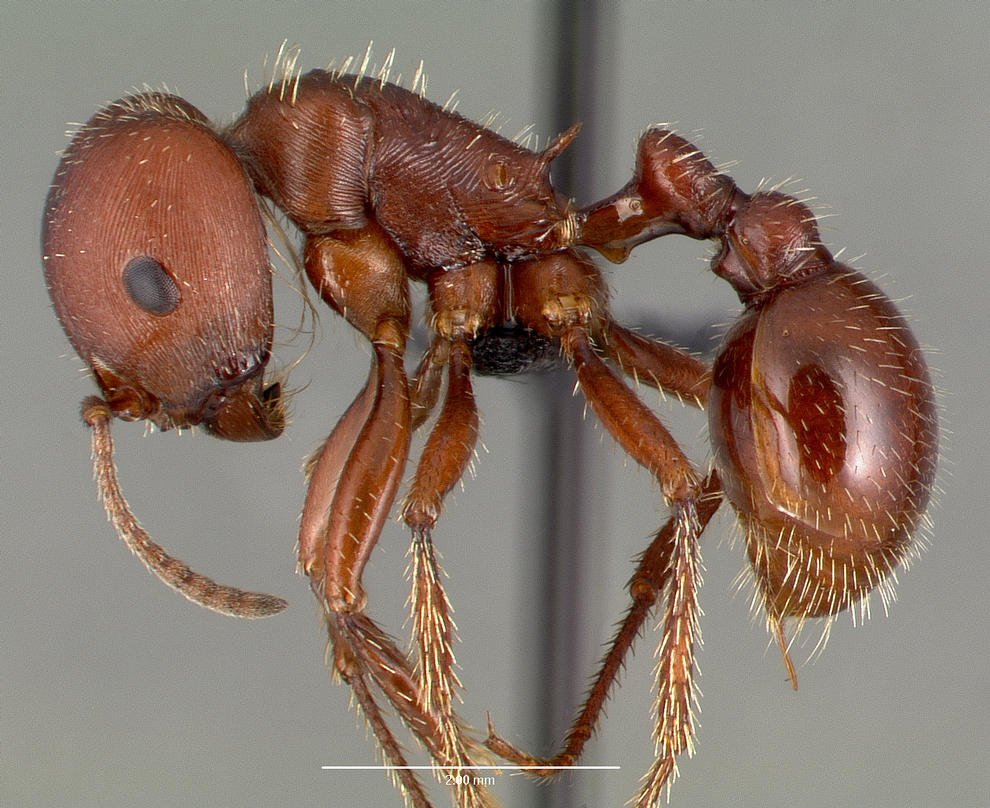
Four different ants people may call “red ants”
1. Red imported fire ant — Solenopsis invicta
The red imported fire ant is the medically important invasive species most people mean when discussing severe “red ant” stings in the southern United States. Fire ants bite the skin to anchor themselves and then sting with the abdomen. One ant can sting repeatedly.
CDC/NIOSH describes immediate burning followed by red bumps that can become white fluid-filled pustules within a day or two. Multiple ants may attack when a mound is disturbed.
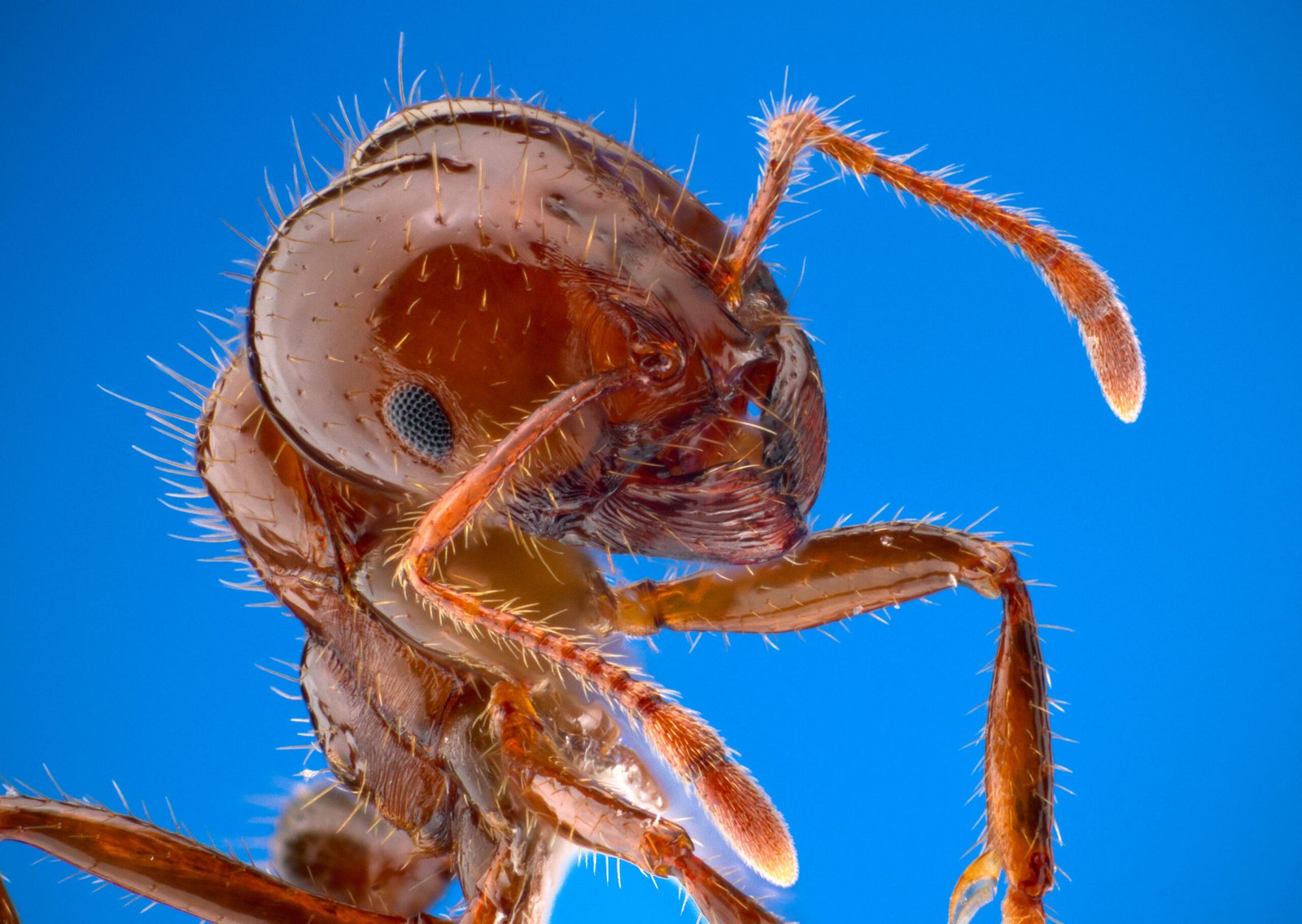
If this pattern fits your exposure, use the dedicated Asian tiger mosquito vs fire ant guide rather than treating every reddish ant as interchangeable.
2. Red harvester ants — Pogonomyrmex species
Some harvester ants are reddish and are commonly called “red ants.” Utah State notes that harvester ants can both bite and sting and inject painful venom. Their nests may have open ground, gravel, or cleared vegetation around the entrance rather than the irregular dome-like mound associated with imported fire ants.
A painful sting from a harvester ant does not automatically produce the characteristic sterile white pustule commonly associated with imported fire ants.
3. Thatching or field ants — Formica species
Some reddish-brown thatching ants can also be mistaken for fire ants. Utah State describes these ants as capable of biting and spraying formic acid but not stinging. Their nests often contain plant material or thatch and may have visible surface trails.
This distinction matters because “bite plus acid spray” is not the same injury mechanism as a venomous fire-ant sting.
4. European red ant — Myrmica rubra
Myrmica rubra, often called the European red ant or European fire ant, is native to Europe and has become invasive in parts of northeastern North America. University of Maine Extension describes it as a small red ant capable of inflicting a painful burning sting and forming dense colonies in moist soil beneath rocks, wood, or debris.
It is not the same species as the red imported fire ant and should not be identified merely from color.
Asian tiger mosquito bite vs red ant bite symptoms
Because “red ant” covers several possible ants, there is no single red-ant skin pattern. That is exactly why the exposure context matters.
Typical Asian tiger mosquito reaction
- Small itchy papule or wheal.
- Localized redness and swelling.
- Several bites may occur on exposed skin.
- Itching may become more noticeable after the mosquito flies away.
Possible red-ant reactions
- Immediate burning or sharp pain with venomous stinging species.
- Localized redness, swelling, itching, or tenderness.
- Multiple lesions after disturbing a colony.
- White pustules after red imported fire ant stings.
- Painful irritation after bites or formic-acid exposure from some non-stinging ants.
Do not assume that a red bump without a pustule proves or excludes fire ants. Reactions vary, and other arthropod bites can mimic the same appearance.
Pictures: can color identify the ant?
No. For asian tiger mosquito bite vs red ant bite pictures, color is one of the weakest ant-identification clues. Fire ants, harvester ants, European red ants, and other species can all appear reddish or reddish-brown.
Useful photographs include the whole ant, close views of its body and waist, the nest type, mound structure, and surrounding habitat. Skin photographs are better for documenting progression than for species identification.
If the ant was not identified, use the StingHelp What Bit Me? identification guide and avoid forcing a fire-ant diagnosis from a red bump.
Asian tiger mosquito bite vs red ant bite treatment differences
For mild reactions, both exposures can start with washing the skin, a cool compress, and avoiding scratching. The difference is that a “red ant” exposure first requires a practical triage question: was this likely a fire ant, another stinging ant, or a biting/formic-acid ant?
What to do after a likely Asian tiger mosquito bite
- Wash the area with soap and water.
- Use a cool compress for itching or swelling.
- Avoid scratching and keep broken skin clean.
- Use an appropriate OTC anti-itch treatment only if safe for you and according to the label.
- Prevent more bites with repellent, protective clothing, screens, and standing-water control.
- If significant illness develops, tell a clinician about travel and local mosquito-borne disease activity.
What to do after an unidentified red-ant exposure
- Move away from the colony or nest area to prevent more bites or stings.
- If ants remain attached, brush them off rather than crushing them against the skin.
- Wash the area gently with soap and water.
- Use a cool compress for pain or swelling.
- Do not cut, squeeze, burn, or attempt to extract venom.
- Photograph the ant or nest safely if identification will affect management.
- Monitor for rapidly worsening swelling, generalized hives, breathing symptoms, fainting, or other systemic reactions.
For broader care, use the StingHelp bite and sting first-aid guide.
Decision guide: which “red ant” pattern fits best?
Immediate burning + many ants + white pustules next day: red imported fire ant becomes more likely.
Painful sting from a reddish ant at a cleared/gravelly mound: consider a harvester ant.
Bite from a reddish field/thatching ant with acid-like irritation but no sting: consider a Formica-type ant.
Small red ants in dense moist-soil colonies in northeastern North America or Europe: European red ant may be relevant.
Breathing difficulty, throat/facial swelling, fainting, or collapse: seek emergency care regardless of species.
What are the warning signs of anaphylaxis?
Venomous ant stings can trigger severe allergic reactions in susceptible people. Seek emergency care for breathing difficulty, wheezing, throat tightness, swelling of the tongue or face, fainting, severe dizziness, rapidly spreading hives, confusion, collapse, or another rapidly worsening systemic reaction.
CDC/NIOSH emphasizes emergency evaluation for serious symptoms after fire-ant stings. Anyone with a prescribed epinephrine autoinjector should follow their clinician’s emergency plan.
What if white pustules appear?
White fluid-filled pustules appearing within about a day or two are strongly associated with imported fire-ant stings. They are not a generic sign of every ant commonly called “red.”
Do not deliberately open or squeeze the pustules. Keep the area clean and seek medical advice if redness is spreading, pain is worsening, drainage develops, or fever appears.
What if there is pain but no pustule?
A painful ant exposure without a pustule may still be a fire-ant sting, but it also broadens the possibilities. Harvester ants can deliver painful venomous stings, Myrmica rubra can sting, and some Formica ants can bite and spray formic acid.
Use nest type, geography, ant size, and expert identification rather than color alone.
USA: why geography matters
Red imported fire ants are concentrated mainly in the southern United States, although their regulated range changes and localized occurrences can happen elsewhere. In western states, reddish harvester ants may be the more relevant “red ant.” In parts of the Northeast, European red ants may occur in moist landscapes.
That is why a “red ant bite” in Texas, Utah, and coastal Maine can involve completely different ant species.
Europe: “red ant” often means something else
European readers should not assume that a reddish ant is the South American red imported fire ant. Myrmica rubra is a native European red ant capable of painful stings, while the red imported fire ant has only recently established localized populations in parts of Sicily rather than across Europe as a whole.
Local entomology and invasive-species information should guide identification when a suspected imported fire ant is found.
Why this guide is separate from the Fire Ant guide
The phrase “red ant” creates a real identification problem that a fire-ant-only article cannot solve. This page exists to prevent exactly that misclassification. If the exposure clearly matches imported fire ants, the dedicated fire-ant guide gives more specific information on pustules, mound exposure, repeated stinging, and anaphylaxis.
For other ant comparisons, see the carpenter-ant guide or browse the StingHelp Ant & Fire Ant hub.
How Asian tiger mosquito disease risk differs
Asian tiger mosquitoes can transmit dengue, chikungunya, and Zika when infected mosquitoes are present and local transmission occurs. A routine bite does not prove infection.
Red-ant concerns are different. The major medical risks are local venom or acid injury, many simultaneous stings, and allergy—not mosquito-borne viral transmission.
How to prevent Asian tiger mosquito bites
Use EPA-registered or locally approved repellent, wear protective clothing when practical, maintain screens, and remove standing water from containers around the home.
For more mosquito-specific guidance, browse the StingHelp Mosquito Bites hub.
How to reduce ant stings and bites
Do not stand on or disturb unknown ant mounds. Wear closed footwear and gloves when working around soil, rocks, landscaping, or stored materials. If aggressive ants are repeatedly found around a property, obtain species identification before choosing a control method.
Imported fire ants, harvester ants, thatching ants, and European red ants have different colony biology, so a one-size-fits-all pesticide strategy is not appropriate.
Frequently asked questions
Is every red ant a fire ant?
No. “Red ant” is a color-based common name, not a species. Harvester ants, European red ants, thatching ants, and imported fire ants can all be described as red or reddish. Correct identification matters because their bite/sting behavior differs.
How can you tell an Asian tiger mosquito bite from a red-ant injury?
A mosquito bite is often mainly itchy and follows visible mosquito exposure. Ant injuries are more likely to involve immediate pain or burning, contact with a nest or colony, and sometimes multiple lesions. A skin photo alone cannot identify the ant species.
Which red ants cause white pustules?
White fluid-filled pustules are strongly associated with imported fire-ant stings. Other ants commonly called red ants may cause pain, swelling, or irritation without producing the same classic pustule pattern.
Can red ants sting more than once?
Some can. Imported fire ants and harvester ants can sting, and fire ants may sting repeatedly while anchored to the skin. Thatching ants bite and spray formic acid but cannot sting.
Which symptoms are an emergency?
Breathing difficulty, throat or facial swelling, fainting, severe dizziness, widespread hives, confusion, or collapse after an ant sting requires emergency evaluation. Many simultaneous stings also deserve extra caution.
When should someone seek medical care after a mosquito or red-ant exposure?
Seek care for severe or worsening swelling, increasing pain, spreading redness, drainage, fever, many stings, systemic symptoms, or diagnostic uncertainty. Emergency allergic symptoms require immediate emergency care.
Authoritative references
- Utah State University Extension — Imported Fire Ants and Look-Alikes
- University of Maine Extension — European Red Ant / European Fire Ant
- CDC/NIOSH — Insects and Scorpions at Work, updated March 4, 2026
- USDA APHIS — Imported Fire Ants
- CDC — Asian Tiger Mosquito
Bottom line
The most important asian tiger mosquito bite vs red ant bite treatment differences start with identification: “red ant” does not name one species. Mosquito bites usually need itch relief and mosquito prevention. Red-ant injuries may involve venomous stings, bites, or formic-acid exposure, so nest type, geography, pustules, and ant behavior should guide the next step.
Educational information for a U.S.- and Europe-focused audience. This article cannot diagnose an insect species, allergic reaction, infection, or mosquito-borne illness from a photograph and does not replace professional medical care.