No-See-Um Bites: Symptoms, Treatment, and How Long They Really Last
The fast answer: A no-see-um bite usually announces itself with a sharp prick, then builds into an intensely itchy red welt over the first 6–24 hours. For most people the itching peaks on day one or two and fades within three to seven days. If you are a strong reactor — and many people are — the welts can swell surprisingly large, blister, and itch for up to two weeks. That marathon itch is exactly what separates no-see-um bites from mosquito bites, which typically settle within a few days. Below: the full symptom picture, an honest day-by-day timeline, the treatment steps that actually help, a side-by-side comparison with mosquito bites, and the warning signs that mean you should stop waiting and see a doctor.
What Bit You: A Fly You Practically Cannot See
No-see-ums are biting midges — tiny flies in the family Ceratopogonidae, also called punkies or sand gnats in some regions. At roughly 1 to 3 millimeters long, a female no-see-um can pass through ordinary window screening, which is why people get bitten on screened porches and wake up convinced the culprit is imaginary. They are most active at dawn and dusk on calm, humid days, and they thrive near water, marsh, and moist soil — a signature pest of Florida, the Gulf Coast, the Carolinas, and coastal areas generally, with peak activity in early summer and year-round presence in the warmest regions.
The reason their bites punch so far above their size is their feeding method. A mosquito pierces the skin with a fine, needle-like proboscis — a relatively clean puncture. A no-see-um does something cruder: she uses saw-like mouthparts to slice the skin open and laps up the blood that pools in the tiny wound (a feeding style called pool feeding). Her saliva carries anticoagulants that keep the blood flowing, and your immune system’s reaction to that saliva — and to the extra tissue damage from slicing — is what produces the disproportionate itch. Understanding that mechanism explains the whole timeline that follows: more tissue trauma plus a stronger immune response equals a bigger welt that peaks later and leaves later than a mosquito’s.
No-See-Um Bite Symptoms: What to Expect
- At the moment of the bite: A sharp prick, sting, or burning sensation — many people feel the bite happen even though they never see the insect. Some feel nothing until later, especially if several midges feed at once.
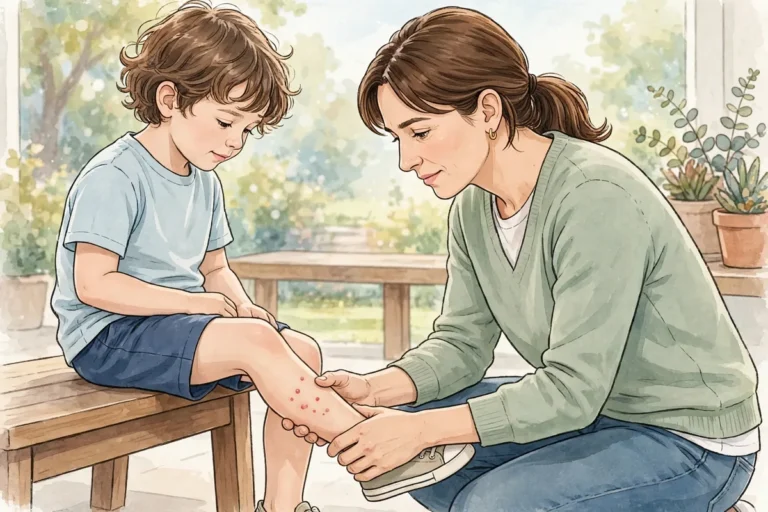
- Within hours: Small red spots or welts appear, typically in clusters where a group of midges fed together. Common sites are exposed skin — ankles, legs, arms, wrists, neck, ears, and around the hairline.
- The itch: Intense, often described as out of all proportion to the size of the mark, and frequently worse than a mosquito bite. Itching commonly builds over the first day rather than fading.
- Swelling: Welts can grow much larger than the initial spot. In strong reactors, individual welts can reach up to about two inches across.
- Blisters: Sensitive people may develop small fluid-filled blisters on top of the welts. Do not pop them — intact blister skin is the best bandage, and broken blisters are an open door for infection.
- Delayed reactions: It is normal for the worst of it to arrive late. Pronounced itching, redness, and swelling often begin 6–24 hours after the bite and peak at 24–48 hours, which is why people frequently wake up the morning after an evening outdoors wondering what happened overnight.
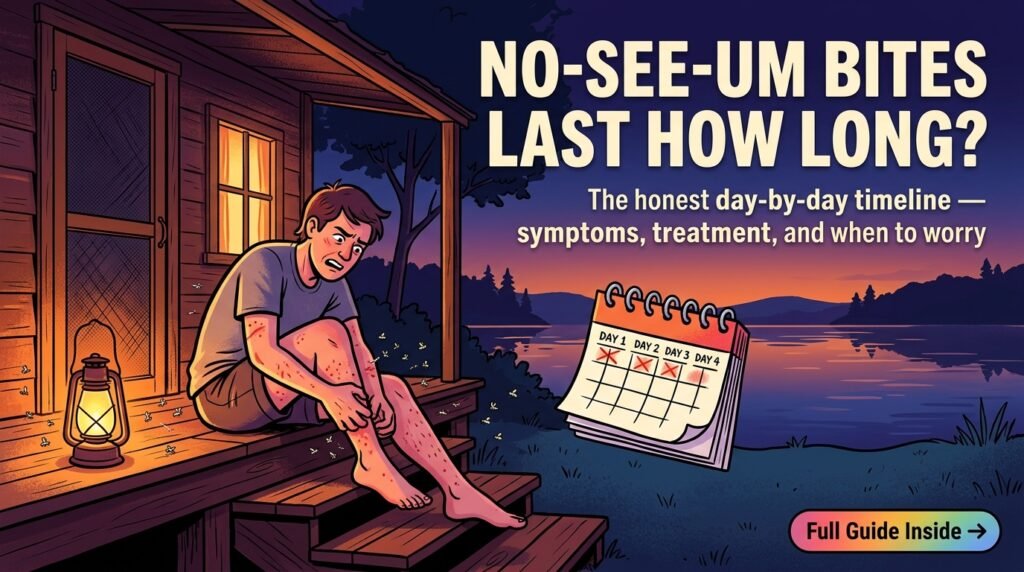
The Honest Timeline: How Long No-See-Um Bites Last, Day by Day
| When | What’s Typical |
|---|---|
| First minutes | Sharp prick or burning sting at the bite site; a tiny red spot may appear |
| First 6 hours | Small red welts form, often in clusters; itching begins and steadily builds |
| 6–24 hours | Delayed reaction kicks in for many people — itching, redness, and swelling noticeably increase |
| Days 1–2 | Peak itch and swelling for most people; strong reactors may see large welts or blisters |
| Days 3–4 | For most people, itching fades and welts flatten — this is where a mosquito bite would already be nearly gone |
| Days 5–7 | Most bites are resolved or nearly so; sensitive skin may still show itchy bumps |
| Up to 2 weeks | Strong reactors: welts, blisters, and recurring itch can persist this long, especially if scratching has irritated the skin further |
| Beyond 2 weeks | Not typical for a simple bite — get it checked (see warning signs below) |
Two honest caveats about that timeline. First, scratching rewrites it: every round of hard scratching re-inflames the bite, delays healing, and raises the risk of a bacterial skin infection that can keep a spot angry for weeks. Second, if you were bitten by dozens of midges at once, judge the timeline by the worst few bites, not the average — the tail of a heavy exposure is always longer. For a direct comparison with the insect everyone confuses these with, our page on how long mosquito bites last lays out the mosquito’s shorter arc.
No-See-Um Bites vs Mosquito Bites
| Feature | No-See-Um Bites | Mosquito Bites |
|---|---|---|
| How it feeds | Slices the skin with saw-like mouthparts and laps pooled blood | Pierces skin with a needle-like proboscis |
| Do you feel it? | Often a sharp prick or burn at the moment | Usually unnoticed while it happens |
| Mark size | Small starting spots (~1–2 mm) that can swell into welts up to ~2 inches in strong reactors | Puffy welts usually under half an inch |
| Pattern | Clusters of many bites close together — a group fed on you | Single, spaced-out bites |
| Itch intensity | Intense, sharp or burning; famously out of proportion to bite size | Noticeable but milder for most people |
| When it peaks | Often delayed — worst at 24–48 hours | Usually within the first day |
| How long it lasts | Typically 3–7 days; up to 2 weeks in strong reactors | Typically a few hours to 3–4 days |
| Disease risk (US) | Primarily a nuisance — US biting midges are not considered a significant source of human disease; the real risks are itching misery and skin infection from scratching | Mosquitoes are the ones with meaningful US disease risk (e.g., West Nile virus) |
One more pattern clue: location and timing. Dozens of clustered bites appearing after sitting outside at dusk near water, grass, or a porch with the screens closed — that scenario is no-see-ums until proven otherwise, because they come through standard screens that stop mosquitoes cold. (Yes, really — we answer the common question directly in our guide on whether no-see-ums can bite through window screens.)
How to Treat No-See-Um Bites: Steps That Actually Help
- Wash the bites. Soap and cool or lukewarm water, right away if you can — it cleans the tiny wounds and removes surface saliva and debris.
- Apply cold. A cold compress or ice pack for 10–15 minutes calms swelling and takes the edge off the itch. Repeat through the first day as needed.
- Use 1% hydrocortisone cream or calamine lotion. These are the standard over-the-counter responses for bite itching; follow the label. Apply after washing and drying the skin.
- Take an oral antihistamine for widespread itching — especially at night, when itching is most likely to destroy your sleep. A sedating nighttime option is a common approach; ask a pharmacist what suits you.
- Reach for simple soothers if you have no cream. Aloe vera gel or a baking soda paste can cool the skin and ease itching for some people. Understand what they do: they soothe symptoms; they don’t speed healing.
- Do not scratch, and protect blisters. Keep nails short, leave blisters intact, and cover any spot you’re tempted to dig at with clothing or a bandage. Scratching is the single biggest factor that turns a 4-day bite into a 2-week problem — or an infected one.
Our broader no-see-um bite treatment guide goes deeper on relief options, including what to do about bites around the house. Expect treatment to make you comfortable, not to erase the bite overnight — with this insect, patience is genuinely part of the prescription.
Preventing the Next Round
- Upgrade your mesh where it matters. Standard 16×16 or 18×16 window screens let no-see-ums straight through. Fine “no-see-um” netting (around 30×30 mesh) on porch screens, tents, and bed nets actually stops them.
- Use fans — this is a real control, not a folk tip. Biting midges are weak fliers. A strong fan on a porch or patio creates a zone they simply cannot operate in.
- Time your exposure. Dawn and dusk on calm, humid days near water or marsh are peak biting conditions. If you can move the cookout an hour earlier or later, do it.
- Use repellent properly. DEET and picaridin — the same repellents used for mosquitoes — also repel biting midges. Apply to exposed skin per the label; treat ankles, wrists, neck, and the hairline, their favorite targets.
- Cover up in midge country. Light, tightly woven long sleeves and pants make a real difference, and permethrin-treated clothing (applied to clothing only, never skin) adds a strong second layer for people who work or fish outdoors at dusk.
- Reduce breeding habitat near the house. Midges breed in wet soil and organic muck rather than in open standing water, so fix drainage problems, avoid over-watering lawns, and clear wet leaf piles and rotting material near sitting areas. Fogging the yard, by contrast, gives only brief relief because midges continually fly in from surrounding habitat.
When to See a Doctor
Most no-see-um bites, however miserable, heal on their own. Get medical care if you notice:
- Signs of skin infection: spreading redness, increasing warmth, swelling, pain, pus, or red streaks moving away from a bite — the risk rises sharply if you’ve been scratching or a blister has broken
- Fever or feeling unwell alongside bite symptoms
- Allergic warning signs: swelling of the face, lips, or tongue, or any difficulty breathing — treat as an emergency
- A bite very close to the eye with significant swelling
- Symptoms that are still going strong after two weeks, or individual spots that keep worsening instead of improving
- Large blistering reactions, especially in children or anyone with a weakened immune system
Frequently Asked Questions
How long do no-see-um bites last, honestly?
For most people, three to seven days: the itch peaks in the first day or two and fades steadily after that. For strong reactors — a substantial minority — swollen welts and itching can last up to two weeks, particularly with blistering or heavy scratching. Anything still worsening after two weeks deserves a medical look rather than more patience.
Why do no-see-um bites itch so much worse than mosquito bites?
It’s the feeding method. A mosquito makes a clean needle puncture; a no-see-um saws the skin open and pools blood at the surface, causing more tissue damage, then leaves anticoagulant saliva in the wound. Your immune system mounts a bigger histamine response to both the trauma and the saliva proteins — more histamine means more itch, more swelling, and a longer-lasting welt.
Do no-see-um bites spread or keep appearing for days?
The bites themselves don’t spread across your skin. Two things create that impression: delayed reactions mean bites you received at the same time “arrive” on different days, and repeated evenings outdoors add genuinely new bites to the old ones. If fresh welts keep appearing while you’re staying indoors, reconsider the culprit — indoor-clustered bites suggest something else entirely, like fleas or a bed-based pest.
Can no-see-ums get through my window screens?
Yes — through standard ones. At 1–3 mm, they pass through ordinary 16×16 and 18×18 mesh with room to spare. Fine no-see-um netting (about 30×30 mesh) blocks them, and fans handle the ones that find another way in, since they are weak fliers.
What is the best thing to put on no-see-um bites?
After washing, the reliable trio is cold (compress or ice), 1% hydrocortisone cream or calamine for the itch, and an oral antihistamine when itching is widespread or keeping you awake. Aloe vera and baking soda paste can soothe but don’t shorten the timeline. The most important “treatment” is not scratching — it is what keeps a normal bite from becoming an infected one.
Are no-see-um bites dangerous?
For people in the United States, they are overwhelmingly a nuisance rather than a danger: US biting midges are not considered a significant transmitter of human disease (some Culicoides species matter greatly for livestock diseases like bluetongue, which is an animal-health issue). The genuine risks at home are severe allergic reactions in a small number of people and bacterial skin infections from scratching — both covered in the warning signs above.
By Dr. Sarah Jones