Kissing Bug vs Look-Alikes: Is This a Kissing Bug?
# Kissing Bug vs Look-Alikes: Is This a Kissing Bug? If you found a dark bug in your bedroom at night and you are…
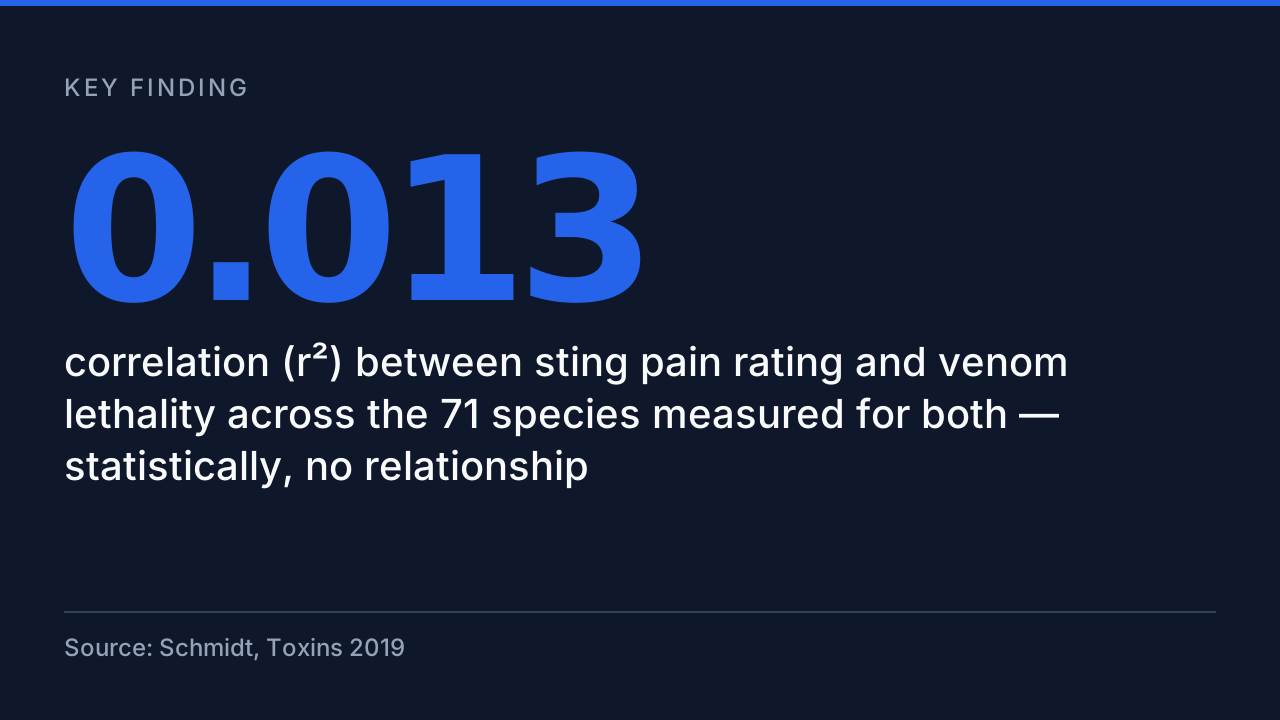
Schmidt rated sting pain for 96 species and venom lethality for 90. Joined, the two rankings are effectively unrelated — the most painful sting carries one of the weakest venoms measured, and the most toxic venoms barely hurt.
Source: Schmidt JO, Toxins 2019 (2019)
Every ranking of “dangerous” stinging insects quietly assumes that the sting which hurts most must also be the one that can kill you. Only one study has ever tested that assumption, by measuring both properties across the same set of species: entomologist Justin Schmidt rated the sting pain of 96 species of ants, wasps and bees and determined or compiled the venom lethality of 90 ((Schmidt JO, Toxins 2019, 2019)). This page prints the two lists side by side — the joined table that has never been assembled outside the journal paper — with the method and the year attached to every number.
Read the two columns as different kinds of evidence, because they are. The pain ratings are a semi-quantitative scale built from one research team’s own sting experience, anchored on the honey bee sting, and Schmidt is candid that some ratings rest on a single sting. The lethality figures are LD50 values: the venom dose, per kilogram, that killed half of a group of laboratory mice when injected intravenously. Neither column is a measurement of danger to a person — and the distance between the two columns is exactly the finding.
One warning before the numbers, because it matters more than anything in the tables: a sting does not need to hurt, and does not need to come from an exotic insect, to be life-threatening. If any sting — a honey bee’s included — is followed by difficulty breathing, swelling of the lips or tongue, dizziness or collapse, treat it as anaphylaxis: use an epinephrine auto-injector if one is available and call 911 immediately. Our guide to the warning signs of a sting allergy emergency sets out what to watch for.
No — across the species measured for both, the two rankings are effectively unrelated. Of 115 taxa evaluated, 71 carry both a pain rating and a venom lethality value, and the correlation across them is 0.013 ((Schmidt JO, Toxins 2019, 2019)), indistinguishable from zero. Ants alone give 0.028 and social wasps 0.095. The lists were compiled independently, and joined, they show it.
| METRIC | VALUE | SOURCE |
|---|---|---|
| Species measured for both sting pain and venom lethality | 71 | Schmidt JO, Toxins 2019 |
| Stinging-insect taxa evaluated in the study | 115 | Schmidt JO, Toxins 2019 |
| Genera covered by the dataset | 67 | Schmidt JO, Toxins 2019 |
| Pain–lethality regression, ants only (33 species), r² | 0.028 | Schmidt JO, Toxins 2019 |
| Pain–lethality regression, social wasps only (22 species), r² | 0.095 | Schmidt JO, Toxins 2019 |
| Pain–lethality regression, solitary bees and wasps (10 species), r² | 0.398 | Schmidt JO, Toxins 2019 |
| Mean sting pain rating, social wasps (of 4) | 2.18 | Schmidt JO, Toxins 2019 |
| Mean sting pain rating, social bees (of 4) | 1.92 | Schmidt JO, Toxins 2019 |
| Mean sting pain rating, ants (of 4) | 1.62 | Schmidt JO, Toxins 2019 |
| Mean venom LD50, social species [mouse, intravenous], mg/kg | 10.6 | Schmidt JO, Toxins 2019 |
| Mean venom LD50, solitary species [mouse, intravenous], mg/kg | 52.7 | Schmidt JO, Toxins 2019 |
Why the scatter matters: the two properties are selected for different jobs. Pain is a defence signal aimed at large vertebrate predators — it pays a social insect to be remembered. Lethality in these assays mostly tracks what a venom does to small animals, including prey. Schmidt’s own group means show the confusion clearly: social species average more painful stings (social wasps 2.18, social bees 1.92, ants 1.62) and, separately, more toxic venoms (mean LD50 10.6 against 52.7 for solitary species) — yet within every group the two traits rise independently, which is why the regressions stay flat. If you are trying to identify what stung you, start with our guide to wasps, hornets and yellowjackets rather than with either ranking.
The honest caveat belongs in the same breath: this is one dataset, assembled by one laboratory, and no second measurement of the join exists to confirm or refute it. The pain half is calibrated judgment, not instrumentation — Schmidt’s methods paper states plainly that the evaluator compares each new sting against memory of the anchor sting, and that ratings based on a single sting carry more subjectivity than those based on many. The lethality half pools values measured across decades. The join is published here because it is the only one there is, labelled as exactly what it is.
Three stings share the maximum pain rating of four: the bullet ant, the tarantula hawk wasp and the warrior wasp. Their venoms could hardly differ more. The bullet ant’s mouse LD50 is 1.4 and the warrior wasp’s is 3, while the two tarantula hawk species sit at 90 and 120 — among the least lethal venoms in the entire dataset ((Schmidt JO, Toxins 2019, 2019)). Identical pain, unrelated chemistry.
| METRIC | VALUE | SOURCE |
|---|---|---|
| Bullet ant (Paraponera clavata) — pain 4 of 4; venom LD50 [mouse], mg/kg | 1.4 | Schmidt JO, Toxins 2019 |
| Warrior wasp (Synoeca septentrionalis) — pain 4 of 4; venom LD50 [mouse], mg/kg | 3 | Schmidt JO, Toxins 2019 |
| Tarantula hawk (Pepsis grossa) — pain 4 of 4; venom LD50 [mouse], mg/kg | 90 | Schmidt JO, Toxins 2019 |
| Tarantula hawk (Pepsis thisbe) — pain 4 of 4; venom LD50 [mouse], mg/kg | 120 | Schmidt JO, Toxins 2019 |
| Cow killer velvet ant (Dasymutilla klugii) — pain 3 of 4; venom LD50 [mouse], mg/kg | 70 | Schmidt JO, Toxins 2019 |
| Harvester ants (Pogonomyrmex, 20 North American species) — pain 3 of 4; venom LD50 range [mouse], mg/kg | 0.12–0.7 | Schmidt JO, Toxins 2019 |
| Paper wasp (Polistes infuscatus) — pain 3 of 4; venom LD50 [mouse], mg/kg | 1.3 | Schmidt JO, Toxins 2019 |
| Paper wasp (Polistes annularis) — pain 3 of 4; venom LD50 [mouse], mg/kg | 11 | Schmidt JO, Toxins 2019 |
The tarantula hawk is the purest case. It is a solitary spider wasp: it has no colony to defend, it almost never stings unless handled, and its sting exists to teach a predator a lesson in a single, unforgettable instant — then everyone walks away. The velvet ant tells the same story, and recent work explains the machinery: in a 2025 study, researchers found that the scarlet velvet ant’s venom switches on insect pain-sensing channels through a single peptide, Do6a, while the pain mammals feel comes from other, weaker peptides — a deterrent toolkit, not a killing one ((Borjon et al., Current Biology 2025 (PubMed), 2025)). If a velvet ant ever stings you, our guide to what to do after a velvet ant sting covers the aftermath; the pain is severe and the venom, by the numbers above, is not the emergency.
The exceptions prove the independence of the lists. The bullet ant and the warrior wasp sit near the top of both: social or famously defensive insects whose venom genuinely is potent and whose colonies can deliver it repeatedly. And the harvester ants in the callout pair a strong pain rating with the most toxic venom band in the whole dataset. Nothing in the pain column told you any of that in advance — each of these species had to be measured, which is the point of printing the join. Note, too, that the insect Americans call the cow killer is not an ant at all: velvet ants are wingless wasps, which is why one appears in this table of wasps and solitary species.
The toxicity ranking is topped by ants whose stings sit at the bottom of the pain scale. The Old World twig ant pairs the lowest pain band with a mouse LD50 of 0.35, and the trap-jawed ant Daceton pairs the same low pain with 1.1 ((Schmidt JO, Toxins 2019, 2019)). Even the single most toxic venom in the dataset, at 0.088, belongs to a harvester ant whose sting rates only in the middle of the pain scale.
| METRIC | VALUE | SOURCE |
|---|---|---|
| Argentine harvester ant (Pogonomyrmex cunicularius) — pain 3 of 4; lowest venom LD50 in the dataset [mouse], mg/kg | 0.088 | Schmidt JO, Toxins 2019 |
| Red bulldog ant (Myrmecia gulosa) — pain 1.5 of 4; venom LD50 [mouse], mg/kg | 0.18 | Schmidt JO, Toxins 2019 |
| Ectatomma tuberculatum — pain 1.5 of 4; venom LD50 [mouse], mg/kg | 0.3 | Schmidt JO, Toxins 2019 |
| Old World twig ant (Tetraponera sp.) — pain 1 of 4; venom LD50 [mouse], mg/kg | 0.35 | Schmidt JO, Toxins 2019 |
| Trap-jawed ant (Daceton armigerum) — pain 1 of 4; venom LD50 [mouse], mg/kg | 1.1 | Schmidt JO, Toxins 2019 |
| Jack jumper ant (Myrmecia pilosula) — pain 2 of 4; venom LD50 [mouse], mg/kg | 5.7 | Schmidt JO, Toxins 2019 |
| Matabele ant (Megaponera analis) — pain 1.5 of 4; highest ant venom LD50 in the dataset [mouse], mg/kg | 128 | Schmidt JO, Toxins 2019 |
Read the top of this table correctly and it teaches the opposite lesson from the headlines. These are laboratory numbers: venom injected into mice in quantities no single sting delivers, ranking how poisonous a venom is drop for drop — not which insect is likeliest to harm a person. Several of the most toxic venoms belong to ants that use their sting mainly on other insects, where lethality is the job and a vertebrate warning signal is beside the point. A painless sting from one of these species is still a sting: broken skin, venom proteins, and the same allergic possibilities as any other.
The jack jumper ant in this table is the bridge to the final section. In the laboratory ranking it is unremarkable — mid-table for pain, mid-table for toxicity at 5.7. In Australia it is nevertheless one of the insects most associated with fatal sting allergy. Both facts are true, and they can only both be true because human danger runs on a third variable that neither of Schmidt’s columns measures: the individual immune system of the person stung.
The stings a North American reader will actually meet cluster in the middle of both lists. The honey bee — the anchor sting the entire pain scale is calibrated against — pairs its mid-range pain with a mouse LD50 of 2.8, and the German yellowjacket records exactly the same venom figure, 2.8 ((Schmidt JO, Toxins 2019, 2019)). Nothing in the backyard tops either ranking, in either direction.
| METRIC | VALUE | SOURCE |
|---|---|---|
| Honey bee (Apis mellifera) — pain 2 of 4 (the scale’s anchor sting); venom LD50 [mouse], mg/kg | 2.8 | Schmidt JO, Toxins 2019 |
| German yellowjacket (Vespula germanica) — pain 2 of 4; venom LD50 [mouse], mg/kg | 2.8 | Schmidt JO, Toxins 2019 |
| Western yellowjacket (Vespula pensylvanica) — pain 2 of 4; venom LD50 [mouse], mg/kg | 6.4 | Schmidt JO, Toxins 2019 |
| Bald-faced hornet (Dolichovespula maculata) — pain 2 of 4; venom LD50 [mouse], mg/kg | 6.1 | Schmidt JO, Toxins 2019 |
| Common eastern bumble bee (Bombus impatiens) — pain 2 of 4; venom LD50 [mouse], mg/kg | 11 | Schmidt JO, Toxins 2019 |
| Eastern cicada killer (Sphecius grandis) — pain 1.5 of 4; venom LD50 [mouse], mg/kg | 46 | Schmidt JO, Toxins 2019 |
| Red imported fire ant (Solenopsis invicta) — sting pain rating (no LD50 published in the dataset), of 4 | 1 | Schmidt JO, Toxins 2019 |
The fire ant makes the point from everyday experience: its sting rates only one for pain (1), and Schmidt’s dataset publishes no LD50 for it at all — its familiar pustules are a separate chemical story, which our fire ant bite and sting guide covers in full. At the other extreme of size, the cicada killer is one of the largest wasps in North America and one of the mildest entries here, at 46: bulk predicts neither column.
What separates the familiar species in real life is not rank but exposure and behaviour. A yellowjacket can sting repeatedly and defends a colony aggressively at exactly the season when people eat outdoors; a honey bee stings once and dies. Their identical laboratory numbers (2.8 and 2.8) say nothing about how often each one reaches a person, or about the small minority of people for whom either sting is an emergency. For the practical side, see what to do after a yellowjacket sting and our comparison of yellowjackets and honey bees.
What kills people is anaphylaxis — an individual allergic reaction, not venom strength. United States death records count an average of 72 deaths a year from hornet, wasp and bee stings, 84% of them among males ((CDC MMWR QuickStats 2023 (NVSS), 2021)), all filed under one combined category, because the deciding factor is the person’s immune system rather than the insect. The deadliest sting in practice is a pain-two honey bee sting in a sensitised person.
| METRIC | VALUE | SOURCE |
|---|---|---|
| Deaths from hornet, wasp and bee stings per year, US average 2011–2021 [measured, combined category] | 72 | CDC MMWR QuickStats 2023 (NVSS) |
| Share of those deaths among males [measured, combined category] | 84% | CDC MMWR QuickStats 2023 (NVSS) |
| Highest single-year death count in the series (2017) [measured, combined category] | 89 | CDC MMWR QuickStats 2023 (NVSS) |
| First-line treatment for anaphylaxis from any sting | Epinephrine | Mayo Clinic |
This is why the safety advice never changes with the species. Any sting, from any insect on either list — or from one too mild to appear in Schmidt’s tables at all — can trigger anaphylaxis in a sensitised person, and the reaction does not scale with how much the sting hurt. Know the warning signs after a bee sting, use epinephrine first when they appear, and know when a second EpiPen dose is needed if symptoms return or do not improve.
Two honest qualifications complete the picture. First, dose can matter in mass-stinging events: hundreds of stings from a disturbed colony are a toxic exposure in their own right, which is a different emergency from allergy and one our page on multiple bee, wasp and hornet stings separates carefully. Second, a large, angry-looking local reaction is usually not anaphylaxis — the distinction is set out in large local reaction versus anaphylaxis. But the answer to the question this article started with stands: the most dangerous sting is the one you are allergic to, it is usually an ordinary one, and no pain index can rank it for you.


How this page was built, and what could not be done. The topic came from a data-gap discovery run on this site; demand for it could not be measured from the research host (Stage 1 ran degraded — Reddit is blocked from that host and no ScrapeCreators key is configured — so the topic’s thread demand is recorded as unmeasured rather than estimated). The backlink format filter did not run (Stage 3), so this page makes no claim about which formats earn links in this niche. The existence gate was run manually against the site’s full sitemap corpus during the discovery run and returned CLEAR: the site had no pain-index or measured-comparison page. The automated recency sweep returned zero items because its platform legs are unavailable without an API key (Stage 6, degraded), so the sweep was repeated by hand with web search; it found no newer pain-and-lethality dataset and one relevant new mechanism study, which is cited. Every figure was then verified against the source it cites; the PubMed record for the 2025 velvet ant study was read and confirmed in a browser after automated fetchers were blocked by the publisher. Charts and cards are drawn locally from the fact sheet; no AI image tool was used. The limitations in the fact sheet’s methodology note — one study, a subjective pain scale, mouse lethality data — are part of the record and are stated in the article itself, not only here.
Three stings share the maximum rating of 4 on Schmidt's 1-to-4 scale: the bullet ant, the tarantula hawk wasp and the warrior wasp (Schmidt, Toxins 2019). The scale is a semi-quantitative rating built from one research team's own sting experience, anchored on the honey bee at 2 — a comparison guide, not an instrument measurement. (Schmidt JO, Toxins 2019, 2019)
By mouse LD50 — the dose that kills half of test mice — the most toxic venom in Schmidt's 2019 dataset is the Argentine harvester ant Pogonomyrmex cunicularius at 0.088 mg/kg, with North American harvester ants close behind. That is a laboratory ranking in mice, not a danger ranking for people: no insect here is 'most dangerous' on this number alone. (Schmidt JO, Toxins 2019, 2019)
No. In the only study that measured both, across 71 species with pain ratings and venom LD50 values, the correlation between the two was r² = 0.013 (P = 0.356) — statistically indistinguishable from no relationship at all (Schmidt, Toxins 2019). The most painful stings and the most toxic venoms are simply different lists. (Schmidt JO, Toxins 2019, 2019)
It is one of the most painful stings known — a maximum 4 on Schmidt's scale — but the venom itself is among the least lethal he measured, with mouse LD50 values of 90 to 120 mg/kg (Schmidt, Toxins 2019). The pain is the point: it is a warning, delivered by a solitary wasp that almost never stings unless handled. Allergic reactions are still possible with any sting, so breathing trouble always means emergency care. (Schmidt JO, Toxins 2019, 2019)
Allergy. US death records counted 788 deaths from hornet, wasp and bee stings in 2011–2021 (CDC National Vital Statistics System) — overwhelmingly anaphylaxis in sensitised people, most often after ordinary bee or wasp stings, not exotic ones. Death certificates record all of them under one combined hornet/wasp/bee category, so no per-species death ranking exists. (CDC MMWR QuickStats 2023 (NVSS), 2021)
Treat it as anaphylaxis, a medical emergency. If the person has an epinephrine auto-injector, use it immediately — epinephrine is the first-line treatment — then call 911 and get emergency care, even if symptoms ease, because a second wave can follow. Do not drive yourself. Antihistamines are not a substitute for epinephrine. (Mayo Clinic, 2026)
It is a semi-quantitative scale: ratings were scored from live stings as they happened, compared against the evaluator's memory of a honey bee sting, which is fixed at 2 as the anchor (Schmidt, Toxins 2019, Methods). Schmidt is explicit that some values rest on a single sting and carry more subjectivity than others. It is the most complete comparison that exists — and it should be read as an expert's calibrated judgment, not a laboratory instrument reading. (Schmidt JO, Toxins 2019, 2019)
Last updated:
This article is for informational purposes only and isn’t medical advice. If you’re worried about a bite or sting, talk to a healthcare professional.
Dr. Jones oversees StingHelp’s clinical verification process. Every guide is systematically evaluated against active Centers for Disease Control and Prevention (CDC), Environmental Protection Agency (EPA), and American Academy of Allergy, Asthma & Immunology (AAAAI) medical consensus standards to ensure symptom distinctions and care recommendations are clinically sound.
Explore physician-reviewed first-aid procedures, identification clues, and symptom comparisons for other common outdoor bites and stings.
# Kissing Bug vs Look-Alikes: Is This a Kissing Bug? If you found a dark bug in your bedroom at night and you are…
Introduction The direct answer is that it depends on the species, the person stung, and the circumstances. For most healthy adults in the United…
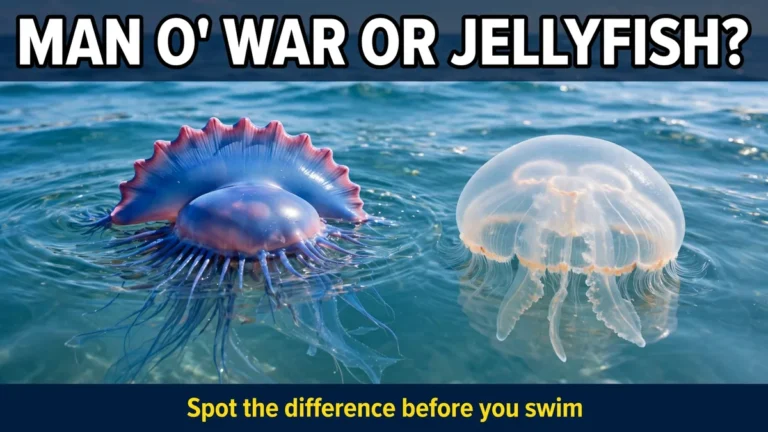
Introduction The direct answer is simple, and it matters for safety: a Portuguese man o' war is not a jellyfish, even though it is…