Skeeter Syndrome vs. Cellulitis: How to Tell a Big Mosquito Allergy From a Real Skin Infection
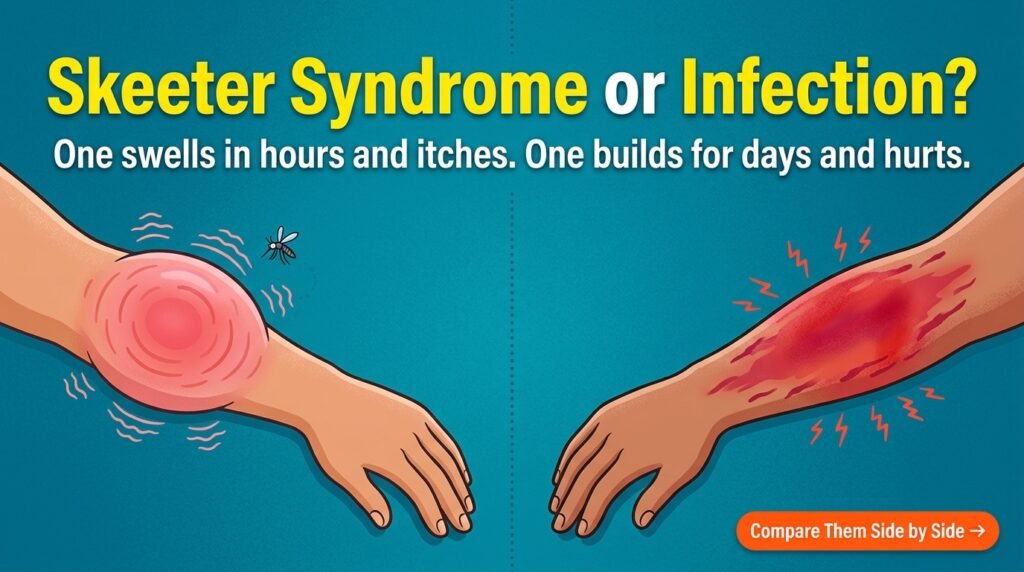
The fast answer: Skeeter syndrome is an allergic reaction to mosquito saliva. It arrives fast — swelling usually starts within about 8 to 10 hours of the bite, peaks within 24 to 48 hours, itches intensely, and then slowly settles over 3 to 10 days. Cellulitis is a bacterial skin infection. It arrives slowly — typically one to three days after the bite — hurts and feels tender more than it itches, keeps spreading, and needs antibiotics. Both can look red, hot, and dramatically swollen, and even clinicians find them genuinely hard to separate at first glance. The most reliable clues are timing, itch versus pain, and what the spot does after the 48-hour mark.
Why These Two Get Confused So Often
A parent brings in a toddler whose forearm has ballooned overnight. The skin is red, warm, and swollen hard. It looks infected — and sometimes it is. But a large share of the time, it is skeeter syndrome: an exaggerated immune reaction to proteins in mosquito saliva, not bacteria at all. The confusion runs in both directions. Skeeter syndrome is frequently treated with antibiotics it never needed, while early cellulitis is sometimes dismissed as “just a big bite reaction” until it has spread.
The stakes of sorting them out are real, because the treatments do not overlap. Antihistamines do nothing for a bacterial infection. Antibiotics do nothing for an allergic reaction. This article lays out the comparison the way clinicians actually make it — and the warning signs that mean you should stop comparing and get seen.
The Side-by-Side Comparison
| Clue | Skeeter syndrome (allergy) | Cellulitis (infection) |
|---|---|---|
| When it starts | Within hours of the bite — typically 8–10 hours | Usually 1–3 days after the bite |
| How fast it peaks | Peaks at 24–48 hours, then plateaus | No early peak — it keeps building day by day |
| Main sensation | Itch is dominant, often intense | Pain and tenderness are dominant and growing |
| Size | Can be very large — sometimes 10 cm or more across | Variable; starts at the bite and expands outward |
| The bite mark | Often a visible bump or puncture at the centre of the swelling | Centre may be a scratch, crust, or nothing obvious |
| Warmth | Warm to the touch | Noticeably hot compared with surrounding skin |
| Fever | Uncommon; if present, usually low-grade | More common, sometimes with chills and feeling unwell |
| Red streaks / pus | Not typical | Possible — streaks suggest spreading infection; pus suggests an abscess |
| Course without treatment | Improves on its own over 3–10 days | Keeps worsening without antibiotics |
| Usual treatment | Cold compresses, antihistamines, steroid cream; occasionally a short oral steroid course | Prescription antibiotics; drainage if an abscess forms |
| Who gets it | Young children, people new to an area’s mosquitoes, people prone to allergies | Anyone — risk rises with diabetes, poor circulation, weakened immunity, broken skin |
No single row settles the question. A skeeter reaction can be scratched open and then become cellulitis — the two are not mutually exclusive, and the second can grow out of the first. That is why the trend over 24 hours matters more than any one observation.
Skeeter Syndrome, Hour by Hour
Skeeter syndrome is the name for a large local allergic reaction to mosquito bites. The word “local” matters: the reaction stays at and around the bite. It is not the same as anaphylaxis, the whole-body allergic emergency, which is very rare with mosquito bites.
The typical course looks like this. A mosquito bites — the bite itself may be barely noticed. Within about 8 to 10 hours, the area begins to swell, sometimes dramatically: a bite on a child’s forearm can puff up the whole forearm and hand. The swelling peaks within 24 to 48 hours. The skin is red, warm, sometimes hard or lumpy, and the itch is intense. Some people develop a blister at the centre, and a low-grade fever or swollen nearby lymph nodes can occasionally occur. Then, over the following days, the swelling slowly deflates. Most reactions are much better within 3 to 10 days, though a faint mark can outlast the symptoms.
Who reacts this way? Most often it is young children, whose immune systems are still meeting local mosquitoes for the first time. It is also common in people who have moved to a new region — different mosquito species carry different saliva proteins, so a person can react strongly to an unfamiliar species while barely reacting at home. People with allergy-prone (atopic) immune systems and people with certain immune conditions also react more strongly. With repeated seasons of exposure, many children’s reactions gradually calm down as their immune systems learn to ignore the saliva proteins. If large reactions run in your family, our guide to skeeter syndrome in children covers the pattern in more depth.
Cellulitis, Day by Day
Cellulitis begins quietly. Bacteria that live harmlessly on the skin surface — commonly streptococcus and staphylococcus — get through the tiny break the bite created, or through scratch damage, and begin multiplying in the deeper skin layers. That takes time, which is why cellulitis typically announces itself one to three days after the bite rather than within hours.
Its character is different from the start. The area becomes tender. Pressing it hurts in a way an itchy welt does not. The redness spreads outward with a blurry edge and feels hot. As it progresses over days two, three, and four, pain builds rather than fades. Fever, chills, and a general run-down feeling may appear; red streaks can track away from the site along lymph channels; and a pocket of pus can form an abscess — a soft, increasingly painful lump that is a related but distinct problem, covered in our comparison of bug bite abscess vs. cellulitis. Unlike skeeter syndrome, cellulitis does not plateau and resolve on its own. Without antibiotics, it keeps going.
How Doctors Tell Them Apart
Clinicians making this call usually weigh the same clues in the table, in roughly this order:
- The story. Was there a known mosquito bite, outdoors, hours before the swelling? A visible bite bump sitting at the exact centre of the swelling strongly favours an allergic reaction.
- The clock. Swelling that was already large within the first day points to allergy. Trouble that starts on day two or three, or a bite that was improving and then worsens, points to infection.
- Itch versus pain. Itch-dominant favours allergy. Pain- and tenderness-dominant favours infection.
- The trajectory. Doing better, even slowly, after 48 hours favours allergy. Still expanding after 48 hours favours infection.
- The whole person. A child who is playing, eating, and afebrile with a huge itchy arm is a different picture from a child who is feverish, miserable, and guarding a painful leg.
Even with all five, there is an honest grey zone — especially in the first day, when a big allergic reaction and a young infection can look identical. In that zone, clinicians may mark the edge of the redness with a pen, give clear return precautions, and recheck in 24 hours; or, if infection can’t be excluded, prescribe antibiotics while treating the allergic component too. That is not indecision — it is the safe way to handle genuine overlap. If antibiotics are started, our guide to bug bite infection and cellulitis antibiotics explains what to expect from the first few days of treatment.
Treatment Differences That Matter
For skeeter syndrome
- Cold compresses for 10–15 minutes at a time calm swelling and itch. Ice, not heat — heat dilates blood vessels and can feed the inflammation.
- Oral antihistamines such as cetirizine or loratadine, per label directions, are the mainstay for itch. For children, follow age and weight directions and check with your pediatrician for the youngest kids.
- Steroid cream — over-the-counter 1% hydrocortisone for milder reactions; clinicians may prescribe a stronger topical steroid for very large ones.
- Elevation of a swollen limb helps fluid drain.
- For severe reactions — for example an eyelid swollen shut — a clinician may add a short course of oral corticosteroids.
- Antibiotics are not part of the treatment unless there are signs of actual infection.
For cellulitis
- Prescription oral antibiotics are the core treatment, taken for the full prescribed course.
- Mark the border of the redness and note the time; clinicians use this to judge whether the antibiotic is winning.
- Rest and elevation support the medication.
- An abscess (a pocket of pus) may need to be drained — antibiotics alone cannot always reach inside one.
- Antihistamines can still help itch, but they are not treating the infection, and improvement in itch should not be mistaken for the infection retreating.
The Red-Flag List: Stop Comparing and Get Seen
Whichever side of the comparison your bite falls on, these signs mean prompt medical care — same day at minimum, emergency care for the severe ones:
- Redness spreading quickly, or still expanding after 48 hours.
- Pain that is growing, or pain that seems out of proportion to how the skin looks.
- Fever, chills, or feeling generally ill.
- Red streaks moving away from the bite toward the armpit or groin.
- Pus, a soft painful lump, blistering, or skin turning dark or numb.
- Swelling involving the eye, lips, tongue, or face, or any trouble breathing — treat this as an emergency and call 911.
- The person has diabetes, poor circulation, a weakened immune system, or is a young infant — lower the threshold and go earlier.
Frequently Asked Questions
Can skeeter syndrome cause a fever?
Occasionally, yes — a low-grade fever can accompany a large reaction, and swollen lymph nodes near the bite can occur too. But fever is more characteristic of infection, and a higher fever, chills, or a fever that arrives on day two or three rather than with the swelling should push you toward getting assessed for cellulitis.
My child’s whole leg is swollen from one mosquito bite. Is that really “just” an allergy?
It can be. Skeeter syndrome swelling can exceed 10 cm and make an entire limb look puffy, and it is most common in exactly that situation — a young child meeting local mosquitoes. The reassuring pattern is fast onset (within hours), dominant itch, a peak within 24–48 hours, and a child who is otherwise well. If instead the leg is increasingly painful, hot, and spreading on day three, that is the cellulitis pattern, whatever the original bite was.
How long does skeeter syndrome last compared with cellulitis?
Skeeter syndrome typically improves within 3 to 10 days with simple home care. Cellulitis, once antibiotics are started, usually begins to feel better within two to three days, though redness can look slightly worse on the first day of treatment before it turns the corner. Untreated cellulitis does not have a “wait it out” timeline — it progresses.
Can a skeeter syndrome reaction turn into cellulitis?
Yes. The conditions are not mutually exclusive. A large, itchy reaction invites scratching; scratched-open skin lets bacteria in; and an infection can develop on top of the allergy a few days in. That is one reason clinicians take a “was improving, now worsening again” history seriously, and why keeping nails short and resisting scratching genuinely matters.
Will an antibiotic help my big bite reaction go down faster?
If the reaction is purely allergic, no — antibiotics have no effect on it, and taking them unnecessarily risks side effects and contributes to antibiotic resistance. If there are infection signs, antibiotics are essential. This is exactly the judgement the comparison above is meant to support — and when you can’t tell, having a clinician make that call is the right move.
Why did I suddenly start reacting hugely to mosquito bites as an adult?
A common reason is a change in exposure: moving to a new area, travelling, or a new mosquito species nearby. Your immune system may be unfamiliar with that species’ saliva proteins and overreacts until it learns them. New large reactions can also appear with changes in immune health, which is one more reason a first-ever dramatic reaction in an adult is worth mentioning to your doctor.
This article explains how the two conditions are distinguished; it cannot diagnose your bite. Big swelling near the eye, on an infant, or in anyone with immune problems deserves an in-person assessment rather than a comparison chart.
By Dr. Sarah Jones