Insect stings are a documented occupational hazard in American agriculture, not just a summertime annoyance. A fatality investigation by California’s FACE Program, part of the NIOSH Fatality Assessment and Control Evaluation network, describes a date palm orchard worker who died from anaphylactic shock after being stung repeatedly by bees while spraying from an elevated work bucket. He had no epinephrine auto-injector with him. His coworkers had not been trained on insect hazards, and nobody knew a hive was hidden in the orchard. The case of bee wasp attacks on farmworkers in fields is recorded in federal safety literature precisely because every contributing factor was preventable.
Farm work puts people in sustained, close contact with the places stinging insects live: flowering crops, orchards, irrigation ditches, fence lines, barns, and equipment sheds. This guide covers why fields are high-risk, how to assess a work area before the shift starts, the escape protocol when a nest is disturbed, allergy planning for crews, and what employers owe their workers under safety guidance.
A Documented Workplace Danger
Stinging-insect deaths in agriculture appear in federal fatality records, OSHA accident reports, and NIOSH Fatality Assessment and Control Evaluation investigations. The pattern repeats: a worker disturbs a hidden hive or ground nest, often with machinery; the insects defend the colony; and a worker with an undiagnosed or unmanaged allergy suffers a severe reaction far from medical help.
The 2018 California FACE investigation report is instructive because it names the failures plainly. No prescription epinephrine was available. No hazard assessment had been done before work began. Workers had not been trained on insect sting hazards or first aid. The report’s recommendations are the backbone of field safety: workers with sting allergies should carry prescribed epinephrine at all times, employers should assess work areas for hives and nests before work begins, hives should be removed by professional services, and crews should be trained in sting response and first aid, including auto-injector use.
Stings are classified as injuries on the OSHA Form 300, which means they are recordable workplace incidents, not trivial events. Treating them as a real hazard is the first step; the sections below make it practical.
Why Fields Are High-Risk Ground
Several features of farm work concentrate sting risk in ways office workers never face.
Flowering Crops Draw Foragers
Orchards, berry fields, and flowering row crops attract honeybees and wasps all day. Harvest crews working among blossoms are surrounded by foraging insects that are normally docile but become defensive near a nest.
Hidden Nests Meet Machinery
Ground-nesting yellowjackets build in old rodent burrows, irrigation berms, and field edges. Mowers, trimmers, harvesters, and even string trimmers vibrate the ground and agitate colonies. A crew member on foot may step directly onto a nest entrance. Barns, equipment sheds, and pump houses host paper wasp nests under eaves and inside dark corners.
Long Hours Far From Help
Field crews work long shifts in remote areas where the nearest clinic may be many minutes away. A severe allergic reaction that would be survivable near a hospital becomes far more dangerous when help is distant. Heat, exertion, and dehydration can also mask the early signs of a reaction, since dizziness and nausea overlap with heat illness.
Sweet Drinks and Food Waste
Sodas, sports drinks, and lunch waste attract wasps to break areas and equipment cabs. Open cans are a classic sting site, with a wasp crawling inside unnoticed. Crews should drink from resealable containers and keep food waste contained. The outdoor worker insect bite and sting prevention guide covers these daily-habit protections in more detail.
Pre-Work Hazard Assessment

NIOSH’s central recommendation is a hazard assessment before work begins. For a crew leader, this is a morning walk, not a paperwork exercise.
Walk the Work Area
Before the shift, walk the field or orchard block and look for signs of nesting: steady streams of insects entering and exiting a single hole in the ground, papery nests under eaves or in sheds, and heavy flight traffic around a particular tree or structure. Mark any suspect area and keep the crew clear of it until it is evaluated.
Note the Machinery Plan
Identify which tasks will vibrate the ground or disturb vegetation: mowing, tilling, trimming, and harvesting near field edges and ditch banks. These are the moments nests get hit. Brief the operators on what to watch for and what to do if insects boil out of the ground.
Confirm Communication and Transport
Make sure every crew has a working phone or radio, knows the address or GPS pin of the work site for 911 calls, and knows which vehicle is designated for emergency transport. In remote fields, the minutes spent figuring out “where are we” during an emergency are minutes a severe reaction does not allow.
Remove, Don’t Disturb
If a hive or nest is found in the work area, it should be removed by a professional bee removal or pest control service, not by the crew. Workers should never be asked to knock down, spray, or dig out a nest as part of their duties.
Personal Protection for Field Crews
Clothing and behavior choices reduce both the chance of attracting insects and the severity of encounters.
- Wear light-colored, smooth clothing. Khaki, beige, and light blue attract less attention than bright colors, floral patterns, or black, which some species treat as a threat. Long sleeves, long pants, and closed boots cover skin.
- Skip the scents. Perfume, cologne, scented lotions, and strongly scented soaps attract foraging insects. Banana-scented products deserve special caution: bananas contain a compound also found in honeybee alarm pheromone.
- Cover up near known activity. Where work must continue near foraging areas, a beekeeper-style hat with netting protects the head, neck, and shoulders. Tape pant legs to boots where wasps are active.
- Eat and drink carefully outdoors. Keep food covered, use wide-mouth or resealable drink containers, and look before every sip.
- Never swat. Swatting or fast movements provoke stings. If a single insect investigates, stay calm, let it leave, or walk away slowly.
Power equipment deserves a specific warning repeated across safety sources: mowers, trimmers, blowers, and chainsaws agitate bees and wasps and can trigger swarming. Operators should stay alert for the loud, agitated buzzing that signals a disturbed colony.
The Attack Response: When a Nest Is Disturbed
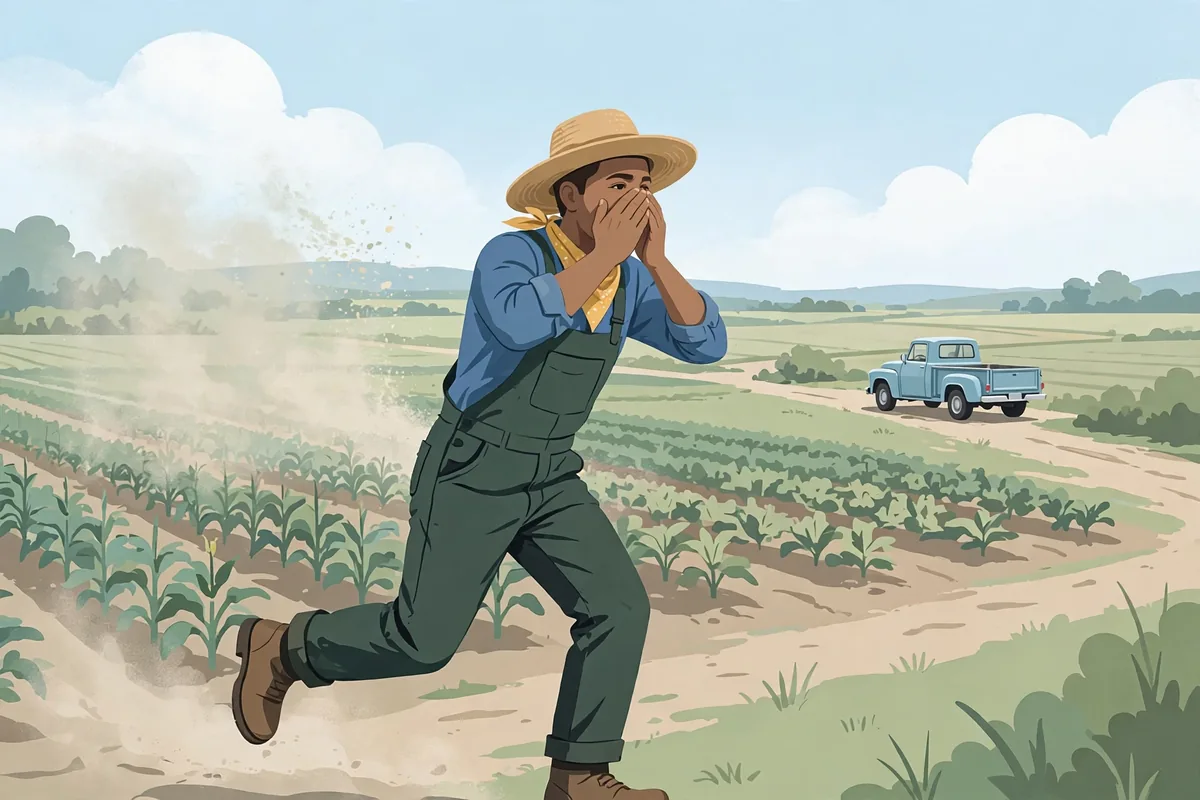
This is the protocol every crew member should know by heart, because it has to work under panic.
Protect Your Face and Run
If you disturb a nest or hive and hear loud, wild buzzing, protect your face and nose with your hands and run away from the area immediately. Run in a straight line, as fast as you can, toward shelter: a vehicle, a building, or dense shade. Bees and wasps defend a zone around the nest; putting distance between yourself and that zone ends most attacks. Covering the face matters because stings to the eyes, nose, and mouth are the most dangerous.
Do Not Jump in Water
Safety sources are explicit on this point. Some bees, particularly Africanized honeybees, are attracted to water and will hover above the surface waiting for you to come up for air. Running to shelter beats hiding in a pond or ditch every time.
Do Not Stop to Help Until You Are Clear
The instinct to help a stung coworker is strong, but entering the defensive zone to assist usually creates a second victim. Get clear first, then call for help and assist from safety. Once away, brush off or scrape away any attached stingers quickly, since attached honeybee stingers continue pumping venom.
After the Attack
Account for every crew member. Anyone with multiple stings needs monitoring even without allergy symptoms, because venom load itself can cause serious illness. Call 911 for any sign of a severe reaction, and get stung workers evaluated rather than sending them back to the field on the assumption that they are fine.
EpiPen and Allergy Planning for Crews
Allergy planning is where the NIOSH case failed most clearly, and it is the cheapest part of the program to fix.
Know Who Is Allergic
Workers with a known sting allergy should tell their supervisor and crew, wear medical identification stating the allergy, and keep their prescribed epinephrine auto-injector on their person at all times in the field, not in a locker or vehicle. A prescription requires a clinician visit; it cannot be improvised after the fact.
Train the Crew
Coworkers should know where each allergic worker keeps their auto-injector and how to help use it in an emergency. A five-minute demonstration during a morning safety talk covers it. Training should also cover the signs of anaphylaxis: difficulty breathing, throat or tongue swelling, widespread hives, wheezing, dizziness, or a sudden drop in blood pressure.
Employers Have Duties
Agricultural employers should include insect sting hazards in safety training, keep first-aid supplies stocked, ensure emergency communication works in the fields, and have a written plan for severe reactions. Stings are recordable injuries, and a crew that has rehearsed the response is a crew that survives the real thing. Broader guidance on handling many stings at once, including venom-load illness distinct from allergy, is covered in the multiple stings allergy and venom guide.
First Aid for Field Stings

For ordinary single stings without allergic symptoms, field first aid is straightforward.
Immediate Steps
Move away from the area first. Remove any visible stinger by scraping with a fingernail or gauze; speed matters more than method. Wash the sting with soap and water and apply a cool compress to reduce pain and swelling.
Symptom Relief
An over-the-counter pain reliever or antihistamine may ease pain and itching, used according to package directions. Calamine lotion can help with itching. These address comfort, not allergy; they do not treat anaphylaxis and must never replace epinephrine or emergency care when severe symptoms appear.
Monitor, Don’t Dismiss
Keep the stung worker under observation for at least 30 minutes, longer after multiple stings. Delayed reactions happen. Anyone who feels unwell, develops spreading hives, or shows any breathing difficulty after a sting needs emergency care immediately, not a wait-and-see approach.
When to See a Doctor for a Sting
Call 911 immediately for any sign of anaphylaxis: difficulty breathing, throat or tongue swelling, widespread hives, wheezing, vomiting, dizziness, fainting, or a sense of doom after a sting. Use prescribed epinephrine as directed and still seek emergency evaluation afterward, since symptoms can return.
Seek urgent or same-day medical care for:
- Multiple stings, roughly ten or more, even without allergic symptoms, because of venom load
- Stings inside the mouth or throat, or near the eye
- A large local reaction with swelling that crosses a joint or keeps expanding after 48 hours
- Signs of infection developing a day or more later: increasing pain, warmth, pus, red streaks
- Any sting in a worker with a known venom allergy, even if this reaction seemed mild
| Situation | Response | Why |
|---|---|---|
| Single sting, local pain only | Field first aid, monitor 30 min | Normal course, low risk |
| Multiple stings, no allergy signs | Medical evaluation same day | Venom load can cause systemic illness |
| Any anaphylaxis sign | Call 911, epinephrine if prescribed | Minutes matter; can be fatal |
| Known allergy, any sting | Emergency evaluation | Reactions escalate unpredictably |
Frequently Asked Questions
How common are bee and wasp deaths among farmworkers?
Exact counts are hard to pin down because incidents are recorded across different systems, but federal safety agencies document sting fatalities in agriculture through NIOSH investigations and OSHA reports. The risk is real enough that both agencies publish specific guidance for outdoor workers.
Should farmworkers carry EpiPens even without a known allergy?
Epinephrine auto-injectors require a prescription, so this is a conversation for each worker’s clinician. Workers with any history of strong sting reactions should absolutely discuss it with a doctor. Employers can support this by making clinic access part of onboarding.
What is the safest way to run from attacking bees?
Protect your face with your hands and run in a straight line away from the nest toward shelter, a vehicle, a building, or shade. Do not swat, do not jump into water, and do not stop until you are well clear of the defensive zone.
Do bee suits make sense for regular farm work?
Full bee suits are impractical for daily field labor, but beekeeper-style veiled hats are reasonable where work continues near known foraging or nesting areas. The bigger protections are hazard assessment, nest removal by professionals, and crew training.
Who is responsible for sting safety on a farm?
Both. Employers must assess hazards, train crews, remove nests professionally, and plan for emergencies. Workers must report allergies, carry prescribed epinephrine, follow the escape protocol, and never disturb nests themselves.
Medically reviewed by Dr. Sarah Jones, MD.
This article is for informational purposes only and isn’t medical advice. If you’re worried about a bite or sting, talk to a healthcare professional.