
Crab Lice vs Head Lice: How to Tell Them Apart
Introduction: The Short Answer Crab lice and head lice are two different types of lice that live on different parts of the body, and…
A big brown spider darts across the lawn, or freezes on your hallway floor, and the question hits instantly: grass spider vs wolf spider, which one is it, and should…

A big brown spider darts across the lawn, or freezes on your hallway floor, and the question hits instantly: grass spider vs wolf spider, which one is it, and should I be worried? Both are large, brown, fast, and common across the United States, so the confusion is completely understandable. The good news is that telling them apart is easier than it looks, and neither one is considered dangerous to people.
This guide walks through the fastest identification tests, detailed profiles of each spider, a side-by-side comparison, close-up field marks like eyes and spinnerets, honest bite-risk information, and what to do when one shows up indoors.
If you want one test that settles most cases, look at where the spider is and whether a web is involved. This single check separates the two more reliably than size, color, or speed.
Grass spiders, members of the funnel-weaver family, build flat sheet webs with a distinctive funnel-shaped retreat at one end. On a dewy morning these webs are easy to spot stretched across the lawn, between grass stems, in ground cover, or along foundation edges. The spider waits at the mouth of the funnel and darts out to grab insects that land on the sheet, then drags them back inside. If the spider you are watching lives in a funnel web, it is a grass spider, or at least a close funnel-weaver relative, and not a wolf spider.
Wolf spiders do not build webs to catch prey. They are active hunters that roam the ground, under leaf litter, along garden beds, and sometimes across indoor floors, chasing down insects on foot. A large brown spider sprinting across open ground or a patio with no web anywhere in sight is behaving exactly like a wolf spider. This behavioral split is so consistent that spider-identification sources call the web the deciding factor between the two.
Grass spiders belong to the funnel-weaver family, and the American grass spiders sit in the genus Agelenopsis. They are built for a sit-and-wait lifestyle on their silk sheets.
A grass spider has a somewhat slender, elongated body, usually around half an inch to three-quarters of an inch in body length, with legs that can make it look considerably larger. The coloring is brown, tan, or gray with lengthwise stripes, often a pair of dark stripes running down the back. The single most recognizable feature is at the rear: two long, finger-like spinnerets that stick out behind the abdomen like a pair of tiny tails. Most other common spiders have short, stubby spinnerets, so prominent long ones are a strong grass-spider clue.
Grass spiders live outdoors in lawns, meadows, garden beds, hedges, and ground cover, anywhere a horizontal sheet can be anchored between stems. They are extremely fast runners but prefer to stay in their webs, retreating deep into the funnel at the slightest disturbance. They are shy around people and almost never leave the web voluntarily. Their webs do no damage to grass, and each funnel represents steady removal of flies, mosquitoes, leafhoppers, and other lawn insects, which is why there is generally no reason to destroy them.
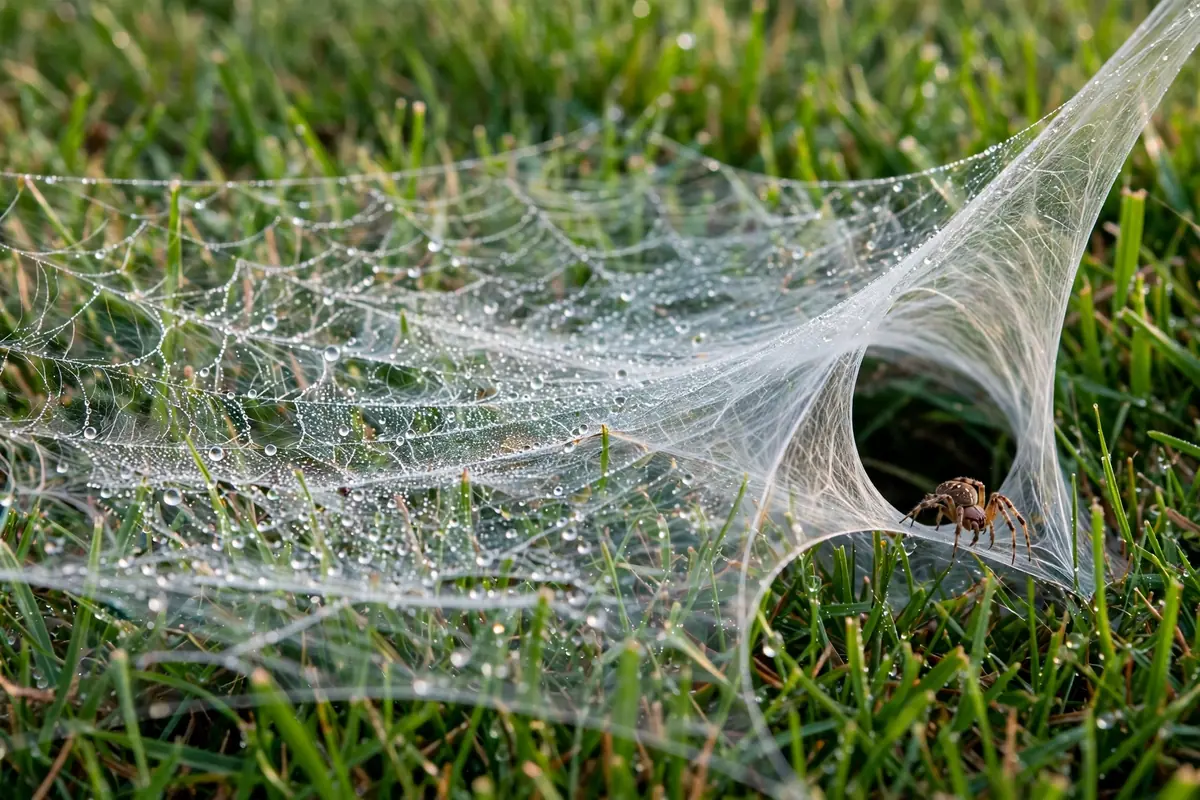
Wolf spiders belong to the hunting family Lycosidae, named for the ancient Greek word for wolf. Everything about their build serves an active, roaming lifestyle.
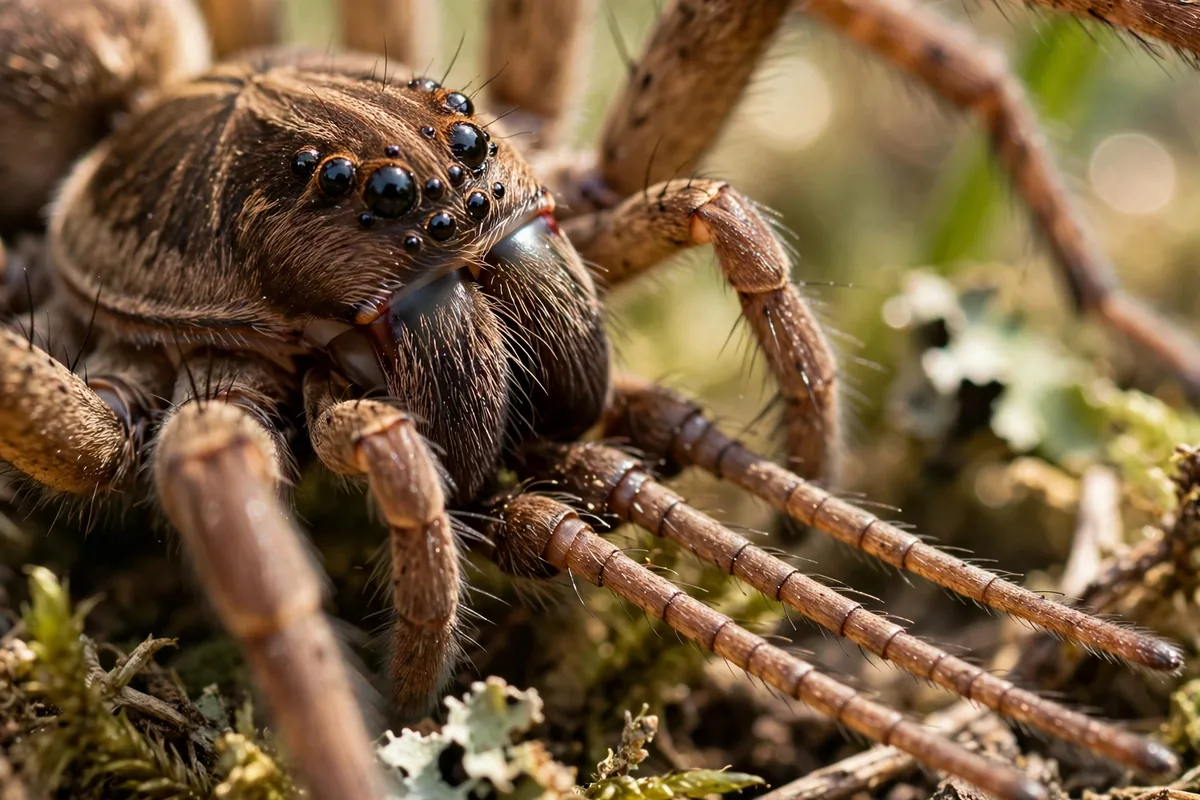
Wolf spiders are stockier and more robust than grass spiders, with a rounded, hairy body and powerful legs. Body length runs from about a quarter inch in small species up to an inch and a half in the largest, and big females with a wide leg span can look startling. Their coloring is mottled brown, gray, tan, or black, excellent camouflage against soil and leaf litter. Their eyes are the standout feature: eight eyes in three rows, with two very large forward-facing eyes that are hard to miss up close and that reflect flashlight or headlamp beams as bright eyeshine at night.
Wolf spiders hunt on foot and use no web at all, relying on speed and excellent eyesight to run down prey. They live in grasslands, woodlands, gardens, and deserts, and they are the spider most likely to wander indoors in search of prey or shelter, especially in fall. Female wolf spiders are famous mothers: they carry a round egg sac attached to their spinnerets and, after hatching, the spiderlings cling to the mother’s back for days. If you ever see a large spider with a ball of silk trailing behind it or dozens of tiny spiderlings riding on its back, you are looking at a wolf spider, and no other common spider does this.
| Feature | Grass Spider | Wolf Spider |
|---|---|---|
| Family | Funnel weavers | Wolf spiders, active hunters |
| Web | Flat sheet with a funnel retreat, the signature clue | No prey web at all |
| Body build | Slender, elongated | Stocky, robust, hairy |
| Spinnerets | Long and prominent, sticking out behind like twin tails | Short, not noticeable |
| Eyes | Eight small eyes in two rows, not prominent | Eight eyes in three rows with two very large forward-facing eyes |
| Back markings | Lengthwise stripes common | Mottled camouflage pattern, no consistent stripes |
| Hunting style | Waits in the funnel, darts out to grab prey | Roams and chases prey on foot |
| Reaction to disturbance | Retreats deep into the funnel | Runs away fast, or stands its ground |
| Egg care | Egg sac guarded in the web area | Carries the egg sac on her spinnerets; babies ride on her back |
| Typical location | Lawns, grass, ground cover, foundation edges | Ground, leaf litter, gardens, and frequently indoors |
| Bite risk to humans | Very low; shy, stays in the web | Low; may bite if handled or pressed against skin |
When the web test is not available, for instance with a spider found indoors, close-up features can still settle the question.
Eye arrangement is the most technical but most definitive field mark. Wolf spiders have eight eyes in three rows: four small eyes along the bottom, two large middle eyes, and two more on top. The two big forward-facing eyes are so prominent that they catch the light, which is why wolf spiders famously show eyeshine in a flashlight beam at night. Grass spiders have eight smaller, less noticeable eyes set in two transverse rows of four. Some sources describe slight variations in how these rows read at a glance, so treat the eyes as one clue among several rather than the only one.
Flip the comparison to the rear end and the answer is often instant. Grass spiders have unusually long spinnerets that project well behind the abdomen, visible even in a quick photo. Wolf spiders have short spinnerets that barely show. In practice, long visible twin tails plus a funnel web nearby is a confident grass-spider identification.
A striped back on a slender body leans grass spider. A bulky, hairy, mottled spider with big forward eyes leans wolf spider. Remember that color alone is the weakest clue: both spiders wear the same brown-gray camouflage palette, and individual spiders vary. Build, eyes, spinnerets, and web behavior together give a far more reliable answer than color ever will.
This is the question behind the question, and the answer is reassuring for both species. Neither grass spiders nor wolf spiders are considered medically significant to humans. Both have venom, as nearly all spiders do, but it is tuned for subduing small insects, not for harming people, and serious effects in humans are not established.
Grass spider bites are rare because the spiders are shy, stay in their webs, and avoid contact. On the unusual occasion that a bite happens, reported effects are mild and local: minor pain, redness, and swelling that fade on their own. Evidence for anything beyond that is limited.
Wolf spider bites are also uncommon and usually happen when a spider is handled roughly, trapped in clothing, or pressed against skin. The bite is often compared to a bee sting: brief pain with redness and swelling that resolves within a day or two. As with any bite, an individual allergic response is possible but not typical. For guidance on caring for a bite from this species, see our wolf spider bite treatment page, and for general spider bite context, the spider bites hub and house spider bite treatment guide are useful next reads.
One caution: grass spiders are funnel weavers, and the hobo spider is a different funnel-weaver species found in the Pacific Northwest. They are not the same spider, and an ID that says grass spider should not be read as a hobo spider. If you are in the Northwest and unsure, a clear photo compared against regional extension resources is the way to settle it.
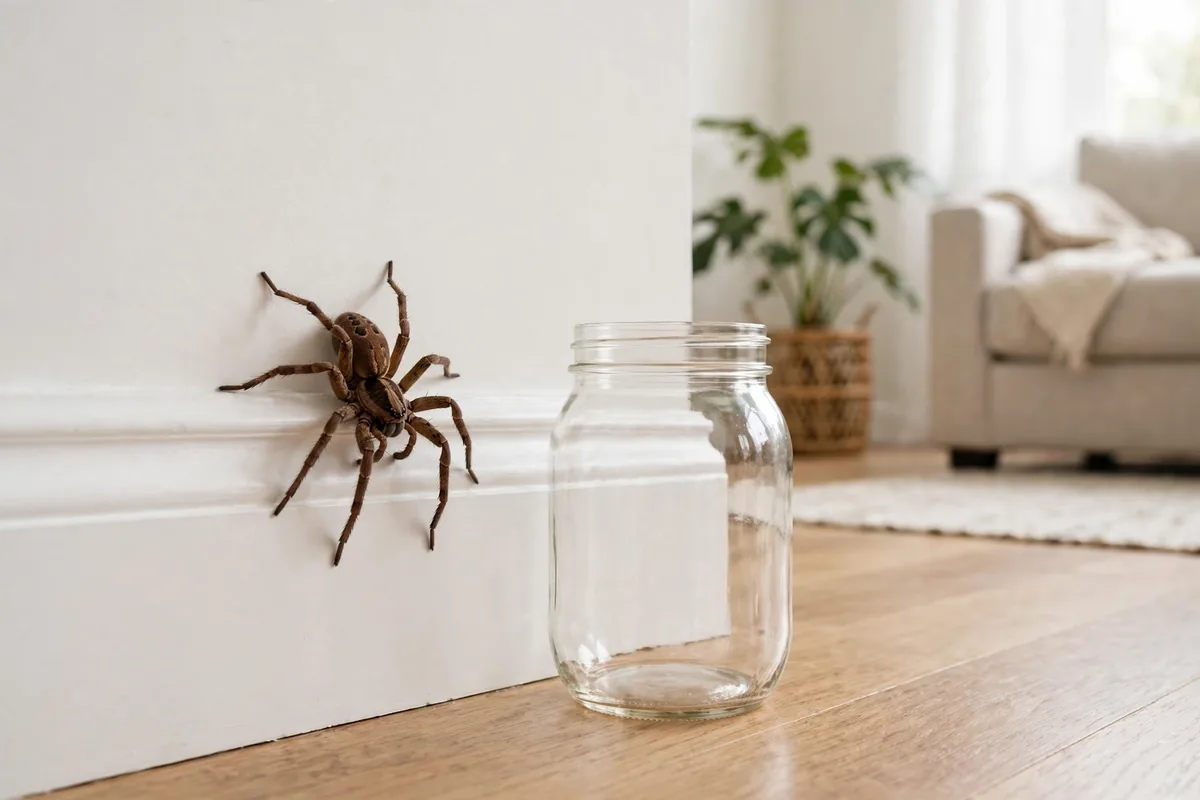
A large spider on the living-room floor is startling, but it is a manageable situation. Indoors, it is most often a wolf spider, since grass spiders rarely leave their outdoor webs. Keep your distance, place a jar or cup over the spider, slide a stiff card underneath, and release it outside away from the house. Avoid handling it with bare hands, not because the bite is dangerous, but because a trapped spider may bite defensively and there is no reason to invite it.
To make the house less inviting, seal gaps around doors and windows, reduce clutter where spiders hide, and trim back vegetation touching the foundation. Insect screens and door sweeps cut down both the spiders and the insects they hunt. Chemical sprays are rarely needed for the occasional wandering spider, and keeping a tidy perimeter does more over time.
Most bites from either spider need nothing more than cleaning and a cold compress. Get medical care promptly for any of the following:
How can I tell a grass spider from a wolf spider quickly?
Check for a web. A flat sheet web with a funnel retreat means a grass spider. No web and a spider hunting on open ground means a wolf spider. Long rear spinnerets confirm a grass spider; two big forward-facing eyes confirm a wolf spider.
Which is bigger, a grass spider or a wolf spider?
Wolf spiders are generally the bulkier of the two, with large species reaching about an inch and a half in body length. Grass spiders are usually smaller and more slender, around half to three-quarters of an inch in body length. Size overlaps between species, so use the web, eyes, and spinnerets rather than size alone.
Are grass spiders or wolf spiders poisonous to humans?
Neither is considered dangerous to people. Both have venom for subduing insects, but it is not medically significant to humans. Bites are rare and typically cause only mild, temporary pain, redness, and swelling.
Do grass spiders come inside houses?
Rarely. Grass spiders are tied to their outdoor funnel webs in lawns and ground cover and seldom wander indoors. A large brown spider found inside the house is much more likely to be a wolf spider, which roams in search of prey.
Why do wolf spider eyes glow at night?
Their large forward-facing eyes reflect light, the same eyeshine effect you see in many nocturnal animals. Shining a flashlight across a lawn at night and watching for pairs of glowing dots is actually a well-known way to spot hunting wolf spiders.
Can a wolf spider bite through clothing?
Bites usually happen when a spider is pressed directly against bare skin, such as when trapped in a sleeve or stepped on barefoot. A bite through normal clothing is unlikely. Shaking out clothes and shoes stored in garages or basements is a simple precaution.
Medically reviewed by Dr. Sarah Jones, MD.
This article is for informational purposes only and isn’t medical advice. If you’re worried about a bite or sting, talk to a healthcare professional.
Dr. Jones oversees StingHelp’s clinical verification process. Every guide is systematically evaluated against active Centers for Disease Control and Prevention (CDC), Environmental Protection Agency (EPA), and American Academy of Allergy, Asthma & Immunology (AAAAI) medical consensus standards to ensure symptom distinctions and care recommendations are clinically sound.
Explore physician-reviewed first-aid procedures, identification clues, and symptom comparisons for other common outdoor bites and stings.

Introduction: The Short Answer Crab lice and head lice are two different types of lice that live on different parts of the body, and…
# No-See-Um Bites vs Flea Bites: Key Differences If your ankles and lower legs are covered in clusters of intensely itchy red welts and…

# Pavement Ant vs Fire Ant: Sting Risk Compared You spot small ants trailing along your sidewalk and a little mound of soil in…