
Crab Lice vs Head Lice: How to Tell Them Apart
Introduction: The Short Answer Crab lice and head lice are two different types of lice that live on different parts of the body, and…
# Pavement Ant vs Fire Ant: Sting Risk Compared You spot small ants trailing along your sidewalk and a little mound of soil in the grass, and the question hits…
# Pavement Ant vs Fire Ant: Sting Risk Compared
You spot small ants trailing along your sidewalk and a little mound of soil in the grass, and the question hits fast: are these fire ants? Here is the direct answer: in most of the United States, the ants along your pavement are pavement ants, which rarely sting people and are mostly a nuisance. Imported fire ants are the ones with the real sting risk, and they look and behave differently once you know the tells. This guide compares the two side by side, walks you through a five-minute yard ID test, and explains what to do if you get stung.
Pavement ants (Tetramorium caespitum and closely related species) are small, dark ants found across most of the continental United States that nest under sidewalks, driveways, and foundations. They can bite and some workers carry a small stinger, but the stinger is usually too weak to pierce human skin, and they rarely sting people at all. Imported fire ants (Solenopsis invicta) are aggressive, venomous ants concentrated in the southeastern United States that both bite and sting, injecting venom that causes burning pain and the white pustules they are famous for. If you live outside the Southeast and your ants are trailing along pavement cracks, pavement ants are the overwhelmingly likely answer, and the reassuring one.
Pavement ants are small, about 2.5 to 4 mm long, dark brown to black with paler legs. Up close, under a magnifier, they show distinctive grooves on the head and thorax, stiff hairs over the body, small spines on the thorax, and a two-segmented waist (two nodes between thorax and abdomen). Workers are all about the same size. They are easy to confuse with other small dark ants at a glance, which is why mound shape and behavior matter more for a quick ID than body details.
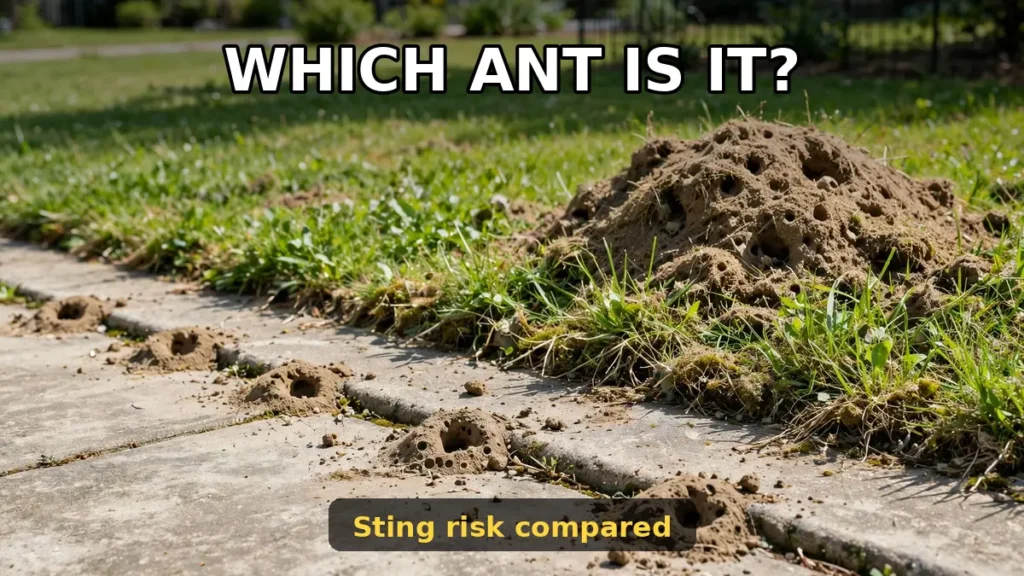
True to their name, pavement ants nest under pavement, pavers, rocks, and foundations, excavating soil that they push up through cracks. Their mounds are modest: small, crater-shaped piles of fine soil around a clear center opening, usually just an inch or two across and fairly flat, like a tiny ring of sand. You will find them along sidewalk cracks, between pavers, and in bare dirt patches. Foraging workers form visible trails to food, and they readily come indoors for sweets and proteins, making them one of the most common kitchen ants in the country. Colonies are modest by ant standards, typically a few thousand workers, and the ants tend to stay calm when disturbed, scattering rather than attacking.
Pavement ants possess a stinger, but multiple pest and extension sources agree it is usually too small to penetrate human skin, and their venom is not potent in people. (Formic acid is a defense of a different ant subfamily, the formicines; pavement ants are myrmicine ants and deliver only a weak venom through their stinger.) They can bite with their mandibles if severely provoked, but painful encounters are uncommon. A sting, where the skin is thin enough for the small stinger to penetrate, can cause mild burning or itching from the weak venom. They do not transmit diseases to people. People with ant venom allergies should still take any sting seriously, but for the general public, pavement ants are a nuisance pest, not a medical one.

Imported fire ants are medium-sized ants, with workers ranging from about 2 to 6 mm because the colony produces different worker sizes. They are reddish-brown with a darker abdomen, and they carry a prominent stinger. Like pavement ants they have a two-segmented waist, but they lack the grooves and head shape of pavement ants; their head is narrower than the abdomen. The size variation among workers in a single trail is itself a useful clue: pavement ant workers are uniform, while fire ant workers vary noticeably.
Fire ant mounds are the giveaway. They build large, fluffy, dome-shaped mounds of loose soil that can rise a foot or more, with no visible central entrance hole (unlike most other ant mounds), in open sunny ground or low grass. Compare that to the flat, tiny crater hills of pavement ants and the difference is obvious at ten paces. Imported fire ants are concentrated in the southeastern United States, ranging from Texas across the Gulf states and up the Atlantic coast; cold limits their spread. They infest a broad southern band of the country, from southern California and the Gulf states to Florida and up the Atlantic coast to about Virginia, which is why a small dark ant in the Northeast, Midwest, or West is almost never a fire ant. If you are in the Northeast, Midwest, or West, a small dark ant on your sidewalk is not a fire ant.
Fire ants are famously aggressive defenders. Disturb a mound and workers pour out fast, climbing up whatever touched them and stinging repeatedly. They grip with their jaws and pivot, injecting venom with the stinger, which produces immediate burning pain. Within about a day, stings typically develop into white, pus-filled pustules, the signature sign of a fire ant encounter. Colonies are huge, often hundreds of thousands of workers with multiple queens, which is why a single mound deserves respect. For detailed sting care, see the guide on fire ant bite treatment.
| Feature | Pavement ant | Imported fire ant |
|---|---|---|
| Scientific name | Tetramorium caespitum (and relatives) | Solenopsis invicta |
| Size | 2.5 to 4 mm, uniform workers | 2 to 6 mm, workers vary in size |
| Color | Dark brown to black, pale legs | Reddish-brown, darker abdomen |
| Close-up tells | Grooves on head and thorax, thorax spines, stiff hairs | No grooves, head narrower than abdomen, prominent stinger |
| Range in the US | All 50 states | Mainly the Southeast, up to about Virginia |
| Nest | Under pavement, rocks, foundations | Large mounds in open ground |
| Mound look | Small crater of fine soil, 1 to 2 inches, flat ring | Fluffy dome up to a foot tall, no visible central entrance hole |
| Behavior when disturbed | Scatter or carry on | Swarm aggressively and sting |
| Bite/sting risk to people | Rarely bite; stinger usually cannot pierce skin | Bite and sting; venom causes burning pain and pustules |
| Colony size | A few thousand workers | Hundreds of thousands, multiple queens |

Walk your yard and driveway and find where the ants are coming from. A tiny crater ring of fine soil along a pavement crack, barely an inch or two wide, points to pavement ants or another harmless species. A big fluffy dome rising from the lawn points to fire ants. Mound shape alone settles most cases.
From a safe distance, gently prod near the nest entrance with a long stick. Pavement ants tend to scatter, hide, or keep working. Fire ants boil out aggressively and climb the stick. Do not use your hand, shoe, or bare foot for this test. Aggression is a strong fire ant signal.
If you can get a close look, note size consistency and color. Uniform tiny dark-brown-to-black ants on a sidewalk trail are classic pavement ants. Noticeably variable reddish ants with some clearly larger workers suggest fire ants. A phone macro photo helps, and your state extension service can confirm an ID from a clear image.
Geography is a legitimate ID tool. In the Northeast, Midwest, Pacific Northwest, and most of the West, imported fire ants are not established, so small pavement ants are the expected find. In the Southeast, both exist, so run the mound and behavior checks carefully. The bite sting clue checklist can help you match any skin symptoms to the right pest as well.
Move away from the mound first, then brush ants off with a cloth or gloved hand rather than slapping, which can trigger more stings. Wash the area with soap and water. Expect burning pain followed by itchy white pustules within about a day; this is the normal course, not necessarily infection. Do not pop the pustules, since breaking the skin invites secondary infection. Cool compresses and over-the-counter anti-itch measures used as directed can ease symptoms. Watch the guide on fire ant sting pustules and what not to do before you are tempted to squeeze them.
If a pavement ant bites or you feel a mild burning from formic acid on sensitive skin, wash the area with soap and water and leave it alone. Symptoms, when they occur at all, are minor and brief: slight redness or itching that fades on its own. No special treatment is needed, and there is no venom load to worry about the way there is with fire ants.
Anyone who sustains dozens of fire ant stings, especially a small child, an older adult, or someone with a known insect venom allergy, should seek medical care promptly. Large numbers of stings mean a large venom load, and symptoms can be more intense. Keep the person calm, note the time of the stings, and do not wait to see if things get worse before calling for help.

Pavement ants are mostly a housekeeping issue. Seal cracks around foundations, store food in sealed containers, wipe up crumbs and spills promptly, and fix moisture problems that attract foragers. Indoor trails can be disrupted by removing the food source and cleaning the trail area. Because pavement ants also aerate soil and eat other small insects outdoors, many gardeners tolerate the outdoor colonies entirely.
Fire ants are a different category and warrant a different response. Keep children and pets away from mounds, wear closed shoes in the yard, and teach kids what the mounds look like. For control, the honest advice is to contact a licensed pest professional or your state extension office rather than improvising treatments. No chemical names, doses, or mound-treatment recipes appear in this article because products and regulations vary by state and label, and misapplied treatments can scatter colonies or harm pollinators. Professional guidance keeps the response effective and legal.
Pavement ants almost never send anyone to a doctor, but fire ant stings sometimes do. Seek medical care if:
If you carry an epinephrine auto-injector for insect sting allergy, use it at the first sign of a systemic reaction and call emergency services.
How can I tell pavement ants from fire ants quickly?
Check the mound and the behavior. Pavement ants make tiny flat crater rings of soil along pavement cracks and scatter calmly when disturbed. Fire ants build large fluffy domes in open ground and swarm aggressively. Worker size also helps: pavement ant workers are uniform and dark, while fire ant workers vary in size and are reddish.
Do pavement ants sting?
They have a stinger, but it is usually too small to pierce human skin, and they rarely sting people. They may bite with their jaws if severely provoked or cause mild irritation with formic acid on sensitive skin. They are not considered a stinging threat the way fire ants are.
How widespread are pavement ants in the US?
Very. Research has documented the common pavement ant as established in 39 states across the continental United States, with a stronghold from New England through the Midwest and into the South, plus parts of the West such as California and Washington. That is why they are the default small sidewalk ant in most of the country. Imported fire ants are limited mainly to the Southeast by climate.
What do fire ant stings look like?
They start with immediate burning pain, then usually develop into white, pus-filled pustules within about a day. The pustules are the signature sign. Do not confuse the normal pustule stage with infection; infection signs include spreading redness, increasing pain after two days, and red streaks.
Can pavement ants damage my house?
They do not cause structural damage like carpenter ants or termites. Their nesting can displace small amounts of soil between pavement cracks, and they can contaminate food indoors, but they are a nuisance pest rather than a destructive one.
Should I treat every ant mound in my yard?
No. Correct identification saves money and protects helpful insects. Pavement ant crater hills near walkways are usually harmless and even beneficial to soil. Reserve control efforts for true fire ant mounds, and get professional advice before treating. That is the advice extension entomologists repeat: let the peaceful crater builders work and save your efforts for the real troublemakers.
What should I do right after stepping on a fire ant mound?
Get away from the mound, brush the ants off quickly with a cloth or gloved hand, and wash the skin with soap and water. Do not stand still trying to pick them off one by one while more climb up. Then monitor for pustules and any allergic symptoms over the next day.
Medically reviewed by Dr. Sarah Jones, MD.
This article is for informational purposes only and isn’t medical advice. If you’re worried about a bite or sting, talk to a healthcare professional.
Dr. Jones oversees StingHelp’s clinical verification process. Every guide is systematically evaluated against active Centers for Disease Control and Prevention (CDC), Environmental Protection Agency (EPA), and American Academy of Allergy, Asthma & Immunology (AAAAI) medical consensus standards to ensure symptom distinctions and care recommendations are clinically sound.
Explore physician-reviewed first-aid procedures, identification clues, and symptom comparisons for other common outdoor bites and stings.

Introduction: The Short Answer Crab lice and head lice are two different types of lice that live on different parts of the body, and…
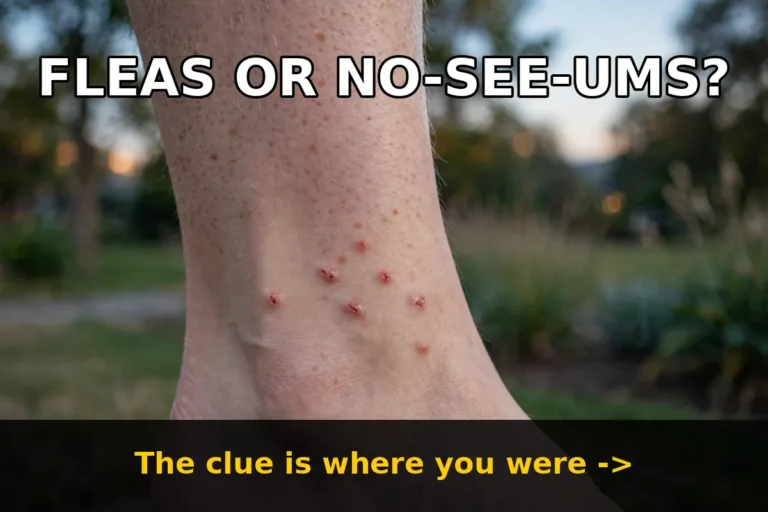
# No-See-Um Bites vs Flea Bites: Key Differences If your ankles and lower legs are covered in clusters of intensely itchy red welts and…

A big brown spider darts across the lawn, or freezes on your hallway floor, and the question hits instantly: grass spider vs wolf spider,…