
Are Paper Wasps Aggressive? Behavior Explained
Finding a gray, umbrella-shaped nest hanging under your porch eave can trigger an instant question: are paper wasps aggressive, and is my family in…
# Are Yellow Jackets Active at Night? The short answer is no, yellow jackets are not really active at night. These wasps are daytime insects with a strong daily rhythm:…
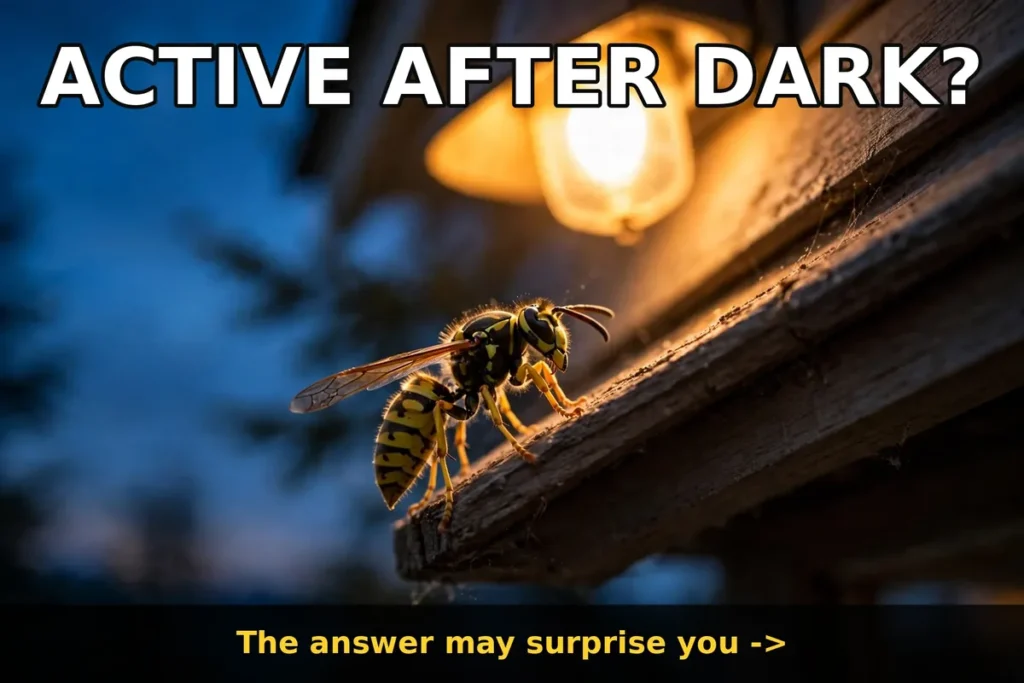
# Are Yellow Jackets Active at Night?
The short answer is no, yellow jackets are not really active at night. These wasps are daytime insects with a strong daily rhythm: they forage during daylight hours, peak in the warm afternoon, and return to the nest as dusk settles. Once full darkness arrives, flight stops almost entirely and the colony rests inside the nest. That is why pest control professionals and extension entomologists consistently recommend dealing with nests after dark, when the whole colony is home and relatively calm.
That said, “not active” does not mean “harmless.” A disturbed nest at night can still defend itself, and late-season colonies may post a few guards near the entrance. So while your backyard barbecue area is far safer after sunset than at 2 p.m., the ground or wall void where a colony lives is never a safe place to poke around, day or night. This guide walks through the full 24-hour behavior of yellow jackets, explains what actually goes on inside the nest after dark, covers the common nighttime sting scenarios (porch lights, ground nests, doorways), and lays out practical timing rules for outdoor activities and nest safety.
Yellow jackets belong to the wasp genus Vespula, and like nearly all social wasps they are strongly diurnal, meaning their activity is tied to daylight. Foraging, nest building, scavenging, and hunting all happen while the sun is up. Their vision is built for daylight: they have poor night vision, which is one of the main reasons flight shuts down after sunset. A yellow jacket that cannot see well cannot navigate, hunt, or find its way back to the nest reliably, so evolution has kept them indoors after dark.
Extension entomologists at universities including Clemson and the University of Georgia describe the same pattern consistently: colonies are busiest during the day, workers return to the nest in the evening, and by full dark the colony is inside and quiet. Large late-season nests, which can hold thousands of workers, may keep a few sentries near the entrance opening at night, but those guards are stationary rather than patrolling. The practical takeaway is simple: if you are wondering whether the threat “ends at dark” for a patio dinner or an evening walk across the lawn, the answer is mostly yes. Outdoor encounters with foraging yellow jackets drop to near zero after sunset. The exception is the nest itself, which always deserves respect, and bright lights, which can draw a few stragglers out of their routine. Those two exceptions are worth understanding in detail, because they are where nearly all nighttime stings happen.
Understanding the colony’s daily schedule makes the nighttime picture much clearer. The rhythm shifts with the season and temperature, but the overall shape holds from late spring through fall.
At first light, most of the colony is still inside and inactive. On a cool morning, you may see almost nothing at the entrance. As temperatures climb past roughly 50°F (10°C), departure rates pick up. Yellow jackets become reluctant to fly once temperatures drop below roughly 50°F, and flight largely stops in the mid-40s°F, so on chilly mornings the day starts late. The first foragers out tend to focus on protein: small insects and scavenged meat that will feed the developing larvae back in the nest. These early trips are purposeful and relatively calm, with workers flying straight lines to and from the entrance.
By mid-morning, a steady stream of workers flows in and out of the nest entrance. Activity peaks through the warm afternoon, roughly between 10 a.m. and 4 p.m. in warm weather. This is when you are most likely to meet yellow jackets away from the nest: around trash cans, fallen fruit, pet food, soda cans, and picnic tables. Foraging preferences also shift across the season: early in the year, workers hunt protein to feed the developing larvae, while late in the season, with the colony at its largest and fewer larvae to feed, foragers turn to sugars for their own energy. University extension sources describe this seasonal switch from protein to sweets, which is why yellow jackets descend on sweet drinks and fruit salad more aggressively in August than in June. Late summer and early fall are the worst months, because the colony is at its largest, natural food sources decline, and workers become bolder around human food.
By late afternoon, the outbound stream slows. Workers still out make their final trips, and by full dusk virtually all foragers have returned. This evening window is a useful one to know: as light fades, the colony consolidates inside the nest. Flight ceases, and while low-level activity continues inside (workers tend larvae, maintain comb, and the queen keeps laying eggs), the colony essentially sleeps. From dark until just after dawn, yellow jackets are at their least active, which is why this window matters so much for safety decisions.
| Time of Day | Yellow Jacket Activity | Risk Level for People |
|---|---|---|
| Dawn (cool) | Colony mostly inside; first sorties as it warms past ~50°F | Low |
| Mid-morning to afternoon | Peak foraging; steady traffic at nest entrance | Highest |
| Late afternoon | Traffic shifts to sugars; final foraging trips | High |
| Dusk | Workers return; flights wind down | Dropping fast |
| Night (full dark) | Colony inside nest; flight stopped | Lowest (away from nest) |
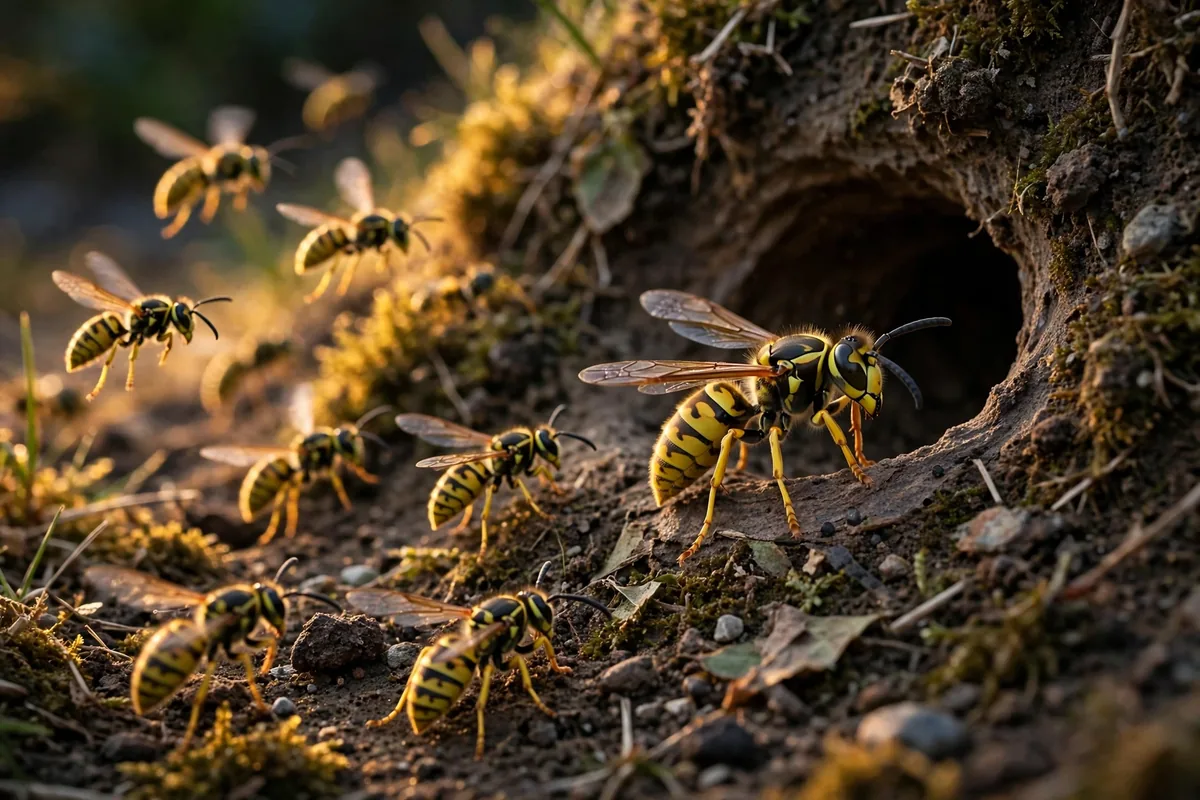
One of the most reassuring facts about yellow jackets at night is also the reason professionals schedule nest work for the evening: after dark, the entire worker force is home. During the day, a large fraction of the colony is always out foraging, so a nest that looks quiet at noon is not truly quiet. At night, nearly every worker is inside, resting in the comb galleries.
Inside, the nest is not dead silent. Workers continue low-level tasks through the night: feeding and tending larvae, doing comb maintenance, and processing food brought in during the day. The queen continues laying eggs. But this is indoor housekeeping, not foraging or defense patrols. No workers are out hunting, scavenging your trash, or investigating your drink. The colony’s defensive posture is also much lower at night, because defense is organized around the nest entrance, and with no traffic coming and going, there is less to defend.
This inside-at-night reality is the foundation of the standard professional guidance: nest treatments are applied after dark because the full population is present and the wasps are at their calmest. It also explains why you should not assume a nest you “didn’t see anyone at” during the day is small. What you see at noon is a fraction of the colony. What is inside at midnight is the whole thing.
This is the honest caveat the anti-rehash notes for this topic demand: do not read the nighttime calm as a promise that you cannot be stung after dark. The colony’s defensive instinct does not switch off at sunset; it just loses its trigger, which is usually movement and vibration near the entrance.
First, disturbed nests still defend at night. If you step on a ground-nest entrance, bump a wall void, or shine a bright light directly into the opening and bang around, workers inside can and will pour out and sting. Nighttime defenders may be fewer and slower to mobilize, but a late-season nest can hold thousands of stinging insects, and provoking that population in the dark, when you cannot see what is happening, is a genuinely dangerous situation. Entomologists note that colonies that have been disturbed previously stay in a higher state of readiness, so a nest that was bothered yesterday is quicker to explode today, even in the evening.
Second, large late-season nests may station a few guards at the entrance after dark. These sentries do not patrol, but they are alert to vibration and disturbance at the opening. Approaching the entrance with a flashlight, a lawnmower, or a weed trimmer can still draw a defensive response.
Third, yellow jackets have poor night vision but are not blind. A single worker caught outside after dark, perhaps one that got separated from the nest or was drawn to a light, can still sting if trapped against skin or clothing. It will not be hunting you, but a sting in self-defense is always possible.
The bottom line: treat nighttime as a much lower-risk window for normal outdoor activity, but keep treating the nest location itself as off-limits around the clock. For more on what a yellow jacket sting involves and how to care for one, see our guide to yellow jacket sting treatment.
If yellow jackets are daytime insects, why do people see them buzzing around porch lights and restaurant patio lamps at night? The honest answer is that this does happen, and lights are the main reason.
Many flying insects are drawn to artificial light, and yellow jackets are no exception. Extension and pest-control sources note that yellow jackets are attracted to light, which is why standard guidance warns against holding a flashlight while working near a nest entrance at night. A bright porch light near a doorway, an illuminated patio, or a bug-attracting lamp can pull a few workers or stragglers out of their rest, especially in late summer when colonies are huge and a few individuals are always near the nest entrance anyway.
In practice, this means:
Restaurant patios with string lights and heat lamps in late summer are a classic setting for these encounters. The combination of bright light, sugary drinks, and food scraps near a ground or wall nest can keep a small number of workers active well past dusk. Our overview of wasps, hornets, and yellow jackets covers how to tell these insects apart when you spot one at the table.
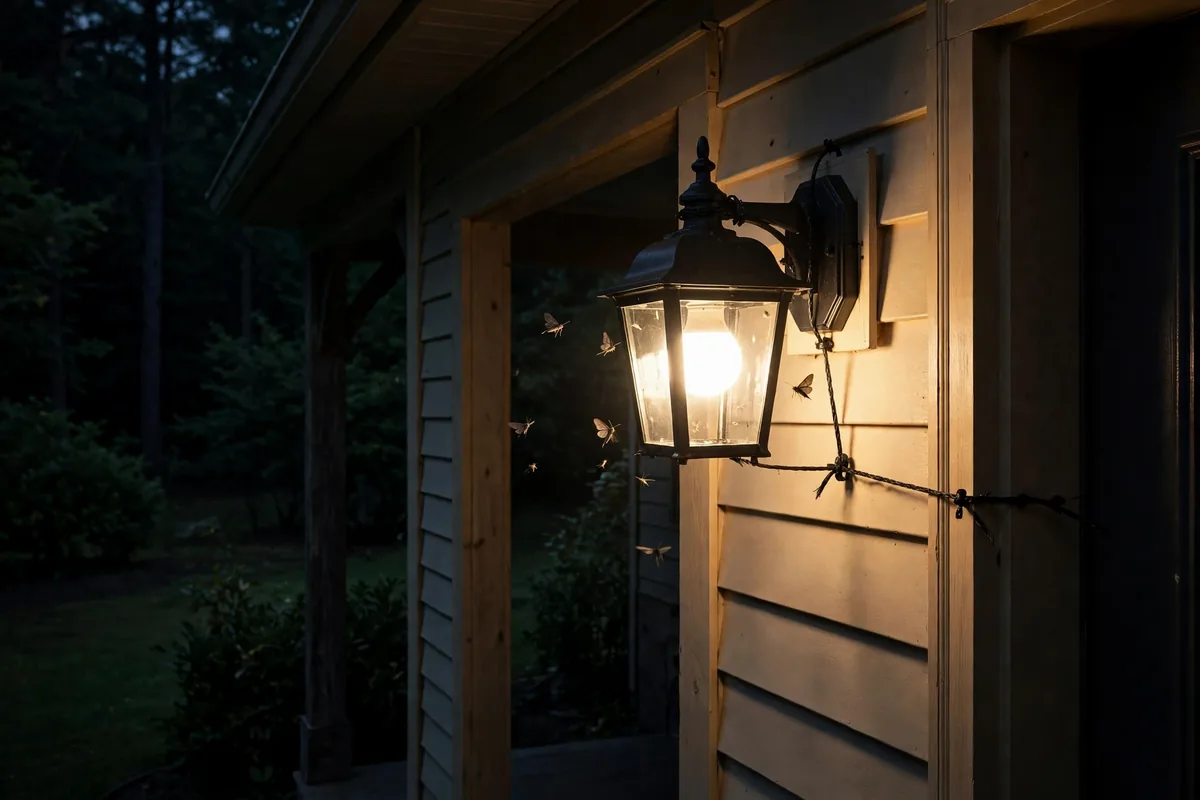
Most nighttime stings do not come from foraging workers. They come from accidental contact with the nest in the dark. Knowing the common scenarios helps you avoid them.
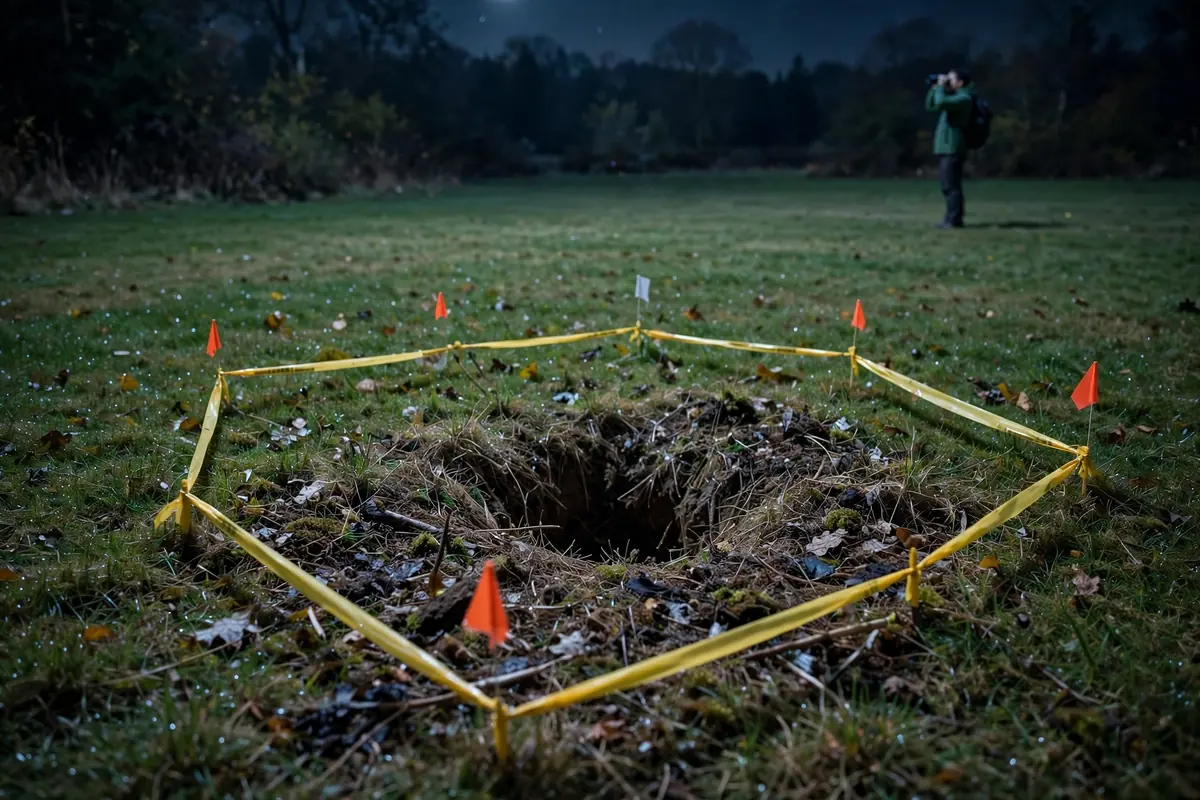
Ground nests are the classic hazard. Yellow jackets frequently nest in abandoned rodent burrows, hollow tree roots, and cavities under sheds or landscape timbers. The entrance is often just a small hole in the lawn, nearly invisible in daylight and completely invisible at night. Stepping near it, mowing over it, or letting a dog sniff around it after dark can trigger a defensive swarm. If you suspect a ground nest, mark a wide no-go circle around the entrance with flags, cones, or a lawn chair, keep children and pets indoors until there is a plan, and pause mowing within at least 15 to 20 feet of the entrance.
Wall voids and eaves are the second common site, especially for the German yellow jacket, which readily nests inside homes, entering through cracks and building large colonies behind drywall. At night you may hear faint buzzing or scratching inside the wall. Do not seal the entrance yourself: trapped workers will chew their way out, sometimes into the living space. This is a call-a-professional situation, and the professional will want to work after dark when the colony is home.
Doorways, windows, and garages become night hazards when interior lights draw workers to screens and gaps. A yellow jacket trapped between a screen and a window, or one that slips inside when the door opens, may end up on skin or clothing in the dark. Check screens for gaps in late summer, keep doors closed after dusk if a nest is nearby, and if one gets indoors, open a window and turn off interior lights rather than chasing it.
With the daily rhythm in mind, here is a practical timing guide for the months when yellow jackets are active.
Safest windows for yard work, dining, and play: early morning before the colony warms up, and evening after dusk. Mowing, trimming, and gardening are best done early or not at all near a known nest. Evening patio dinners are far safer than afternoon cookouts, provided food is covered and trash is sealed. Keep drinks covered with lids or cups with straws, since yellow jackets crawl into open cans.
When to watch the nest (from a distance): if you need to find where workers are coming from, watch the yard in the warm afternoon when traffic is heaviest. Stand well back, at least 15 to 20 feet, and look for the steady stream of insects flying low to one spot. Never approach the entrance to “get a closer look.”
When professionals treat nests: after dark, when the full colony is inside. This is standard practice across the pest-control industry and university extension guidance. The wasps are calmer, fewer are in the air, and the treatment reaches more of the population. If you hire a professional, expect them to schedule the visit for the evening. Homeowners should not attempt this themselves: misapplied treatments at night can still provoke a defensive response, and a late-season nest can mobilize hundreds of defenders in seconds. If you want background on warning signs that a sting situation is becoming a medical one, the anaphylaxis sting warning signs doc explains what to watch for.
Seasonal timing matters too. Colonies grow all summer and peak in late summer and early fall, when they are largest and most aggressive around food. The first hard frosts of fall kill off the workers, and only mated queens survive the winter to start new colonies in spring. If you can wait out a nest in a low-traffic corner of the yard until cold weather, that is often the safest option of all.
Most yellow jacket stings cause sharp pain, redness, and swelling that fades within a few days, but some situations need medical care. Seek emergency care or call 911 if you notice trouble breathing, swelling of the face, lips, tongue, or throat, widespread hives, dizziness or faintness, a rapid pulse, or nausea and vomiting after a sting. These can be signs of anaphylaxis, a severe allergic reaction that needs immediate treatment with epinephrine.
Also get medical advice if you receive many stings at once (a disturbed nest can deliver dozens), if a sting is inside the mouth or throat where swelling can block the airway, or if pain, swelling, or redness spreads and worsens after 48 hours instead of improving, which can suggest infection. People with a known venom allergy should carry their prescribed epinephrine auto-injector whenever yellow jackets are active and should discuss a venom allergy action plan with their allergist. For a practical prevention refresher before outdoor season, see the outdoor bite prevention checklist.
The behavior described here follows university extension guidance: Clemson’s Home & Garden Information Center notes that yellowjackets are attracted to light and that control applications belong late in the evening or at night, when all foragers are inside the nest; the University of Georgia’s extension field report recommends dealing with ground nests in the late evening when activity is at its minimum, while warning that any disturbance will produce instant activity even at night; and UMass Extension’s yellowjackets fact sheet describes the seasonal foraging shift, from hunting insect protein early in the year to foraging primarily for sugar at the end of the season.
Are yellow jackets active at night?
No, yellow jackets are diurnal and not meaningfully active at night. They forage during daylight, return to the nest at dusk, and stop flying once it is fully dark. The colony rests inside the nest overnight, which is why evenings are the calmest and safest time around them.
Do yellow jackets sleep at night?
In a practical sense, yes. Flight ceases after dark and the colony becomes quiet, though low-level activity continues inside the nest as workers tend larvae and maintain the comb. They do not sleep the way mammals do, but the colony enters a rest state with minimal movement and a much lower defensive posture.
Can yellow jackets sting you in the dark?
Yes, if you disturb their nest. Nighttime stings almost always come from accidental contact with a nest entrance: stepping on a ground nest, bumping a wall void, or shining a bright light into the opening while making noise. A disturbed colony will defend itself even at night, and late-season nests may keep a few guards at the entrance. Normal outdoor activity away from the nest is very low risk after dark.
Why are yellow jackets attracted to porch lights?
Like many flying insects, yellow jackets can be drawn to bright artificial lights. A porch light, patio string lights, or a flashlight near a nest entrance can pull a few workers or stragglers out of their nighttime rest. These are usually lone, confused insects rather than foraging parties, but you should not swat at them, and repeated appearances at one light often mean a nest is nearby.
What time of day are yellow jackets most aggressive?
Late morning through the afternoon, roughly 10 a.m. to 4 p.m. in warm weather, is peak activity. Late summer and early fall add an extra edge: colonies are at maximum size and natural food is scarce, so workers are bolder around human food and quicker to defend the nest. Early morning and evening are the calmest windows.
Is it safe to mow the lawn at night if there is a yellow jacket nest?
No. Mowing near a nest entrance is one of the most common ways people get swarmed, and darkness makes it worse because you cannot see the entrance or the insects coming. Pause all mowing and trimming within at least 15 to 20 feet of a suspected nest until the nest has been professionally dealt with or the colony dies off in cold weather.
Will a yellow jacket nest go away on its own?
Yes, with the seasons. Only mated queens survive the winter; the workers and the old queen die off as cold weather arrives, and old nests are never reused. A nest in a low-traffic spot can simply be left alone until fall. Nests near doors, play areas, or walkways should be handled by a professional, ideally scheduled for an evening visit when the colony is home.
Medically reviewed by Dr. Sarah Jones, MD.
This article is for informational purposes only and isn’t medical advice. If you’re worried about a bite or sting, talk to a healthcare professional.
Dr. Jones oversees StingHelp’s clinical verification process. Every guide is systematically evaluated against active Centers for Disease Control and Prevention (CDC), Environmental Protection Agency (EPA), and American Academy of Allergy, Asthma & Immunology (AAAAI) medical consensus standards to ensure symptom distinctions and care recommendations are clinically sound.
Explore physician-reviewed first-aid procedures, identification clues, and symptom comparisons for other common outdoor bites and stings.
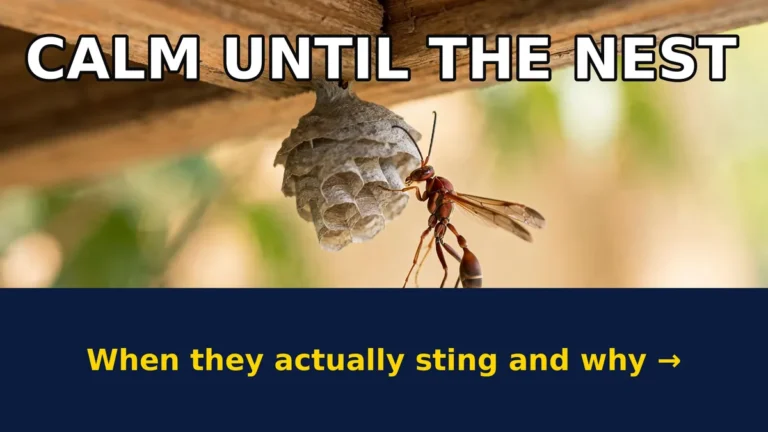
Finding a gray, umbrella-shaped nest hanging under your porch eave can trigger an instant question: are paper wasps aggressive, and is my family in…

There is a sound no homeowner wants to hear in October: a faint, persistent buzzing inside the wall, and a steady stream of yellow-and-black…
The most dangerous part of hanging Christmas lights is rarely the electricity. Every year, decorators climb ladders into the exact territory wasps claimed months…