
Are Yellow Jackets Active at Night?
# Are Yellow Jackets Active at Night? The short answer is no, yellow jackets are not really active at night. These wasps are daytime…
Finding a gray, umbrella-shaped nest hanging under your porch eave can trigger an instant question: are paper wasps aggressive, and is my family in danger? It is a fair question,…
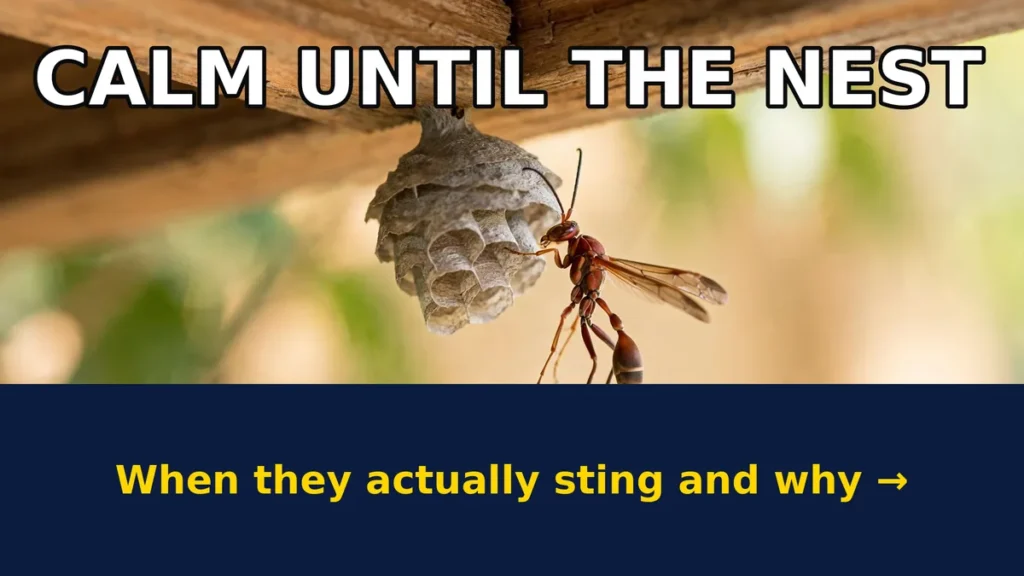
Finding a gray, umbrella-shaped nest hanging under your porch eave can trigger an instant question: are paper wasps aggressive, and is my family in danger? It is a fair question, and the answer is more reassuring than most people expect. Paper wasps are not aggressive in the way yellow jackets are. Away from their nest, they are docile foragers that go about their business and ignore people. They only become defensive when they believe their nest and colony are under threat.
This article explains the real temperament of paper wasps: what counts as aggression versus nest defense, how they behave when they are out foraging, what triggers a sting, how to tell a paper wasp from a yellow jacket, and how to live safely near a nest. You will also find honest first-aid guidance and clear signs for when a sting needs medical attention.
When people ask whether a wasp is aggressive, they usually mean: will it come after me without a reason? For entomologists, though, aggression and defense are two different things. Aggression means actively seeking out a target or attacking without provocation. Defense means protecting a nest, a food source, or oneself when something gets too close. This distinction is the whole key to understanding paper wasps.
A truly aggressive wasp would chase people down across the yard, swarm around food, and sting with little trigger. Some yellow jacket colonies approach that description late in the season. Paper wasps do not. Their default state is calm. They sting to defend their colony, not to pick fights. That means the wasp drifting around your garden flowers is not hunting you; it is hunting caterpillars or sipping nectar. The same wasp becomes a very different animal if you grab the stalk of its nest.
University extension resources, including the University of Maryland and Penn State, describe paper wasps as less defensive of their nests than hornets and yellow jackets. Paper wasp colonies are small, often just 20 to 75 members at peak, so they cannot mount the massive coordinated swarm response of a thousand-strong yellow jacket colony. They can and do sting when a nest is disturbed, and the sting is genuinely painful, but incidents are usually one or two stings from getting too close, not a chase across the yard.
Most of your encounters with paper wasps will have nothing to do with a nest. Workers spend their days away from the colony, foraging alone, and in that mode they are remarkably peaceful insects.
Adult paper wasps feed on nectar, so you will often see them visiting flowers right alongside bees and butterflies. They are also predators: a worker chews up caterpillars and other soft garden insects, carries the pulp back to the nest, and feeds it to the developing larvae. This makes them genuine allies in a vegetable garden. A single colony can remove a noticeable number of caterpillars over a summer. Gardeners who learn to recognize paper wasps often decide to leave them alone for exactly this reason.
Paper wasps do not scavenge around your food the way yellow jackets do. If one lands near you, it is probably investigating a smell, pausing to rest, or hunting a small insect on a plant. Swatting at it is the one thing likely to turn a harmless encounter into a sting, because a wasp being crushed or swatted will defend itself. The safest response is the simplest: stay still or move away slowly. Unlike yellow jackets around a picnic table, paper wasps have no reason to linger around people.
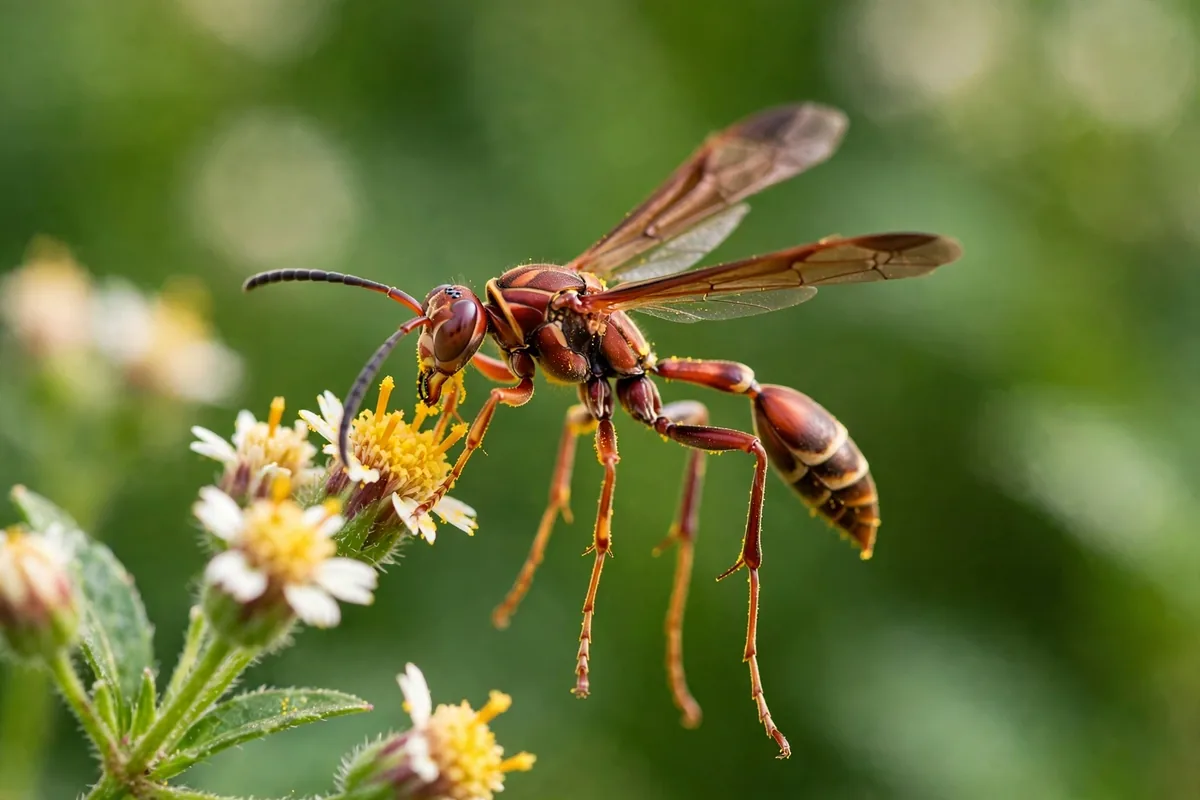
The nest is the one place where paper wasps show a sharper edge. Understanding their defense routine helps you read the situation instead of panicking.
Paper wasps often give a warning before they sting. University extension sources note that a paper wasp may deliberately bump into an intruder as a warning. If a wasp bumps your head or shoulder near a nest, that is your signal to back away calmly. A warning bump is not a failed sting attempt; it is the wasp telling you that you are too close. People who retreat at this point almost never get stung.
When a nest is disturbed, guard wasps near the entrance respond first. The trigger is usually vibration, shadow, or something striking the nest directly. Mowing, hedge trimming, or bumping a ladder against the eave are classic triggers. Paper wasps generally defend a short radius around the nest, a few feet rather than many yards, though an agitated colony can push further. Multiple stings from a paper wasp encounter are possible, and the same wasp can sting more than once, so moving steadily away from the area matters more than trying to fight them off.
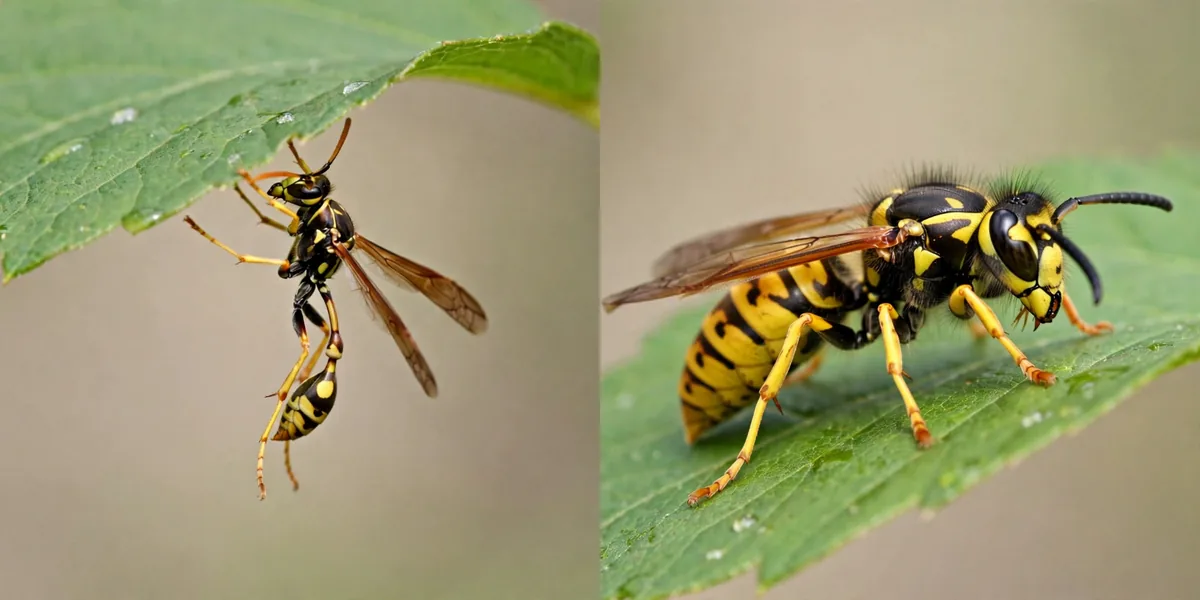
Much of the fear around paper wasps comes from mistaken identity. A paper wasp nest under the eave looks alarming, but the insect itself is one of the least dangerous social wasps in the yard. Here is how to tell the common suspects apart.
| Feature | Paper Wasp | Yellow Jacket | Hornet |
|---|---|---|---|
| Body shape | Slender, long, narrow waist | Stocky, thick waist | Large, bulky |
| Legs in flight | Long legs dangle visibly below the body | Legs tucked tight to the body | Legs tucked, thick |
| Color | Reddish-brown to dark brown with yellow markings | Bright yellow and black bands | Brown with yellow or white markings, larger |
| Nest | Small open umbrella comb, visible cells, single stalk, no covering | Enclosed papery ball, often underground or in wall voids | Large enclosed papery football shape in trees or structures |
| Colony size | Small, roughly 20 to 75 at peak | Large, hundreds to thousands | Large, hundreds |
| Temperament | Calm away from nest, defensive close to it | Aggressive, scavenges food, pursues intruders | Defensive, can be dangerous when disturbed |
The single most reliable field mark is the nest. Paper wasps build an open, downward-facing comb that looks like a small gray umbrella, with the hexagonal cells plainly visible and no outer paper envelope. It hangs from one thin stalk. Yellow jacket and hornet nests are enclosed balls or ovals with a single entrance hole. If you can see open cells from below, you are looking at paper wasps, and the colony inside is small.
Paper wasp stings are not random. They cluster around predictable situations, and knowing the pattern keeps you out of trouble.
Colonies grow through the summer and reach peak population in late summer and early fall. More wasps around the nest means more guards and faster reactions. This is also when queens are producing the next generation of queens and males, and the colony’s mood is at its most defensive. An undisturbed nest in May is barely a concern; the same nest in September deserves more respect. When the first hard frosts arrive, the colony dies off, and the nest is never reused, so a fall nest becomes a non-issue on its own.
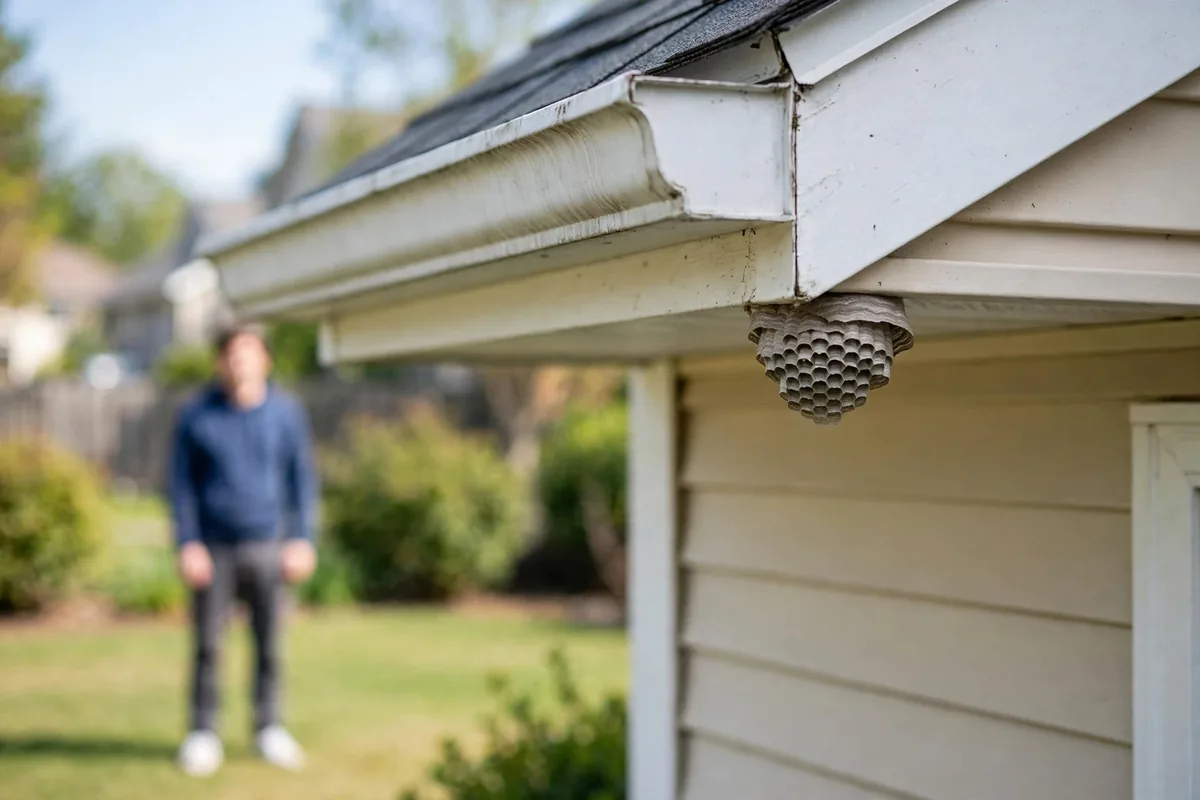
The most common sting scenario is accidental. A homeowner mowing under the eave bumps the nest with the mower or a branch, or a ladder strikes it during gutter cleaning. Nests hidden in shrubs, grills, mailboxes, or play equipment get grabbed by a hand that never saw them. Paper wasps react to sudden disturbance of the nest itself; walking past a nest at a normal distance does not set them off. If you must work near a known nest, work early in the cool morning when wasps are sluggish, keep vibration low, and give the nest a wide margin.
Not every nest needs to come down. The right call depends on where the nest is and who lives in the house.
A nest high under a second-story eave, in a tree, or at the far corner of the yard can simply be left alone. The colony dies with the frost, the wasps eat garden pests all season, and nobody gets stung if the nest is out of the traffic pattern. Tell everyone in the household where it is, keep kids and pets from poking at it, and treat it like a neighbor you do not visit. Many experienced gardeners consider a quiet paper wasp nest a sign of a healthy yard.
A nest over a doorway, a walkway, a play area, or a spot where someone with a known sting allergy passes daily is a different story. The safest removal route is a licensed pest professional, especially for a nest you cannot easily reach or one that has already been disturbed. Extension sources generally advise against treating nests with homemade chemical mixes and against improvising with sprays from unsafe distances, because a botched attempt agitates the whole colony. If you knock down a newly started nest in early spring, when only the founding queen is present, she will usually rebuild elsewhere; this is the one DIY window that carries low risk. If a sting does happen, our paper wasp sting treatment guide walks through the immediate steps, and the wasp sting first aid checklist covers what to do in the first minutes.
A paper wasp sting delivers a sharp, burning pain that most people describe as immediate and intense, then easing into an ache over the next hour or two. The site typically shows a raised red welt, sometimes with a pale center, along with swelling, warmth, and itching. Local reactions often peak within the first day and fade over two to five days.
First steps are straightforward: move away from the nest area so you are not stung again, wash the site with soap and water, and apply a cold compress in intervals to ease pain and swelling. Avoid scratching, since broken skin raises the chance of infection. Because paper wasps have smooth stingers, they do not leave a stinger behind the way honeybees do, so there is nothing to dig out. A simple over-the-counter pain reliever or antihistamine, used as directed on the package, is what most people reach for, but skip any medication you have been told to avoid and ask a pharmacist or clinician if you are unsure. If you were stung by one of the broader wasp and hornet family and want the bigger picture, the wasps, hornets, and yellowjackets hub covers the differences.
Most paper wasp stings are painful but not dangerous. Get medical help promptly for any of the following:
Are paper wasps aggressive toward humans?
No, not in the aggressive sense. Paper wasps are calm away from their nests and sting mainly when the nest is disturbed or they are grabbed or swatted. They do not chase people, and they do not swarm food the way yellow jackets do.
Will a paper wasp sting me if I walk past its nest?
Usually not. Walking past at a normal distance does not threaten the colony. Stings happen when the nest is bumped, vibrated, or grabbed, or when you linger within a few feet of it. If a wasp bumps you as a warning, back away calmly and you will very likely avoid a sting.
Are paper wasp stings worse than yellow jacket stings?
The pain is comparable in the moment, sharp and burning, but paper wasp encounters usually involve fewer stings. A disturbed yellow jacket colony can deliver many stings and pursue people; a paper wasp incident is typically one or two stings from a single nest. Any sting allergy makes every sting type more serious.
Do paper wasps reuse their nests every year?
No. Paper wasp colonies last a single season. The workers die with the cold, mated queens overwinter elsewhere, and each spring a queen starts a brand-new nest. Old nests are never reoccupied, so there is no need to remove an empty winter nest for safety.
Should I remove a paper wasp nest myself?
It depends on the nest. A tiny spring starter nest with one queen can be knocked down with a long pole in the early morning with little risk. An established summer nest in a high-traffic spot is safer left to a professional, because a failed removal attempt agitates the whole colony and invites multiple stings.
Are paper wasps good for the garden?
Yes. They hunt caterpillars and other plant pests to feed their larvae, and adults visit flowers for nectar. Many gardeners tolerate a nest that is out of the way specifically because the wasps provide free pest control all summer.
Medically reviewed by Dr. Sarah Jones, MD.
This article is for informational purposes only and isn’t medical advice. If you’re worried about a bite or sting, talk to a healthcare professional.
Dr. Jones oversees StingHelp’s clinical verification process. Every guide is systematically evaluated against active Centers for Disease Control and Prevention (CDC), Environmental Protection Agency (EPA), and American Academy of Allergy, Asthma & Immunology (AAAAI) medical consensus standards to ensure symptom distinctions and care recommendations are clinically sound.
Explore physician-reviewed first-aid procedures, identification clues, and symptom comparisons for other common outdoor bites and stings.
# Are Yellow Jackets Active at Night? The short answer is no, yellow jackets are not really active at night. These wasps are daytime…

There is a sound no homeowner wants to hear in October: a faint, persistent buzzing inside the wall, and a steady stream of yellow-and-black…
The most dangerous part of hanging Christmas lights is rarely the electricity. Every year, decorators climb ladders into the exact territory wasps claimed months…