
Are Yellow Jackets Active at Night?
# Are Yellow Jackets Active at Night? The short answer is no, yellow jackets are not really active at night. These wasps are daytime…
There is a sound no homeowner wants to hear in October: a faint, persistent buzzing inside the wall, and a steady stream of yellow-and-black insects flying in and out of…

There is a sound no homeowner wants to hear in October: a faint, persistent buzzing inside the wall, and a steady stream of yellow-and-black insects flying in and out of a single gap in the siding. A yellowjacket colony has moved into your wall void, and the calendar makes it worse. Searches for yellowjackets nesting in house walls fall spike every autumn for good reason: colonies reach their maximum size and maximum temper just as the weather turns, and a wall nest is the most dangerous kind.
Here is the direct answer: a yellowjacket nest inside a house wall in fall is a genuine hazard that needs professional handling, not a do-it-yourself project. Fall colonies can number in the thousands, the workers are at their most defensive as food grows scarce, and the nest can expand by chewing through drywall into your living space. Never seal the entrance, never spray liquids into the wall, and never try to dig the nest out yourself. Call a licensed pest management professional, keep people and pets away from the area, and know the first aid for stings in the meantime. This article explains why fall wall nests are uniquely dangerous, how to confirm what you are hearing, what the pros actually do, and how to protect your household until the nest is gone.
Yellowjacket colonies run on an annual cycle, and fall is the climax. A queen founded the colony in spring, workers built it up through summer, and by August and September the nest holds its peak population: hundreds to thousands of workers, new queens, and males. Pest professionals consistently describe late summer and fall as the danger window, because everything about the colony’s behavior sharpens at once.
A wall-void nest discovered in October is not a starter colony; it is a mature one, and pest companies note that nests larger than a softball signal thousands of highly aggressive workers. More wasps means more defenders mobilized by any disturbance, and a wall void gives the colony a protected, insulated headquarters that lets it stay active deep into the fall.
As natural food sources dwindle, yellowjackets shift toward scavenging, which is why they crash your October barbecue and hover around trash cans. The same scarcity makes nest defense more intense: the colony has the most to protect and the least to eat. Vibrations that a summer colony might have tolerated, a slammed door, a lawnmower near the wall, work on the siding, can trigger a full defensive response from a fall colony.
Yellowjackets that nest in a wall void behave as though they are underground; it is the enclosed, dark cavity they evolved to exploit. When the colony needs more room, or when it is disturbed and seeks another exit, the workers do what comes naturally: they chew. Drywall, insulation, and wood are all chewable, and a colony that decides the interior of your house is the way out will make it the way out. This is not a theoretical risk; pest companies document cases of yellowjackets chewing through the back of drywall until the wall surface goes soft, warm, and bulging, with the nest’s combs sitting inches from the living room.
Yellowjackets do not chew their way in from outside; they walk in through gaps you already have. The typical entry points are gaps in siding, soffits, and eaves, cracks around window and door frames, openings where utility lines or vents penetrate the wall, and the joint where the roof meets the wall. A queen scouting in spring needs only a small opening to found a colony that becomes a fall problem.
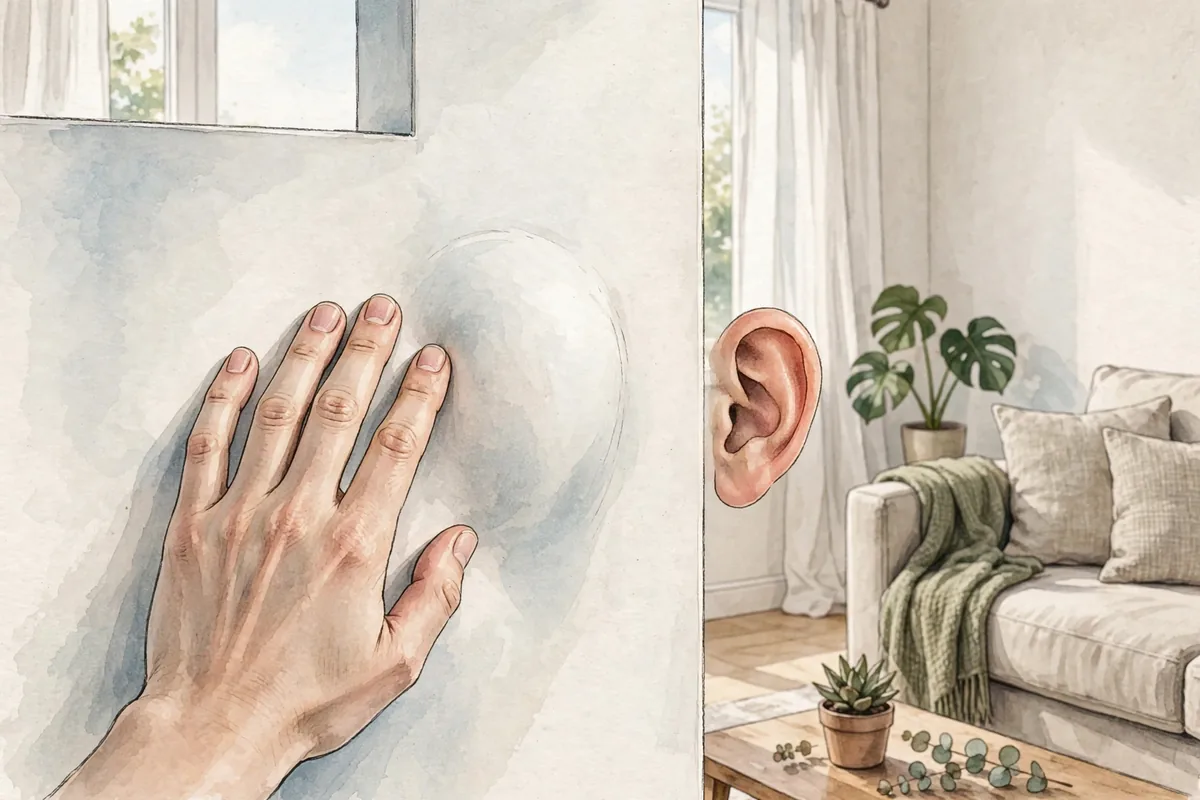
Confirmation is a matter of watching and listening. The signature sign is a steady stream of yellowjackets entering and leaving through one specific gap, especially on warm fall afternoons when foraging peaks. Traffic through a single hole, repeated day after day, is the hallmark of a nest, as opposed to a few curious foragers investigating a trash can. The second sign is sound: press your ear to the interior wall near the entry point, ideally in the evening when the colony is home, and listen for buzzing, scratching, or a faint crackling. Pest technicians use exactly this method to locate the nest before treating it.
Two more physical clues: a warm spot on the interior wall, since a large active colony generates noticeable heat, and a soft or bulging patch of drywall where chewing has thinned it from behind. If you find the soft spot, do not press on it, do not poke it, and do not hang anything from that section of wall. Note the location and tell the pest professional; it tells them where the nest sits.
A quick identification note, since several wasps nest around houses: yellowjackets are the stocky, bright yellow-and-black wasps with rapid, darting flight, distinct from the longer, dangling-legged paper wasps and the larger hornets. If the insects using the gap match that description and the traffic is heavy, proceed as a yellowjacket wall nest.
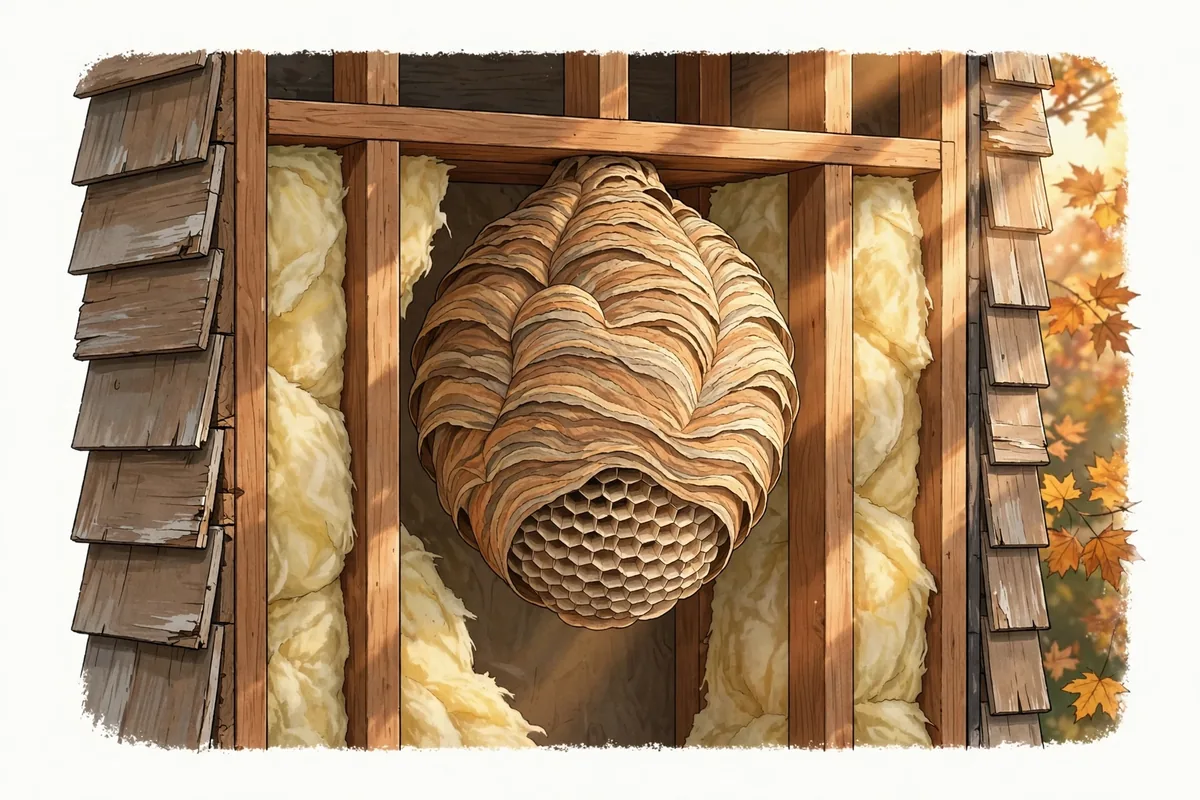
This deserves its own section because it is the scenario that turns a pest problem into an indoor emergency, and it is driven by one specific mistake.
Yellowjackets chew through interior walls for two reasons: expansion and escape. A growing colony enlarges its cavity the way it would enlarge an underground chamber, and drywall is simply in the way. More urgently, a colony that feels trapped will chew toward light, sound, and vibration, which means toward the inside of your house. The University of Maryland Extension’s guidance on yellowjackets states the rule plainly: do not block a nest entrance hole in a wall, because angry yellowjackets can chew through wallboard to escape.
That warning exists because blocking the entrance is the intuitive DIY move, and it is the most dangerous thing you can do. Seal the outside gap with caulk, foam, or a rag, and the thousands of workers inside do not quietly die; they redirect. The colony’s foragers return to a sealed entrance, agitation spikes, and the workers begin chewing through the interior drywall to find another way out. Homeowners have opened interior walls to find the drywall chewed paper-thin from behind, and in the worst cases the colony breaks through into a bedroom, bathroom, or living room while people are inside. A renovation story from a New Jersey pest company describes exactly this: a homeowner removing drywall near the ceiling was attacked by the colony living behind it, because the nest had expanded through the home’s infrastructure as though it were soil.
The lesson is absolute: the entrance stays open until a professional treats the nest. Ventilation, patience, and distance are your tools; sealant is not.
It is worth being explicit about why the standard DIY wasp advice does not apply to wall voids, because the internet is full of confident instructions for visible nests that become dangerous when applied to hidden ones.
A visible nest under an eave can sometimes be handled by a homeowner with a wasp spray, applied in the evening from a safe distance, because the target is visible, the escape routes are open, and the applicator can retreat. A wall void offers none of that. You cannot see the nest, so you cannot confirm the treatment reached it; a partial treatment that agitates the colony without killing it produces thousands of angry wasps with nowhere to go but through your drywall. Extension guidance is direct on this point: with a hidden nest there is no guarantee of getting the pesticide where it is needed, and protective gear is a must.
Liquid sprays are specifically wrong for wall voids. Professionals warn that liquid insecticide can wet the nest material, and a wetted, disturbed colony is more likely to chew through drywall to escape into the living space. The professional treatment for a structural nest is an insecticide dust, puffed into the void so that workers track the fine particles deep into the colony on their bodies, reaching the queen and the combs without sealing or flooding anything.
Ladder work adds another layer of risk. Many wall-void entries are at the eave or second story, and a defensive swarm at height is a fall hazard on top of a sting hazard. If anyone in the household has a known sting allergy, the calculus is not close: even a single sting can be life-threatening, and a wall-void colony can deliver many. Our multiple stings guidance covers the medical side of that scenario.
The honest summary: a wall-void yellowjacket nest in fall combines a peak-population colony, peak defensiveness, a hidden target, and a chew-through escape route. Every one of those factors argues for professional handling, and together they make DIY removal one of the riskier home pest projects there is.
| Common DIY move | What actually happens with a wall-void nest |
|---|---|
| Sealing the entrance with caulk or foam | Trapped workers chew through interior drywall to escape, potentially into living spaces |
| Spraying liquid wasp killer into the gap | Liquid wets the nest, agitates the colony without killing it, and provokes chew-through |
| Poking or opening the wall to “see” the nest | Releases defenders at close range; risks a multi-sting event indoors |
| Waiting for cold weather to kill them | The colony stays dangerous through every warm fall day until then, and the dead nest attracts secondary pests |
| Hiring a pro for dust treatment | Workers distribute the dust through the colony themselves; queen and combs eliminated without structural breach |
Knowing the professional playbook helps you hire well and avoid interfering with the treatment.
A technician starts with inspection: confirming the species, mapping the entry point from outside, and locating the nest from inside by sound and by the warm or soft spot on the wall. Protective gear is standard; this is not a job done in a t-shirt.
Treatment is typically an insecticide dust injected into the wall void through the existing entry point or a small drilled hole, using a specialized applicator. The dust formulation matters: workers entering and exiting carry the particles into the nest on their bodies, distributing the active ingredient through the colony, including to the queen and developing brood, over 24 to 48 hours. The entrance is deliberately left open during this period so workers keep moving the dust inward. After activity ceases, the technician may open the wall to remove the nest combs, clean the void, and dispose of the material; dead colonies left in walls can attract carpet beetles and other secondary pests, and the pheromone traces can attract future queens.
Timing is usually evening, when foragers have returned and the maximum number of workers is home to contact the dust. A reputable company will also advise on sealing the entry point after the colony is confirmed dead, and on monitoring for secondary nests, since a property attractive to one colony may host another.
When hiring, ask whether the company has treated structural yellowjacket nests specifically, what formulation they use for wall voids, and what their follow-up includes. Be wary of anyone who proposes sealing the entrance first or spraying liquid into the wall; both contradict the approach described above.
Professional help may be a day or two away, and the colony is active now. These measures keep the household safe in the interval.
Keep everyone, especially children and pets, away from the entry point and the interior wall section nearest the nest. Do not let kids play ball against that wall, and keep pets from scratching or barking at the buzzing. Avoid vibrating the wall: no hammering, no drilling, no slamming doors nearby, and postpone any renovation work in that area. Keep windows near the entry point closed, and check that window screens are intact so foragers cannot wander inside.
Reduce attractants around the house. Keep trash cans tightly covered, clean up fallen fruit, cover food and drinks outdoors, and avoid wearing strong fragrances or bright floral patterns near the entry zone. If yellowjackets are entering the living space through gaps, a temporary towel along the bottom of an interior door can block their movement between rooms, but do not seal the exterior entry, and do not caulk interior gaps in a way that traps wasps inside a room with people.
Have a sting plan ready before you need one. Know where the nearest emergency care is, make sure any household member with a known sting allergy has their emergency medication accessible and that others know how to help, and review the first aid steps below. If wasps begin emerging inside the house in numbers, leave the room, close the door behind you, and call the pest company for emergency guidance rather than trying to swat them; swatting releases alarm pheromone that recruits more defenders.
Despite precautions, stings happen, and fall colonies can sting multiple times; unlike honeybees, yellowjackets do not lose their stingers and can sting repeatedly.
Move away from the area calmly but quickly; rapid movement is fine, flailing is not. Wash the sting site with soap and water. Apply a cold compress for 10 to 15 minutes at a time to reduce pain and swelling. An oral antihistamine can help with itching, and an over-the-counter pain reliever can address pain; check with your pharmacist about appropriate choices, especially for children. Remove any rings or tight jewelry near a sting on a hand or finger before swelling starts. Our yellowjacket sting first aid guide has the full sequence, and the wasp sting first aid page covers the same principles.
For multiple stings, the concern expands beyond local pain. A large number of stings can cause systemic effects from venom load alone, including nausea, dizziness, and a general ill feeling, even without allergy. Anyone with many stings, stings to the mouth or throat, or any sign of allergic reaction should get medical evaluation promptly. The standard treatment reference covers the clinical side.
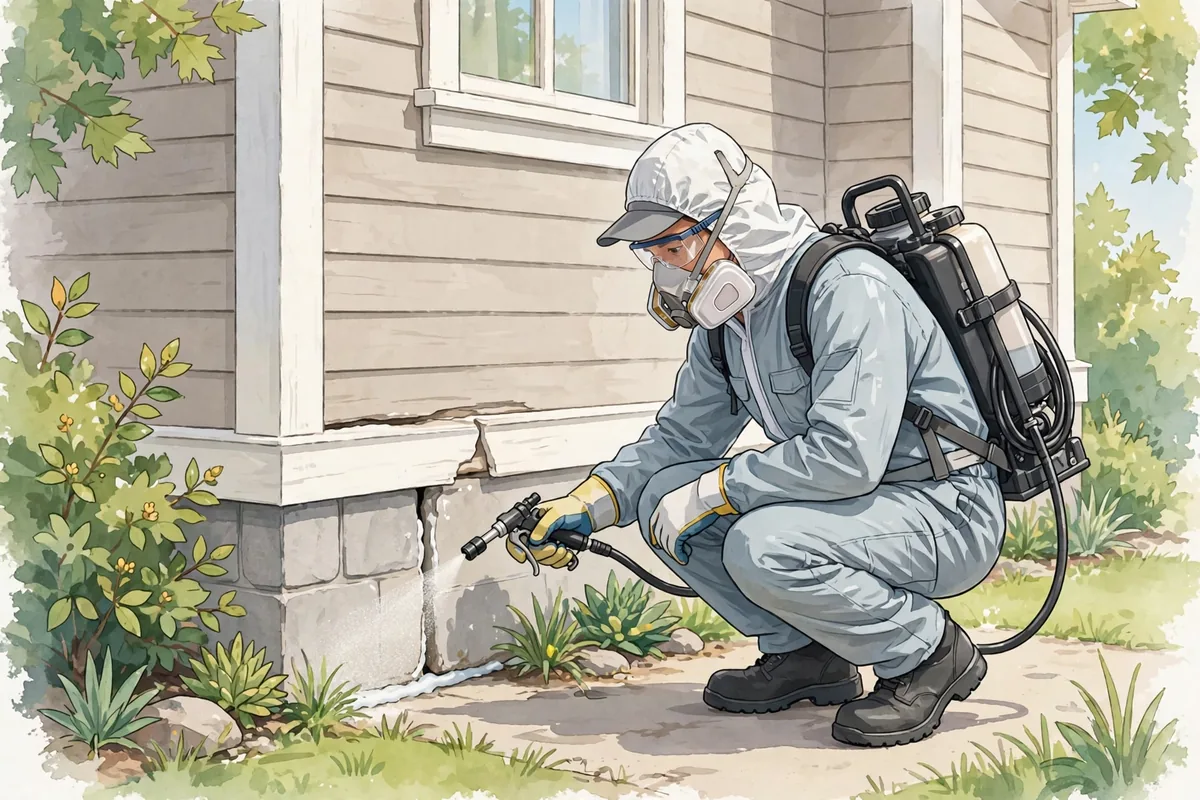
Once this colony is gone, make sure the next queen does not repeat the story. In early spring, before queens start scouting, walk the exterior and seal the gaps that served as this year’s entry: siding joints, soffit gaps, utility penetrations, and cracks around windows and frames. Install fine-mesh screens over vents. Keep the spring yard tidy; queens look for both nest sites and food, so covered trash and cleaned grills remove the welcome mat.
Consider setting out yellowjacket traps in early spring to intercept founding queens; catching queens in April and May prevents colonies in August. This is the one point in the cycle where homeowner action is genuinely effective, because a single queen caught in spring is a colony that never exists. Mark your calendar: the wall-void emergency of October is prevented by the sealing and trapping of April.
Get medical care if:
Tell the clinician how many stings occurred, where on the body, when they happened, and whether the nest is still active, since ongoing exposure changes the advice.
How do I know if yellowjackets are nesting in my wall or just passing through?
A nest announces itself with repetition: a steady stream of yellowjackets using one specific gap day after day, plus buzzing or scratching audible from the interior wall, often in the evening. A warm or soft spot on the interior drywall near the entry is a strong confirm. A few wasps investigating a trash can or a single insect at a window is foraging, not nesting.
Can I just seal up the hole where they go in?
No, never seal an active wall-void nest entrance. Trapped yellowjackets will chew through interior drywall to escape, potentially breaking into your living space. The University of Maryland Extension specifically warns against blocking nest entrances in building walls for this reason. Leave the entrance open and call a pest professional.
Will the nest die off on its own in winter?
The colony will decline as freezing weather kills the workers, but waiting is a poor strategy. The nest remains a hazard through every warm fall day until then, the colony is at peak defensiveness right now, and the dead nest left in the wall can attract secondary pests. Professional treatment now resolves the danger on your schedule, not the colony’s.
Can I spray wasp killer into the wall void myself?
You should not. Liquid sprays can wet the nest and provoke the colony into chewing through drywall to escape, and you cannot verify the spray reached the nest. Professionals use insecticide dust applied with specialized equipment, which workers distribute through the colony themselves. The wrong treatment is worse than no treatment here.
What does professional wall-void treatment cost?
Cost varies by region, nest accessibility, and whether drywall must be opened for nest removal, so get two or three quotes from licensed companies with structural yellowjacket experience. Whatever the price, weigh it against the cost of an emergency room visit for multiple stings or drywall repair after a chew-through; professional treatment is the economical option as well as the safe one.
Medically reviewed by Dr. Sarah Jones, MD.
This article is for informational purposes only and isn’t medical advice. If you’re worried about a bite or sting, talk to a healthcare professional.
Dr. Jones oversees StingHelp’s clinical verification process. Every guide is systematically evaluated against active Centers for Disease Control and Prevention (CDC), Environmental Protection Agency (EPA), and American Academy of Allergy, Asthma & Immunology (AAAAI) medical consensus standards to ensure symptom distinctions and care recommendations are clinically sound.
Explore physician-reviewed first-aid procedures, identification clues, and symptom comparisons for other common outdoor bites and stings.
# Are Yellow Jackets Active at Night? The short answer is no, yellow jackets are not really active at night. These wasps are daytime…
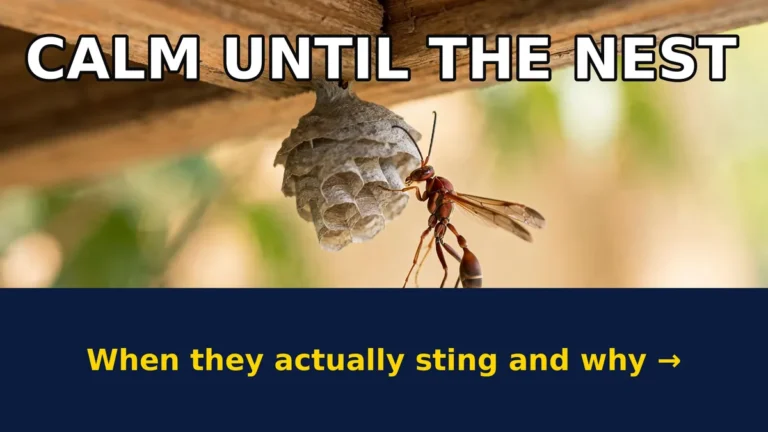
Finding a gray, umbrella-shaped nest hanging under your porch eave can trigger an instant question: are paper wasps aggressive, and is my family in…
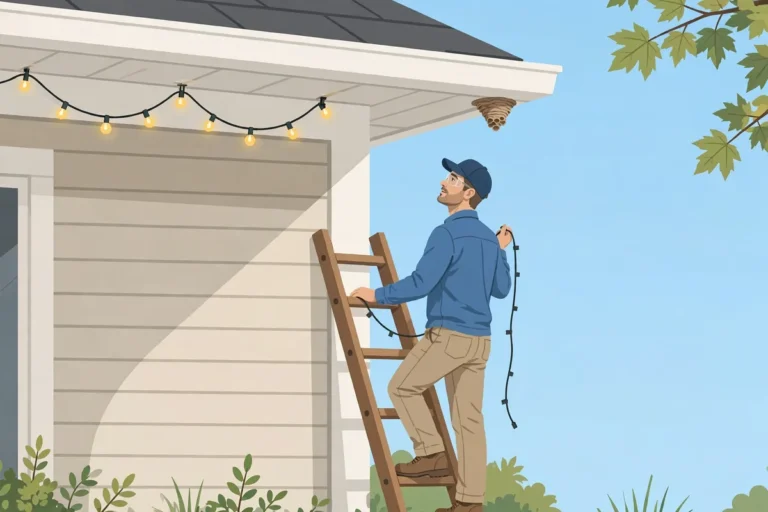
The most dangerous part of hanging Christmas lights is rarely the electricity. Every year, decorators climb ladders into the exact territory wasps claimed months…