
Are Yellow Jackets Active at Night?
# Are Yellow Jackets Active at Night? The short answer is no, yellow jackets are not really active at night. These wasps are daytime…
The most dangerous part of hanging Christmas lights is rarely the electricity. Every year, decorators climb ladders into the exact territory wasps claimed months earlier: the eaves, rooflines, gutters, and…
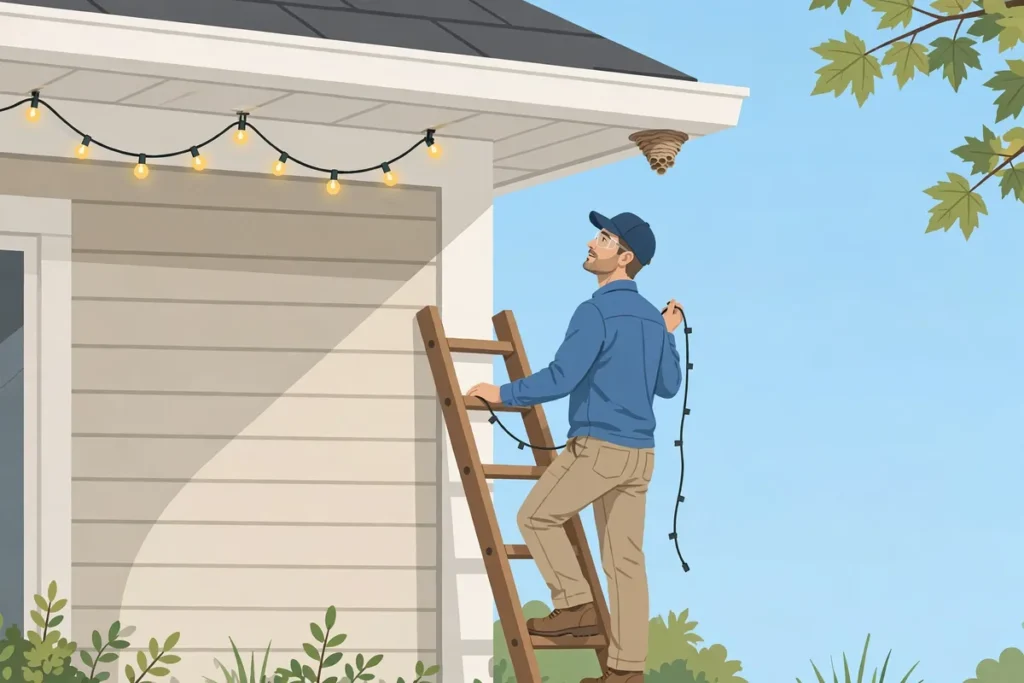
The most dangerous part of hanging Christmas lights is rarely the electricity. Every year, decorators climb ladders into the exact territory wasps claimed months earlier: the eaves, rooflines, gutters, and soffits where paper wasps build their nests. The scenario of wasp stings hanging christmas lights eaves plays out when a hand reaching for a gutter clip brushes a nest, a ladder bumps a soffit, or a startled decorator swats at a wasp while standing ten feet off the ground.
The injury that sends people to the emergency room in these cases is often not the sting. Pest professionals put it bluntly: the fall is usually more dangerous than the sting. This guide covers how to read what is nesting under your eaves, the inspect-before-you-climb protocol that prevents the encounter, ladder safety rules for decorating season, when a nest means calling a professional, and first aid if a sting happens at height.
Paper wasps choose nest sites for shelter and sun exposure, and the underside of a roof eave is close to ideal: protected from rain, warmed by the wall, and close to foraging territory. A nest built in April or May grows all summer, and by late season the colony is at its largest and most defensive. Decorating season overlaps with the tail end of wasp activity. In warmer regions, colonies can still be active into November and December, exactly when lights go up.
Even where colonies have died off for winter, the season leaves hazards behind. Abandoned nests tell you the eave is attractive nest real estate for next year. Overwintering paper wasp queens also tuck themselves into eave gaps, attic vents, and behind shutters, and disturbing them while clipping lights can trigger defensive stinging from wasps that are otherwise sluggish.
The decorating behaviors that trigger stings are predictable: grabbing the gutter edge for balance, leaning a ladder against a soffit that hides a nest entrance, shaking a strand of lights against the eave, and swatting at a curious wasp while standing on a rung. Every one of these is avoidable with a ground-level inspection first.
Before any ladder comes out of the garage, spend a day watching your eaves from the ground. This inspection determines everything that follows.
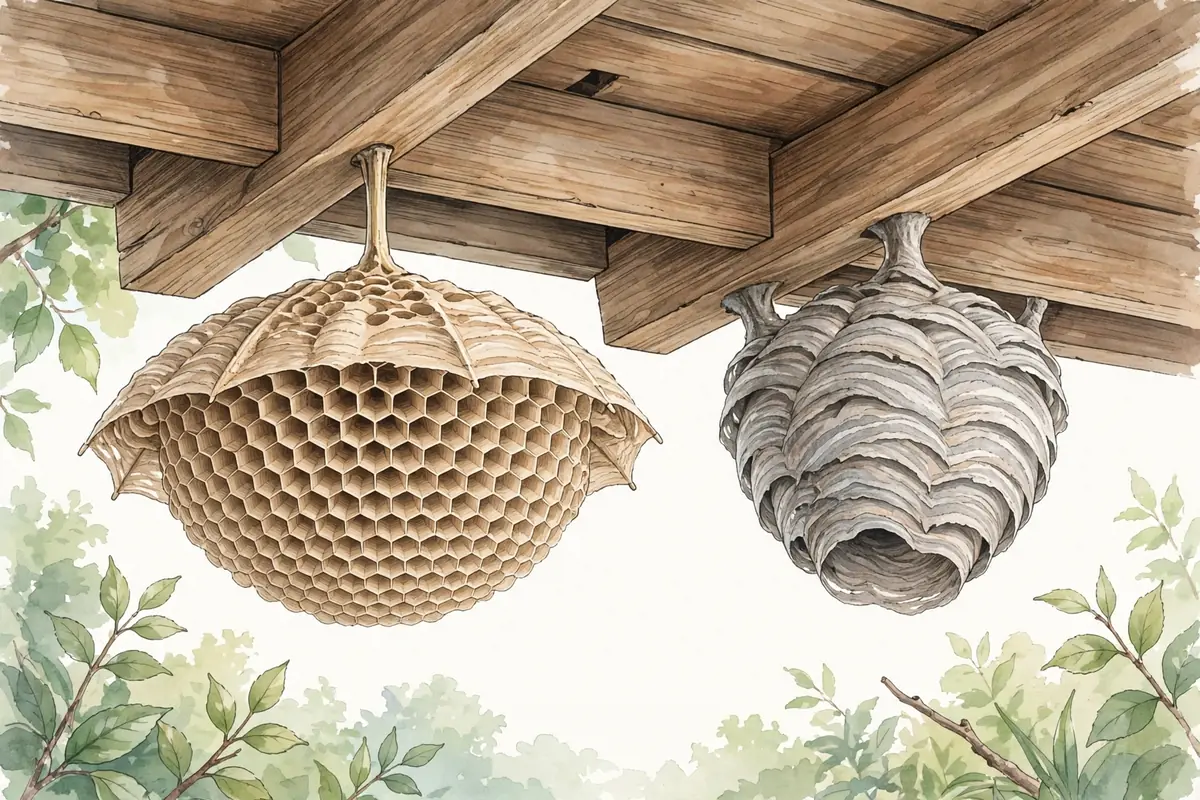
Paper wasps build open, umbrella-shaped combs attached to the surface by a thin central stalk, with the individual cells clearly visible and no outer envelope. The wasps themselves are slender with long dangling legs. A small, exposed paper wasp nest away from where you will be working is a low-priority problem. One directly in the path of your light clips is not.
A nest covered by a layered paper shell with a small entrance hole belongs to yellowjackets or hornets, and it demands more caution. These colonies are larger, more defensive, and harder to evaluate from below. University extension sources note that concealed or cavity nests, including those inside eave voids, are the situations where professional help is the right call.
| Nest sign | Likely insect | Decorating risk |
|---|---|---|
| Open umbrella comb, visible cells, thin stalk | Paper wasp | Moderate; observe from distance, plan route around it |
| Gray papery ball with entrance hole | Yellowjacket or hornet | High; do not approach, call a professional |
| Steady traffic in and out of a soffit gap | Cavity-nesting wasps | High; nest is hidden, pro inspection needed |
| Old, empty comb with no activity | Abandoned nest | Low; safe to remove in daylight |
Watch from at least 15 to 20 feet away during midday, when foragers are active and traffic patterns are visible. Note where wasps enter and exit. Dawn and dusk observations show less activity but can confirm whether a nest is still occupied. Binoculars let you inspect the eave line without climbing. Do not poke the eave, tap the soffit, or throw anything at a suspected nest to test it. Disturbing a colony to see what happens is how stings happen.
If you find an active nest in the decorating zone, stop planning the light route through that section. Either reroute the lights or deal with the nest first, and the sections below explain which one applies to your situation.
Make this a checklist you run every decorating season, not a one-time event.
This protocol also protects anyone helping you. Tell every person on the decorating crew where the nests are, who is allergic, and where the first-aid kit and phone are. A helper who does not know about the nest under the east eave is the person most likely to disturb it.
Ladder falls injure hundreds of thousands of Americans every year, and decorating season concentrates a large share of them into a few weekends. Add wasps to the equation and the standard ladder rules become non-negotiable.
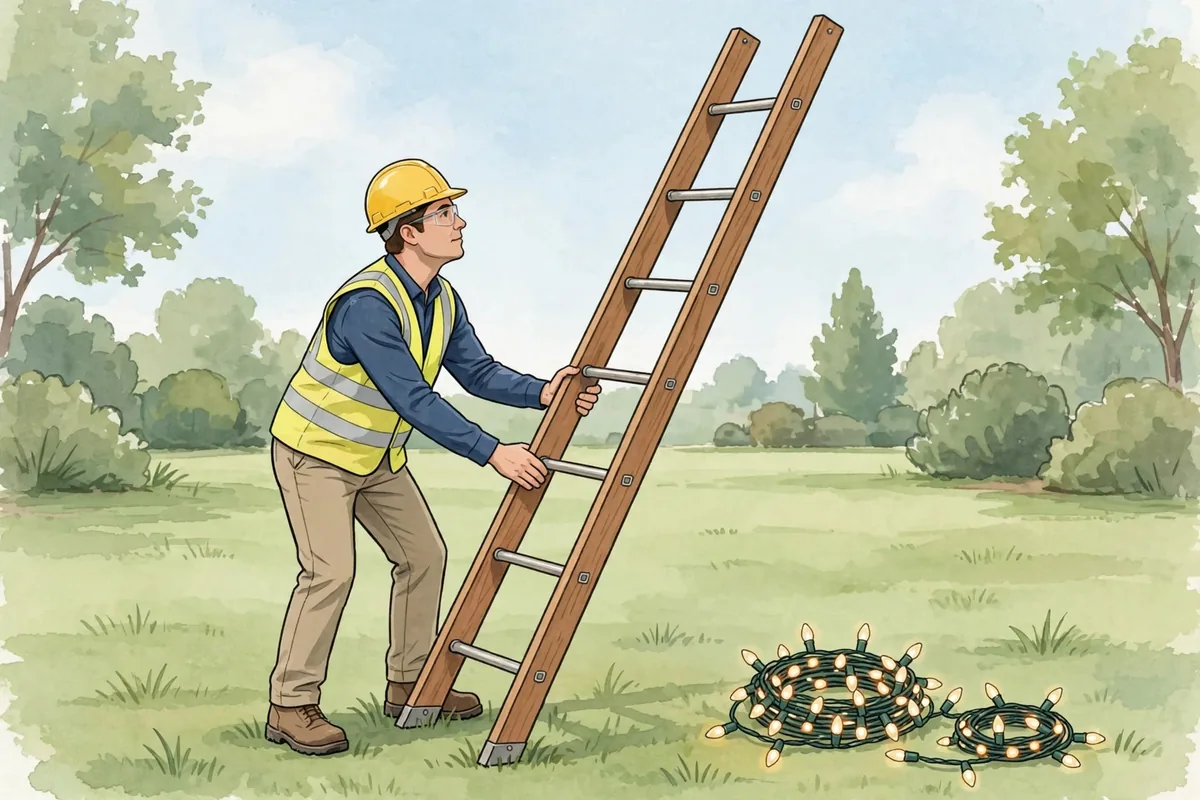
Place the ladder on firm, level ground, never on soft soil, ice, or uneven pavers. Use the four-to-one rule: for every four feet of height, the base sits one foot out from the wall. Extend the ladder at least three feet above the eave you are reaching. Face the ladder while climbing, keep three points of contact, and never lean sideways past the rails. A ladder stand-off attachment keeps the top stable against the wall and gives you clearance from the eave surface.
When wasps are a known factor, a second person on the ground is mandatory, not optional. The spotter steadies the ladder, watches for wasp activity you cannot see from the rungs, and can call for help or fetch the first-aid kit if you are stung. Agree on a signal before you climb: if either of you sees aggressive wasp behavior, you come down immediately and calmly.
This is the rule the research brief emphasizes for good reason. Swatting at a wasp while on a ladder combines the sting risk with a startle reflex at elevation. If a wasp approaches, stay still or descend calmly and slowly. Sudden movements provoke stings; stillness or slow retreat usually ends the encounter. Keep one hand free and your phone in a pocket, not in your hand, so a surprise does not turn into a dropped object and a flinch.
Do not decorate at dusk to avoid wasps if it means working in poor light on a ladder. The visibility loss is a bigger hazard than the insects. Decorate in daylight, when you can see both the nests and the rungs.
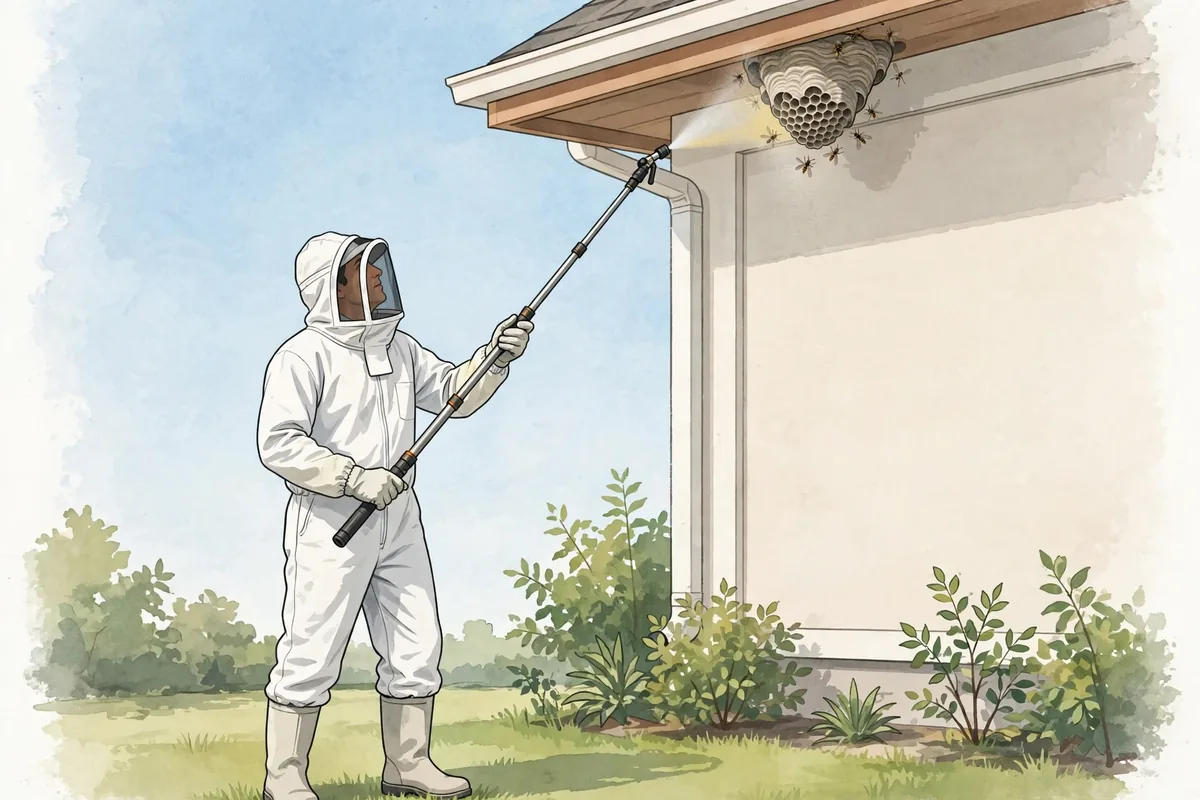
Some eave situations are firmly in professional territory. Call a licensed pest professional rather than handling it yourself when:
Extension guidance from Penn State and UC IPM consistently points toward professional removal for concealed, large, or ladder-accessible nests. Professionals have protective suits, extension poles, and non-repellent dust formulations designed for void nests. What you should never do is seal a soffit gap while wasps are still active inside. Trapping a colony can drive wasps into living spaces through fixtures and wall gaps and makes the colony more aggressive. For general wasp-sting first aid after any encounter, StingHelp’s wasp sting first aid guide covers the standard steps.
If a wasp stings you while you are on the ladder, the priority order is: get down, then treat.
Climb down slowly and deliberately. Do not rush, jump, or swat while descending. Get both feet on the ground and move away from the nest area before doing anything else. Most stings happen near the nest, and lingering to treat the sting within the colony’s defensive zone invites more.
Wash the area with soap and water. Wasps do not leave stingers behind the way honeybees do, so there is usually nothing to remove, but check anyway. Apply a cold compress for 10 to 15 minutes to reduce pain and swelling. An over-the-counter pain reliever or antihistamine may help with symptoms; follow package directions and check with a pharmacist if you take other medications. The paper wasp sting treatment page has species-specific aftercare detail.
A normal sting produces local pain, redness, and swelling that peaks within a day or two. Seek emergency care by calling 911 for trouble breathing, throat or tongue swelling, widespread hives, dizziness, fainting, or a sting inside the mouth or throat. People with known venom allergies should use their prescribed epinephrine as directed and still get emergency evaluation afterward. General wasp, hornet, and yellowjacket safety background is at wasps, hornets, and yellowjackets.
Beyond the emergency signs above, see a clinician or urgent care for:
Keep the date and circumstances in mind when you go. “Stung while hanging lights near an eave nest” tells the clinician about possible multiple-sting exposure and helps them assess the allergy risk going forward.
Are wasps still active when Christmas lights go up?
In warmer regions, yes, colonies can remain active into November and December. In colder areas the workers have usually died off, but overwintering queens shelter in eave gaps and can sting if disturbed. Either way, inspect before climbing.
Can I just knock down a small paper wasp nest myself?
A small, exposed, early-season nest with only a queen present is the lowest-risk DIY case, done at night with full protective clothing. An active eave nest in decorating season, especially an enclosed or concealed one, belongs to a professional. When in doubt, call one.
What should I do if wasps swarm while I am on the ladder?
Protect your face, descend slowly without swatting, and move away from the area. Do not jump from the ladder. Once on the ground, get indoors or well away from the nest before treating any stings.
Do decoy wasp nests keep wasps away from my eaves?
Evidence is limited. Paper wasps are sometimes said to avoid building near other nests, and some homeowners report success with decoys hung in spring, but there is no strong scientific backing. Treat decoys as a supplement to inspection and sealing, not a replacement.
Will the nest come back next year in the same spot?
Paper wasp nests are not reused, but the same sheltered eave that attracted one queen will attract another. Sealing gaps and removing old nest remnants in early spring reduces the odds of a repeat performance next decorating season.
Medically reviewed by Dr. Sarah Jones, MD.
This article is for informational purposes only and isn’t medical advice. If you’re worried about a bite or sting, talk to a healthcare professional.
Dr. Jones oversees StingHelp’s clinical verification process. Every guide is systematically evaluated against active Centers for Disease Control and Prevention (CDC), Environmental Protection Agency (EPA), and American Academy of Allergy, Asthma & Immunology (AAAAI) medical consensus standards to ensure symptom distinctions and care recommendations are clinically sound.
Explore physician-reviewed first-aid procedures, identification clues, and symptom comparisons for other common outdoor bites and stings.
# Are Yellow Jackets Active at Night? The short answer is no, yellow jackets are not really active at night. These wasps are daytime…
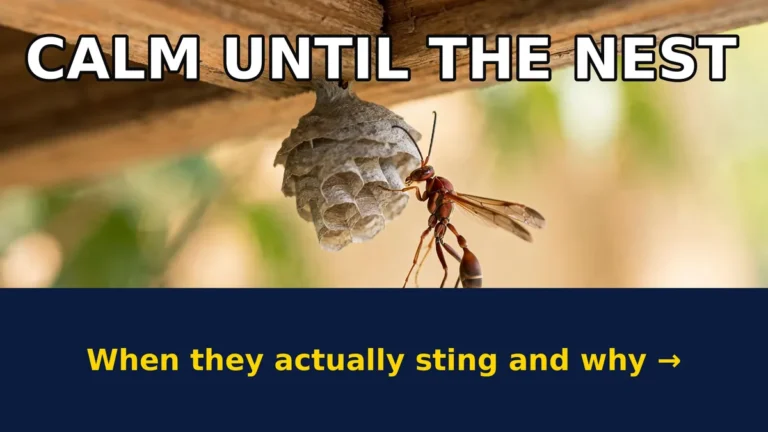
Finding a gray, umbrella-shaped nest hanging under your porch eave can trigger an instant question: are paper wasps aggressive, and is my family in…

There is a sound no homeowner wants to hear in October: a faint, persistent buzzing inside the wall, and a steady stream of yellow-and-black…